
The fastest way to estimate runtime on a power bank is a three-step math problem: convert its capacity from mAh to watt-hours, multiply by a realistic efficiency factor, then divide by your device’s power draw in watts. For quick planning, use 75 to 85 percent efficiency. The rest of this guide walks through the exact formula, worked examples for phones, tablets, and laptops, and the real-world variables that push your estimate up or down.
TL;DR:
- Using 80 percent efficiency is the typical assumption for real-world power bank runtime estimates, but lower efficiency should be used for critical trips or older banks.
- A 20,000mAh power bank provides roughly four full smartphone charges or one laptop charge, depending on device wattage and actual efficiency.
- Devices draw between 0.3 watts for earbuds and up to 100 watts for highly demanding laptops, significantly affecting actual runtime.
- Temperature and age impact capacity, with cold weather and old banks reducing available energy by as much as 15 percent or more.
- Converting mAh to watt-hours first ensures accurate calculations, especially since power banks are rated at 3.7V, not the higher voltages used during charging.
Table of Contents
- How Do You Convert mAh to Wh and Calculate Runtime?
- Why Doesn’t All That Capacity Reach Your Device?
- What Do Your Devices Actually Draw in Watts?
- Worked Examples: Phone, Tablet, and Laptop Runtime
- What Changes Your Runtime Estimate in the Real World?
- What Actually Matters When You Run the Numbers
- Why Ifory Fits This Kind of Runtime Math
- Sources
- FAQ
How Do You Convert mAh to Wh and Calculate Runtime?
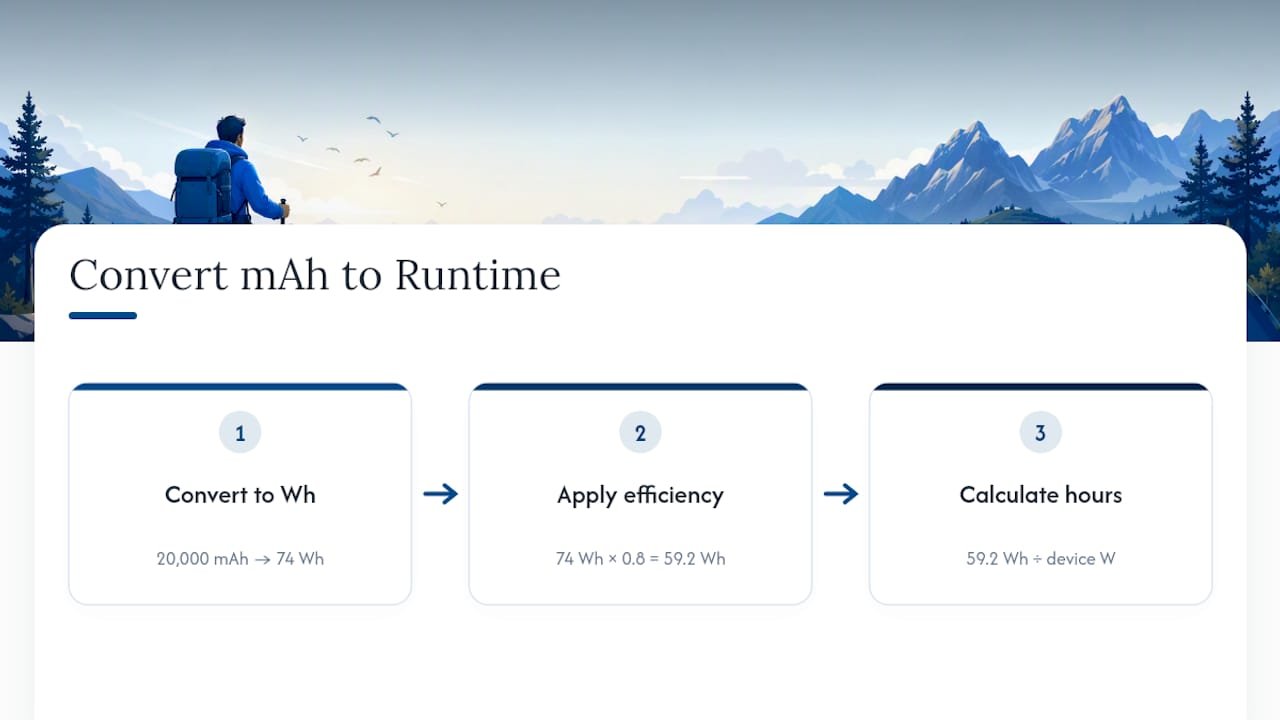
Every power bank capacity number on the box is in milliamp-hours (mAh), but that figure alone tells you nothing about runtime. You need watt-hours (Wh), because watts are what your devices actually consume. The conversion formula is:
Wh = (mAh × 3.7) ÷ 1000
The 3.7 comes from the nominal voltage of a standard lithium-ion cell, which is what’s inside the bank itself, not the 5V, 9V, or 20V your USB-C port outputs. Using 5V instead of 3.7V is the single most common mistake in DIY runtime math, and it overstates the stored energy enough to matter for travel planning.
Once you have Wh, runtime is simple:
Hours = (Wh × efficiency) ÷ device watts
A 20,000mAh bank converts to 74Wh. At 80 percent efficiency, that’s 59.2 usable Wh. Divide by whatever your device draws, and you have your answer. For a deeper breakdown of the mAh to Wh conversion with more examples, the math scales the same way regardless of bank size.
Why Doesn’t All That Capacity Reach Your Device?
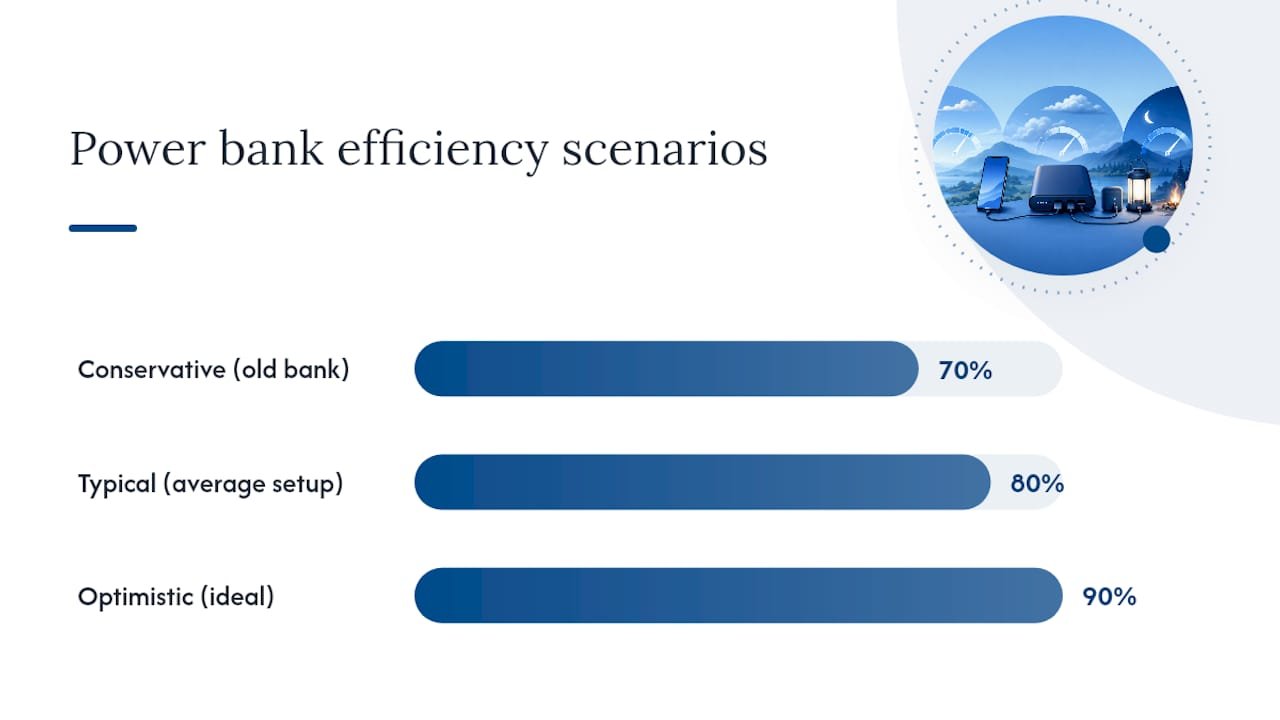
A power bank never delivers 100 percent of its rated capacity to your phone or laptop. Energy gets lost at the boost converter that steps 3.7V up to 5V or higher, more gets lost as heat in the cable, and a bit more disappears in the bank’s own control circuitry. Real-world efficiency for most banks lands between 70 and 90 percent, and the number you should plug into your math depends on how conservative you want to be.
- 70% (conservative): older bank, cheap cable, cold environment, or you want a safety margin for critical trips
- 80% (typical): average USB-C cable, moderate temperature, a bank under two years old
- 90% (optimistic): short high-quality cable, ideal conditions, newer PD-capable hardware
Statistic Callout: Online runtime calculators commonly settle on 85 percent as a baseline for real-world estimates, which sits right in the middle of that range.
Fast charging and higher-wattage Power Delivery don’t dramatically change this efficiency window, but pushing more current through a cable does generate more heat, which nudges losses toward the higher end of the range rather than the lower one.
What Do Your Devices Actually Draw in Watts?
Your runtime estimate is only as good as the device wattage you plug into the formula. Here’s roughly what different devices pull:
- Wireless earbuds: 0.3 to 1 watt during charging
- Smartphone (idle/charging): 5 to 10 watts
- Smartphone (active use, streaming, GPS): 8 to 15 watts
- Tablet: 10 to 20 watts
- Handheld game console: 10 to 18 watts
- Mirrorless or compact camera: 5 to 12 watts
- Laptop (light use, browsing): 20 to 30 watts
- Laptop (heavy use, video editing): 45 to 100 watts
If you only know a device’s mAh rating (common on phones and tablets), run it through the same Wh formula. A phone battery listed at 4,000mAh converts to 14.8Wh using the 3.7V standard.
Here’s how far a 20,000mAh (74Wh) bank stretches at typical efficiency:
These are approximate planning estimates subject to variation.
Worked Examples: Phone, Tablet, and Laptop Runtime
Here’s the math laid out step by step, so you can copy the same logic into a spreadsheet for your own gear.
- Phone example: A 20,000mAh power bank equals 74Wh (20,000 × 3.7 ÷ 1000). At 80 percent efficiency, usable energy is 59.2Wh. A 4,000mAh phone battery is 14.8Wh. Divide 59.2 by 14.8, and you get roughly four full phone charges from one bank.
- Tablet example: Say your tablet has a 30Wh battery and draws 15 watts while actively in use. Using the same 59.2 usable Wh from the bank, the runtime formula gives 59.2 ÷ 15, which comes out to about 3.9 hours of continuous active use, or roughly two full charges if you’re just topping off the battery instead of running the device directly off the bank.
- Laptop example: A 50,000mAh Ifory-class bank converts to 185Wh (50,000 × 3.7 ÷ 1000). At 80 percent efficiency, that’s 148Wh usable. A laptop with a 50Wh battery pulling 45 watts under moderate load would run for about 148 ÷ 45, or roughly 3.3 hours, assuming the bank’s 100W PD output can actually match what the laptop’s charging port requires. Laptops are pickier than phones: if the bank’s PD wattage is lower than the laptop’s charging demand, you get partial, slower charging instead of the full number the math suggests.
Statistic Callout: The compact version of this formula for any spreadsheet: Runtime (hours) = ((Capacity_mAh × 3.7 / 1000) × Efficiency) / Device_Watts. Swap in your own numbers and it scales for any bank or device.
What Changes Your Runtime Estimate in the Real World?
Temperature is the biggest wild card. Lithium cells lose usable capacity in cold weather, and Battery University’s data on temperature effects shows the drop can be substantial in freezing conditions, which matters if you’re estimating runtime for a winter hike rather than a desk in a heated office.
Age matters too. Most lithium-ion cells lose meaningful capacity after 300 to 500 charge cycles, so a bank you’ve owned for a couple of years won’t hit the same numbers as day one.
- Store banks in cool, dry conditions rather than a hot car or direct sun
- Use quality, short cables to cut resistive losses
- Avoid charging two power-hungry devices simultaneously if you need maximum runtime from one
- Subtract an extra 5 to 15 percent from your capacity estimate when it’s cold outside or the bank is more than a year or two old
Pro Tip: Charging your phone while it’s actively running navigation or streaming video is called “pass-through” use, and it’s noticeably less efficient than charging a phone that’s idle. If you’re trying to stretch every watt-hour, let the phone charge fully before using it hard.
What Actually Matters When You Run the Numbers
Most runtime disappointment comes down to one thing: people divide mAh by mAh and expect a clean, whole-number answer. A 20,000mAh bank does not give a 4,000mAh phone exactly five charges, because the bank’s mAh is measured at 3.7V and the phone’s charging port runs at 5V or higher. Converting to watt-hours first removes that illusion entirely.
The other habit worth building is picking your efficiency number based on how much margin you actually need, not just grabbing 80 percent by default. If you’re relying on a bank to keep a phone alive during an emergency, run the conservative 70 percent scenario. If you’re just topping off gear at home, 85 to 90 percent is realistic. For anything travel-related, check the Wh rating printed on the bank itself before you fly.
*— Mats
Why Ifory Fits This Kind of Runtime Math
A 40,000mAh capacity works out to roughly 148Wh, nearly double the 20,000mAh examples used throughout this guide, which means the same phone, tablet, and laptop math applies but with far more room before you hit zero. Ifory pairs that capacity with 100W fast charging across multiple ports, so a laptop pulling 45 to 60 watts doesn’t get starved the way it would on a lower-wattage bank.

The IP67 waterproof rating and anti-drop build matter for the exact scenario this guide is built around: outdoor use where you can’t control temperature, humidity, or how carefully your gear gets tossed into a pack. A built-in LED display also removes the guesswork, showing real-time output so you’re not estimating blind in the field. If you’re ready to match your runtime math to hardware built for it, check the Ifory power bank lineup or look at the emergency model with a built-in flashlight for trips where reliability matters most.
Sources
For deeper detail, see the FAA’s lithium battery guidance, Battery University on temperature effects, and VoltCalcs’ runtime calculator for additional worked conversions.
- Power Bank Runtime Calculator — mAh, Wh & USB-C PD · VoltCalcs
- Power Bank & Watt-Hour Calculator · Sorted Gear
- Battery University — Discharging at high and low temperatures
FAQ
How do you calculate how long a power bank will last?
Convert the capacity from mAh to Wh using the formula Wh = (mAh × 3.7) ÷ 1000, apply an efficiency factor between 70 and 90 percent, then divide by your device’s watt draw to get hours of runtime.
How long will a 20,000mAh power bank last?
A 20,000mAh bank equals 74Wh, or about 59.2Wh usable at 80 percent efficiency, which is enough for roughly four full smartphone charges or one partial laptop charge.
How long will a 1,000mAh battery last in hours?
A 1,000mAh battery converts to 3.7Wh; divide that by your device’s watt draw to get hours. A device pulling 1 watt would run for roughly 3 hours accounting for efficiency losses.
How long will a 50,000mAh power bank last?
A 50,000mAh bank equals 185Wh, or about 148Wh usable at 80 percent efficiency, enough for roughly ten smartphone charges or three to four hours running a laptop under moderate load, depending on the bank’s PD output.