
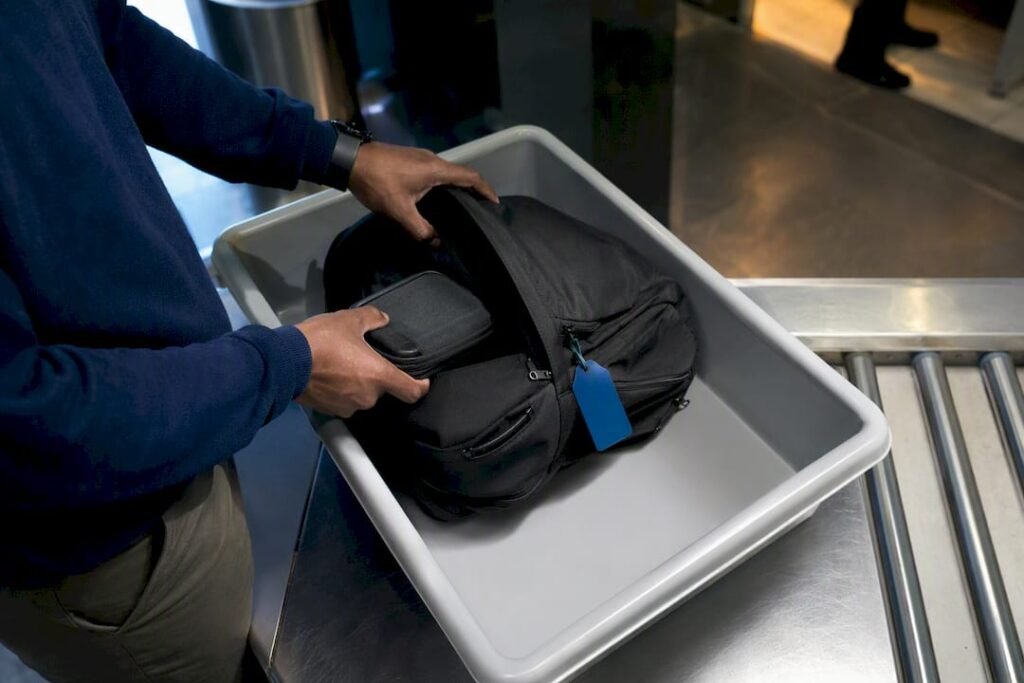
Yes, but only conditionally: a 160Wh power bank can fly in your carry-on if your airline approves it in advance, and it can never go in checked luggage. Most carriers cap approved units at a small number per passenger. Skip the approval step and you risk having the unit confiscated at security, so check with your airline before you pack it.
TL;DR:
- Power banks between 100Wh and 160Wh require airline approval and are typically limited to two units per traveler, while those over 160Wh are prohibited entirely.
- Most lithium-ion power banks list their Wh rating either directly or can be calculated by multiplying the voltage (usually 3.7V) by the mAh capacity; documentation should be kept ready for security checks.
- Approval involves checking airline policies online or contacting customer service, obtaining written confirmation, and carrying proof of approval along with the power bank and original packaging.
- High-capacity power banks must always be carried in cabin baggage, with terminals covered and physical damage avoided, as damaged units are strictly refused at security.
- For travel convenience, choosing power banks under 100Wh simplifies security, but longer trips requiring more capacity demand planning for approval or renting local charging options.
Table of Contents
- What Do the 100Wh and 160Wh Power Bank Limits Actually Mean?
- How Do You Check Your Power Bank’s Wh Rating?
- How Do You Get Airline Approval for a 100–160Wh Power Bank?
- How Should You Pack and Handle a Power Bank in Flight?
- What About 20,000mAh, 30,000mAh, and Other Common Sizes?
- An Editor’s Take on Flying With High-Capacity Power Banks
- Where to Find a Travel-Ready Power Bank
- Where to Verify the Rules Before You Fly
- Sources
- FAQ
What Do the 100Wh and 160Wh Power Bank Limits Actually Mean?
The 160Wh power bank limit isn’t one airline’s invention. It traces back to IATA guidance and the UN’s dangerous goods framework, which most civil aviation authorities and carriers follow. Airlines then apply their own discretion on top of that baseline, so policies may vary between airlines on the same route.
The practical breakdown looks like this:
- Up to 100Wh: Allowed in carry-on without asking anyone. This covers nearly every phone-charging power bank on the market.
- Over 100Wh, up to 160Wh: Allowed only with airline or operator approval, and usually capped at two units per traveler.
- Above 160Wh: Not permitted on passenger aircraft, full stop, per IATA’s rules.
Some airlines tighten this further and either lower their approval threshold or refuse 100–160Wh batteries entirely. Getting written approval before you head to the airport is the single best way to avoid a bad surprise at check-in.
How Do You Check Your Power Bank’s Wh Rating?
Watt-hours come from a simple formula: Wh = V × Ah. Most lithium-ion cells run at a nominal 3.7 volts, so the 160Wh limit translates to a capacity in the range of about 43,000mAh.
Manufacturers print the Wh rating directly on the housing or the retail box more often than not, usually right next to the mAh figure. If your power bank only lists mAh, here’s how to work out where it lands:
- Divide the mAh figure by 1,000 to convert to Ah.
- Multiply by the voltage (3.7V for most lithium-ion cells) to get Wh.
- Compare your result against the 100Wh and 160Wh thresholds.
- Save a screenshot of the product listing or spec sheet as backup documentation.
Pro Tip: Keep the original box or a saved PDF of the spec sheet on your phone. Screeners often flag units with worn-off printing, and a clear digital record settles the question in seconds instead of holding up the line.
How Do You Get Airline Approval for a 100–160Wh Power Bank?
Start with your airline’s dangerous goods or battery policy page, since most major carriers publish their exact rules there. If the page doesn’t spell out a submission process, call customer service or the dangerous goods desk directly and ask specifically about spare lithium-ion batteries rated 100–160Wh.
Push for written confirmation whenever you can get it. A reliable email confirmation beats a verbal “yes” from a call center agent, because gate staff and security screeners can’t verify a phone call, but they can read an email on your phone.
Approval typically covers a limited number of 100–160Wh units per traveler, but it’s discretionary. An operator can still refuse approval for a specific flight or aircraft type even if your battery is fully compliant, so don’t assume prior approval automatically applies.
Before you leave for the airport, confirm you have:
- The power bank itself, with the Wh rating clearly readable on the casing.
- A printed or saved copy of the airline’s written approval.
- The original packaging or a digital spec sheet as backup proof.
How Should You Pack and Handle a Power Bank in Flight?
Every approved power bank travels in your cabin bag, never in checked luggage. That single rule sits at the center of nearly every airline’s battery policy, and it exists because a thermal event in an unpressurized, unmonitored cargo hold is far harder to catch and contain than one in the cabin.
Cover the terminals with tape or the original cap to prevent short-circuiting, and keep the unit somewhere you can reach it quickly if a crew member asks. Many carriers prohibit using or charging power banks while airborne, even when the battery is approved for carriage, so check this specifically rather than assuming it’s permitted.
A damaged or swollen battery gets refused outright, no exceptions and no approval letter will override that. The UK CAA’s guidance on lithium batteries makes this point directly: batteries must be individually protected against short-circuit and show no signs of physical damage. If your power bank has a swollen case, a cracked shell, or a battery indicator that behaves erratically, replace it before your trip rather than gambling on getting it past a screener.
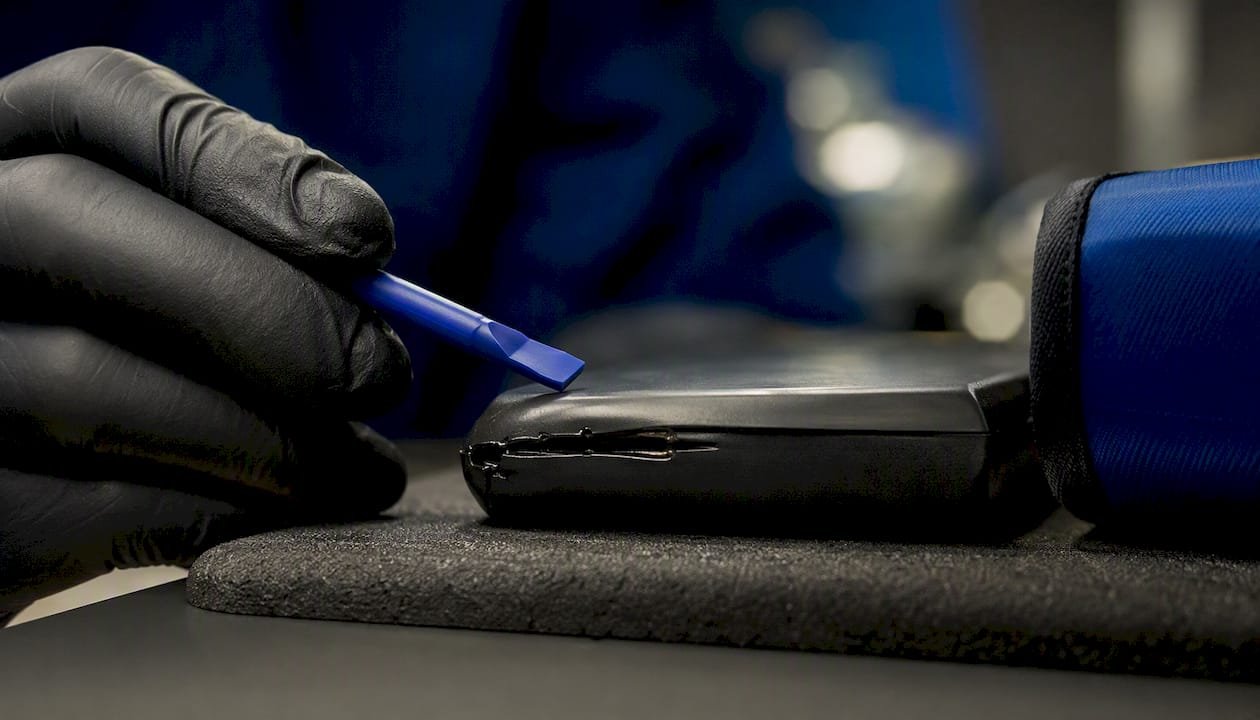
Enforcement has also gotten noticeably tighter. Travelers who once carried high-capacity banks through security without a second glance should expect more consistent checks now, not fewer.
What About 20,000mAh, 30,000mAh, and Other Common Sizes?
Much confusion comes from seeing mAh numbers without Wh conversion. At the standard 3.7V nominal voltage:
- 20,000mAh corresponds to below 100Wh, typically allowed without approval.
- 30,000mAh is above 100Wh, generally requiring approval.
- Capacities near 43,000mAh correspond approximately to the 160Wh regulatory limit for most passenger flights.
If you travel often and want to skip the approval step entirely, a power bank capacity of 100Wh or under is the simplest choice. Need more capacity than that for a longer trip? Build in time to request approval, carry your documentation, or look into renting a charging solution locally instead of hauling a borderline unit through security.
An Editor’s Take on Flying With High-Capacity Power Banks
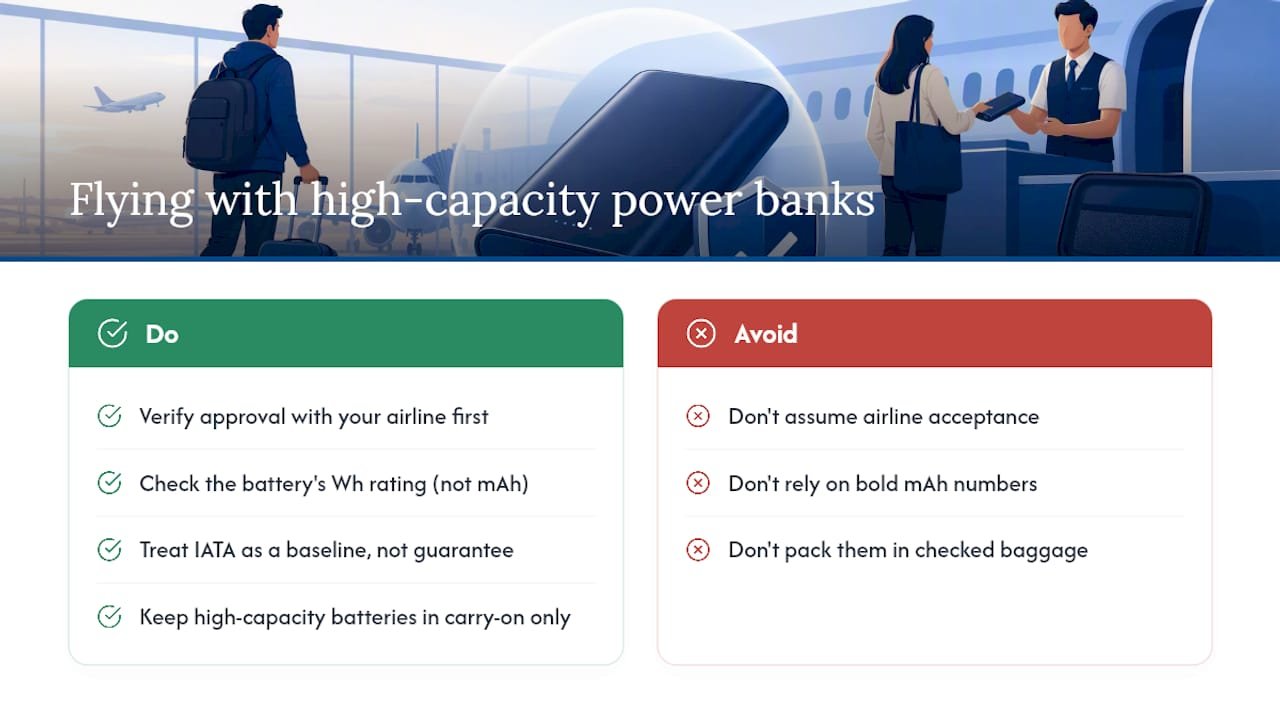
The rules around the 160Wh power bank limit aren’t complicated once you separate the baseline (IATA’s framework) from the wildcard (each airline’s own discretion). Where travelers get burned is assuming one covers the other. A power bank being technically legal under 160Wh doesn’t mean any given airline has to accept it that day.
Outdoor power banks built around a 40,000mAh capacity with 100W charging, an IP67 rating, and a real-time LED display, sit in territory that demands the same scrutiny: check the rated Wh, not just the mAh printed in bold on the box. Whatever brand you’re carrying, verify with your airline first and never let a high-capacity battery anywhere near checked baggage.
— Mats
Where to Find a Travel-Ready Power Bank
Power banks built for people who need real capacity without the confiscation risk of guessing wrong on a Wh rating include models with 40,000mAh capacity, 100W fast charging, IP67 waterproof rating, and live power status displayed on an LED screen, useful specs whether you’re topping off camera gear at a trailhead or a laptop at a layover.
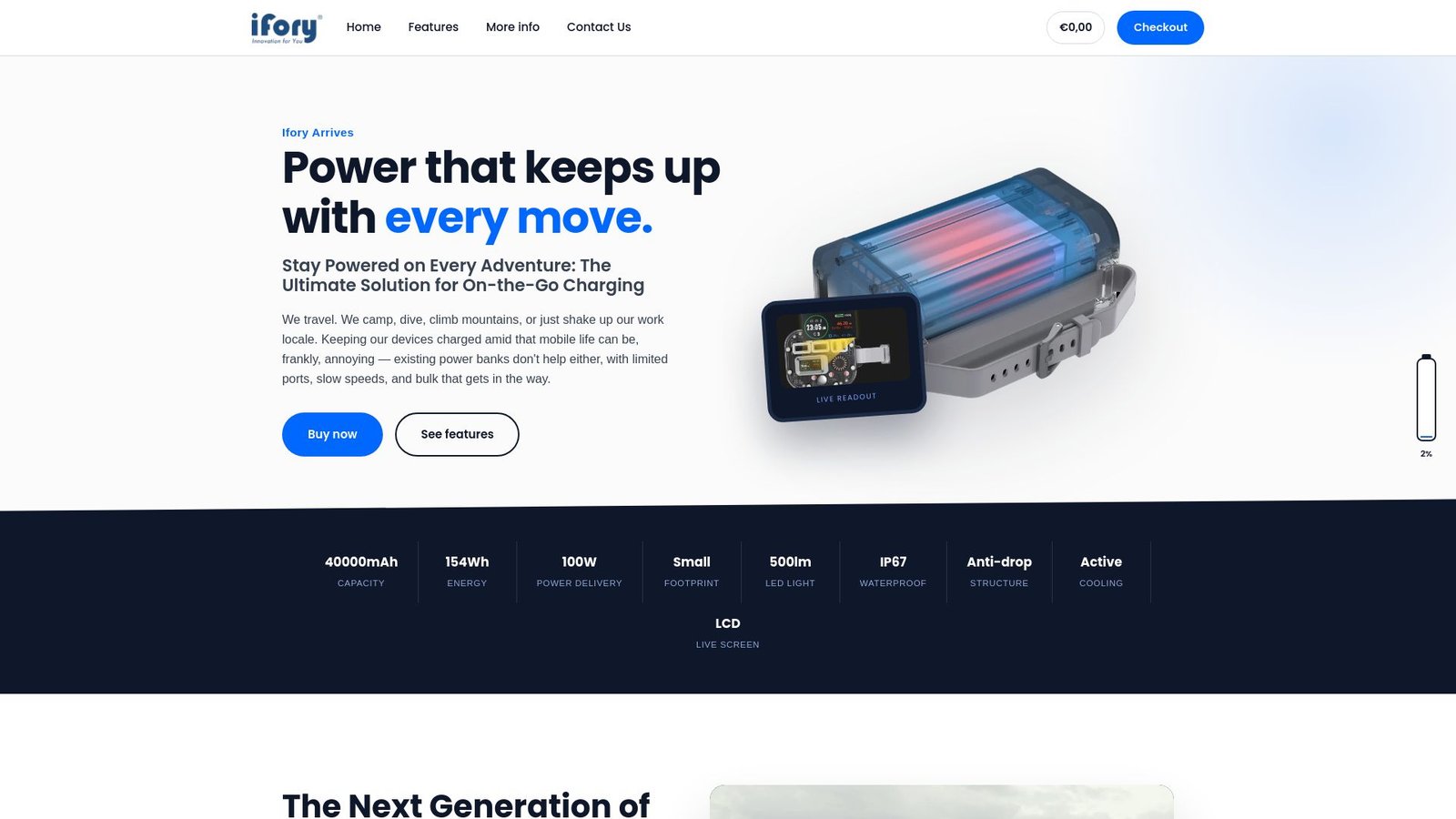
Before you fly, pull up the Ifory power bank lineup and check the rated Wh listed on each product page against your airline’s approval threshold. If you’d rather sidestep the approval process entirely, browse the compact power bank models built for travel under the 100Wh line. And if you need a charging accessory to round out your kit, Refurbished Amsterdam carries compatible hardware worth a look.
Where to Verify the Rules Before You Fly
Regulations shift, and airline policy shifts faster. Check IATA’s traveler guidance, the FAA’s PackSafe page, or the UK CAA’s battery guidance, then confirm the specifics on your own airline’s dangerous goods page.
Sources
- Safe Travel with Lithium Batteries — IATA
- PackSafe — Lithium batteries (FAA)
- Changes to rules on the carriage of lithium cells/batteries and power banks — UK CAA
FAQ
Can I Take a 160Wh Power Bank on a Plane?
Yes, but only in carry-on baggage and only with your airline’s approval beforehand, since batteries above 160Wh aren’t permitted on passenger aircraft at all.
How Many mAh Is a 160Wh Power Bank?
At the standard 3.7V lithium-ion cell voltage, 160Wh works out to roughly 43,200mAh, the largest capacity most airlines will consider approving.
Can I Bring a 20,000mAh Power Bank on a Flight?
Yes. A 20,000mAh power bank is roughly 74Wh, which falls under the 100Wh threshold and usually needs no special airline approval.
Can I Bring a 30,000mAh Power Bank on a Plane?
Generally yes, but it requires approval first. A 30,000mAh unit is about 111Wh, which puts it in the 100–160Wh range that airlines only allow with prior sign-off.
What Happens if I Don’t Get Approval for a 100–160Wh Power Bank?
Security or gate staff can confiscate the device on the spot, and you’ll have no recourse since the rule exists specifically to keep unapproved high-capacity batteries off the aircraft.