

Yes, you can charge most rechargeable headlamps with a standard power bank, as long as the lamp has a USB charging port and you use the right cable. USB Power Delivery banks won’t force extra voltage into the lamp since the lamp only draws what its battery needs. The main caveat is to follow the manufacturer’s own charging warnings, including keeping the port dry and avoiding unattended charging when the instructions say not to.
TL;DR:
- Most rechargeable headlamps can safely be charged from a standard power bank, provided the port type matches and manufacturer instructions are followed.
- Using high-quality cables and keeping the charging port dry and undamaged minimizes connection issues and prevents potential damage.
- Power banks with a capacity of around 74 watt-hours typically allow for 15 to 20 full top-ups of a headlamp before needing recharges, assuming normal efficiency.
- It is safest to monitor charging sessions, avoid unattended charges if not recommended, and use approved chargers to prevent battery damage.
- Keeping port covers shut during hikes and topping off headlamps nightly can improve longevity and guarantee light availability when needed most.
Table of Contents
- How headlamp charging works: ports, batteries, and power delivery basics
- Quick compatibility checklist to run before you plug in
- Step-by-step: safely charging a headlamp from a power bank in the field
- Choosing a power bank for headlamps: what matters
- Safety, longevity, and charging do’s and don’ts
- A camper’s take on keeping headlamps charged on trail
- Ifory as an option for keeping headlamps and gear charged on longer trips
- Primary sources and manufacturer guidance
- Sources
- FAQ
How headlamp charging works: ports, batteries, and power delivery basics
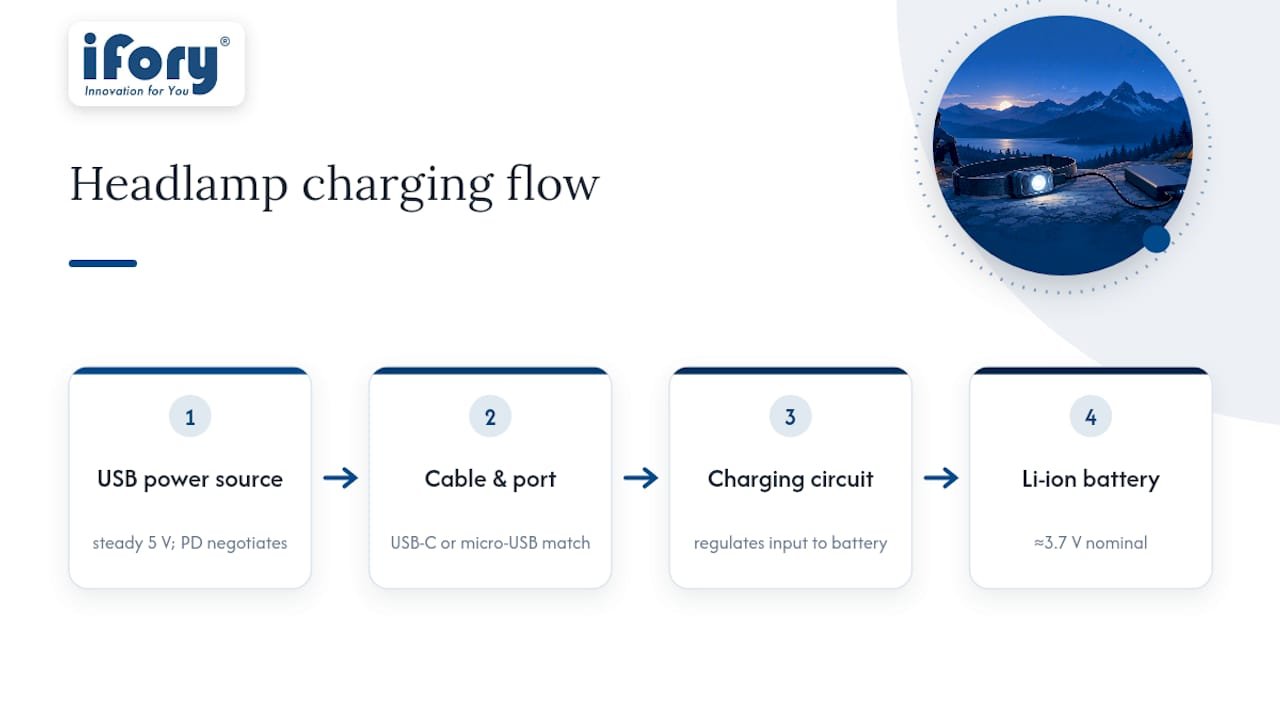
Most rechargeable headlamps use either USB-C or micro-USB ports, and the cable you use has to match. A USB-C headlamp needs a USB-C cable, and a mismatched or generic cable can charge slowly or not connect properly at all.
Inside the lamp sits a small lithium-ion battery, usually rated around 3.7 volts, wrapped in a charging circuit that regulates how much power comes in. That circuit is why most headlamps only need a steady 5-volt supply to charge, the same baseline voltage nearly every USB port and power bank provides.
USB Power Delivery, or USB PD, is a protocol that lets a power source and a device negotiate higher voltages and currents for things like laptops or fast-charging phones. Headlamps rarely need that. According to a USB Power Delivery application note, PD can scale up to much higher power levels for compatible devices, but low-power gear like a headlamp typically just draws a stable 5 volts and is never forced into a higher voltage it can’t use.
Quick compatibility checklist to run before you plug in
Before connecting your headlamp to a power bank, run through a short checklist. It takes less than a minute and prevents most charging problems in the field.
- Check your headlamp’s manual for its allowed charging voltage and whether the manufacturer permits using the lamp while it charges.
- Confirm the port type (USB-C or micro-USB) and use the original cable or another high-quality one rather than an unmarked cheap cable.
- Make sure the port is dry, clean of grit, and undamaged, and reseat any port cover fully before charging.
- If the manual warns against unattended charging, plan to either supervise the session or wait until you’re back at camp.
Pro Tip: Keep a spare cable in a separate dry bag. A lost or corroded cable at camp is one of the most common reasons hikers end up with a dead headlamp and no fix.
Step-by-step: safely charging a headlamp from a power bank in the field
Charging a headlamp from a power bank is straightforward once you’ve confirmed compatibility. Following a consistent routine keeps the process safe and predictable, especially after a wet or dusty day on trail.
- Power down the headlamp before connecting it, unless the manual explicitly allows charging while in use.
- Inspect and dry the charging port thoroughly, removing the lamp from the headband first if that makes the port easier to reach.
- Connect the recommended cable to the headlamp, then to the power bank, and watch for the lamp’s charging indicator light to confirm the connection.
- Monitor the session and favor several short top-ups over one long unattended charge whenever that’s practical.
- If you do need light while charging, use a low-power mode and make sure the power bank is delivering a stable 5-volt output rather than swinging voltage.
Petzl’s technical guidance recommends charging only with specified cables and Class II approved chargers, warning that non-certified chargers or unattended charging sessions can damage the battery or shorten its life. Lithium-ion headlamp batteries typically lose about 10% of their capacity per year even under normal use, according to Petzl’s technical notice, which is why sticking to approved gear and charging habits matters more than it might seem.
Choosing a power bank for headlamps: what matters
Capacity numbers on power banks are usually listed in milliamp-hours (mAh), but watt-hours (Wh) give you a more honest way to compare devices, since Wh accounts for voltage differences between a power bank’s output and a headlamp’s battery. To convert, multiply mAh by voltage and divide by 1,000: a 20,000mAh bank rated at 3.7 volts works out to about 74 watt-hours before any conversion losses.
Say a headlamp battery holds 3 watt-hours. A 74Wh power bank, after accounting for typical conversion losses, could realistically deliver somewhere in the range of 15 to 20 full top-ups before needing its own recharge.
- Look for an IP-rated housing and sealed port covers if you’re camping near water or in wet climates.
- A basic, stable 5-volt output is enough for headlamps; USB PD only matters if you’re also charging laptops, cameras, or other higher-draw gear from the same bank.
- Multiple output ports let you charge a headlamp and another device at the same time without juggling cables.
Safety, longevity, and charging do’s and don’ts
Stick to CE-marked, Class II approved chargers and cables. Manufacturers warn against using untested or unbranded chargers, since these can supply unstable current that damages the battery. Never plug a cable into a wet port: drying it first, even with a breath of air or a soft cloth, prevents shorts and corrosion, a point Petzl’s guidance repeats across its headlamp manuals.

Lithium-ion batteries in headlamps lose about 10% of their capacity per year under normal use, per Petzl’s technical documentation, so budget for eventual battery or lamp replacement rather than expecting indefinite performance. If a battery ever swells or shows damage, dispose of it according to local battery recycling rules and the manufacturer’s disposal instructions rather than tossing it in general trash.
A camper’s take on keeping headlamps charged on trail
My routine on multi-day trips is simple: top off the headlamp every night at camp rather than waiting for it to run flat, and keep one spare set on the lowest power mode reserved for emergencies only. That habit has saved more than one dark walk back to a tent.
One detail people skip: keep port covers snapped shut while hiking, and route your charging cable so it doesn’t tug at the port when the lamp shifts in a pack pocket. A cracked port cover is something EU ecodesign rules and manufacturer manuals require robust connectors and standardized designs to prevent, but the flap still deserves the same care in the field.
— Mats
Ifory as an option for keeping headlamps and gear charged on longer trips
If you’re heading out for more than a night or two, a single power bank that can handle a headlamp and everything else in your kit saves weight and hassle. The Ifory Powerbank is built for exactly that kind of trip.

- A large capacity with fast charging, capable of topping off headlamps and other devices multiple times.
- Multiple ports for charging several devices at once.
- Durable waterproof and drop-resistant construction suited for outdoor conditions.
- A display showing real-time power status to monitor remaining charge.
- An integrated flashlight serving as a backup light when other devices are charging.
It pairs well with the resold Portable Solar Panel for longer stretches off-grid. Check the current listing on the Ifory shop page if you want a rugged, high-capacity option for your next trip.
Primary sources and manufacturer guidance
Claims above draw on Petzl’s charging guidance, the EU ecodesign regulation, and a USB Power Delivery technical note, along with real-world reports from a BackpackingLight forum discussion on power bank drain while charging headlamps.
Sources
- Petzl – Technical notice / charging guidance
- EUR-Lex — Regulation (EU) 2025/2052 (ecodesign for external power supplies)
- BackpackingLight forum thread — rechargeable headlamps and excess power bank drain
FAQ
Can I use a power bank for LED lights?
Yes, most USB-rechargeable LED lights, including headlamps and standalone LED flashlights, can charge from a standard power bank as long as the port and cable match. Devices like the LA020 LED flashlight illustrate how rugged LED lighting hardware is designed around standard, low-power charging expectations.
How do I charge my headlamp?
Connect the headlamp’s charging cable, usually USB-C or micro-USB, to a power source such as a wall adapter, computer, or power bank, then watch for the lamp’s charging indicator light. Always check the manufacturer’s manual first, since some models specify a maximum charging voltage or warn against use while charging.
Can I charge my Bluetooth headphones with a power bank?
Yes, Bluetooth headphones with a USB charging port work the same way headlamps do: they draw a low, steady voltage from any standard power bank. Using the manufacturer’s cable and avoiding damaged ports applies equally to headphones and headlamps.
Can a power bank be used while charging?
Many power banks support pass-through charging, meaning you can charge a device from the bank while the bank itself is plugged into a wall outlet, though not every model allows this safely. Check the power bank’s own manual, since running pass-through charging on an unsupported unit can shorten its battery life over time.