
For reliable 100W charging, stick to a 1-meter cable with an e-marker chip, and treat anything up to 2 meters as workable if the listing explicitly names the chip and PD version. Three retail options worth checking are the INIU 100W USB C to USB C Cable, the Jupio 100W USB-C Cable (CAB0070), and the INET USB C Cable 100W 1M. Devices designed for high power output make the cable length a critical factor, since a weak cable throttles the charge no matter how much power the source can deliver.
TL;DR:
- A reliable 100W USB-C cable must have an e-marker chip and be within 1 to 2 meters for practical retail use, especially at full power.
- The INET cable explicitly states its e-marker chip and is the best choice for a verified 1-meter option, while shorter length is crucial for consistent high power delivery.
- Cables without an e-marker often cannot support full 100W safely, and longer passive cables tend to drop to lower data speeds or lower power levels.
- Check the PD version and return policy before buying, as these influence power negotiation and whether the cable truly supports 100W.
- Pairing a certified, short cable with high-power devices or powerbanks ensures full charging speed and safety, especially for outdoor or portable setups.
Table of Contents
- Shortlist: INIU, Jupio (CAB0070), and INET compared by length and spec
- How length changes the rules for power and data
- A practical checklist for choosing your cable length
- Why cable choice matters for high-power portable chargers
- The Ifory option for readers who need a 100W power source
- A cable buyer’s real takeaway
- Sources
- FAQ
Shortlist: INIU, Jupio (CAB0070), and INET compared by length and spec
Each of these three cables approaches the 100W question differently, and the differences matter more than the branding.
The INIU 100W USB C to USB C Cable is sold mainly in short retail lengths, commonly 1-meter and 1.5 meter, often as a pair rather than a single long cable. Its braided jacket and reinforced connector ends are aimed at everyday carry rather than desk permanence, and INIU markets the 100W rating directly on the packaging. This is the pick for someone who wants a familiar, widely stocked 1 meter cable without hunting for a niche brand.
The Jupio 100W USB-C Cable (CAB0070) takes a more deliberate approach to length, with the retailer listing a specific 0.7 meter (2.3 foot) variant alongside its 100W claim. That short length is a design choice: shorter runs need less copper to hit the same power target, so Jupio’s SKU structure signals a cable built for desk or bag use rather than reaching across a room. Buyers should check the specification sheet for the exact PD version before assuming it matches other 100W cables on the market.
The INET USB C Cable 100W 1M stands out because its listing calls out an E-MARK chip by name alongside the 1 meter length and PD compatibility. That explicit mention is worth more than a bare “100W” claim on a box, since the chip is what actually negotiates the higher power levels with a charger or powerbank.
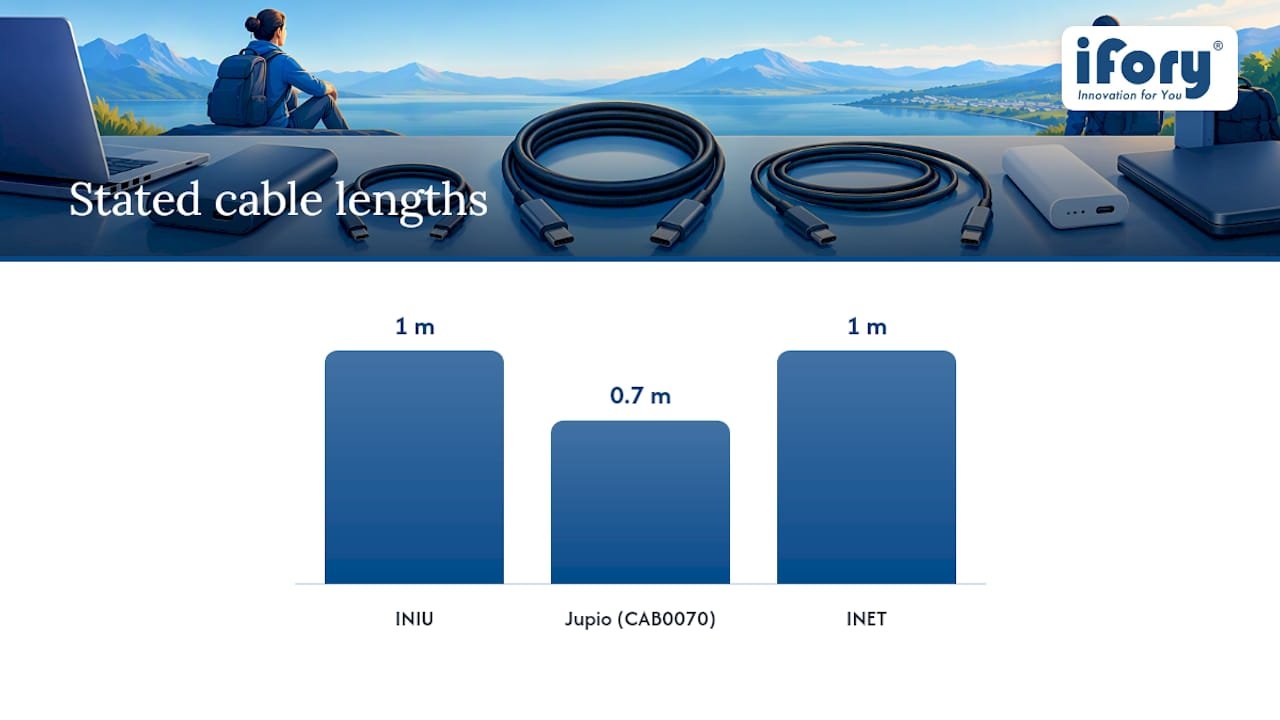
None of the three currently list a long passive option beyond roughly 1.5 to 2 meters at full 100W, which tracks with how the broader retail market handles length. Availability for buyers who need to check stock, sizing, or return terms will depend on the specific retailer’s regional listings, so confirm shipping and warranty details before ordering.
A quick way to sort the shortlist by use case:
- Best short cable (1 meter): INET USB C Cable 100W 1M, mainly because the e-marker is stated up front.
- Best compact option: Jupio 100W USB-C Cable (CAB0070), if a 0.7 meter reach fits your setup.
- Best for a common retail braided cable: INIU 100W USB C to USB C Cable, especially when you want a spare short cable included.
- Best long passive option: none of the three currently advertise a certified passive cable past 2 meters at full 100W, which is consistent with the technical limits below.
How length changes the rules for power and data
USB-C cables aren’t one-size-fits-all once you push toward 100W, and length is the variable that breaks things first. The USB Type-C specification allows passive cables up to 4 meters in theory, but that number assumes lower power and data demands than 100W charging requires.
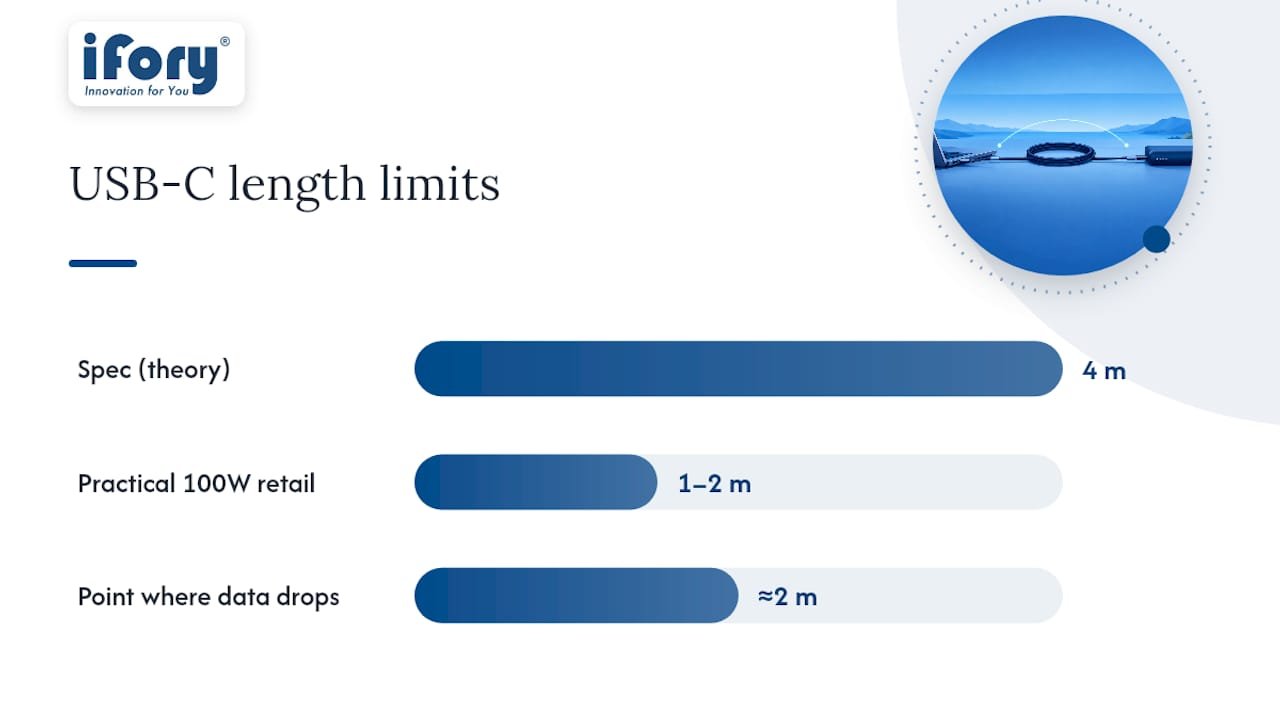
Practical retail limits for 100W passive cables sit closer to 1 to 2 meters, according to Infineon’s technical guidance, because carrying that much current over longer copper runs demands thicker conductors and careful safety design that most consumer cables skip past 2 meters.
An e-marker chip is the part that makes any of this trustworthy. It identifies the cable’s capabilities to the connected devices, and it’s commonly required before a retail cable can safely claim full 100W support. A few things worth knowing before you shop:
- Cables without an e-marker often cap out well below 100W regardless of what the packaging implies.
- Active cables can extend usable length while preserving power and data, but they behave inconsistently across brands of laptops and chargers.
- Longer passive cables frequently drop to USB 2.0 data speeds even while still carrying full charging power, so a 2 meter cable that charges fine might transfer files slowly.
That last point catches a lot of buyers off guard: a cable can be excellent for charging and mediocre for data at the same length.
A practical checklist for choosing your cable length
Buying a 100W cable without a clear process is how people end up with a cable that charges slowly or not at all. Work through this order:
- Match the cable’s rated wattage to your device’s charging needs. A laptop that draws 100W needs a cable rated for it, not just a phone-charging cable relabeled as fast.
- Prioritize cables that list an e-marker chip or reference USB-IF testing. This single detail separates a cable that will actually hit 100W from one that only claims it.
- Pick the shortest length that comfortably fits your setup. A 1 meter cable is easier to certify reliably than a 3-meter one, and it’s the length most retail 100W cables are actually built and tested for.
- Confirm the PD version and the seller’s return policy before buying. PD 3.0 and PD 3.1 handle power negotiation differently, and a return window matters if the cable underperforms once you test it.
Before checking out, look for the answers to three questions directly on the product page: whether an e-marker is mentioned by name, which PD version is supported, and whether the cable is described as active or passive. If none of that is listed, treat the wattage claim skeptically.
A few warning signs are worth walking away from: a bare “100W” claim with no e-marker mentioned anywhere, a cable that’s unusually thin for its stated length and wattage, or a listing with no spec sheet and no return policy.
Pro Tip: Test a new 100W cable with a device you already trust before relying on it for something like a laptop that needs the full charge rate.
Why cable choice matters for high-power portable chargers
A 100W-capable power source is only as fast as the cable attached to it. High-capacity powerbanks and laptops both depend on a certified cable to transfer that power safely and at full rate, which is why the e-marker question above isn’t a minor technicality.
Some powerbank lines built around 100W charging, multiple output ports, and an IP67 waterproof design meant for outdoor use require pairing with a certified 100W cable to deliver their rated output rather than falling back to a slower default speed.
The Ifory option for readers who need a 100W power source
If you’re shopping for a cable because you’re pairing it with a power source, not just a wall charger, the Ifory Powerbank, Portable Solar Panel – PD 40W lineup is worth a look. It’s built for outdoor use with a 40,000mAh capacity, 100W output, and an IP67 rating that holds up to rain and drops better than a standard charger.

A few things to keep in mind if you’re considering it:
- Pair it with a certified 100W cable, ideally 1 to 1.5 meters, to get the full charge rate it’s rated for.
- The multiport design means you can charge a laptop and a phone at the same time without switching cables.
- Check the Ifory shop page for current availability of the powerbank and the compatible solar panel accessory.
A cable buyer’s real takeaway
Certification beats length every time. A shorter, e-marker-verified cable will outperform a longer one with a vague 100W claim, so when you’re unsure, reach for a 1 to 1.5 meter certified cable and skip the guesswork on anything longer.
— Mats
FAQ
Can any USB-C cable do 100W?
No, only cables built with an e-marker chip and rated for the appropriate USB Power Delivery version can safely carry 100W. A basic charging cable without that chip typically caps out at a much lower wattage regardless of what the connector looks like.
What is the maximum length for a USB-C cable?
The USB Type-C specification allows passive cables up to 4 meters in theory, but that figure assumes lower power and data demands than 100W charging needs. For reliable 100W performance, practical retail lengths run closer to 1 to 2 meters.
Should I buy a 100W or 240W USB-C cable?
If your devices, including laptops and powerbanks like Ifory’s, top out at 100W, a 100W-rated cable with an e-marker is sufficient and often easier to find in shorter, more reliable lengths. A higher-wattage cable only matters if you own hardware that actually draws that much power.
How long is a normal USB-C cable?
Most retail USB-C cables sold for everyday charging run 1 meter to 2 meters, with 1 meter being the most common length for cables that reliably support 100W. Longer cables exist but often shift to active electronics or accept slower data speeds to maintain safe power delivery.