
If you ever notice heat, a strange smell, or swelling, stop charging it immediately and set it aside for proper disposal.
TL;DR:
- Storing power banks at around 50-80% charge in a cool, dry, ventilated place slows aging and minimizes risks, especially avoiding full charge or complete discharge.
- Keep power banks separated, stored in original or padded containers, away from heat sources, moisture, and extreme temperatures that can damage the battery.
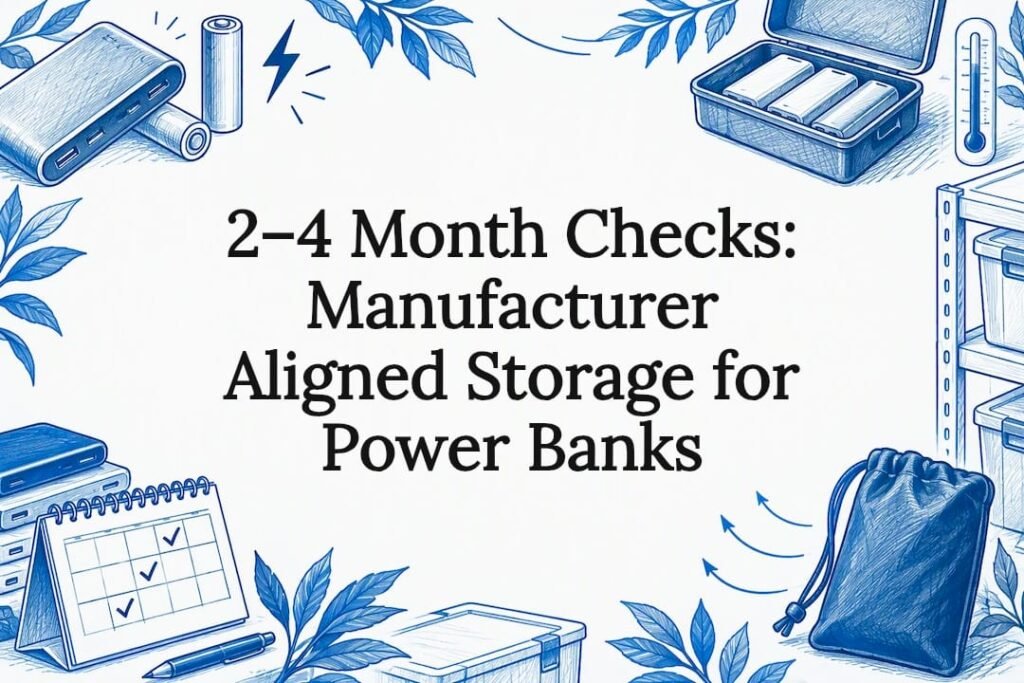
- Regularly check unused power banks every two to four months for swelling, warping, or unusual smells, and top them up with slow charging before use.
- Swollen, leaking, or warm power banks must be isolated immediately, disposed of at hazardous waste facilities, and never charged further.
- Cell chemistry matters: lithium-polymer banks require more careful inspection due to their vulnerability to physical damage, but all storage guidelines remain similar.
Table of Contents
- 1. Step-by-step long-term storage checklist
- 2. What charge level to set and the technical reasons
- 3. Temperature, humidity, and where not to keep power banks
- 4. Safety inspection, red flags, and how to dispose of unsafe banks
- 5. Maintenance schedule: calendar of checks and safe topping-up
- 6. How device features make storage easier
- 7. Does storage orientation affect battery health?
- 8. How to reactivate a power bank after long-term storage
- 9. Li-ion versus Li-polymer: does chemistry change the rules?
- What the storage advice everyone repeats gets wrong
- Sources
- FAQ
1. Step-by-step long-term storage checklist
Storing a power bank correctly is less about equipment and more about sequence. Get these steps right once, and the rest of the process is just repetition every few months.
- Charge or discharge the bank to your target band, generally 40 to 60%, before you put it away.
- Power the unit off completely and disconnect any cables still attached to it.
- If you are storing it near metal objects, cover the exposed terminals with a strip of electrical tape.
- Place it in its original pouch or an individual container rather than tossing it loose in a drawer.
- Leave a few inches of space between multiple stored banks instead of stacking them tightly.
- Write the storage date and the date of your next planned check on a label or sticky note.
Picking the exact number within your target range depends on how long the bank will sit.
- Choose the original box or a padded pouch over a loose drawer or bag.
- Keep banks separated rather than stacked, which limits heat transfer if one unit ever overheats.
- Label each unit with the date it went into storage.
Pro Tip: Set a recurring phone reminder for your check dates instead of relying on memory, since a forgotten power bank is the one most likely to fully discharge or swell unnoticed.
2. What charge level to set and the technical reasons
Lithium-ion cells age fastest at the extremes. A cell held near full charge for months experiences more stress on its internal chemistry than one sitting at a moderate state of charge, and a cell left completely empty risks dropping below the voltage its battery management system needs to safely wake it back up. That is why manufacturer guidance and consumer-tech reporting both point toward a partial charge for storage, generally in the range of 50 to 80% depending on the brand, according to reporting on power bank maintenance.
Manufacturers do not all agree on the exact figure, so check your device’s manual when one is available, since some brands specify their own storage windows.
- Avoid storing at 100%, which accelerates chemical aging in the cells.
- Avoid storing fully discharged, which risks the battery management system failing to recognize the pack later.
- When in doubt, a middle-of-the-road charge beats either extreme.
3. Temperature, humidity, and where not to keep power banks
Heat is the fastest way to age a lithium-ion battery, and cold slows chemical reactions inside the cell in ways that stress it when you try to charge it too soon afterward. A manufacturer manual for one commonly sold power station specifies a storage range of 25°C ± 5°C (about 68 to 82°F) in a cool, dry place, according to the product’s user manual, and that range is a reasonable benchmark when your own device’s documentation does not list one.
Ventilation matters as much as temperature. An airtight sealed box traps any heat or off-gassing a stressed cell produces, so a breathable pouch or an open shelf beats a vacuum-sealed container.
- Good spots: a closet shelf, a drawer indoors, or a cabinet away from windows.
- Bad spots: a car glovebox, an attic, a garage in summer, or anywhere near a heat vent.
- If a bank has been sitting in the cold, let it warm to room temperature before you plug it in to charge.
Public safety guidance on lithium batteries reinforces the same pattern: avoid both hot and cold extremes, and charge only in ventilated areas, per official fire safety guidance.
4. Safety inspection, red flags, and how to dispose of unsafe banks
Before every recharge, give the unit a quick look and feel. A power bank that is swollen, warm to the touch while sitting idle, emitting an odd smell, or leaking any residue has moved past normal wear and into territory that needs immediate attention.
- Stop charging or using the bank the moment you notice any of these signs.
- Isolate it in a fire-resistant container or a metal tin, away from anything flammable.
- Tape over the terminals to prevent an accidental short circuit while it sits isolated.
- Take it to a local e-waste or hazardous-waste collection point rather than a household trash bin.
- Contact the manufacturer if the unit is still under warranty, since some offer their own return or disposal programs.
Regulation in the EU places responsibility for battery safety and consumer information on the manufacturer, which is why the product manual and any onboard warnings should be your first reference point, per the EU battery regulation. Official safety guidance also recommends taking damaged lithium batteries to designated collection facilities rather than disposing of them with regular waste, according to the same lithium battery safety guidance cited above.
Pro Tip: Never attempt to “revive” a swollen bank by charging it anyway. A swollen cell has already suffered internal damage that charging will not reverse.
5. Maintenance schedule: calendar of checks and safe topping-up
A power bank sitting untouched for months still needs light attention. Checking it every two to four months lets you catch a slow discharge or an early warning sign before it becomes a real problem, a cadence echoed in manufacturer guidance recommending periodic discharge and recharge cycles during long idle periods.
At each check, look at the charge level, inspect the case for swelling or warping, and top up gently if the charge has drifted below your target band.
- Use a standard, slower charging speed for top-ups rather than a fast-charge port, since repeated rapid cycles add more stress than a gentle refresh.
- If you own more than one power bank, rotate them so the oldest unit gets used first instead of sitting idle the longest.
- Reset your label with a new check date every time you top one up.
6. How device features make storage easier
Some of the friction in long-term storage comes down to guesswork: what charge is it actually at, and is the casing holding up in the meantime. A built-in state-of-charge display removes the first problem, letting you glance at a percentage instead of estimating from how long ago you last charged it. Some power banks have an LED display giving a real-time read on power status so you can set the bank to a target storage band and confirm it later without opening an app or guessing.
The second problem is physical. A power bank stored in a garage, a car, or a bag that gets rained on faces more risk than one kept on an indoor shelf, and a rugged, sealed casing reduces that exposure. A power bank with an IP67 waterproof rating and anti-drop structure is better suited for handling outdoor conditions, which matters for anyone who stores gear between camping trips rather than in a climate-controlled office drawer.
- A visible charge readout removes the guesswork of hitting a 40 to 60% storage target.
- A sealed, rugged case lowers the risk of moisture or impact damage during storage or transport.
Pro Tip: If you store power banks between outdoor trips rather than at a desk, prioritize a unit with a clear charge display and weather sealing, since both reduce the routine maintenance burden. You can see examples of these features on power bank product pages such as the one at Ifory Powerbank product page.
7. Does storage orientation affect battery health?
Orientation gets asked about often, but it has little direct effect on a sealed lithium-ion or lithium-polymer pack. Unlike a lead-acid battery, which can suffer from internal plate distortion or electrolyte settling if left on its side for extended periods, the pouch or cylindrical cells inside a power bank are sealed units with no free liquid to shift.
What orientation does affect is physical safety and airflow. A power bank left standing on a narrow edge is more likely to tip and take an impact than one lying flat on a shelf, and a bank wedged upright between other objects in a tight space may get less airflow around its casing than one stored flat with room on all sides.
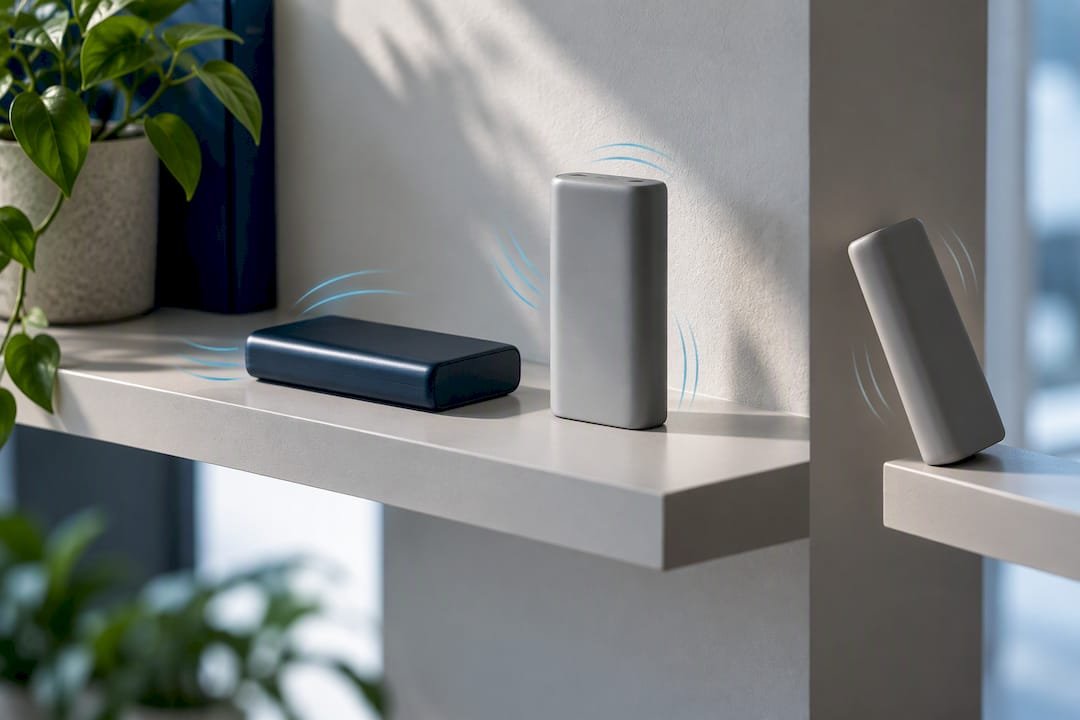
In practice, orientation is a minor consideration compared to charge level, temperature, and humidity. Lay the unit flat or stand it upright based on whichever position is more stable in your storage space, and put your attention into the factors that actually drive battery aging.
8. How to reactivate a power bank after long-term storage
Bringing a stored power bank back into rotation takes a few extra minutes compared to a quick recharge, but skipping the steps risks waking up a cell that has drifted into a low-voltage state.
- Inspect the casing first for any swelling, warping, or discoloration before you connect a cable.
- If the bank has been in a cold space, let it sit at room temperature for at least an hour before charging.
- Connect it to a standard charger, not a fast-charge port, for the first charge cycle.
- Watch the first 15 to 20 minutes of charging for any unusual heat or smell, and disconnect immediately if you notice either.
- Let it charge fully once, then run it through a full discharge and recharge cycle to help recalibrate the battery management system’s read on remaining capacity.
- Resume normal use once the charge indicator behaves consistently with expected drain over a day of use.
If the bank refuses to power on or take a charge at all after an extended storage period, it may have dropped below the voltage threshold its protection circuit needs to reset. Some manufacturers include a manual reset button or hole for this scenario, so check the product manual before assuming the unit is dead.
9. Li-ion versus Li-polymer: does chemistry change the rules?
Most consumer power banks use either lithium-ion (Li-ion) cylindrical cells or lithium-polymer (Li-po) pouch cells, and the core storage advice, a partial charge in a cool, dry place, applies to both. The differences show up at the margins rather than in the fundamental rules.
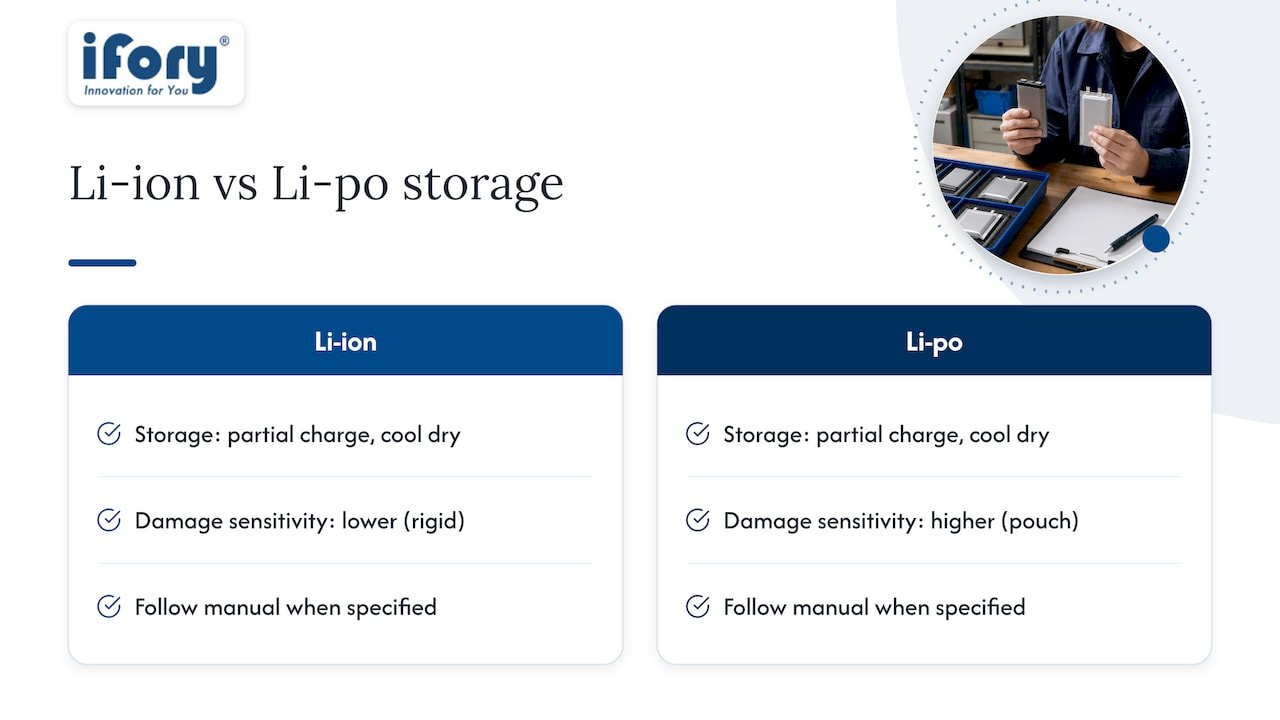
Li-po cells are generally more sensitive to physical damage, since their soft pouch casing can swell or puncture more easily than a rigid metal Li-ion cylinder. That makes the inspection step in your maintenance schedule slightly more important for Li-po-based banks, since visible swelling is often the first and clearest warning sign.
Li-ion cells, common in many higher-capacity power banks, tend to hold up well over practical use, since larger capacity packs often spread the load across more cells and may show slower practical aging, according to consumer-tech reporting. When your product manual specifies a chemistry-specific range, follow it over the general guidance here.
What the storage advice everyone repeats gets wrong
The failure point is almost always the recheck. People set a power bank aside at a sensible charge and never look at it again for a year, by which point it may have self-discharged into a range that stresses the cell or trips its protection circuit.
The environmental advice gets oversimplified too. “Cool and dry” gets repeated without explaining that a sealed, airtight container is often worse than a breathable pouch on an open shelf, since trapped heat has nowhere to go. If I had to pick one habit to prioritize over the others, it would be the calendar reminder, not the charge percentage.
Treat storage as a small recurring task, not a one-time setup step, and the rest of the guidance here mostly takes care of itself.
— Mats
Sources
- Regulation (EU) 2023/1542 on batteries (extract)
- Power-Station 500 user manual (example manufacturer guidance)
- How to safely maintain, use, and dispose of your power banks | The Verge
- Lithium battery fire safety (public safety guidance)
FAQ
What is the best way to store a power bank?
Avoid airtight sealed containers and keep multiple units separated rather than stacked.
Do power banks go bad if not used?
Yes, lithium-ion and lithium-polymer cells degrade gradually even when sitting unused, especially if stored at a full charge, empty, or in hot conditions. Periodic checks and a partial-charge storage habit slow that decline but do not stop it entirely.
How long can a power bank store power?
A power bank can typically hold a usable charge for several months in storage, though the exact rate of self-discharge depends on the specific battery and its storage conditions. Checking and topping up every two to four months, as recommended in manufacturer guidance, keeps it from drifting into a risky low-charge state.
Should you charge a power bank to 100% before first use?
Most modern power banks do not require a full charge before first use, since their battery management systems handle calibration automatically. Check the included manual for your specific model, as a small number of manufacturers still recommend an initial full charge cycle.
Is it safe to store a power bank in a car?
It is not recommended, since a parked car can reach temperature extremes in both summer heat and winter cold that exceed the safe range most manufacturers specify, such as the window listed in one manufacturer’s manual. An indoor closet or drawer is a safer choice for long-term storage.