
Don’t put a power bank in your household trash. Insulate the terminals with non-conductive tape, then hand it to a retailer take-back point or a municipal collection service for certified recycling. If the unit is swollen, punctured, or hot, stop and follow special handling steps before it goes anywhere near a standard collection box.
TL;DR:
- Taping the terminals with non-conductive material and inspecting the power bank for damage are crucial steps before drop-off to prevent short circuits during transportation.
- Most retail stores and municipal centers are legally required to accept used power banks free of charge, but damaged or swollen units must be handled through hazardous waste services.
- Swollen, hot, or punctured power banks should be cooled in a ventilated space and placed in a metal or sand-filled container before professional disposal; never toss them in regular trash or electronic waste bins.
- Certified recycling facilities safely dismantle and process power banks to recover valuable materials like lithium and cobalt, which helps prevent fires caused by crushed or short-circuited batteries.
- Proper disposal takes only a few minutes extra but significantly reduces fire risks associated with household waste collection and promotes environmentally responsible recycling.
Table of Contents
- How to prepare your power bank before drop-off
- Where can you actually drop off a used power bank?
- What to do with a swollen, damaged, or hot power bank
- What happens once your power bank reaches a certified facility
- Why the extra five minutes of care is worth it
- Sources
- FAQ
How to prepare your power bank before drop-off
Before you take a power bank anywhere, check whether the battery is fixed inside the casing or sits in a removable compartment. Most power banks have sealed, non-removable cells, so do not try to pry the case open. Prying at a lithium cell risks a puncture, and a punctured cell can short circuit or ignite.
You do not need to fully drain the battery first. A partial charge is fine for transport, and forcing a full discharge adds risk without any real benefit, according to The Verge’s disposal guidance. What matters more is isolating the terminals so they cannot touch metal or each other during handling.
Follow these steps to get a power bank ready for a collection point:
- Inspect the casing for cracks, bulging, or heat, and stop immediately if you see any of these signs.
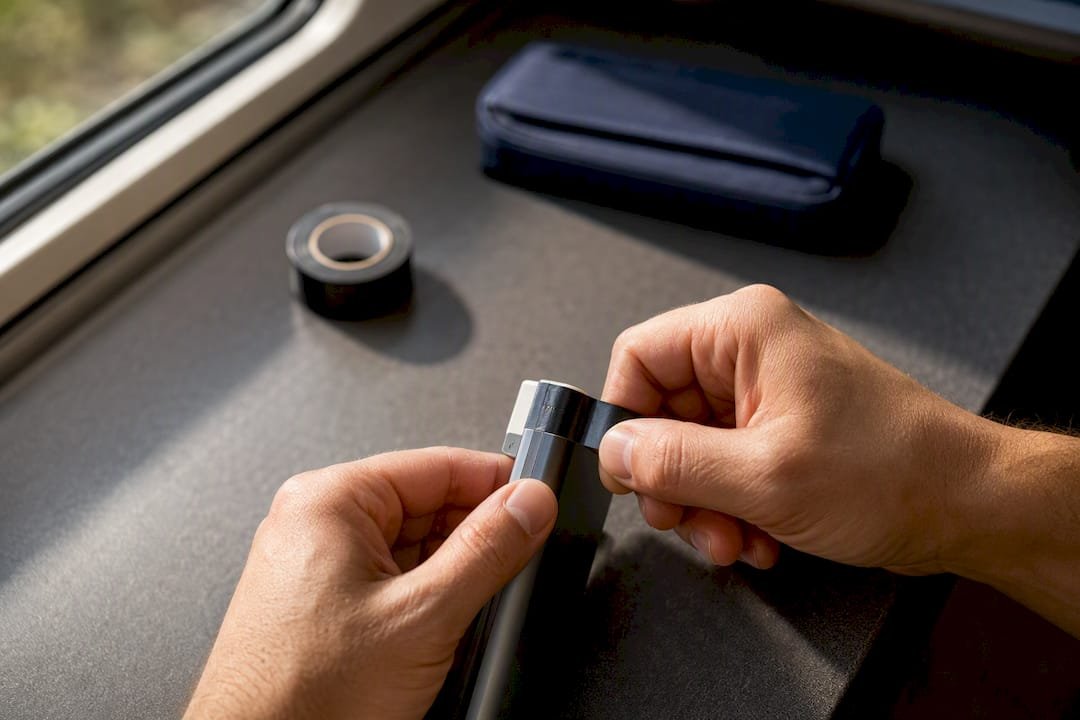
- Cover the exposed terminals or charging ports with clear packing tape or electrical tape, never metallic foil.
- Place the taped unit in a plastic bag if you are transporting more than one device, keeping each unit separated.
- Label bags with “used lithium battery” if your local collection point requests it.
- Carry the unit upright in a bag or box rather than loose in a pocket or backpack.
Retailers and municipal centers expect batteries taped this way because a bare terminal touching a coin, a key, or another battery is one of the most common causes of a short circuit in transit, a point echoed in engineering guidance on thermal runaway. If you are shipping a power bank rather than dropping it off in person, the same insulation principle applies under lithium battery shipping rules that classify damaged or recalled cells separately from healthy ones.
Pro Tip: Keep a small role of electrical tape near your charging drawer so you can insulate a retired power bank the moment you decide it is done, rather than storing a bare battery loose for weeks.
Where can you actually drop off a used power bank?
Retailers that sell batteries or electronic devices are legally required to take back used batteries and battery-powered devices free of charge, a duty set out under Germany’s battery law and the wider EU battery regulation framework. In practice, this means most electronics and hardware stores keep a collection box near the entrance or checkout counter.
Beyond retail, you have a few reliable routes:
- Municipal recycling centers accept power banks and other battery-containing devices at no cost, and most publish drop-off hours online.
- Hazardous-waste collection services handle units that need extra care, including anything swollen or damaged.
- Small collection boxes at retailers are meant for loose batteries and small devices, while larger or damaged power banks should go through a staffed municipal counter instead.
- A batteries-only drop box differs from an electronics drop-off: a power bank with a sealed, integrated cell sometimes counts as an electronic device rather than a battery, so check the labeling if you are unsure.
If you want to confirm a collection point is legitimate, look for the official return logo or check municipal listings rather than assuming any bin marked “recycling” will do. Guidance from stiftung ear on battery versus device classification can help you sort out which category your unit falls into, and when in doubt, a municipal recycling center is the safest universal choice because staff there are trained to handle both categories correctly.
What to do with a swollen, damaged, or hot power bank
A swollen or hot power bank is not a device you drop into a regular collection box. Swelling means gas has built up inside the cell, and puncturing or crushing it in that state can trigger a fire.
- Move the unit away from flammable materials and let it cool in an open, ventilated space rather than a closed drawer or bag.
- Never puncture, squeeze, or tape over a bulge, since pressure on a swollen cell can force a rupture.
- Place it in a metal or ceramic container, or surround it with sand, until you can hand it off.
- Contact your municipal hazardous-waste service directly and describe the damage before transporting it, since some services want to schedule a specific pickup for damaged cells.
- Call emergency services immediately if the unit is actively smoking, hissing, or too hot to approach safely.
Fire risk from a single damaged power bank is low, but reporting on lithium-ion disposal has documented multiple garbage-truck and recycling-facility fires traced back to batteries crushed during ordinary waste collection. That pattern is exactly why standard battery boxes and household trash are the wrong destination for anything that is bulging or hot.
What happens once your power bank reaches a certified facility
Certified recycling facilities do not just toss batteries into a bin. Workers first sort incoming devices, discharge any remaining charge safely, and manually dismantle units that need it before anything goes near heavy machinery, a sequence detailed by the Umweltbundesamt’s overview of battery recycling.
- Sorted batteries move through mechanical shredding or hydrometallurgical processing depending on the facility and battery chemistry.
- These processes recover lithium, cobalt, nickel, and copper along with the plastics in the casing.
- Manual handling of anything questionable happens before mechanical stages, which is why the terminal-taping step you did at home matters even after drop-off.
Professional handling exists because these same materials, if crushed or short-circuited outside a controlled setting, are what causes fires in trucks and sorting plants. Handled correctly, that same material becomes a source of secondary raw material rather than hazardous waste, which is the core rationale behind Umweltbundesamt’s data on battery recovery. Facilities operating under these rules also report their volumes and outcomes as part of the extended producer responsibility system, which is what keeps the whole take-back and recycling chain accountable rather than voluntary.
Why the extra five minutes of care is worth it
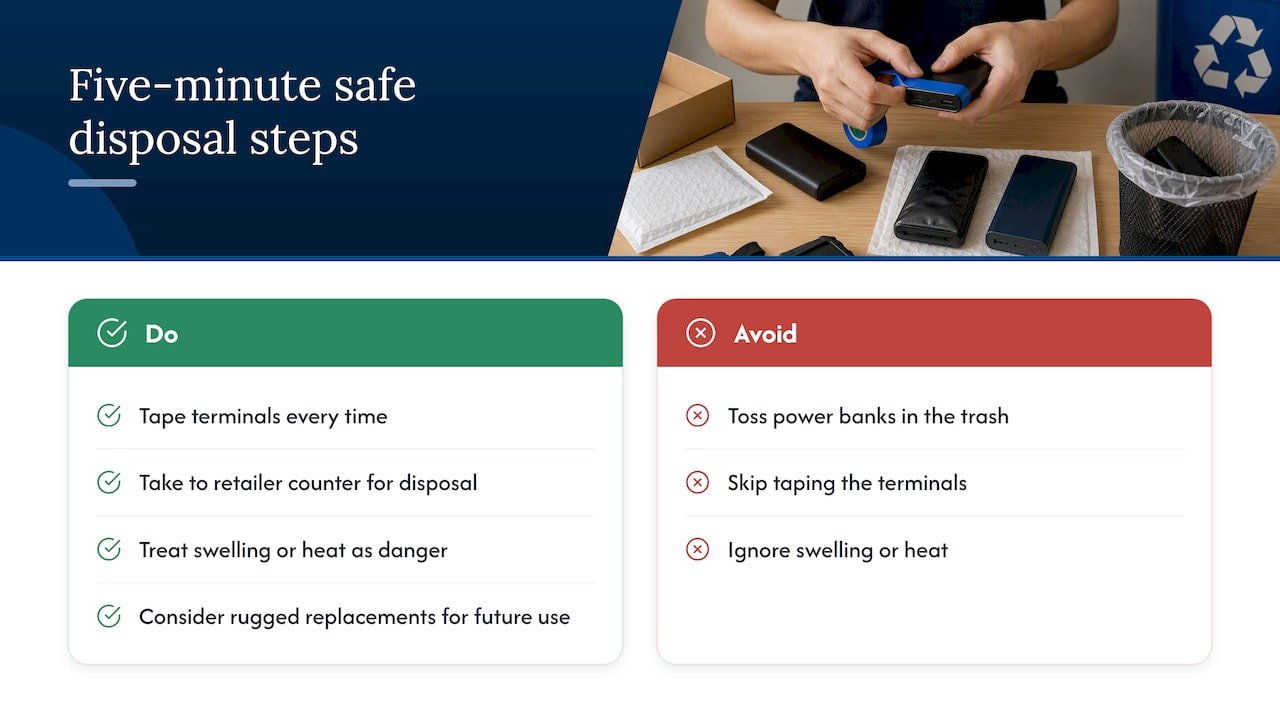
Recycling a power bank properly takes maybe five extra minutes compared to tossing it in the trash, and that gap is where most of the fire risk in waste collection actually comes from. A taped terminal or a five-minute detour to a retailer counter is a small trade against a truck fire.
Two things are worth remembering: tape the terminals every time, no exceptions, and treat any swelling or heat as a stop sign rather than an inconvenience. If you are shopping for a replacement built for rough handling in the first place, Ifory’s outdoor power banks are worth a look, though the safe-disposal steps above apply no matter what brand you retire.
— Mats
Sources
For the legal basis behind retailer take-back duties and reporting obligations, the German battery law text covers the EU battery regulation as implemented nationally.
- Batterien und Altbatterien | Umweltbundesamt
- BattDG – Gesetz zur Durchführung der Verordnung (EU) 2023/1542 betreffend Batterien und Altbatterien
- How to safely maintain, use, and dispose of your power banks | The Verge
FAQ
How do you dispose of old power banks?
Tape the terminals with non-conductive tape, then return the unit to a retailer take-back point or a municipal recycling center, both of which are required to accept it free of charge under German and EU battery rules. Never place it in household trash, since crushed lithium cells are a known cause of waste-collection fires.
Can I throw a power bank into an e-waste bin?
A sealed power bank with an integrated battery often counts as an electronic device rather than a loose battery, so a standard batteries-only box is not always the right fit. Check the stiftung ear classification guidance or ask municipal staff, since a general electronics or municipal collection point will accept either category safely.
How do I dispose of an inflated power bank?
Do not tape or puncture a swollen power bank. Let it cool in a ventilated space away from flammable material, place it in a metal or sand-filled container, and contact your municipal hazardous-waste service to arrange proper collection instead of using a regular drop box.
How do I dispose of my Anker power bank?
The same safety-first process applies regardless of brand: inspect it for damage, tape the terminals if it is intact, and take it to a retailer take-back point or municipal recycling center. If it shows any swelling or heat, treat it as damaged and follow hazardous-waste handling steps rather than standard drop-off.