

Yes, a rugged power bank can survive most accidental drops, but survival depends on real engineering, not a sticker. What separates a survivor from a paperweight is an IP67 rating, sealed ports, a shell built to absorb shock, and internal mounts that isolate the battery cell. Some brands build around those four points specifically. No power bank is indestructible, so treat any “unbreakable” claim with the same skepticism you’d give a “waterproof” tent that leaks in a drizzle.
TL;DR:
- An IP67 rating, threaded port caps with O-rings, and reinforced corners are essential features for real impact resistance in rugged power banks.
- Drop impacts commonly occur from waist height onto solid surfaces or onto uneven terrain, with impact severity greatly affected by surface and contact angle.
- Internal shock mounts significantly reduce the risk of damage to fragile components during impact by isolating the battery and circuits.
- Consumer drop tests often only confirm shell durability and do not reliably predict long-term port integrity after repeated impacts.
- Verified testing reports and specific construction details provide a more trustworthy assessment of a power bank’s durability than vague marketing claims.
Table of Contents
- How to Read Drop-Resistance Claims on a Product Page
- What Real Drops Look Like for Outdoor Gear
- Materials and Design Choices That Actually Help
- Checking Your Power Bank After a Drop
- What to Prioritize When Buying a Rugged Power Bank
- Where the “Military-Grade” Drop Standard Actually Comes From
- How This Compares to Other Drop-Test Approaches
- Where Drop-Test Methodology Falls Short
- Real-World Pass and Fail Patterns Worth Knowing
- What I Look for Before Trusting a Power Bank on a Trip
- Built for the Drops You Didn’t Plan For
- Sources
How to Read Drop-Resistance Claims on a Product Page
"“Military-grade” and “drop-tested” are two of the most meaningless phrases in outdoor gear marketing. Neither term is regulated for consumer electronics, so a company can print either one on a box without submitting to any outside lab. That doesn’t mean the product is bad, but it means the phrase alone tells you nothing about how it will behave when it slides off a kayak seat onto a boat ramp.
What actually tells you something is specific and checkable. Look for these on the product page or in the manual before you trust a durability claim:
- The exact IP rating (IP67, IP68), not just the word “waterproof”
- Named shell material, such as polycarbonate blend, TPU overmold, or anodized aluminum
- Port protection type: threaded cap, flip cover, or none
- A drop height and surface type if a lab test is referenced
- A visible warranty clause covering accidental damage, not just manufacturing defects
If a listing skips all five, email the seller and ask directly which lab performed testing and whether a report exists. A company confident in its build will usually hand over a spec sheet without hesitation. One that dodges the question is telling you something too.
What Real Drops Look Like for Outdoor Gear
Lab jargon aside, most power bank drops in the field follow a small set of patterns, and knowing them helps you judge which specs actually matter for your trip.
The most common scenario is a pocket-to-ground drop from waist or hip height, typically 3 to 4 feet, onto packed dirt, wood decking, or pavement. The second most common is a pack-to-rock drop: the bank slips out of a side pouch while you’re scrambling over boulders or loading a canoe, landing on an irregular, hard surface from a similar or greater height. The third, and often the harshest, is a boat-deck drop onto fiberglass or aluminum, where the surface has almost no give at all.
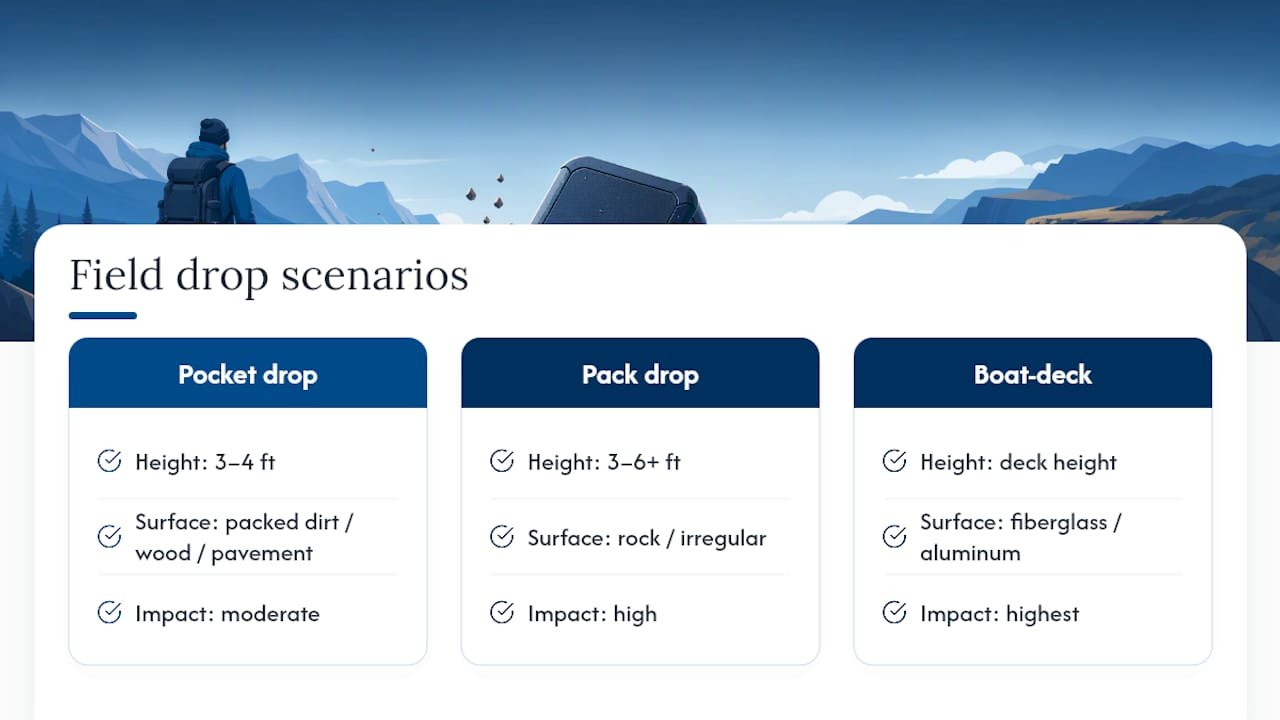
Surface hardness changes everything about impact severity. A drop onto sand or grass disperses energy over a wider contact area and longer time window. The same drop onto concrete or rock concentrates that same energy into milliseconds, spiking the acceleration felt by everything inside the casing. Contact angle matters too. A flat landing on the widest face spreads force; a corner-first landing focuses it into a small point, which is exactly why reinforced corners show up on every rugged design worth considering.
Repeated impacts compound risk. A single hard drop might not crack a seal, but a bank that’s been dropped five times on a multi-day trip has taken five separate chances at hairline damage that only shows up later as a leak or a dead port.
This is where internal shock mounts earn their keep. Drop-tower research on portable electronics shows that isolating the battery cell and circuit board from the outer shell measurably reduces peak accelerations transmitted to those fragile components during impact. A firm outer shell that’s rigidly bonded to the battery inside transmits shock almost directly; a shell with internal cushioning between the casing and the cell buys the electronics a fraction of a second of deceleration, which is often the difference between a scare and a failure.
Materials and Design Choices That Actually Help
Shell material decide more of the outcome than most buyers assume. Polycarbonate-ABS blends flex slightly on impact and resist cracking better than brittle plastics, which makes them a common choice for the outer shell on rugged designs. Anodized aluminum brings a different advantage: it offers thermal conductivity around 120 to 180 W/m·K, far higher than plastic, which matters when a 100W charging session is generating real heat inside a sealed case. The tradeoff is that pure aluminum is less forgiving than plastic in a hard corner impact, which is why most durable designs pair a metal or hard-plastic core with soft TPU overmolds at the edges.
A few structural details separate a genuinely drop-resistant design from a cosmetically rugged one:
- Reinforced or rounded corners, since corner-first impacts concentrate the most force
- TPU bumpers along edges and seams to absorb energy before it reaches the shell
- Internal shock mounts isolating the battery cell from the outer casing
- Threaded port caps with rubber O-rings rather than simple flip covers
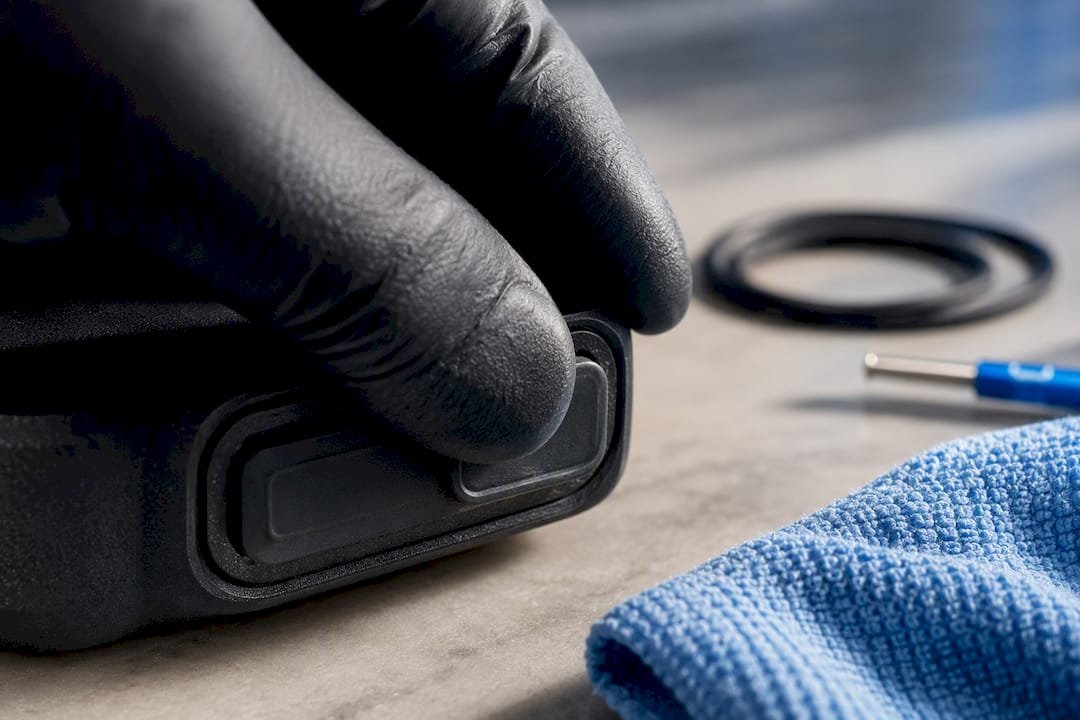
That last point deserves emphasis. Port covers are consistently the weakest link on otherwise rugged power banks, more so than the main casing seam. A flip cover made of thin rubber can peel back or fail to seat fully after repeated use, letting grit or moisture into the exact spot where a cracked port can kill the whole unit. Threaded caps with O-rings maintain a compression seal that doesn’t rely on the user remembering to press it shut correctly, which is why they consistently hold up better in wet or salty conditions than flip-style covers.
Pro Tip: Press a rubber port cap firmly into place and try to wiggle it side to side. If it shifts easily or doesn’t snap into a distinct closed position, that seal is doing less work than the spec sheet implies.
None of this comes free. A reinforced 40,000mAh unit with a metal-reinforced shell and rubber bumpers will run heavier than a bare plastic version of the same capacity. For most backpackers and boaters, that extra weight is a fair trade against the cost of a dead battery two days into a trip with no signal.
Checking Your Power Bank After a Drop
A drop that looks harmless can still cause internal damage you won’t see from the outside. Run through this sequence before you trust the unit again:
- Inspect the casing for cracks, gaps at the seams, or a corner that’s visibly deformed compared to the rest of the shell.
- Check every port and cap for a snug seal. A cap that no longer clicks shut or a port with a hairline gap around it is your biggest red flag.
- Listen and feel for rattling. Shake the unit gently near your ear. A loose internal component that wasn’t rattling before the drop is a sign the shock mount or battery bracket has shifted.
- Power it on and check the LED display responds normally and shows a plausible charge level, not a frozen or blank screen.
- Run a load test. Plug in a phone and confirm it actually starts charging. If you own a USB multimeter, check that voltage and current stay stable under load rather than fluctuating or dropping out.
- Check for heat, smell, or swelling. Any of these three during or after charging means stop using the unit immediately and store it away from flammable material.
If you spot any of these red flags, photograph the damage right away, including a close-up of the seam, port, or cap in question, and note the date and circumstances of the drop before filing a warranty claim. Sellers with an actual quality process will usually ask for this documentation before processing a return, and having it ready speeds up the whole exchange.
What to Prioritize When Buying a Rugged Power Bank
Skip the marketing copy and check these specifics before you pay for anything advertised as outdoor-ready.
An IP67 rating is the practical minimum for camping, hiking, or boat use. It confirms the unit is fully dust-tight and can survive submersion up to 1 meter for 30 minutes, which covers a dropped bank in a shallow stream or a sudden downpour on deck. Look past the rating number to the port design itself, and favor threaded caps with visible O-rings over thin flip covers. Reinforced or rubberized corners should be visible in product photos, not just claimed in the description.
Ask the seller for any lab test report or third-party documentation before buying in bulk or for a trip where failure isn’t an option. A legitimate manufacturer can usually produce one on request.
Capacity numbers deserve a skeptical eye too. Independent testing on portable battery packs shows that declared cell capacity, rated at the cell’s native 3.7V, and usable output at 5V rarely match. A 40,000mAh unit delivering around 26,000 to 28,000mAh of actual phone charging is normal, not a defect.
| What to check | Why it matters |
|---|---|
| IP67 or higher rating | Confirms dust-tight and 1m/30min water survival |
| Threaded port caps with O-rings | Outperform flip covers in wet or salty conditions |
| Reinforced corners visible in photos | Corner-first drops concentrate the most impact force |
| Lab test report on request | Signals real quality control, not just a marketing label |
| Usable output often around 65% of rated capacity | Sets a realistic expectation versus the advertised number |
Weight is the honest tradeoff for all of this protection. A bank built to survive a boat deck will never be as light as a bare-bones travel charger, and that’s a fair price for not being stranded with a dead phone on day three of a trip.
Where the “Military-Grade” Drop Standard Actually Comes From
The phrase “military-grade drop tested” traces back to a real Department of Defense standard covering environmental testing for military equipment, which includes a formal drop-test method specifying repeated free-fall drops from set heights onto a rigid steel surface, at various orientations, to certify gear for battlefield transport conditions. That standard was written for radios, laptops, and sensor equipment procured by the military, not for consumer power banks bought at a camping store.
Some consumer electronics brands do send products through independent labs that follow the same general procedure, dropping units repeatedly from a specified height onto a hard surface and checking for functional failure afterward. When a brand does this and shares the report, it’s a meaningful signal. The problem is that most brands invoke the standard’s name without ever submitting to that testing, since nothing prevents a marketing team from printing “military-grade” on packaging with no lab behind it at all. Treat the phrase as a claim to verify, not a certification to trust on sight, and go back to the specific checkable items covered earlier, port seal type, shell material, and reinforced corners, whenever a listing leans on the label instead of the documentation.
How This Compares to Other Drop-Test Approaches
Military-style drop testing isn’t the only method used to judge how consumer electronics handle impact, and the differences matter more than most shoppers realize.
Consumer electronics durability programs, the kind used for smartphones and some rugged gear, often test drops onto varied surfaces such as concrete, asphalt, and sand, from a range of heights meant to reflect everyday accidents like slipping out of a hand or a pocket. That’s a closer match to how most people actually drop a power bank than a steel-plate procedure designed around military transport crates. Some manufacturers also run their own internal drop cycles, dropping a unit dozen or hundreds of times from a lower height to simulate cumulative wear rather than a single dramatic impact.
The tradeoff is standardization. A government-defined method, even one built for a different product category, at least specifies a fixed height, surface, and orientation that any lab can replicate. An internal company test can be tuned to make a product look good, dropping it only onto forgiving surfaces or only from heights the design is known to survive. That’s exactly why asking for the surface type and drop height behind any durability claim matters more than the name of the standard itself. A number without those two details tells you almost nothing.
Where Drop-Test Methodology Falls Short
Any drop test, however rigorous, is still a simplification of how gear actually gets damaged on a real trip. A handful of gaps show up consistently.
Lab drops are almost always performed on a fresh, undamaged unit at room temperature. They rarely account for a power bank that’s already been through a season of sun exposure, salt spray, or minor scuffs, all of which can weaken seals and seams before the “real” drop ever happens. Repeated cumulative stress, five small drops over a week rather than one big one, is also harder to standardize and gets far less testing attention than single dramatic impact drops.
Orientation matters enormously and gets inconsistent treatment across methods. A flat-face landing and a corner-first landing on the same unit can produce wildly different outcomes, yet a single reported pass or fail often doesn’t specify which orientation was used. Temperature is another blind spot. Plastic shells and rubber seals both stiffen in cold weather, which is exactly when a winter hiker or ice fisherman is most likely to actually drop their gear, and few consumer drop reports test at anything other than room temperature.
None of this means drop testing is worthless. It means a single pass or fail result is a data point, not a guarantee, and the surrounding details, surface, height, orientation, temperature, cycle count, tell you far more than the headline claim.
Real-World Pass and Fail Patterns Worth Knowing
Field reports on rugged power banks and similar gear point to a consistent pattern: casing failures are rare, but port and cap failures are common, even on units that otherwise pass a drop test cleanly. Consumer testing on rugged power banks has repeatedly found that port covers and attachment points are the weak point even when the outer shell survives completely intact. A bank can take a hard fall, show zero cracks, and still fail two weeks later because grit worked past a compromised flip cover into the charging port.
The implication for buyers is straightforward: the headline pass or fail result from any drop procedure tells you about the shell, but it rarely tells you about long-term port integrity under repeated field use. That’s a separate question, and it’s one you answer by checking cap design and running your own periodic seal check, not by trusting a single test result. Field testers evaluating gear for bulk or mission-critical purchases increasingly request test reports or samples for their own verification rather than taking a manufacturer’s summary at face value, and that instinct holds up for any buyer making a purchase they can’t afford to have fail on a remote trip.
What I Look for Before Trusting a Power Bank on a Trip
Casing survives more often than people expect. Ports fail more often than people expect. That mismatch is the single biggest blind spot in how most buyers evaluate ruggedness, since the shell is what you can see in a product photo and the port seal is what actually determines whether the unit is still working in month six. After a drop, I care less about whether the case cracked and more about whether the cap still seats with a firm, distinct click.
[Author credentials and field-testing background to be added]
[Customer testimonial placeholder to be added by the brand]
— Mats
Built for the Drops You Didn’t Plan For
Some power banks target key failure points: an IP67 shell rated dust-tight and submersible to 1 meter for 30 minutes, an anti-drop structure with reinforced housing, and internal shock protection built around a high-capacity cell with fast charging output. A multi-port layout and LED display can provide real-time charge status, and an integrated flashlight can offer illumination when a drop happens after dark, which is when incidents are more likely.

This setup suits multi-day backpacking trips, marine and boat use where saltwater exposure is a real risk, and photographers hauling gear across uneven terrain where a pack strap failure is one bad step away. If you’re comparing specs against the checklist above, the Ifory power bank lineup is worth a direct look, and the waterproof model with integrated LED is a strong starting point if port protection and water exposure are your main concerns. Check current stock and place an order while you’re planning your next trip, not after the current battery has already let you down.
Sources
- Understanding the IP67 protection rating for HMIs — APEM FAQ
- Hard anodizing information, properties and performance — SEMANO
- Experimental and analytical study on dynamic behaviour during impact of portable products — Springer
- Energy journal paper on power bank testing and user-relevant parameters — MDPI