
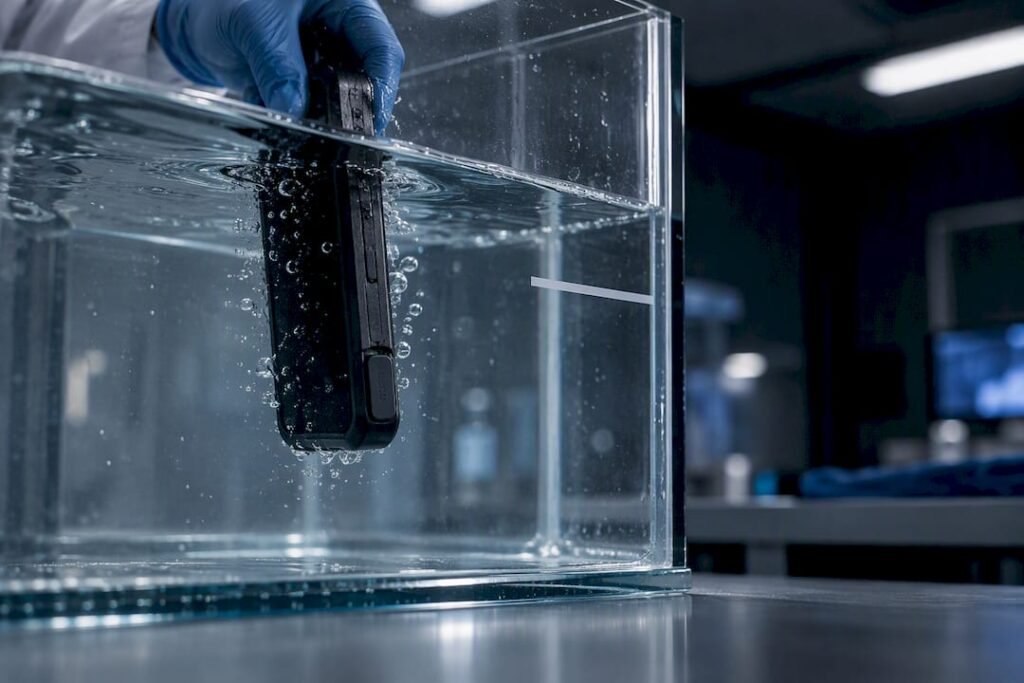
IP67 means a device is dust-tight and can survive temporary immersion in fresh water, nothing more and nothing less. Manufacturers test this by submerging the product about a meter deep for a half-hour. It does not mean the device can handle harsher conditions like saltwater, pool chemicals, pressurized jets, or long-term wear without seal degradation.
TL;DR:
- IP67 guarantees dust-tightness and protection against brief immersion in freshwater up to one meter for 30 minutes, but does not cover saltwater, chemicals, or long-term wear.
- The standard test involves a new, undamaged device submerged in controlled lab conditions; it does not indicate how the device performs over years or after repairs.
- Manufacturers often list multiple IP ratings for different failure modes; passing one standard does not imply resistance to jet streams or deeper, longer immersions.
- Verification of an IP67 claim requires checking the product’s official documentation, test reports, and warranty fine print, especially regarding water damage coverage.
- For outdoor use, select products with the specified IP ratings and test conditions, especially if exposure to chemicals, pressure washing, or saltwater is likely.
Table of Contents
- What Is an IP Rating, and What Do the IP67 Digits Mean?
- How Labs Actually Run the IP67 Immersion Test
- What IP67 Does Not Protect Against
- IP67 vs. IP68 and Jet Ratings: Which One Do You Actually Need?
- How to Verify an IP67 Claim Before You Trust It
- Reading IP67 Claims on Real Gear, Not Just Lab Sheets
- Get an IP67-Rated Power Bank Built for Actual Adventures
- Sources
- FAQ
What Is an IP Rating, and What Do the IP67 Digits Mean?
“IP” stands for Ingress Protection, and the two-digit code that follows comes straight from IEC 60529, the international standard that governs how manufacturers test and label enclosure protection. Every legitimate IP rating traces back to this document (adopted in Europe as EN 60529), so when you see “IP67” printed on a power bank or phone box, it’s referencing a specific, repeatable lab test, not a marketing slogan.
The code breaks down into two separate tests, each measuring a different threat:
- First digit (6): dust-tight. The device sits in a chamber with talc powder circulating under vacuum pressure for eight hours. No dust gets in, period.
- Second digit (7): protection against temporary immersion. The product goes underwater to a specified depth for a specified time, and testers check whether anything harmful got inside.
You’ll sometimes see an “X” in place of a digit, like IPX7. That just means the manufacturer skipped or didn’t disclose the solids test and only reports liquid protection. It’s common on cables and some wearables where dust resistance isn’t the priority.
Some spec sheets list two or three IP codes for one product, such as IP67 plus IP66. That’s not redundant. Each rating validates a different failure mode, immersion versus jets, and a device engineered for both outdoor wash-down and accidental dunking genuinely needs both tests passed, not just the more impressive-sounding one.
How Labs Actually Run the IP67 Immersion Test
The test itself is more specific than most product pages let on, and knowing the exact procedure helps you spot a real claim from a vague one.
- The device gets fully submerged in fresh water at room temperature, positioned in the worst-case orientation for testing.
- It stays underwater at a specified shallow depth for a controlled duration.
- Technicians pull it out and check for “harmful ingress.” That phrase matters. It doesn’t mean zero water molecules anywhere inside the casing; it means no water reached a point where it would impair function or create a safety risk.
1 meter, 30 minutes. That’s the entire scope of the IP67 immersion test as defined by IEC 60529, run at ambient temperature with the device in its worst-case position, not floating passively at the surface.
One detail people miss: this is a type test performed on sample units in a lab, not a lifespan test. Passing IP67 tells you how a brand-new, undamaged unit performed on the day it was tested. It says nothing about how that same unit performs after 200 charge cycles, a hard drop, or two years of pocket lint working its way into the seams.
What IP67 Does Not Protect Against
The gap between what IP67 sounds like and what it actually covers trips up a lot of buyers, and it’s worth being blunt about where the coverage ends.
- Fresh water only. The lab test uses plain fresh water. Saltwater’s conductivity and corrosiveness make it a much harsher environment for seals and circuitry, and most manufacturers exclude ocean exposure from their warranty coverage entirely.
- No pool chemicals, detergents, or oils. Chlorine, cleaning agents, and oily residue weren’t part of the test protocol and can degrade rubber gaskets faster than plain water ever would.
- No water jets or pressure washing. Immersion and jet spray stress a seal in different ways. Jet resistance falls under IPX5 (low pressure) or IPX6 (powerful jets), and passing IP67 tells you nothing about how a device handles a garden hose blast or a car wash.
- No guarantee against physical wear. Drops, scratches, and thermal swings degrade gaskets over time. A device tested for IP67 at the factory can lose that protection after a repair, a battery swap, or a hard impact if it isn’t properly resealed by an authorized technician.
Pro Tip: Check the warranty section before you check the spec sheet. Plenty of otherwise-solid IP67 products carry fine print that excludes water damage from coverage entirely, which tells you the manufacturer trusts the rating for splash protection but isn’t betting money on it for anything more.
Read the fine print on any “waterproof” label the way you’d read nutrition facts, because plenty of general buying guides use the term loosely. Consumer resources like this breakdown of waterproof ratings exist precisely because “waterproof” gets slapped on products that are really only water-resistant under narrow conditions.
IP67 vs. IP68 and Jet Ratings: Which One Do You Actually Need?
IP67 and IP68 both cover immersion, but they’re not interchangeable, and the difference comes down to depth, duration, and who sets the terms.
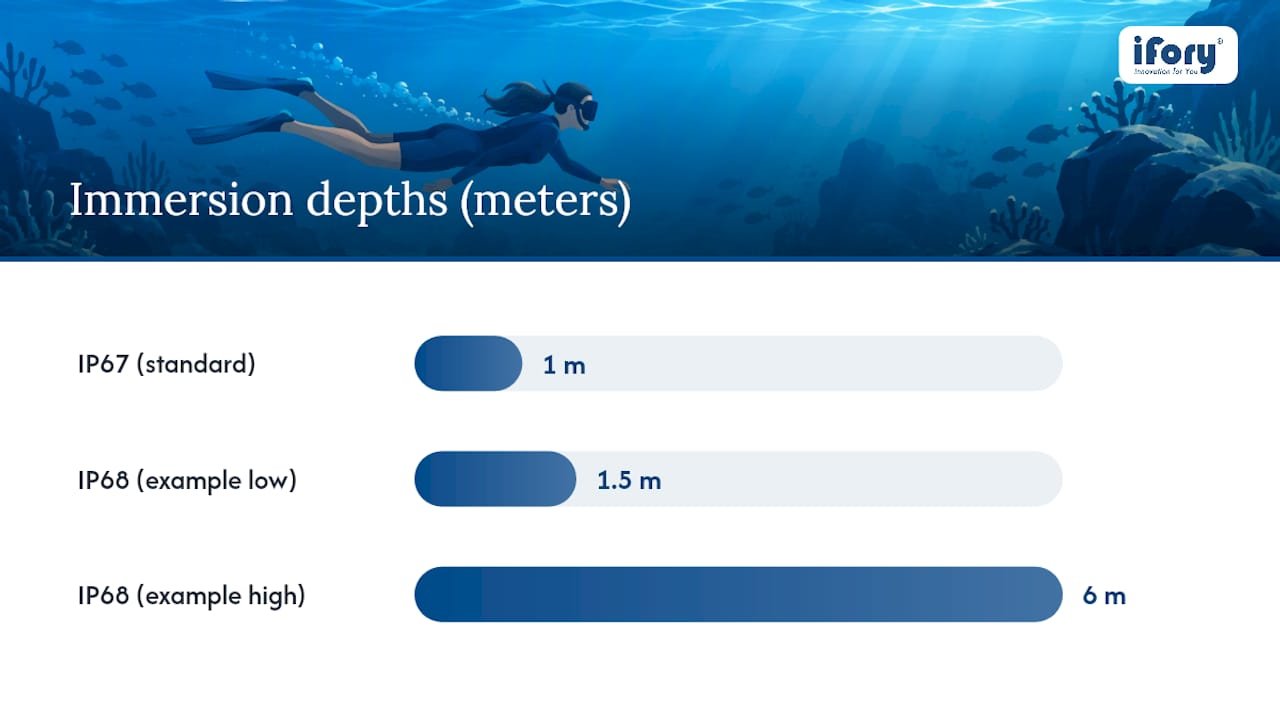
IP67 is limited to a standardized shallow water immersion for a short controlled time. IP68 has no fixed ceiling in the base standard. Manufacturers agree on their own tested depth and duration and publish it themselves, which is why you’ll see one phone rated IP68 at 1.5 meters for 30 minutes and another at 6 meters for 30 minutes. Both are technically IP68. Neither number is comparable without reading the manufacturer’s own disclosure.
Jet resistance is an entirely separate axis. IPX5 covers low-pressure water jets from any direction; IPX6 covers powerful jets. Neither implies immersion resistance, and neither is implied by IP67 or IP68. A device rated only IP67 can fail under a pressure washer even though it survives a full dunk in a lake, because jets attack seals with force and angle that still water never applies.
Matching the rating to the activity keeps this simple:
- Rain, splashes, sweat, accidental drops in a puddle: IP67 covers this comfortably.
- Dropping a device in a river or having it slip off a kayak into a lake: IP67 handles brief exposure; check the exact duration before assuming.
- Regular swimming or snorkeling: you want IP68 with a manufacturer-stated depth that matches your use, not just the base rating.
- Scuba diving or deep submersion: neither IP67 nor most consumer IP68 ratings apply; you need dedicated dive-rated housings.
- Industrial wash-down or pressure cleaning: look for IPX6 or higher specifically, since immersion ratings alone don’t cover jet force.
How to Verify an IP67 Claim Before You Trust It
A printed “IP67” on packaging is only as good as the documentation behind it, and you can check that documentation in a few minutes.
- Find the datasheet or product manual and look for the standard reference. A credible claim cites IEC 60529 or EN 60529 by name rather than just printing “waterproof” with no standard attached.
- Ask the seller for the test conditions and lab report. Reputable manufacturers can name the testing lab and provide a certificate number on request; a vendor who can’t produce either is asking you to take their word for it.
- Check whether the warranty excludes water damage. If the fine print voids coverage for any liquid exposure, that’s a signal the company is more confident in the label than in standing behind it.
- After any accidental exposure, act fast. Power the device down immediately, dry it with a soft cloth, avoid charging it while damp, and let it air out for at least 24 hours before use. If it was exposed to saltwater or chemicals, rinse the exterior in fresh water first.
Pro Tip: If a device ever gets submerged and then repaired, whether for a cracked screen or a battery swap, don’t assume the IP rating survived the service visit. Reseating a seal correctly takes specific tools and gaskets, and an uncertified repair shop can quietly void the protection you paid for.
Reading IP67 Claims on Real Gear, Not Just Lab Sheets
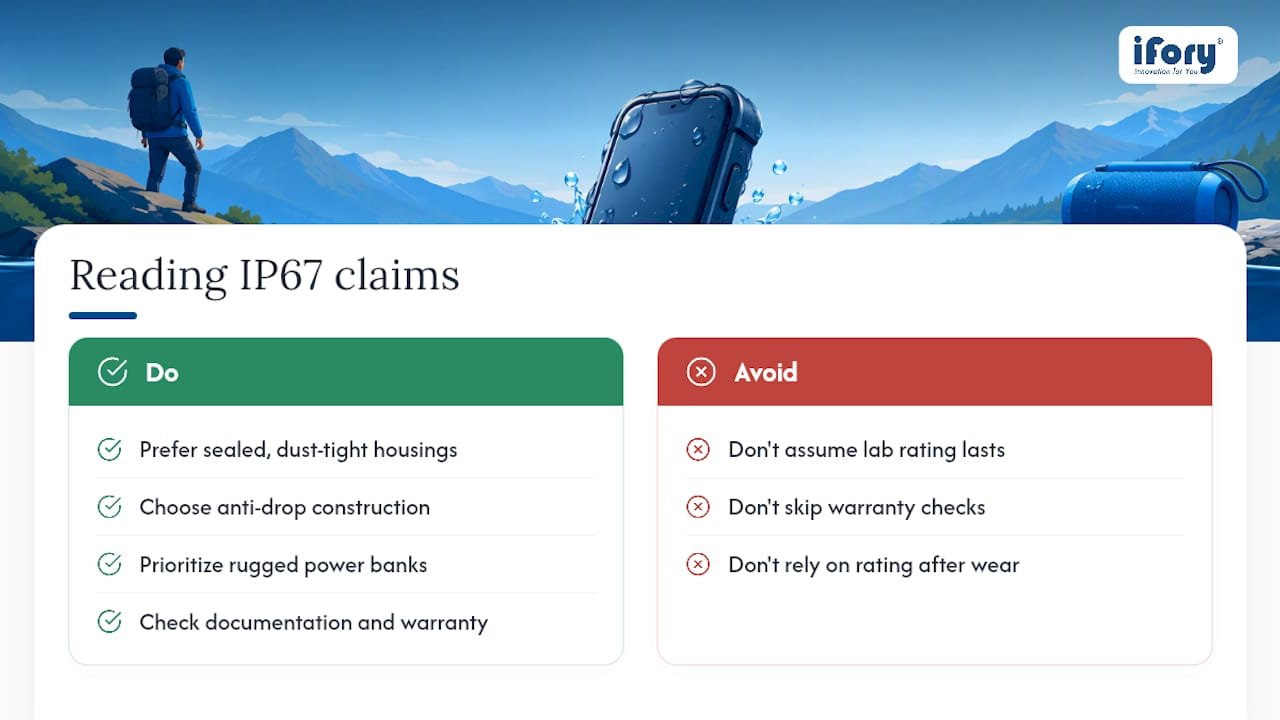
Lab numbers only matter once they show up on something you’d actually carry outdoors. A high-capacity power bank can be built to meet the IP67 standard: dust-tight housing, sealed ports, and protection against brief immersion, paired with an anti-drop structure meant for the kind of handling a lab test doesn’t simulate, such as getting tossed in a pack, set down on wet rock, or splashed by a river crossing.
That combination matters more for a power bank than for most gadgets, since it’s usually the one device in your kit that can’t afford to fail when everything else already has. Still, an IP67 rating on any product, ours included, describes a factory test on a new unit. It’s not a promise about what happens after two years of drops and recharges. Check the product documentation and warranty terms before you rely on immersion protection in the field, the same advice that applies to any IP67 device on the market.
— Mats
Get an IP67-Rated Power Bank Built for Actual Adventures
If you’re shopping for a power bank that won’t die the first time it gets rained on or dropped near a creek, the Ifory Powerbank is built specifically around that gap.

A power bank can pack 40,000mAh of capacity with 100W fast charging, enough to top off a phone in minutes and keep a laptop or camera running for days off-grid. An IP67 rating and anti-drop design target splash exposure, dust, and rough handling, while features like a bright flashlight and LED display can enhance outdoor use. Before you rely on any immersion claim, including ours, check the product documentation for test conditions and warranty terms.
The Ifory Powerbank is priced at €99 one-off, and if you’re planning multi-day trips off the grid, it’s also compatible with a resold Portable Solar Panel (PD 40W) on the same product page for keeping everything charged without an outlet in sight.
FAQ
Is IP67 Completely Waterproof?
No. IP67 means a device can survive temporary immersion in fresh water for a limited time, not permanent or unlimited exposure. It doesn’t cover saltwater, pressurized jets, pool chemicals, or long-term submersion of any kind.
Which Is Better, IP67 or IP68?
IP68 generally offers stronger immersion protection since manufacturers can specify depths and durations beyond IP67’s fixed 1 meter and 30 minutes. That said, “better” depends on the manufacturer’s own disclosed IP68 figures, since the standard doesn’t cap how deep or how long an IP68 test can go.
Is IP67 100% Waterproof?
No rating labeled “100% waterproof” exists in the IEC 60529 standard. IP67 passes when there’s no harmful ingress during a specific 1 meter, 30 minute freshwater immersion test, which is a defined lab condition, not an absolute guarantee against every form of water exposure.
Can I Use an IP67 Device in the Shower?
Brief exposure to shower splash is generally fine for an IP67-rated device, but the direct spray from a showerhead behaves more like a water jet than still immersion. Jet resistance falls under a separate rating (IPX5 or IPX6), so an IP67 device isn’t necessarily tested against that kind of sustained pressurized stream.