
Impact resistance ratings describe how much mechanical energy an enclosure, material, or device can tolerate before it fails or lets in dust and water. The code to check depends on what you’re buying: IK (IEC 62262) covers enclosure impact energy, IP (IEC 60529) covers ingress protection, and Charpy or IEC shock methods cover material and device-level behavior. Mixing these up is the most common mistake buyers make.
TL;DR:
- Impact resistance ratings are measured separately from ingress protection, with IK rating testing enclosure impacts and IP rating assessing dust and water ingress.
- IK impact tests measure specific energy levels, with IK10 surviving impacts of 20 joules, but they do not guarantee protection against real-world drops or stresses.
- Charpy impact tests evaluate material properties in laboratory conditions and are not reliable indicators of a finished product’s impact durability.
- Device shock testing under IEC standards involves functional and fixture considerations, not just visual damage, and must be verified with detailed test reports.
- Buyers should request full test documentation, including standards, configuration, impact points, and pass criteria, to accurately interpret impact and ingress claims.
Table of Contents
- IK vs IP: what each code measures and why they are not interchangeable
- IK scale explained: IK00 through IK10, joules and equivalent drop energies
- Material and component tests: what Charpy ISO standards actually measure
- Shock and drop qualification for electronics: the IEC 60068 and IEC 60749 methods
- A practical checklist for evaluating impact claims and test reports
- Checking impact and ingress claims for an outdoor power bank
- What buyers should take away from impact resistance ratings
- Sources
- FAQ
IK vs IP: what each code measures and why they are not interchangeable
IK and IP look similar on a spec sheet, two letters followed by two digits, but they answer completely different questions. IEC 62262 defines the IK code, which rates how much mechanical impact energy an enclosure can absorb without damage that affects its protective function. IEC 60529 defines the IP code, which rates protection against solid objects, dust, and water entering the enclosure, along with protection against someone touching hazardous internal parts.
A product rated IP67 has been tested for dust tightness and submersion to a defined depth and time. That test tells you nothing about whether the housing survives being dropped on concrete. Conversely, an IK08 rating tells you the enclosure took a 5 joule hit without losing its protective properties, but says nothing about whether water can get past a seam afterward.
A few practical distinctions worth keeping straight:
- IP ratings use two digits: the first for solids, the second for liquids (a missing digit is shown as an “X”).
- IK ratings use a single scale from IK00 (no protection) to IK10 (highest tested impact energy).
- A product can carry both ratings independently, and a high IP number does not imply any IK rating at all.
- IP69K, often cited as a top-tier ingress rating for high-pressure, high-temperature washdown, is still an ingress test, not an impact test, per the same IEC 60529 framework.
When should you ask for which? If your concern is a product surviving rain, submersion, or a dusty job site, IP is the relevant number. If your concern is the housing cracking from a fall, a knock, or rough handling, you need an IK report or an equivalent shock test. A supplier that only quotes IP67 and calls it “impact resistant” is making a claim the IP standard does not support.
IK scale explained: IK00 through IK10, joules and equivalent drop energies
The IK scale assigns each class a specific test energy, measured in joules, delivered by a defined mass falling from a defined height or swung on a pendulum hammer. These are not marketing numbers. They come directly from the test apparatus described in IEC 62262.
The commonly cited equivalences are:
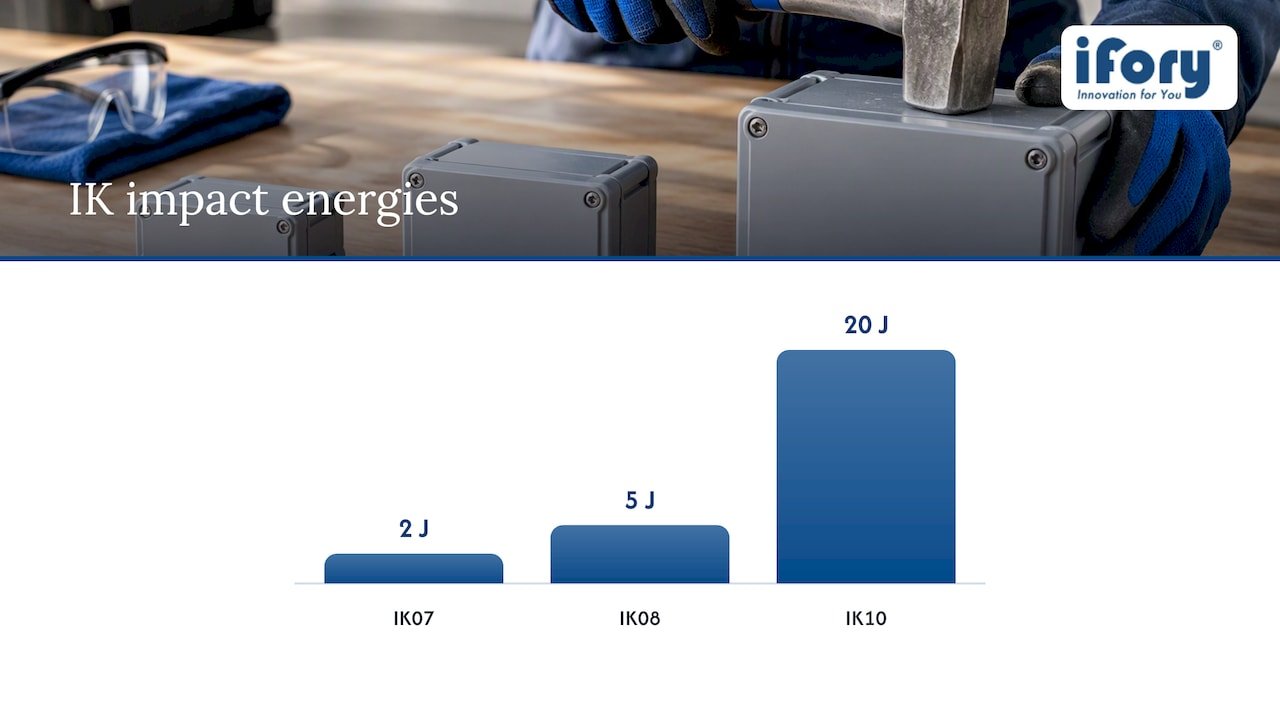
- IK07 corresponds to 2 joules of impact energy.
- IK08 corresponds to 5 joules of impact energy.
- IK10 corresponds to 20 joules of impact energy, the highest class on the scale.
These figures come from the standard’s defined mass and drop height combinations, which the testing body converts into an equivalent joule value depending on the apparatus used, according to the IK ratings reference compiled by PolyCASE. A 5 kilogram hammer dropped from a specific height, for instance, can deliver the same energy as a spring-loaded striker calibrated to the same joule target. The standard also specifies how many times the enclosure is struck and at which locations, since a single clean hit on a flat panel tells you less than repeated strikes across corners, seams, and mounting points.
The caveat that matters most for buyers: a joule rating describes energy delivered under laboratory conditions, with a specific striker geometry and a specific impact point. It does not guarantee the product will survive every real-world impact at that energy level, especially when the impact lands on an edge, a port opening, or a stress point the lab test did not target. An IK10 badge on a spec sheet tells you the enclosure passed a defined test, not that it is indestructible.
Material and component tests: what Charpy ISO standards actually measure
Charpy testing is where impact resistance numbers often get misapplied. ISO 179-1 describes the instrumented Charpy test for plastics, and ISO 148-1 describes the equivalent pendulum test for metals. Both methods strike a small, standardized specimen with a swinging hammer and measure the energy absorbed during fracture, as described in ZwickRoell’s overview of Charpy testing.
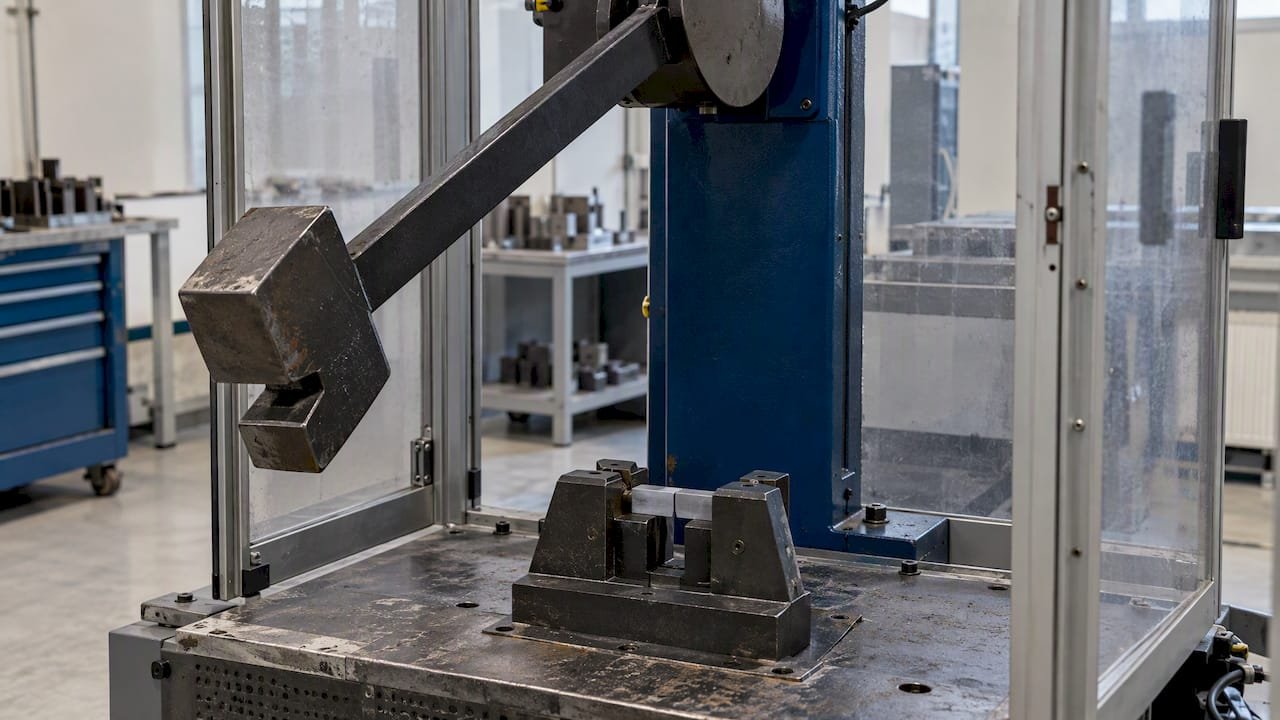
These tests exist to compare materials, not to predict how a finished product behaves. The result is reported per unit of cross-sectional area, which makes it useful for ranking one polymer grade against another, but the number does not translate directly into how a molded housing will perform once it has ribs, wall thickness variation, weld lines, and mounting bosses.
Several variables change the result enough that two labs testing the same material can report different numbers if they do not match conditions exactly:
- Notch geometry: a notched specimen concentrates stress differently than an unnotched one, and the two are not comparable.
- Specimen thickness and support span: thicker or differently supported bars absorb energy differently.
- Test temperature: polymers in particular can shift from ductile to brittle behavior across a narrow temperature range.
- Impact location relative to grain direction in metals, or flow lines in molded plastics.
The practical rule: use Charpy and equivalent instrumented impact data to compare candidate materials during design, not as a stand-in for a finished-product impact guarantee. A material that scores well in a Charpy test can still fail in a housing if the wall is thin, the geometry concentrates stress at a corner, or the part was molded with an unfavorable grain orientation. ISO’s own documentation of the instrumented Charpy method is explicit that these tests characterize material behavior under controlled conditions, not finished-part performance.
Shock and drop qualification for electronics: the IEC 60068 and IEC 60749 methods
Electronics need a different kind of test than a bare enclosure or a plastic coupon, because the concern is whether the assembly still functions after a jolt, not just whether the case cracks. IEC 60068-2-27 defines shock test procedures that apply a specified pulse shape, typically half-sine, to reveal mechanical weakness or performance degradation in equipment. IEC 60749-10 extends similar thinking to semiconductor devices and subassemblies, including the math for converting a shock pulse into an equivalent drop height.
The approach differs from IK testing in a few important ways:
- The test defines a pulse shape and duration (commonly half-sine), not a single point impact, which better represents the deceleration a circuit board experiences during a drop or a transport jolt.
- Mounting and fixture matter enormously: a device shock-tested while rigidly clamped behaves differently than the same device tested in its actual housing with its actual internal standoffs and connectors.
- Functional checks after the shock, not just visual inspection, determine pass or fail, since a board can look intact but have a cracked solder joint or a dislodged connector.
For anyone qualifying a device, the documentation to request includes the exact pulse definition (peak acceleration, duration, waveform), the fixture or mounting method used during the test, the acceptance criteria (does the device need to power on, pass a self-test, maintain a seal), and whether functional checks happened immediately after the shock or after a conditioning period. A report that lists only “survived shock testing” without these details is not verifiable. Fixture choice alone can change results significantly, which is one reason industrial equipment specs for items like power distribution units typically document mounting configuration alongside any shock or vibration rating.
A practical checklist for evaluating impact claims and test reports
Most impact resistance claims on a spec sheet or product page are incomplete. A joule number or an IK class without supporting detail is a marketing headline, not a verifiable test result. Before accepting a claim, look for these fields in the actual report:
- Standard and edition, since IEC 62262 and IEC 60529 have both been amended, and a test run against an older edition may use different criteria.
- The exact product or specimen configuration tested, including whether it was the complete assembly or a bare housing.
- Test orientation and impact locations, since a single flat-face impact is a much easier pass than strikes on corners, seams, or ports.
- Impact energy or pulse shape and the number of repetitions applied.
- Environmental conditioning: was the sample tested at room temperature, or after exposure to heat, cold, or humidity.
- Pass/fail criteria: does the standard require no visible damage, continued sealing, or continued electrical function.
A synthesized checklist covering these fields across the IK, IP, and shock standards is a useful reference when comparing supplier claims side by side, since the scope differences between IEC 62262, IEC 60068-2-27, and IEC 60529 mean no single number tells the whole story.
Red flags include a quoted joule value with no standard cited, a test report that covers a bare housing when the product ships with ports and seams, or language like “military grade” with no actual MIL-STD or IEC reference attached. When comparing an outdoor enclosure or device, combine the three data points: IP tells you about water and dust, IK or shock testing tells you about mechanical survival, and Charpy data (if available) tells you whether the base material was a reasonable choice.
Pro Tip: Ask the supplier for the raw test report, not the summary claim, and check that the tested configuration matches what you’re actually buying, including ports, lens, and seams.
Checking impact and ingress claims for an outdoor power bank
Power banks marketed for outdoor use often advertise IP67 water resistance and some version of drop or anti-drop protection. Treat these as two separate claims requiring two separate documents. For the ingress claim, request the IP67 test report showing the dust and submersion conditions used. For any drop or impact claim, request either an IK report (if the enclosure was tested against IEC 62262) or a device-level shock report under something like IEC 60068-2-27.
For a battery pack specifically, the functional checks after impact testing matter as much as the housing integrity. Look for confirmation that ports remained sealed, internal cell mounting stayed intact, and the battery passed a safety check (no swelling, no thermal event) after the test, not just that the case looked undamaged.
Ifory’s power bank line lists an IP67 waterproof rating and an anti-drop structure among its specifications on the product shop page, illustrating the kind of dual claim worth verifying with both an ingress report and a drop or shock test document before assuming full coverage of both failure modes.
What buyers should take away from impact resistance ratings
The biggest mistake I see in procurement conversations is treating “impact resistant” as one property instead of three. IK measures enclosure impact energy. IP measures ingress. Charpy measures a material candidate’s behavior in a lab, not a finished part. Device-level shock testing under the IEC 60068 or IEC 60749 families measures whether a circuit board survives a jolt and still works afterward. None of these substitute for each other, and a supplier quoting one while implying another is giving you half the picture.
At minimum, ask for the standard and edition, the tested configuration, the orientation and location of impacts, and the pass/fail criteria, in writing, before you sign off on a spec. If you’re drafting an RFQ, specify the test orientation and the functional checks you require after impact, not just a target joule value. A number without a method behind it is not a rating, it’s a guess dressed up as one.
— Mats
Sources
- IEC 62262:2002+A1:2021 — Degrees of protection provided by enclosures for electrical equipment against external mechanical impacts (IK code)
- IK ratings explained (PolyCASE)
- IEC 60529 explained — IP ratings and what they cover (Keystone Compliance)
- Charpy impact strength and ISO 179-1 overview (ZwickRoell)
FAQ
What does an IK07 rating mean?
IK07 means the enclosure withstood a test impact of 2 joules without damage that compromised its protective function, as defined under the IK scale. It sits in the mid-range of the IK scale, below IK08 and well below IK10.
Is IP69K the highest IP rating?
IP69K is among the most demanding ingress tests, covering resistance to high-pressure, high-temperature washdown, but it is still only an ingress classification under IEC 60529, not an impact rating. It says nothing about mechanical shock resistance.
What does an IK10 rating mean?
IK10 is the highest class on the IK scale and corresponds to a test impact energy of 20 joules. It confirms the enclosure survived that defined impact in the lab, not that it will survive every possible real-world collision.
What is the difference between IK08 and IK10?
IK08 corresponds to a test energy of 5 joules, while IK10 corresponds to 20 joules, making IK10 the more demanding standard of the two. Both describe laboratory impact energy under IEC 62262, not a guarantee against all impact scenarios.
Can a product have a high IP rating but no impact rating?
Yes, IP and IK are independent classifications, so a product can be thoroughly sealed against water and dust under IEC 60529 while carrying no tested IK rating at all. Always check for both numbers separately rather than assuming one implies the other.