
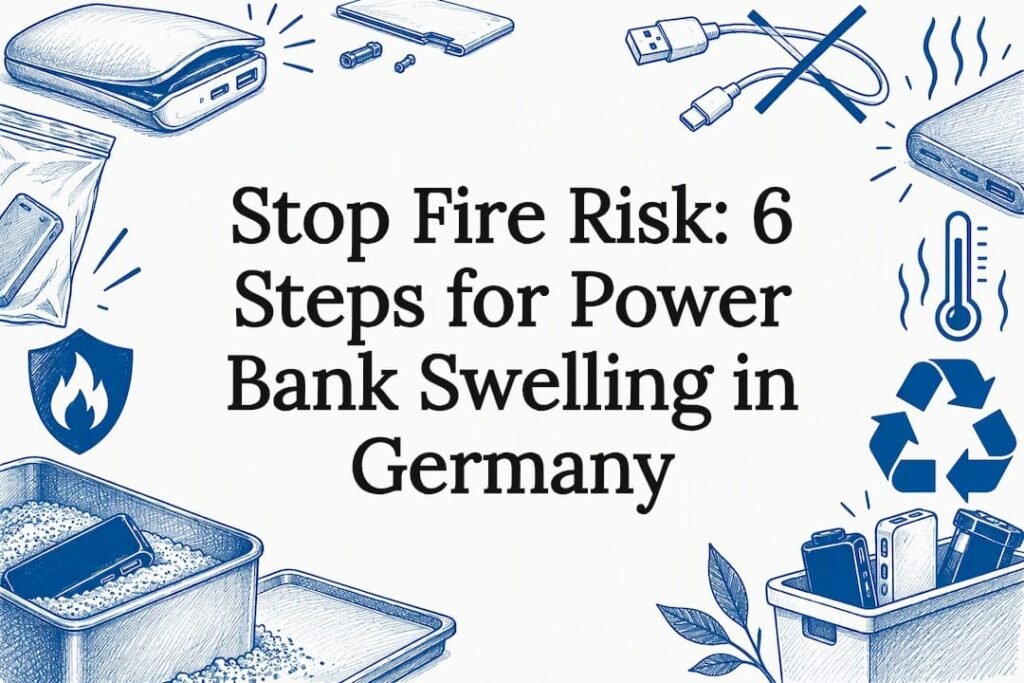
A swollen power bank is unsafe. Stop using or charging it immediately, even if it still powers your devices, and isolate it in a cool, non-flammable spot while you arrange safe disposal. A bulging case means the battery has already failed internally.
TL;DR:
- Continued use of a swollen power bank risks fire, rupture, or explosion, even if it still charges devices, so immediate disposal is essential.
- Swelling occurs from internal gas buildup caused by electrolyte breakdown, triggered by overcharging, overheating, physical damage, or manufacturing flaws.
- Signs of swelling include a bulging case, stiff buttons, warmth when idle, and sometimes hissing, smoke, leaks, or a chemical smell indicating active failure.
- Disposing of a swollen power bank requires it to be moved to a fireproof container and handed over to professionals, never punctured or thrown in household trash.
- Preventive habits include using certified chargers, avoiding extreme temperatures, not leaving it fully charged long-term, and inspecting for warping or warmth, especially after drops.
Table of Contents
- How to recognize a swollen or damaged power bank
- Why lithium-ion power banks swell
- Risks and consequences of continuing to use a swollen power bank
- Immediate steps to take when you discover a swollen power bank
- Safe storage, transport, and handing off a swollen pack for recycling
- How to prevent power bank swelling
- Why a swollen power bank cannot be fixed at home
- Treating battery safety as a buying decision, not an afterthought
- An alternative built around outdoor safety margins
- FAQ
- Sources
How to recognize a swollen or damaged power bank
Swelling usually shows up before anything catastrophic happens, which is exactly why it is worth checking your power bank now rather than after it starts smoking. The case itself tells most of the story: a flat rectangle that now bows in the middle, side seams that look slightly separated, or buttons and ports that no longer sit flush are all signs the cells inside have pushed outward against the housing.
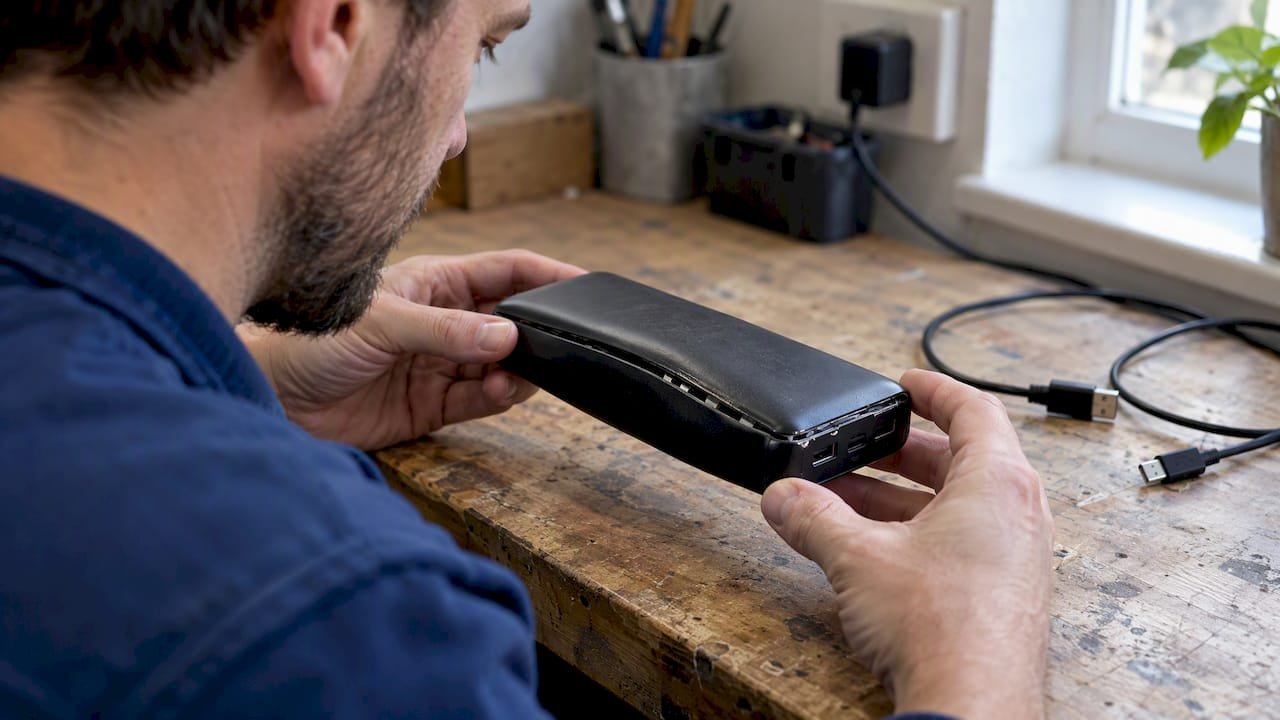
Some signs are easier to feel than see. The pack may not sit flat on a table anymore, rocking slightly on a raised belly. Buttons can feel stiff or stuck. If the unit feels warmer than usual just sitting idle, that is a signal on its own, since a healthy power bank at rest should stay close to room temperature.
A smaller set of signs means you should leave the area rather than keep inspecting:
- Hissing or a faint popping sound coming from the case.
- Any visible smoke, even a thin wisp.
- Leaking fluid or residue around the seams.
- A sharp, chemical or burning-plastic smell.
Any one of these means the pack has moved past “swollen” into active failure. Treat it the way you would a gas leak: get people and pets out of the room, and do not go back in to retrieve the device.
Why lithium-ion power banks swell
The cells inside a power bank are sealed, and swelling happens when something inside that seal generates gas faster than the casing can handle. That gas usually comes from the electrolyte breaking down, a reaction that speeds up under conditions the battery was never designed to tolerate for long.
The usual triggers are overcharging, letting a pack get too hot, discharging it too far or too fast, or physical abuse like a hard drop or a crushed corner. Manufacturing defects play a role too: a cell with a slightly misaligned separator or a stray metal particle from assembly can develop an internal micro-short that heats one small spot from the inside, which is much harder to spot from outside the case until the damage is already done.
Recent research adds a more specific mechanism to that list. A 2026 experimental study published in IOPscience tested cells under forced-discharge conditions and found that pushing a battery past its normal discharge limits can trigger copper migration inside the cell, where copper from the negative electrode’s current collector starts dissolving and redepositing in places it should not be. That process damages the solid electrolyte interphase, the thin protective layer that normally keeps the electrolyte stable, and once that layer breaks down the electrolyte decomposes faster and releases gases including carbon monoxide, carbon dioxide and various alkanes. The researchers used electrochemical impedance spectroscopy, gas chromatography-mass spectrometry and electron microscopy to confirm the pattern, giving a mechanistic explanation for bulging that goes beyond the simple “it got too hot” story most consumers hear.
The practical takeaway is that swelling is not always a sign of obvious abuse. A pack that has never been dropped or left in a hot car can still swell from a forced-discharge event, like being run all the way to zero repeatedly, or from a manufacturing flaw that only reveals itself after months of normal use. Related guidance from SLAC’s battery research communications reinforces the same point: once a cell bulges, the internal damage is already done, and there is no safe way to reverse it at home.
Risks and consequences of continuing to use a swollen power bank
Continuing to use a bulging power bank is a bet against physics, and physics tends to win. The same gas buildup that caused the swelling can accelerate into thermal runaway, a chain reaction where heat triggers more chemical breakdown, which creates more heat, until the cell vents, catches fire or ruptures outright.
A bulge is a stop-use signal, not a cosmetic issue: University of Reading safety guidance states that continued charging or use of a swollen lithium-ion battery can contribute to fire, rupture or explosion, regardless of whether the device still appears to function normally.
Beyond fire, the gases released during electrolyte breakdown can include toxic and irritant compounds. Breathing in smoke or vapor from a venting lithium-ion cell is a real inhalation hazard, not just an unpleasant smell to wave away. If the pack is connected to a phone, laptop or camera when it fails, that device is at risk too: a ruptured cell can damage or destroy whatever it is plugged into, and a fire that starts in a backpack or glovebox puts everything nearby at risk along with it.
The fact that a swollen pack still charges your phone is not evidence it is safe. Batteries do not degrade in a straight line. A cell can function normally for days or weeks after swelling begins and then fail abruptly, because the electronics that regulate charging and discharging are often the last thing to notice that the cell chemistry underneath has already broken down.
Immediate steps to take when you discover a swollen power bank
Act in this order, and resist the urge to troubleshoot:
- Stop charging and stop using the pack the moment you notice swelling.
- Unplug any connected device and power it down separately if it was mid-charge.
- Move the pack to a non-combustible surface, outside if possible, away from furniture, paper or fuel sources.
- Keep it away from heat, direct sun and anything that could ignite it.
- If the pack is cool to the touch and not actively venting, place it in a fireproof container or a dedicated lithium-ion containment bag.
- Arrange transport to a collection point as soon as you reasonably can, rather than letting it sit indefinitely.
Pro Tip: Keep a small metal tin or a sand-filled bucket on hand if you store or travel with power banks often. It turns “I don’t know what to do with this” into a thirty-second fix.
There is an equally important list of things not to do. Do not puncture, squeeze, bend or try to pry open the case, since mechanical pressure on a swollen cell can trigger the exact rupture you are trying to avoid. iFixit’s repair guidance is blunt about this: puncturing a swollen battery can cause fire or explosion, so professional removal or containment is the safer path. Do not throw it in household trash or a mixed recycling bin, and do not attempt a home repair or “just one more charge” to see if it still works.
Call emergency services if the pack is actively smoking, hissing, visibly on fire, or too hot to approach safely. In that scenario, evacuate the area first and let professionals handle it. For anything short of that, the containment and collection route below is the correct next step.
Safe storage, transport, and handing off a swollen pack for recycling
Once a swollen pack is cool and not actively venting, the goal is to get it out of your home safely and into the hands of people equipped to deal with it. Package it in something rigid and non-flammable: a metal tin, a container partly filled with sand, or a dedicated fireproof lithium-ion bag all work. Keep it isolated from other batteries and metal objects during transport, since a short circuit against another cell or a loose key can make a bad situation worse.
Before you drop it anywhere, call ahead. Umweltbundesamt guidance is specific on this point: swollen or leaking batteries should not be placed in ordinary waste, and the local waste authority or collection point should be contacted first for instructions on handling a damaged pack. Related guidance on handing in used batteries adds that a warm, smoking or otherwise damaged battery should be placed outside or in a fireproof container and reported to the appropriate local service rather than dropped off unannounced.
A few practical rules for the handoff itself:
- Do not place a swollen pack into a standard public battery collection box without telling staff first, since those bins and their sorting systems are built for undamaged batteries.
- Recycling centers, municipal collection points, and many retailers that sell batteries accept portable batteries for recycling, typically free of charge.
- Tell whoever receives it that the pack is swollen or damaged so they can route it correctly rather than mixing it with routine stock.
- If you are unsure where your nearest option is, a practical disposal guide can help you find a collection point before you need one in a hurry.
This is not a step to skip or postpone. A swollen battery sitting in a drawer for months is a slow-motion risk, and getting it out of the house is the only way to fully close that loop.
How to prevent power bank swelling
Most swelling is preventable, and the habits that prevent it are simple once they become routine.
- Use the charger and cable that came with the pack, or a reputable USB Power Delivery-compliant replacement, since USB-IF’s PD standards are designed to keep charging current within safe, predictable limits.
- Keep the pack out of extreme heat and cold where you can, aiming for roughly 10 to 25 degrees Celsius during storage and use.
- Avoid leaving it at full charge for long stretches, and skip the habit of keeping it plugged in around the clock.
- Check it over every so often for warping, discoloration or unusual warmth, especially after a drop.
- Keep it dry and away from standing water unless it carries a specific waterproof rating for that use.
Pro Tip: If you travel with a power bank, check it before every trip the same way you’d check tire pressure: thirty seconds now save a ruined bag or a canceled flight later.
Buying a pack with recognized certification and a clear safety track record matters too. A guide to power bank safety standards walks through what certification actually covers and why it is worth checking before you buy, not after something goes wrong.
Why a swollen power bank cannot be fixed at home
A bulge is not cosmetic. It means gas has already built up inside a sealed cell, which means the internal structure has already failed. There is no at-home fix for that, and no amount of tape, pressure or careful handling restores the cell to a safe state. The only responsible response is to stop using it and get it to people equipped to handle it.
Qualified recycling and disposal facilities handle damaged cells differently from intact ones. At a high level, damaged batteries are kept isolated from other stock, often submerged in sand or a similar inert material, and processed in ways designed to contain a rupture rather than prevent one entirely. That is a very different setup from a kitchen drawer or a car glovebox, which is why handing off to professionals rather than storing a damaged pack indefinitely is the safer long-term choice.
Design choices made before a battery ever swells matter too. Some power banks are built with features intended to reduce the physical and thermal stress that can contribute to cell damage, such as waterproof ratings, anti-drop structures, and active cooling. These are the brand’s own stated design choices, not a claim that any power bank is immune to swelling. No casing design changes what to do once swelling actually happens: stop use, isolate, and dispose of it properly.
Treating battery safety as a buying decision, not an afterthought
When I think about outdoor gear, battery safety sits above capacity, speed, and price on my list of what actually matters, because a fast charger that fails badly costs you more than the minutes it saved you. The specs that get marketed loudest, like charge speed and capacity, say nothing about how the pack behaves after a drop onto rock or a soak in a river crossing.
If you’re buying a new power bank, a short mental checklist helps: does the casing look genuinely rugged or just thick, does the listing mention any kind of battery management system, and does the brand say anything at all about how to recycle the unit at end of life? A brand that addresses disposal upfront is usually one that has thought about the whole lifecycle, not just the unboxing moment.
— Mats
An alternative built around outdoor safety margins
If you’re shopping for a replacement after dealing with a swollen pack, Ifory’s power banks are worth a look specifically because they are built for the conditions that often cause swelling in the first place: drops, water exposure, and heat. The Ifory Powerbank carries a 40,000mAh capacity with 100W fast charging, an IP67 waterproof rating, an anti-drop structure, active cooling, and multiple ports for charging more than one device at a time, all aimed at holding up during camping, boating, and other off-grid use where a standard pack is more likely to take damage.

None of that makes any lithium-ion battery immune to swelling. Rugged design and active cooling reduce certain physical and thermal stresses, but you should still follow the same safety steps above if you ever notice bulging, heat, or odd smells from any power bank, Ifory included. If you want a pack built with those risk factors in mind from the start, you can check the current Ifory lineup and decide if it fits how you actually use power on the go.
FAQ
Is it safe to use a bulged power bank?
No. A bulged power bank has already suffered internal damage, and safety guidance from the University of Reading says continued use or charging can lead to fire, rupture, or explosion. The fact that it still powers a device does not mean it is safe to keep using.
What should I do if my power bank is swollen?
Stop using and charging it right away, then move it to a cool, non-flammable spot away from heat sources. If it is cool and not venting, place it in a fireproof container and contact your local collection point or waste authority for instructions on disposing of a damaged battery.
How does a power bank get swollen?
Swelling happens when gas builds up inside a sealed cell, usually from electrolyte breakdown triggered by overcharging, overheating, deep discharge, physical damage, or a manufacturing defect. A 2026 study in IOPscience also found that forced discharge can cause copper migration inside the cell, which accelerates gas-producing breakdown and leads to bulging.
Is it safe to use a phone with a swollen battery?
No. The same risks that apply to a swollen power bank apply to a swollen phone battery: internal damage has already occurred, and continued use raises the risk of overheating, rupture, or fire. Stop using the phone, avoid charging it, and take it to a qualified repair or recycling service rather than continuing to carry or use it.