
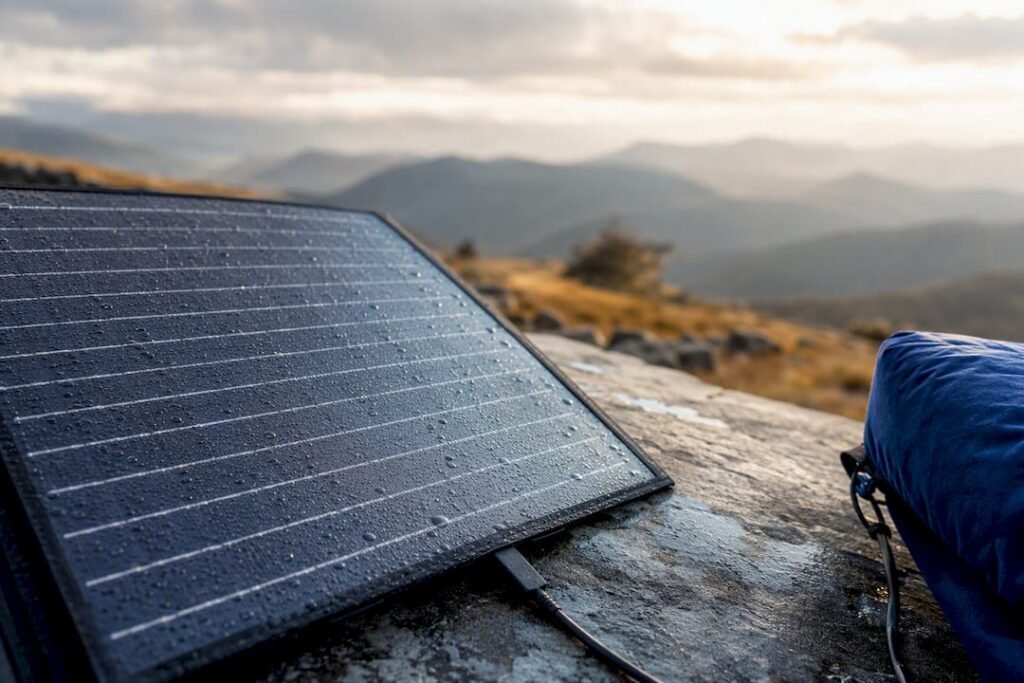
Charging losses outdoors come mostly from two places: the voltage conversion and thermal throttling inside your power bank, and the gap between a solar panel’s rated wattage and what sunlight, heat, and angle actually let it produce. The single best fix is keeping your bank shaded and cool while confirming real output with a $10 USB power meter, since heat and guesswork cause more wasted energy than any cable or connector ever will.
TL;DR:
- Cable resistance and connector quality significantly affect efficiency, with thin, long cables increasing resistance and heat indicating potential contact issues.
- Proper storage, shading, and maintenance habits can prevent capacity loss from heat, cold, humidity, and dirt, which are common field challenges.
- Using an MPPT controller and conducting simple field tests can help measure actual efficiency loss, enabling better management of outdoor charging setups.
Table of Contents
- What Causes Charging Losses Outdoors, and Where They Start
- Why Power Banks Deliver Less Than Their Rated mAh
- How Solar and Weather Cut Into Your Panel’s Real Output
- Cable, Connector, and Contact Losses That Quietly Leak Watts
- How Temperature and Storage Affect Usable Capacity
- Three Field Tests to Measure Your Real-World Losses
- A Prioritized Checklist for Cutting Outdoor Charging Losses
- How Humidity and Weather Beyond Heat Affect Charging Efficiency
- What Ten Years Around Outdoor Electronics Taught Me About Power Loss
- Why Ifory Pairs Well With a Field-Tested Charging Strategy
- Sources
- FAQ
What Causes Charging Losses Outdoors, and Where They Start
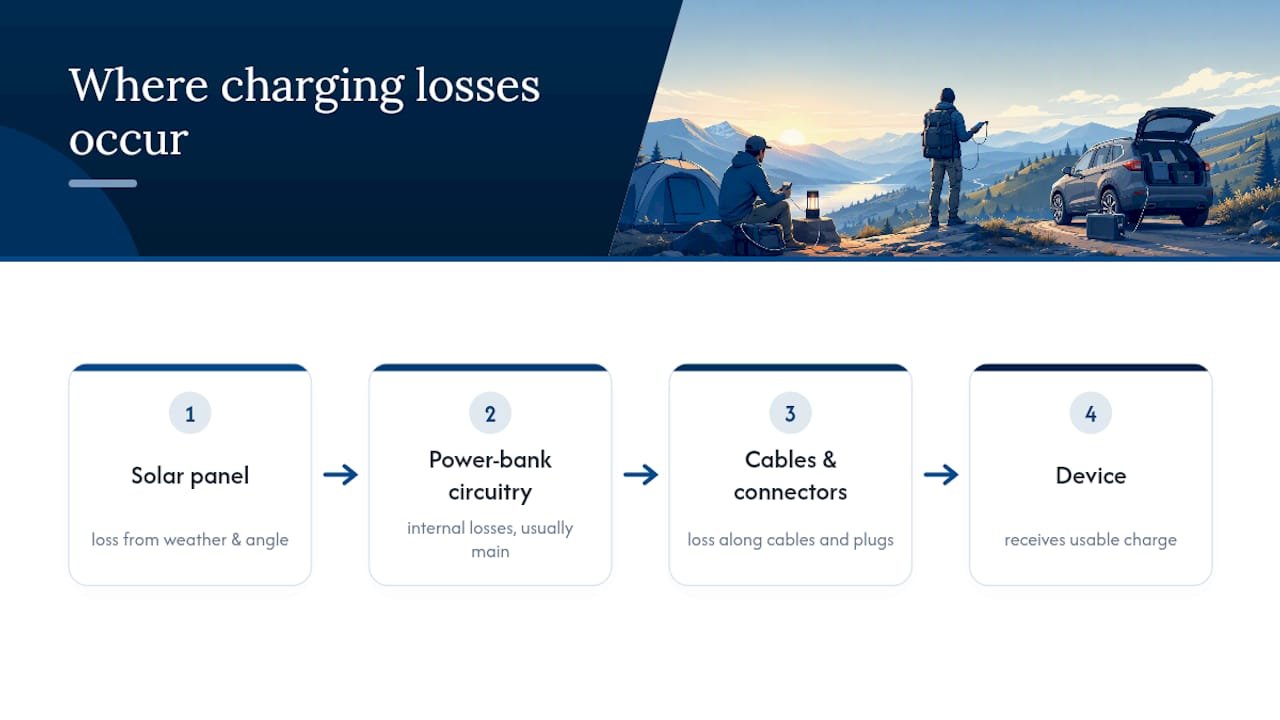
The term covers energy lost anywhere between a power source (a battery cell or a solar panel) and the device that actually needs the charge. That loss happens in three stages: inside the power bank’s own circuitry, in the solar panel’s response to weather and angle, and along the cables and connectors linking everything together. Most people blame a “bad battery” when the real culprit is one of these three, and usually the first one.
Why Power Banks Deliver Less Than Their Rated mAh
A 20,000mAh power bank almost never delivers 20,000mAh to your phone. The number on the box is measured at the cell’s native 3.7V, but your devices charge at 5V or higher, and that step-up conversion has a cost.
Run the math: 20,000mAh × 3.7V equals 74,000mWh of raw energy. That is a 30–40% loss before your phone sees a single watt.
The battery management system, or BMS, adds its own penalties:
- Cell imbalance in multicell packs forces the weaker cell to limit total output.
- Thermal foldback throttles power delivery once internal temperatures climb, which is common in direct sun.
- Pass-through charging (charging the bank while it powers a device) can drain 15 to 30 percent of capacity to parasitic losses alone.
- Aging cells lose real capacity over hundreds of cycles, quietly shrinking your margin trip after trip.
That is why a bank rated for “five full phone charges” often delivers three, especially after a summer of car trunks and beach bags.
How Solar and Weather Cut Into Your Panel’s Real Output
A “100W” portable panel is rated under Standard Test Conditions: 1,000 W/m² of irradiance, 25°C cell temperature, and a specific sun angle, as detailed in this solar panel output factors checklist for homeowners. Field conditions rarely match any of that.
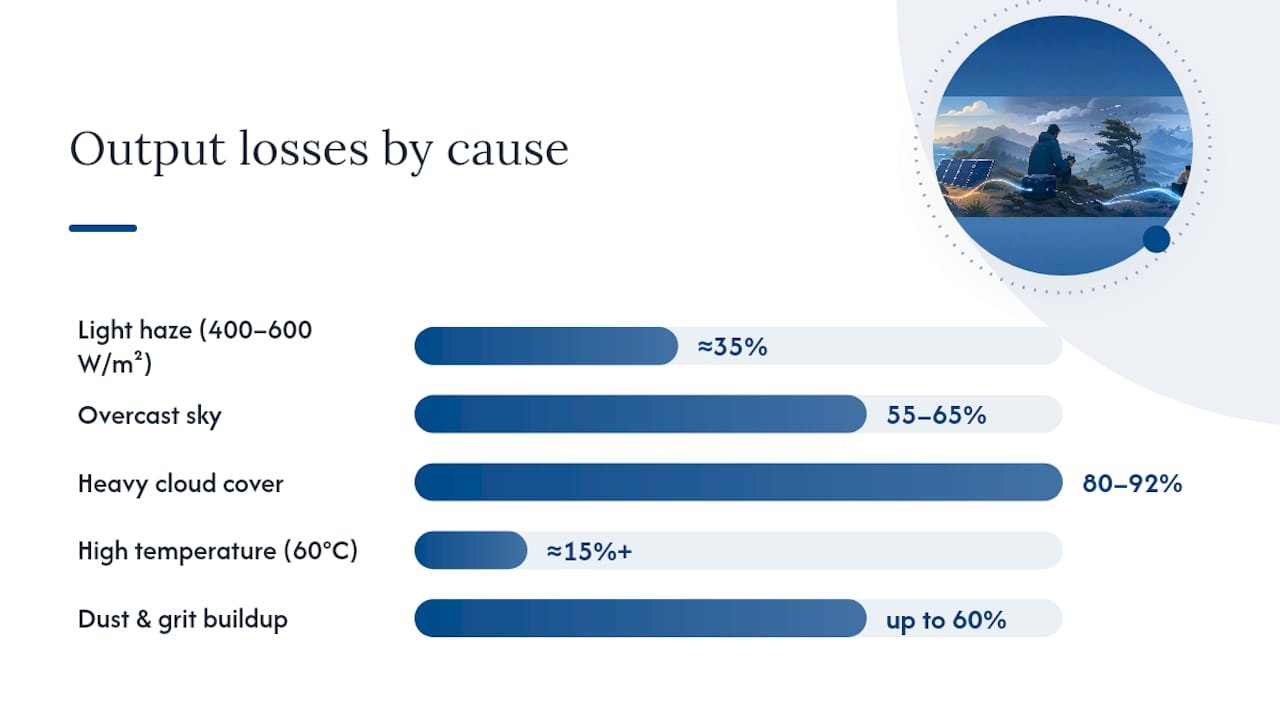
At 400 to 600 W/m², which is common under light haze or hazy midday sun, that same panel might deliver only about 65W. Push into overcast skies and output can fall 55 to 65 percent; heavy cloud cover routinely cuts it 80 to 92 percent.
Temperature works against you too. Panel efficiency drops roughly 0.4 to 0.5% for every degree Celsius above 25°C, so a panel baking on black asphalt at 60°C can lose 15% or more before shading or angle enter the picture.
In extreme desert conditions, accumulated dust and grit on panel surfaces can cut output by up to 60%, a loss most travelers never think to check for.
A few other realities worth knowing:
- Partial shading hurts disproportionately: covering even 10% of a panel with a shadow can cut output by far more than 10%, because shaded cells act like resistors in the circuit.
- MPPT controllers track the panel’s optimal operating point and typically outperform PWM controllers by a meaningful margin in cool or variable light.
- Many budget controllers simply stop charging below a minimum voltage threshold, which is why diffuse light on an overcast day can produce zero output instead of just reduced output.
Cable, Connector, and Contact Losses That Quietly Leak Watts
Voltage drop across a cable and connector is a smaller loss than conversion or solar shortfall, but it is the easiest one to fix for free. A well-built setup should stay under a 3% round-trip DC voltage drop; a thin, coiled charging cable bundled in a backpack can easily exceed that.
- Check cable gauge and length: thinner, longer cables multiply resistance, and halving that resistance roughly halves the loss.
- Feel connectors after 20 minutes of charging. Warm to the touch signals resistive loss; hot signals a problem worth replacing the cable over.
- Inspect for corrosion or a loose fit at USB-C and barrel connectors, especially after saltwater exposure or a rainy trek.
- Swap cheap bundled cables for a short, thick, quality one rated for the amperage you actually need.
How Temperature and Storage Affect Usable Capacity
Lithium cells lose usable capacity in both directions: extreme cold slows the chemical reaction, and extreme heat risks permanent degradation or a safety shutdown. Field tests have recorded internal temperatures exceeding 60°C in banks left in direct sun under heavy load, right where thermal protection kicks in.
For travel storage, keep a bank between 40 and 60% state of charge rather than full or empty, and never leave it in a hot car, a sun-baked tent pocket, or freezing gear at altitude. Small habits like these protect capacity you would otherwise lose before you even start charging.
Three Field Tests to Measure Your Real-World Losses
You do not need a lab to find out how much energy you are actually losing. These three tests take a few minutes each and work with gear you probably already carry.
- Device discharge test. Charge your phone from 20% to 80%, note the battery’s rated Wh (listed on most phones’ regulatory pages), and calculate delivered energy from the percentage change.
- Inline USB power meter test. A small meter plugged between your bank and device shows real Wh delivered over a session, letting you compare that number against the bank’s rated capacity to find your true efficiency.
- Solar characterization test. Measure open-circuit voltage, then Vmp and charge current once connected through an MPPT controller, at three points in the day to see how output tracks the sun angle.
Pro Tip: Run the USB power meter test once at home before your trip and once again in the field. If field efficiency drops more than 15 to 20 percent below your baseline, the problem is heat, shading, or a bad cable, not a defective bank.
A Prioritized Checklist for Cutting Outdoor Charging Losses
Not every fix matters equally. Start at the top of this list, since the first two items address the biggest loss sources.
- Keep your power bank shaded and out of direct sun; heat is the fastest way to trigger thermal foldback.
- Avoid heavy draws (like fast-charging a camera battery) once the bank drops below 40% state of charge, when voltage sag gets worse.
- Choose an MPPT controller over PWM where budget allows, and reposition panels every hour or two to track the sun.
- Wipe panels clean of dust and salt spray, and check that nothing casts even a partial shadow across the cells.
- Use short, thick cables and inspect connectors for warmth or corrosion before every multi-day trip.
- Skip pass-through charging unless your input source clearly outpaces your device’s demand.
- Carry a USB power meter and re-check efficiency any time you swap a cable, panel, or bank.
Pro Tip: Treat solar as a top-up, not your main power source.
How Humidity and Weather Beyond Heat Affect Charging Efficiency
Temperature gets most of the attention, but humidity and general weather conditions matter too, just through different mechanisms. High humidity does not directly reduce a panel’s electrical output the way heat does, but it changes how quickly dew and condensation form on cold panel surfaces at dawn, which creates a thin water film that scatters light and briefly cuts output until it evaporates.
Fog and mist behave like a diffuse cloud layer: they scatter and absorb sunlight before it reaches the cells, often producing the same kind of steep output drop you see under overcast skies. Coastal and humid environments also accelerate corrosion at exposed connectors and charging ports, which raises contact resistance over weeks of use even if you never notice a single bad connection day to day.
Wind is the one weather factor that occasionally helps: it cools both panels and power banks passively, which can partially offset the heat-driven efficiency losses covered earlier. Rain is straightforward. Water on a panel’s surface reduces light transmission and, if it pools, can create shading effects similar to soiling. None of this means humid or damp climates make outdoor charging impractical. It means the checklist habits, wiping panels dry, keeping connectors sealed, and checking for corrosion, matter more in a rainforest or coastal trip than they do in a dry mountain climate.
What Ten Years Around Outdoor Electronics Taught Me About Power Loss
Most guides treat charging loss as a spec sheet problem. It is really a heat management problem wearing a spec sheet disguise. Some power banks feature 100W PD output to reduce conversion cycles for high-draw devices, waterproof and anti-drop designs to protect internal electronics from moisture and impact that accelerate contact resistance, and an LED display to help catch thermal issues before failure.
— Mats
Why Ifory Pairs Well With a Field-Tested Charging Strategy
Every loss source covered here, conversion inefficiency, thermal throttling, weak solar input, sloppy cables, comes down to how well your gear handles heat, moisture, and inconsistent power delivery. Ifory’s 40,000mAh power bank was built around exactly those failure points: 100W PD output cuts down on wasted conversion cycles for cameras and laptops, the IP67 rating and anti-drop shell protect the internal circuitry from the field conditions that cause corrosion and connector wear, and the real-time LED display tells you your actual charge state instead of leaving you guessing.

For multi-day trips or photography expeditions where sunlight is inconsistent, pairing the bank with a PD-capable portable solar panel gives you a resilient top-up source without depending on solar as your only input. Browse the full powerbank lineup to find the capacity and port configuration that matches your next trip, and check the product page for full specs before you pack.
Sources
- Power Bank Battery Physics: The 30% Efficiency Loss Explained | Power Bank Tests
- Why Your Power Bank Stops Charging Mid-Trip: 5 Common Causes and Fixes – ChargingGearLab
- The environmental factors affecting solar photovoltaic output
- Why Your Portable Solar Charging Slow? Data-Backed Causes – Anern
FAQ
Why Does My Power Bank Charge My Phone Fewer Times Than Advertised?
The rated mAh is measured at the battery’s native 3.7V, but your phone charges at 5V or higher. That conversion, plus BMS overhead, typically cuts usable capacity by 30 to 40 percent versus the number printed on the box.
Does Cold Weather Hurt Charging Efficiency As Much As Heat?
Cold slows the chemical reaction inside lithium cells and temporarily reduces usable capacity, but extreme heat is generally more damaging since it risks permanent degradation and triggers thermal shutdown circuits.
How Much Should I Expect a Portable Solar Panel to Underperform Its Rating?
Under real-world irradiance of 400 to 600 W/m², a “100W” panel often delivers around 65W, and overcast conditions can cut output by 55 to 92 percent depending on cloud density.
Is MPPT Worth the Extra Cost Over a PWM Controller?
Yes for variable outdoor conditions. MPPT controllers track the panel’s optimal voltage point and typically outperform PWM controllers by a meaningful margin, especially in cool or shifting light.
Can I Rely on Solar Alone to Keep My Devices Charged?
Not for anything mission critical.