
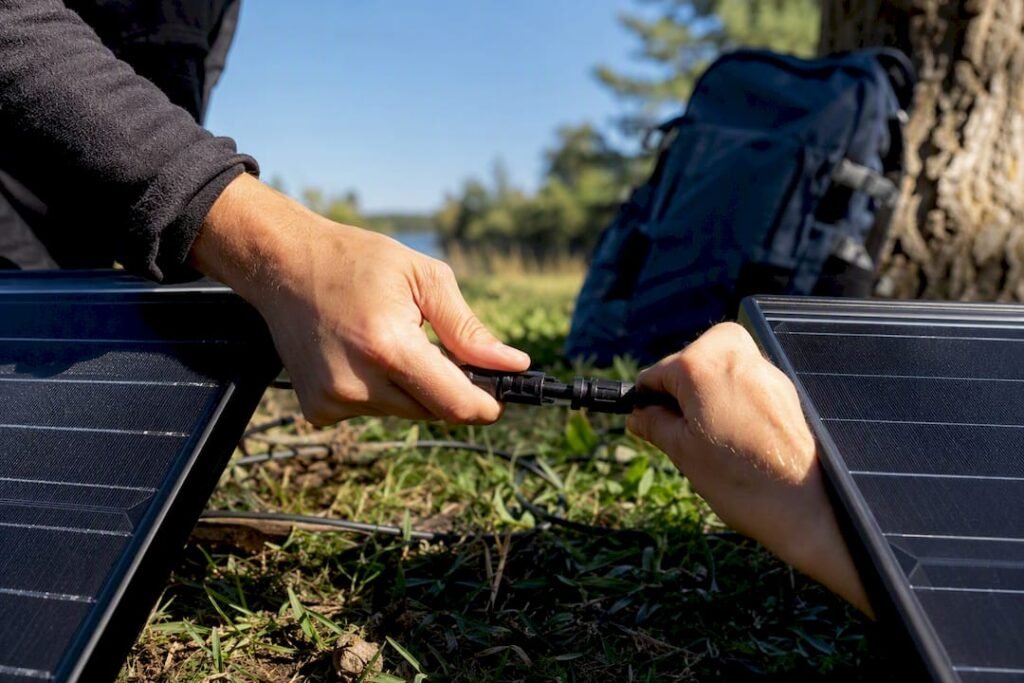
Daisy chaining means wiring solar panels in series, positive to negative, so their voltages add while the current stays the same. It works well for most small and mid-size setups as long as you follow three rules before you connect a single wire:
- Polarity first. Every connection is positive terminal to negative terminal, end to end.
- Voltage ceiling. Your total string voltage, calculated at the coldest temperature your site sees, must stay under your charge controller or inverter’s maximum input.
- Basic protection. A fuse or breaker and a disconnect switch belong on every string, no exceptions.
The full wiring checklist is in the how-to section below. Read the voltage math first. It’s what keeps you from frying a controller.
Key Takeaways
Safe series wiring depends on matched panels, a voltage calculation done at cold temperature, and a minimum protection set of fuse, disconnect, and correct grounding.
| Point | Details |
|---|---|
| Voltage adds, current doesn’t | In series, panel voltages sum while current stays at the single-panel rating. |
| Size for cold, not room temperature | Calculate string Voc using the panel’s temperature coefficient at your coldest expected temperature. |
| Match your panels | Keep series strings limited to panels with identical voltage and current ratings to avoid mismatch losses. |
| Protect every string | Fit a fuse or breaker and a DC disconnect, and confirm grounding against local code. |
| Portable needs, portable gear | For small-scale charging without string math, Ifory’s PD 40W panel and power bank line handle the job directly. |
Table of Contents
- What Happens Electrically When You Daisy Chain Solar Panels
- How to Wire Solar Panels in a Series String
- Can You Mix Different Solar Panels in One String?
- Sizing Your String: Voltage Limits and a Worked Example
- Protecting a Series String: Fuses, Grounding, and Cable Sizing
- Testing and Troubleshooting a Series String
- When Daisy Chaining Doesn’t Fit: Portable Panels and Power Banks
- Frequently Asked Questions
- Sources
What Happens Electrically When You Daisy Chain Solar Panels
Series wiring connects the positive terminal of one panel to the negative terminal of the next, and the voltages stack while the current holds steady at whatever the weakest panel produces. Renogy’s wiring guide lays out the basic pattern this way, and it’s the foundation for every calculation you’ll do afterward.
The math is simple:
- Vtotal = V1 + V2 + V3… (add the voltage of every panel in the string)
- Itotal = the current of a single panel (current does not add in series)
Two numbers matter here, and people mix them up constantly. Vmp is the voltage a panel produces while actively working under load. Voc is open-circuit voltage, what the panel outputs with nothing connected, and it’s always higher than Vmp. Controllers and inverters list their maximum input as a Voc figure, not Vmp, because that’s the worst-case scenario your equipment has to survive.
Statistic to remember: voltage rises as temperature drops. A panel’s Voc temperature coefficient means a cold morning can push your string voltage well above its rated spec, sometimes enough to trip or damage equipment rated close to the limit.
How to Wire Solar Panels in a Series String
Here’s the actual sequence, in order:
- Lay out your panels in their final mounting position and confirm you know which cable is positive and which is negative on each one.
- Check every panel’s nameplate to confirm matching Vmp and Isc ratings before connecting anything.
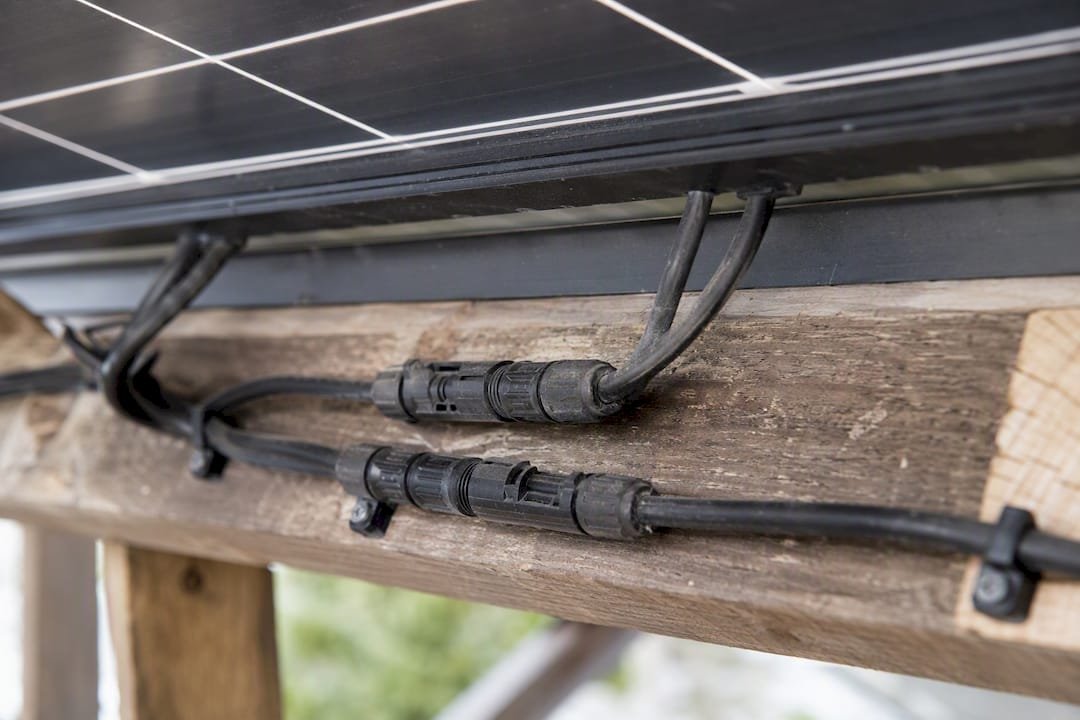
- Connect panel 1’s positive MC4 connector to panel 2’s negative connector. Repeat down the line.
- Leave the string’s two end leads (the final positive and final negative) unconnected until the last step.
- Install your fuse or breaker and DC disconnect on the output leads.
- Connect the string to your charge controller or inverter only after confirming total voltage with a multimeter.
- Power up and check the display for expected voltage and current readings.
Tools and materials: MC4 connectors and a proper crimping tool, UV-rated solar cable sized for your run length (10 AWG or 12 AWG for most residential and RV strings), insulated screwdrivers, a digital multimeter, and basic PPE (gloves and safety glasses).
Pro Tip: Cover each panel with an opaque tarp or cardboard while you’re making connections. A panel in direct sun is a live circuit the second light hits it, and an uncovered panel on a bright day can also throw enough glare to make precise connector work miserable.
Never assume a panel is “off.” Sunlight makes voltage the moment it hits the cells, whether or not anything is plugged in.
Can You Mix Different Solar Panels in One String?
Mixing panel voltages in a single series string causes problems, and it’s one of the most common DIY mistakes. Haina Solar’s technical overview notes that daisy chaining raises total voltage efficiently, but the string becomes sensitive to any mismatch between panels, since series current is capped by the weakest link. Put a 5A panel next to an 8A panel in the same string, and the whole string performs like it’s made of 5A panels.
Rules worth following:
- Keep panels in a single string matched on nominal voltage and current rating, ideally identical models.
- If you’ve got mismatched wattage panels, wire them in parallel instead (assuming voltages match), or feed them into separate MPPT inputs on a multi-input controller.
- For arrays where partial shading is likely, such as a roof with a chimney shadow, separate strings or microinverters isolate the shaded panel’s losses instead of dragging down the whole array.
- BackupWatt’s practitioner guide recommends sticking to one panel model per string as the simplest way to avoid all of this.
Sizing Your String: Voltage Limits and a Worked Example
Every controller and inverter has a maximum input voltage, and exceeding it during cold weather is the single most common way DIYers damage equipment. Photonik is blunt about this: never size a string using a panel’s rated Voc at room temperature. Calculate Voc at your site’s coldest expected temperature using the panel’s Voc temperature coefficient, because voltage climbs as the mercury drops and can blow past your equipment’s max input on a frosty morning.
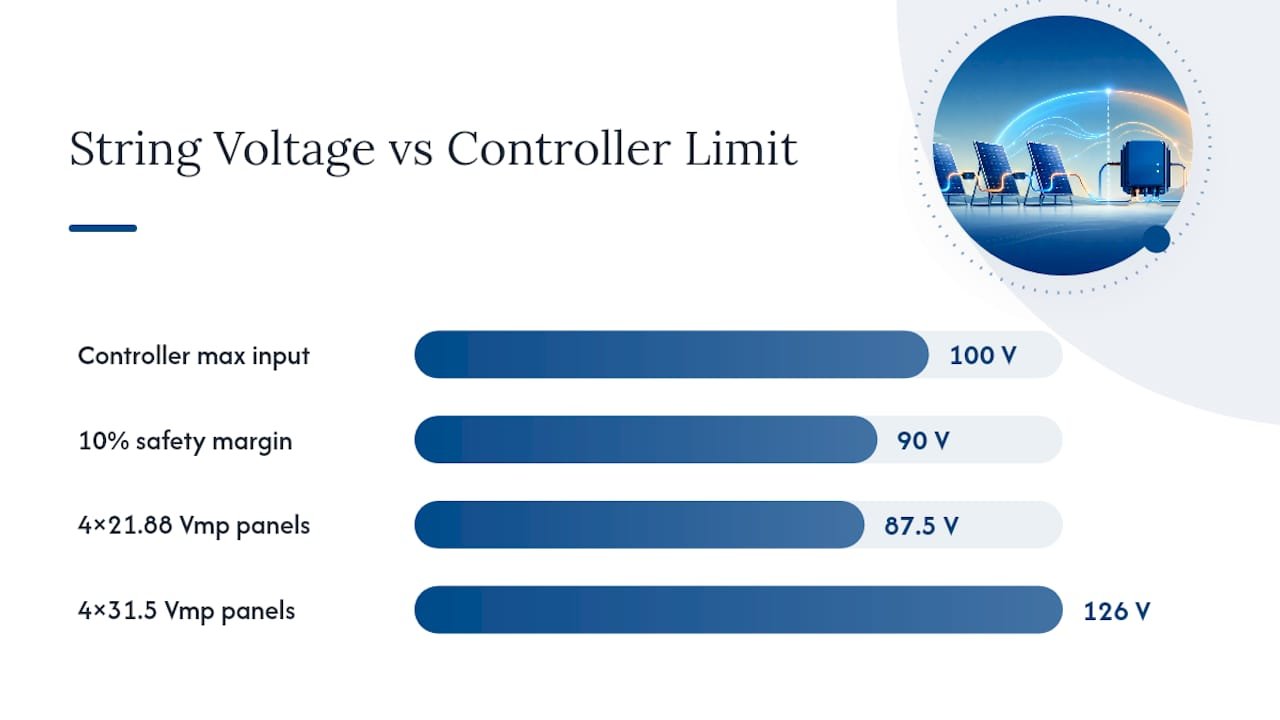
Worked example: ThegreenWatt’s series wiring breakdown shows four panels at 31.5V Vmp in series producing roughly 126V total, at the same current a single panel produces. If you’re working with common 21.88V Vmp portable-style panels and your controller maxes out at 100V, you could theoretically fit four panels (87.5V), but you still need to check cold-weather Voc, which will run higher than Vmp.
Checklist before you connect:
- Max input Voc listed on your controller or inverter’s datasheet
- Recommended MPPT voltage range (not just the ceiling, the working window)
- Panel Voc temperature coefficient (usually expressed as %/°C or mV/°C)
- A safety margin of at least 10% below the stated maximum
Protecting a Series String: Fuses, Grounding, and Cable Sizing
A series string without protection is a fire risk waiting for the wrong afternoon. The minimum hardware set:
- String fuse or DC breaker, sized to the string’s expected current, to protect against fault currents.
- DC disconnect switch, so you can isolate the string from the controller for maintenance without disconnecting individual MC4 pairs under load.
- Blocking diode, mainly relevant in older or mixed-string setups to prevent reverse current flow at night; most modern charge controllers handle this internally.
- Surge protection, worth adding if your array is exposed and your region sees lightning activity.
On grounding: panel frames are typically bonded to a common ground per most electrical codes, but the exact requirement depends on your local jurisdiction and whether the system is grid-tied. This is one spot where guessing is a bad idea. Follow your local code, or better, have a licensed electrician verify your grounding scheme, especially for anything permanently mounted or grid-connected.
Cable sizing matters more than people expect. Undersized cable on a long run causes voltage drop and heat buildup at the connectors. Match your cable gauge to both the current and the run length, and make sure every MC4 connector you use is rated for your string’s voltage and current, not just “compatible looking.”
Testing and Troubleshooting a Series String
Once wired, verify the string before trusting it:
- Measure open-circuit voltage (Voc) across the string’s end leads with a multimeter, panels uncovered, controller disconnected.
- Compare that reading to your calculated total from the sizing step. A big mismatch means a bad connection or a wrong panel somewhere in the chain.
- Connect to the controller and check current under full sun against the expected Isc or Imp.
- Inspect every MC4 joint for a solid click and no exposed metal.
Common symptoms and causes:
- Low current output: shading on one panel, a mismatched panel in the string, or a loose connector.
- Zero output: reversed polarity, an open connector, or a blown fuse.
- Voltage reads correctly but no charging: check the controller’s own input range settings and confirm it hasn’t gone into fault mode.
To isolate a suspect panel, disconnect it from the string and test its Voc alone against its nameplate rating before reconnecting.
When Daisy Chaining Doesn’t Fit: Portable Panels and Power Banks
Not every charging need requires a wired string. If you’re topping off a phone, camera batteries, or a power bank on a weekend trip, series wiring and Voc math are overkill. Ifory’s Portable Solar Panel PD 40W operates at 21.88V/2.19A and is built for direct, low-voltage charging into a device like a power bank rather than feeding a high-voltage MPPT string.
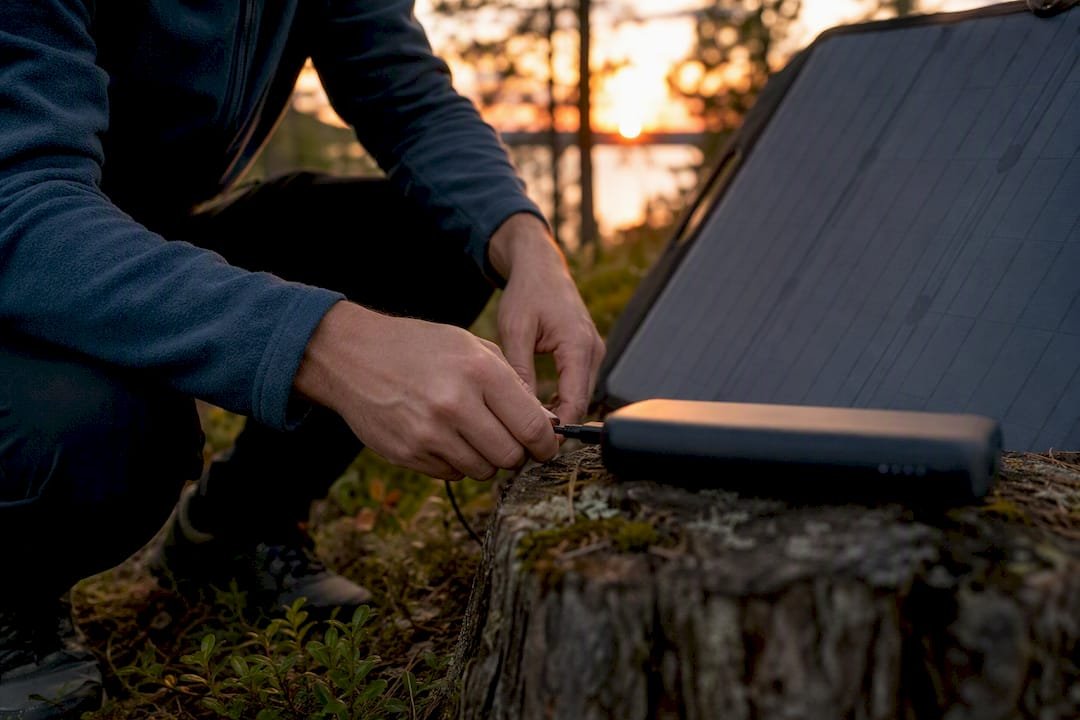
The compatibility distinction matters: a power bank’s PD input expects a single, regulated voltage within its accepted range, not the summed voltage of a multi-panel series string. If your goal is charging gear in the field rather than running a rooftop array, a portable panel paired with a power bank sidesteps the whole daisy-chain calculation, and the 40,000mAh 100W power bank route is simpler for that use case.
A Few Things I’ve Learned Wiring Strings
Cover panels before you touch a connector. It sounds excessive until you’ve felt an MC4 arc under load. Pre-measure your cable runs before mounting anything permanently. It saves a second trip up the ladder.
For anything grid-tied or above low voltage on a rooftop, bring in a licensed electrician.
A Simpler Route for Portable Charging
If you camp, shoot photos on the move, or just want backup power without touching a multimeter, wiring a series string is more setup than you need. Ifory’s approach skips the Voc math entirely: pair the Portable Solar Panel PD 40W with a compatible power bank and you’re charging within minutes, no fuses or disconnects to source.

This setup is built for portable use, not for replacing a rooftop array or a grid-tied installation. If that’s your project, the wiring guidance above still applies. But for campers, van-lifers, and anyone who wants dependable power in a bag rather than on a roof, browse the power bank lineup and check which capacity fits your typical trip length.
Frequently Asked Questions
Can I mix different solar panels in a daisy chain?
You can, but you shouldn’t mix different voltage ratings in the same series string. Series current is limited by the weakest panel, so a mismatch drags down the whole string’s output. If wattages differ, use parallel wiring with matched voltages or separate MPPT inputs instead.
How many panels can I connect to one charge controller?
It depends entirely on your controller’s maximum input voltage compared to your string’s total Voc at the coldest expected temperature. There’s no universal number. Check your controller’s datasheet, calculate your string’s cold-weather Voc, and leave a safety margin before finalizing panel count.
Do I need a blocking diode for a series string?
Most modern MPPT charge controllers handle reverse current internally, so a separate diode usually isn’t necessary. Older or simpler PWM systems, or setups combining multiple strings, sometimes still benefit from one.
What’s the difference between Vmp and Voc, and which one matters for sizing?
Vmp is the working voltage under load; Voc is open-circuit voltage with nothing connected, and it’s always higher. Size your string against Voc at cold temperature, since that’s the worst-case number your equipment has to tolerate.
Is daisy chaining better than parallel wiring?
Neither is universally better. Series wiring reduces current-related losses over long cable runs and suits MPPT controllers well. Parallel wiring keeps voltage lower and current higher, and it’s more shading-tolerant since one shaded panel doesn’t drag down the whole array.
Sources
- Solar Panel Wiring Basics: How to Wire Solar Panels | Renogy US
- Photonik
- How To Wire Solar Panels: Series vs Parallel Explained (+ Diagrams)