
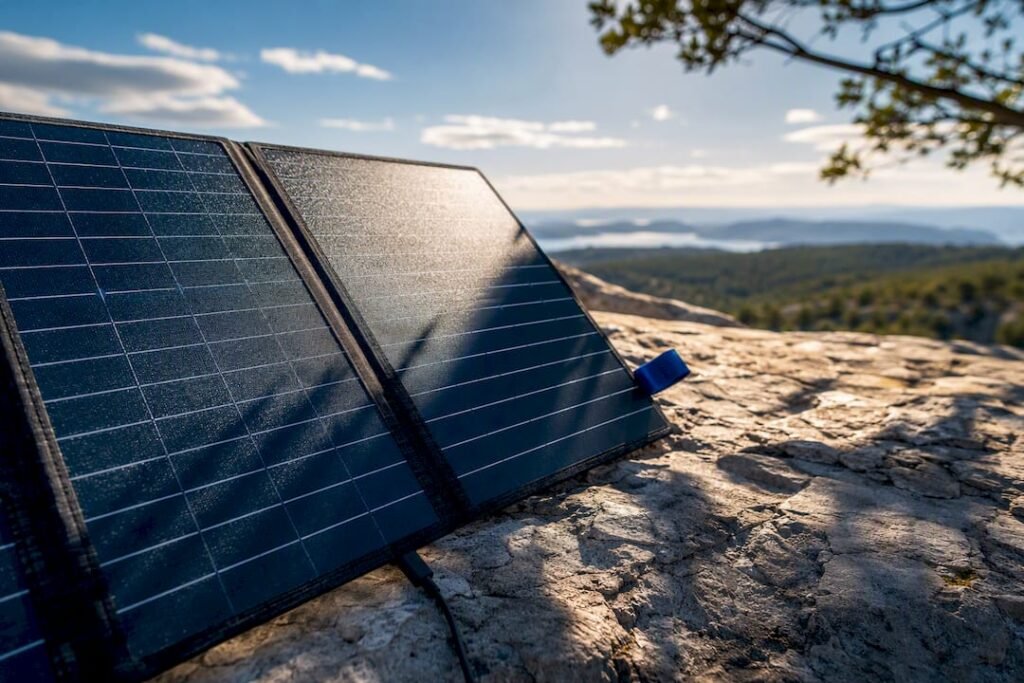
Yes, solar panels and solar lights still generate power in shade, but charging speed often drops to a fraction of what you get in direct sun. The fix isn’t complicated: avoid static, hard shadows whenever you can, lean on MPPT controllers or power optimizers when you can’t, and carry a dedicated portable panel like a PD 40W unit rather than relying on a power bank’s tiny built-in cell.
TL;DR:
- Using MPPT controllers or power optimizers significantly improves charging efficiency in shaded conditions compared to PWM controllers.
- Partial or hard shade causes more than 50 percent loss in panel output, with static shade being more damaging over time than moving shadows.
- Wiring panels in parallel prevents a shaded panel from limiting the entire array’s output, especially when shade is patchy or unpredictable.
- Elevating panels or adjusting their angle can double or triple charging speed by reducing shadow effects during setup.
- Relying solely on built-in small panels on power banks results in minimal gains under shade, making dedicated portable panels essential for effective charging.
Table of Contents
- How Does Shade Actually Reduce Solar Charging Efficiency?
- What Are the Different Levels of Shade and Their Real-World Losses?
- Which Hardware Choices Minimize Shade Losses?
- How Do You Set Up a Portable Panel to Minimize Shade Loss?
- What Should You Expect Charging Power Banks and Solar Lights in Shade?
- How Do You Diagnose a Shade-Related Charging Problem?
- What I’ve Learned About Solar Charging Trade-Offs in the Field
- Why a Dedicated Panel Beats a Built-In One for Real Charging
- Where to Read More on Solar Charging Performance
- Sources
How Does Shade Actually Reduce Solar Charging Efficiency?
A solar cell produces current in rough proportion to the light hitting it. Cover half the cell and you don’t lose half the power evenly across the panel. You create a bottleneck.
Most panels wire their cells in series, which means every cell in that string carries the same current. If one cell sits in shadow and can only produce a trickle, the entire string gets throttled down to that cell’s output, even though the other 90% of the panel is sitting in full sun doing nothing useful. Field and lab data show that shading even a small fraction of a panel can cut whole-panel output by tens of percent, sometimes far more, depending on how the panel is wired and protected.
Bypass diodes exist to stop this from becoming a fire hazard. When a shaded cell group tries to absorb power instead of producing it, the diode routes current around that section entirely. That protects the panel from a dangerous hotspot, but it doesn’t restore the power that section would have made. Bypass diodes mitigate damage, not lost output.
There’s an important distinction between diffuse shade and hard shade. Cloud cover lowers the light hitting every cell roughly equally, so the panel just runs at reduced output overall, with no single cell acting as a bottleneck. A tree branch or a tent pole casting a sharp-edged shadow across part of the panel is worse, because it creates that current bottleneck even though most of the panel still sees full sun.
What Are the Different Levels of Shade and Their Real-World Losses?
Not all shade behaves the same way, and the category matters more than most people realize. Here’s how the main types break down:
- Diffuse or overcast light: even, whole-panel reduction from cloud cover, no localized bottleneck.
- Intermittent or moving shade: shifting shadows from moving branches, clouds, or your own body, with output cycling up and down throughout the day.
- Partial or hard shade: a sharp shadow edge (a pole, a branch, a building corner) sitting across part of the panel, creating that series bottleneck.
- Full shade: the panel is entirely shadowed, producing near-zero usable current.
Published field guides put rough numbers on these categories. Light cloud cover tends to cut output by around 20 to 40 percent. Partial, localized hard shade can cause substantial power loss, often around half or more, due to the bottleneck effect. Heavy or static shade, such as panels under tree canopies or shaded walls, can cause very severe losses, sometimes most of the panel’s output.
| Shade type | Typical cause | Approximate output reduction |
|---|---|---|
| Diffuse / overcast | Cloud cover | 20 to 40 percent |
| Intermittent / moving | Shifting branches, moving clouds | Varies throughout the day |
| Partial / hard | Pole, branch, or edge shadow across part of panel | 50 percent or more |
| Full / static | Tree canopy, building shadow, all day | 80 to 95 percent |
The practical takeaway: moving shade actually costs you less over a full day than static shade, even if it looks worse at any given moment, because the panel gets clean sun during the gaps. A panel that sits under one unmoving shadow for six straight hours loses far more daily energy than one that gets clipped by a shifting branch for a few minutes at a time.
Which Hardware Choices Minimize Shade Losses?
Controller choice matters more in shade than in full sun. A PWM controller just connects the panel to the battery and lets the battery pull the voltage down to its own level, wasting whatever voltage the panel had left over. An MPPT controller constantly hunts for the exact voltage and current combination that extracts the most watts, which matters far more when shade creates multiple power peaks on the panel’s output curve. Comparative testing shows MPPT controllers can deliver notable gains over PWM in variable or shaded light, often improving efficiency by a significant margin. MPPT controllers can also track dynamically between those peaks, something a PWM controller has no ability to do at all.
For larger installations, microinverters and power optimizers push this idea further by managing each panel (or even each panel segment) independently, so one shaded panel doesn’t drag down the output of the panels next to it. That’s the same logic behind why panel sectioning and bypass diode placement matter for portable arrays too. A panel divided into multiple diode-protected sections loses less to a small shadow than one long unbroken string.
Wiring configuration matters just as much as the controller. Series wiring boosts voltage but makes the whole array vulnerable to one shaded panel. Parallel wiring lets unshaded panels keep contributing their full current even when a neighboring panel gets bypassed.
- MPPT controllers extract more energy than PWM in almost any variable light condition.
- Microinverters and optimizers isolate shaded panels so they don’t drag down the rest of the array.
- Parallel wiring protects total output better than series when shade is patchy or unpredictable.
Pro Tip: If you’re running two or more portable panels and expect intermittent tree shade, wire them in parallel instead of series. One shaded panel will still limit its own output, but it won’t pull down the panel standing in full sun next to it, which is exactly what happens in a series connection.
How Do You Set Up a Portable Panel to Minimize Shade Loss?
Small placement decisions matter more than most people expect, because a shadow edge that clips one corner of a panel can throttle the whole string.
- Watch the shadow for ten minutes before setting up. Shadows from trees and structures move faster than they look, and a spot that’s clear now may not stay clear an hour later.
- Angle the panel toward open sky, not just toward the sun. A panel facing a gap in the canopy captures more usable light than one facing the sun through leaves.
- Move it a few feet before you tilt it. Small position shifts that clear a shadow off even one string of cells can double or triple charging speed. That’s often a bigger win than fiddling with the angle.
- Run panels during true peak hours. Late morning through mid-afternoon delivers the strongest and most direct light, which matters more in already-compromised shaded conditions.
- For solar lights, check the sensor and panel placement separately. A light with a great panel but a sensor blocked by foliage will underperform regardless of how much sun the panel gets.
- When shade is unavoidable, size up. A larger panel or bigger battery capacity absorbs shade losses better than a small one running at the edge of its output.
Elevating a panel even a foot or two off the ground can clear low grass shadows and pick up reflected light, a detail campers overlook constantly.
What Should You Expect Charging Power Banks and Solar Lights in Shade?
Built-in solar panels on power banks are small by necessity, often just a few square inches, and that limits how much current they can generate even in full sun. In shade or heavy cloud, testing on these small panels shows they typically produce a trickle current that adds a modest percentage to runtime rather than delivering a real recharge. Fully topping off a large-capacity bank this way can take days, not hours.
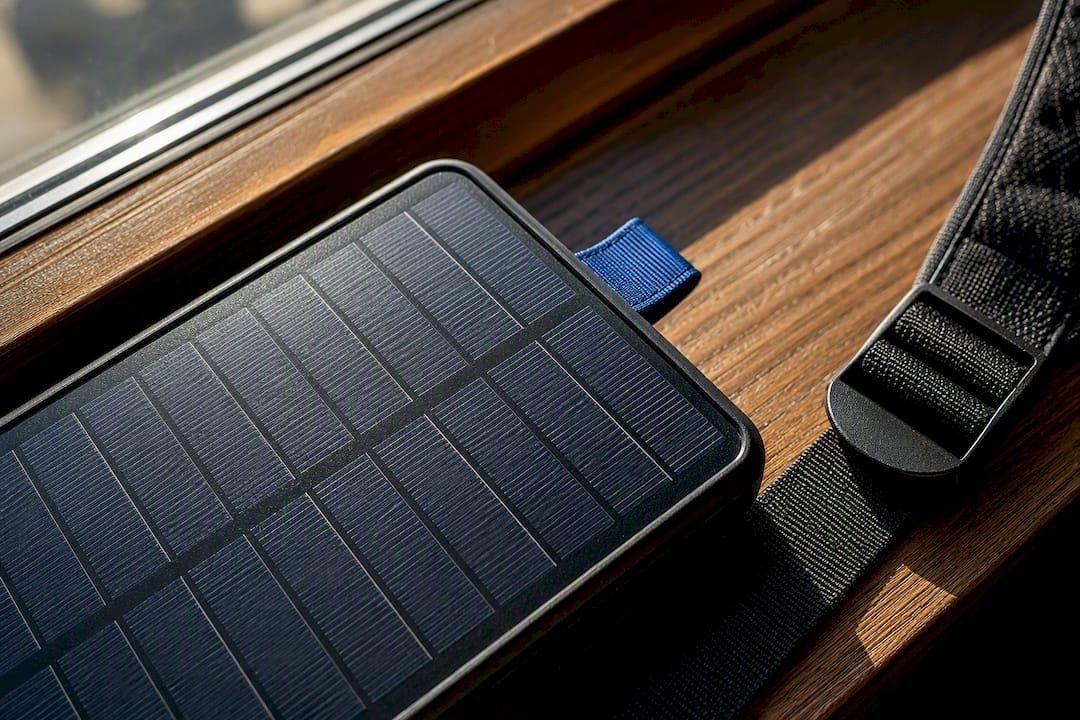
That gap is exactly why panel wattage and battery capacity matter so much together. A tiny 1 or 2 watt integrated panel struggles even in good light, while a dedicated 40 watt panel captures dramatically more energy per hour, shade losses and all. That difference is the whole reason a PD 40W-class panel exists as a separate purchase rather than something manufacturers just build into every bank.
The practical move: charge your power bank fully from a wall outlet before any trip, treat the built-in panel as a slow backup for extending a charge in the field, and use a dedicated portable panel during actual peak sun hours whenever real charging is the goal.
How Do You Diagnose a Shade-Related Charging Problem?
A cheap USB power meter or multimeter tells you fast whether shade is the real culprit or your equipment has hit a limit.
- Compare open-circuit voltage in full sun versus your shaded spot. A big drop confirms shade is the bottleneck.
- Check operating voltage against your controller’s MPPT range. Voltage sitting below that range often means a bypass diode has activated and part of the panel is offline.
- Watch current output, not just voltage. Voltage can look fine while current collapses, which is the classic sign of a shaded cell throttling the string.
- Try repositioning the panel a few feet, switching to a parallel wiring setup if you’re running multiple panels, and wiping down the surface. Dust and grime cost real output too.
What I’ve Learned About Solar Charging Trade-Offs in the Field
Three rules cut through most of the confusion here. Avoid static shade before you do anything else. Use MPPT controllers or optimizers when shade is unavoidable, since they consistently claw back energy a basic PWM setup just leaves on the table. And if reliable charging actually matters to your trip, carry a dedicated portable panel and a larger battery bank instead of hoping a tiny built-in cell will get there.
Solar works best as a supplement, not a guarantee. If you’re depending on charge for anything time-sensitive, like a satellite communicator or a phone you need for navigation, treat solar as the backup and a charged battery as the plan.
— Mats
Why a Dedicated Panel Beats a Built-In One for Real Charging
A tiny built-in panel on a power bank will never outrun a shady campsite. Pairing a PD 40W portable solar panel with a high-capacity power bank changes the math entirely, because you’re feeding a real battery reserve instead of waiting on a trickle.

The Ifory 40,000mAh power bank pairs naturally with that panel setup: IP67 waterproof protection and an anti-drop build mean the combination survives the same rough conditions that cause shade problems in the first place, whether that’s a tree line, a boat deck, or a rocky trail. The real-time LED display shows exactly how much charge you’re pulling in, so you can tell immediately whether repositioning the panel actually helped. Before you buy, check that any panel you pair with a bank matches its input voltage and cable standard, since mismatched connectors are a common source of “slow charging” complaints that have nothing to do with shade at all.
If your trips regularly involve tree cover, cloudy weather, or unpredictable shade, pick up the PD 40W panel and pair it with a compatible power bank before your next outing.
Where to Read More on Solar Charging Performance
- Do Solar Panels Work in the Shade? — Renogy
- How Shade Affects Solar Charging Speed — Nexdaro
- How to Maximize Solar Charging Efficiency — Jackery
- Solar Charging in Partial Shade — Portable Energy Lab
- Off-Grid Charging Setups — Ifory
Sources
- Do solar panels work in the shade? — Renogy blog
- How shade affects solar charging speed — Nexdaro
- Comparative review of PWM and MPPT charge controllers — JED (2025)
- Bypass diodes explained — Autarc Energy