
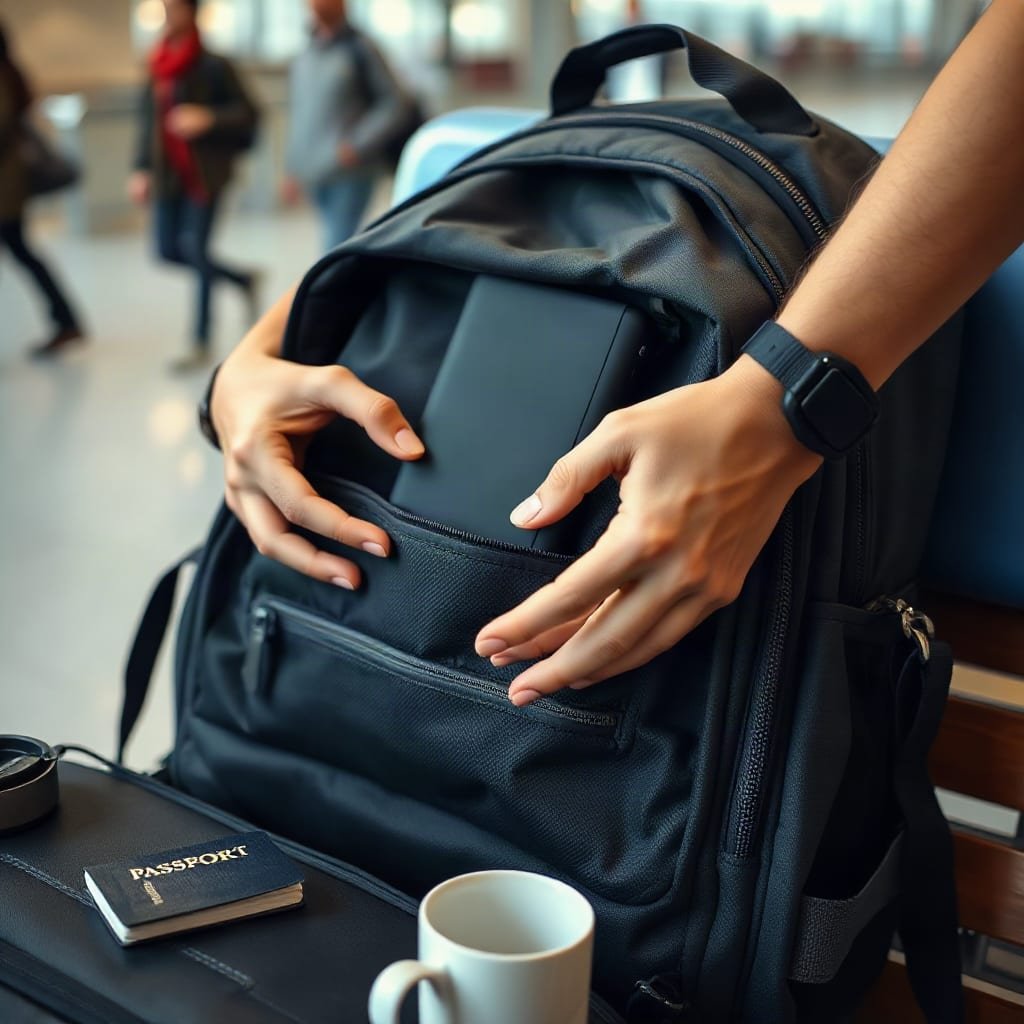
The airline rules for carrying power banks over 100Wh come down to one line: under 100Wh you can bring it in your cabin bag without asking, 100 to 160Wh needs airline approval (and most airlines cap you at two), and above 160Wh it stays home. Every power bank must travel in the cabin, never in checked luggage. The number that matters is watt-hours, not the mAh printed on the box.
TL;DR:
- Power banks are allowed on flights, but only in carry-on baggage. Spare lithium batteries are banned from the hold under ICAO and IATA rules.
- The thresholds are 100Wh (no approval needed), 100 to 160Wh (airline approval, usually two max) and over 160Wh (forbidden on passenger aircraft).
- A 20000mAh power bank is almost always fine; a 30000mAh one often is not, because the mAh figure is rated at cell voltage, not the 5V USB output.
- Convert it yourself: mAh x 3.6 to 3.7V / 1000 = Wh. If the label shows no Wh figure, many security staff will refuse it.
- Tape terminals, keep it out of the seat pocket and in reach, and screenshot the airline's policy before you leave for the airport.
Table of Contents
- The 100Wh Line: What the Rule Says and Where It Comes From
- Why mAh Misleads You and How to Convert to Wh
- Can You Carry a 20000mAh or 30000mAh Power Bank on International Flights?
- What Airlines Do Differently: Approval, Quantity Limits and Bans
- Are Portable Power Banks Allowed on Flights at All?
- How to Pack a 100Wh-Plus Power Bank So You Actually Get Through
- Get a 40,000mAh Power Bank That Is Built for Flying, Not Fighting Security
- Frequently Asked Questions
- Sources
The 100Wh Line: What the Rule Says and Where It Comes From
The rule is not an airline whim. It traces back to the United Nations dangerous goods framework that the International Civil Aviation Organization turns into binding technical instructions and that the IATA publishes in its lithium battery guidance for airlines. A power bank counts as a "spare" lithium-ion battery, because it is not installed in a device. Spare batteries have a strict cap on energy, and that cap is expressed in watt-hours.
Here is the same rule in plain terms:
| Battery rating | Allowed in cabin? | Allowed in checked bag? | What you need to do |
|---|---|---|---|
| Up to 100Wh | Yes | No | Nothing special; protect terminals |
| 100Wh to 160Wh | Yes, with airline approval | No | Get approval before flying; usually max two |
| Over 160Wh | No | No | Ship it by cargo or leave it |
160Wh is the hard ceiling. Above it, a lithium battery cannot ride on a passenger aircraft as a traveler's spare, no matter which airline you ask.
Notice the third column. Checked luggage is off the table for every size. The reasoning is practical: if a cell goes into thermal runaway in the cabin, a crew member can reach it with a fire containment bag and water. In a cargo hold, nobody can.
Why mAh Misleads You and How to Convert to Wh
Most of the confusion comes from the number on the box. Milliamp-hours measure charge, not energy. Energy depends on voltage, and lithium-ion cells sit at roughly 3.6 to 3.7V nominal. So the conversion is:
Wh = mAh x 3.7 / 1000
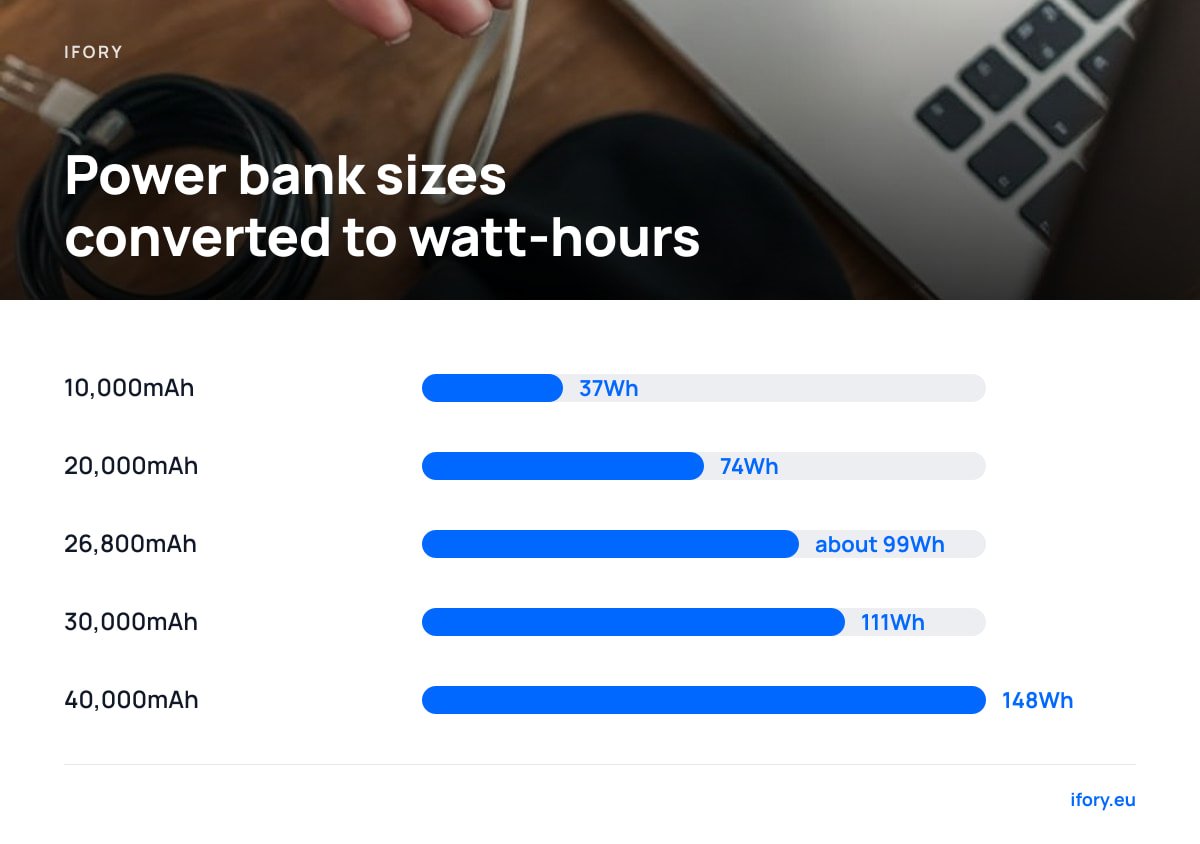
A few worked examples at 3.7V:
- 10,000mAh = 37Wh. Fine everywhere, no questions.
- 20,000mAh = 74Wh. Fine everywhere.
- 26,800mAh = about 99Wh. This is why so many power banks are sold at exactly this size: it sits right under the line.
- 30,000mAh = 111Wh. Over the line, so it needs airline approval.
- 40,000mAh = 148Wh. Over the line, inside the 160Wh ceiling, so approval needed.
Here is the trap. Some brands print the mAh figure at the 5V USB output instead of at cell voltage, which makes the pack look larger or smaller depending on how they do the math. That is exactly why a Wh figure on the casing matters. If the shell shows only mAh, a security officer has to guess, and guesses tend to go against you.
Rule of thumb: divide the mAh by roughly 270 and you have a fast estimate of Wh. A 27,000mAh pack lands at about 100Wh.
Can You Carry a 20000mAh or 30000mAh Power Bank on International Flights?
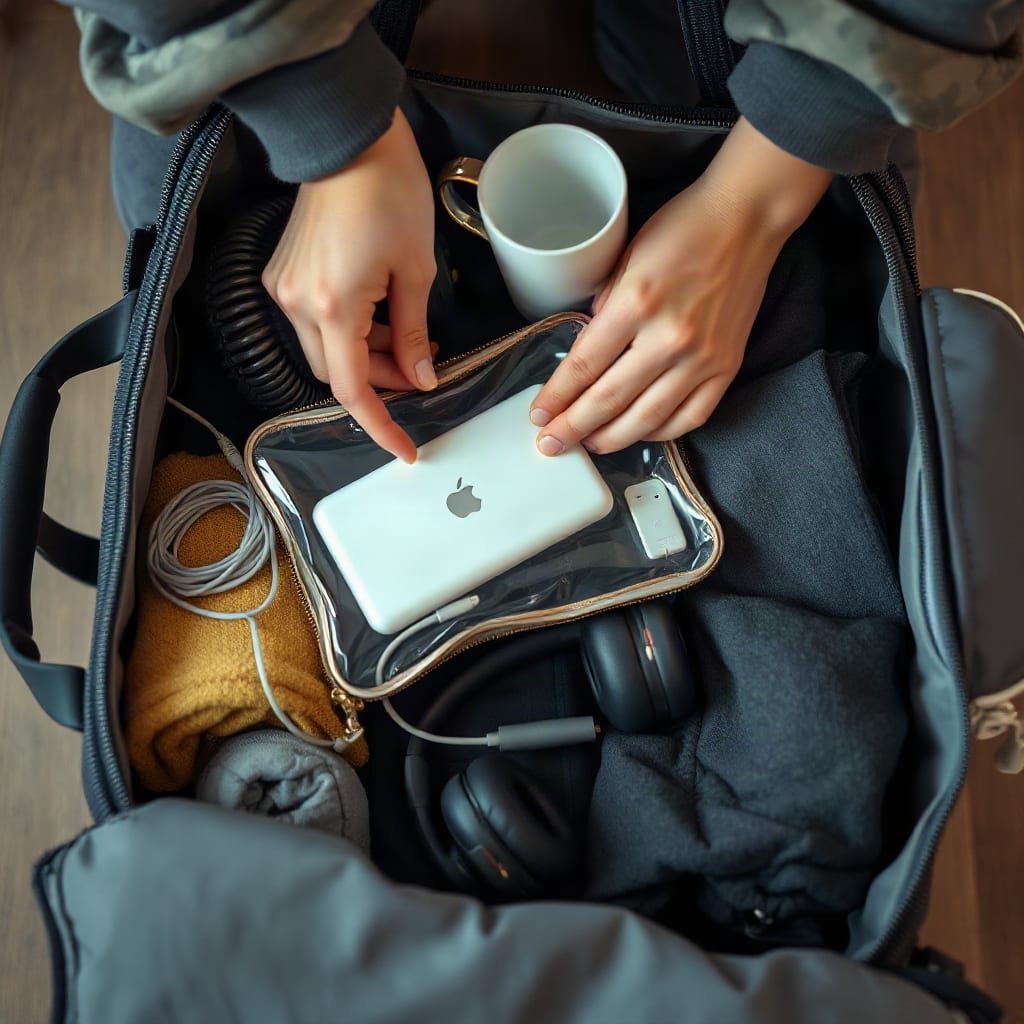
A 20000mAh power bank on an international flight: yes, with no approval. At about 74Wh it sits comfortably under the 100Wh limit used by essentially every major carrier, and it goes in your cabin bag. This is the safe default size for a traveler who just wants a phone charged three or four times.
A 30000mAh power bank on an international flight: it depends on the label, and that is the part competitors skip. If the cells are rated at 3.7V, you are at about 111Wh, which puts it in the approval band. If the manufacturer states a lower Wh figure on the casing, security will go by that printed number. If the casing shows no Wh figure at all, expect questions, and expect that "it's 30000mAh" will not settle them.
My pick for anyone flying more than a couple of times a year: either stay at or below roughly 27,000mAh and skip the paperwork, or buy a larger pack that has the Wh rating printed on it and email the airline once. The middle path, a big pack with no rating printed on the case, is the one that gets confiscated at the gate.
What Airlines Do Differently: Approval, Quantity Limits and Bans
The 100Wh threshold is nearly universal, but everything above it is airline policy. The same 111Wh pack can be waved through on one carrier and refused on another.
Common patterns you will run into
- Approval, then two max. The most common policy for 100 to 160Wh. You contact the airline in advance, and they note it or issue confirmation. Two spare batteries in this band is the usual cap.
- Flat refusal. Some carriers simply do not approve anything over 100Wh for passengers. Check before you buy a ticket if portable power matters to you.
- In-flight use restrictions. A growing number of airlines now prohibit using a power bank while it is plugged in during the flight, or ask that you keep it visible and not stowed in an overhead bin. Several Asian carriers and some regional regulators have moved this way after cabin incidents.
- Quantity caps under 100Wh. Some airlines limit you to a set number of power banks, commonly around two to five, even under the threshold.
Air India specifically
Air India follows the standard international framework: power banks are treated as spare lithium batteries, must be in carry-on only, and anything between 100Wh and 160Wh needs prior approval from the airline. Because airline policies are revised and Indian aviation authorities have their own advisories, check the DGCA and Air India's own baggage page for the current wording before you fly. Do not rely on a screenshot from last year.
Pro Tip: Email the airline and ask for the answer in writing, quoting the exact Wh figure from the label. A reply that says "approved, maximum two units" is worth more at the gate than any amount of explaining. Print it or save it offline, because airport Wi-Fi and gate-agent patience both run short.
Are Portable Power Banks Allowed on Flights at All?
Yes. Portable power banks are allowed on flights, in carry-on baggage only. This is consistent across the US TSA, European regulators and the rules that ICAO sets for member states. The common misunderstanding is thinking the restriction is on the power bank itself. It is not. The restriction is on where it travels and how much energy it holds.
What gets people stopped is not size alone. It is one of these:
- Checked luggage. If a security scan finds a power bank in your hold bag, expect your bag to be pulled and you to be paged.
- Damaged or swollen packs. A pack with any visible swelling, dents or heat damage should never fly.
- Missing labels. No Wh or voltage and capacity information, no easy decision for the officer.
- Loose terminals. Bare USB ports are not a violation on their own, but a pack rattling around loose with keys and coins is a short-circuit risk. Use a pouch.
How to Pack a 100Wh-Plus Power Bank So You Actually Get Through
A big battery is easy to travel with if you set it up the way the screeners expect to see it.
- Do the math before you pack. Write the Wh figure on a piece of tape on the case if the manufacturer did not print it.
- Carry it on your body or in the top compartment. If an officer needs to inspect it, you do not want to unpack a whole bag.
- Protect the ports. A small cloth pouch or the original sleeve is enough. Tape works too.
- Switch it off. Many large packs have a button; make sure a stray bump cannot start it.
- Do not charge it from the seat during takeoff and landing. Keep it visible and unstowed during use, so crew can see it if it overheats.
- Carry the proof. The airline email, the product page or the manual showing the Wh rating.
The reason this matters now is that regulators are paying more attention. Airlines have reported rising numbers of in-flight battery incidents, and the FAA's lithium battery incident chart lists confirmed events involving batteries and battery-powered devices on aircraft. It is a public, regularly updated record, and it is the reason policies tend to tighten rather than relax.
Get a 40,000mAh Power Bank That Is Built for Flying, Not Fighting Security
If you want one pack that handles a laptop, a phone and a console on a long trip, the Ifory 40,000mAh 100W power bank is aimed squarely at that. At 40,000mAh it comes to roughly 148Wh at cell voltage, which puts it in the 100 to 160Wh band: under the 160Wh ceiling, but over the 100Wh line. The 100W output charges a laptop at speed, and you can pair it with the 40W portable solar panel to top it up away from any outlet. Free shipping and 30-day returns apply, and there is a bundle with a free solar panel running at the moment.
Here is the honest caveat. Because it sits above 100Wh, you must get airline approval before you fly, and some carriers will say no outright. Always check your airline's current policy and the Wh figure on the spec sheet, including ours, before you book around it. If you fly on carriers that refuse anything over 100Wh, buy a smaller pack for flights and keep the 40,000mAh for trips by road, rail and trail, where it earns its keep.
Frequently Asked Questions
Are portable power banks allowed on flights?
Yes, but only in your carry-on or on your person, never in checked baggage. Packs up to 100Wh need no approval, packs from 100Wh to 160Wh need airline approval, and anything above 160Wh is not allowed on passenger aircraft.
What are the rules for carrying power banks on Air India flights?
Air India applies the standard international dangerous goods rules: carry-on only, no approval needed up to 100Wh, and prior approval required between 100Wh and 160Wh. Check the airline's baggage page and the DGCA's current advisories before you fly, because airline policies change.
Can I carry a 20000mAh power bank on an international flight?
Yes. At roughly 74Wh it is well under the 100Wh limit used by nearly every airline, so it goes in your cabin bag with no approval. Keep the terminals protected and the Wh rating visible on the casing.
Is a 30000mAh power bank allowed on an international flight?
Often yes, but not automatically. At about 111Wh it falls in the 100 to 160Wh band, so you need airline approval and are usually limited to two such batteries. If the casing has no printed Wh rating, expect it to be questioned at security.
How do I convert mAh to Wh for a power bank?
Multiply the mAh by the nominal voltage, usually 3.7V for lithium-ion cells, then divide by 1,000. A 20,000mAh pack is about 74Wh and a 40,000mAh pack is about 148Wh.
Sources
- ICAO Technical Instructions and dangerous goods guidance | International Civil Aviation Organization
- Lithium Battery Guidance for Airlines | International Air Transport Association
- Lithium Batteries in Aviation | Federal Aviation Administration
- Directorate General of Civil Aviation | Government of India