
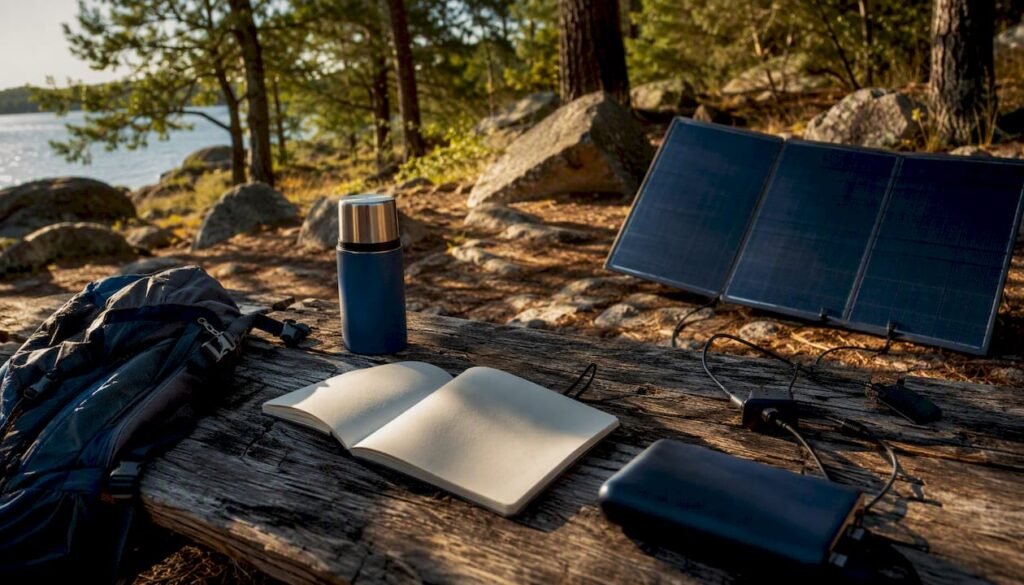
A rugged 40,000 mAh, 100W‑class portable power bank paired with a 40W or larger foldable solar panel is the most reliable off‑grid charging system for multi‑day outdoor trips. It stores enough energy for several days of phone, camera, and even laptop use, recharges fast from a wall outlet before you leave, and tops back up in the field when the sun cooperates.
The setup breaks down into four things worth checking before you buy:
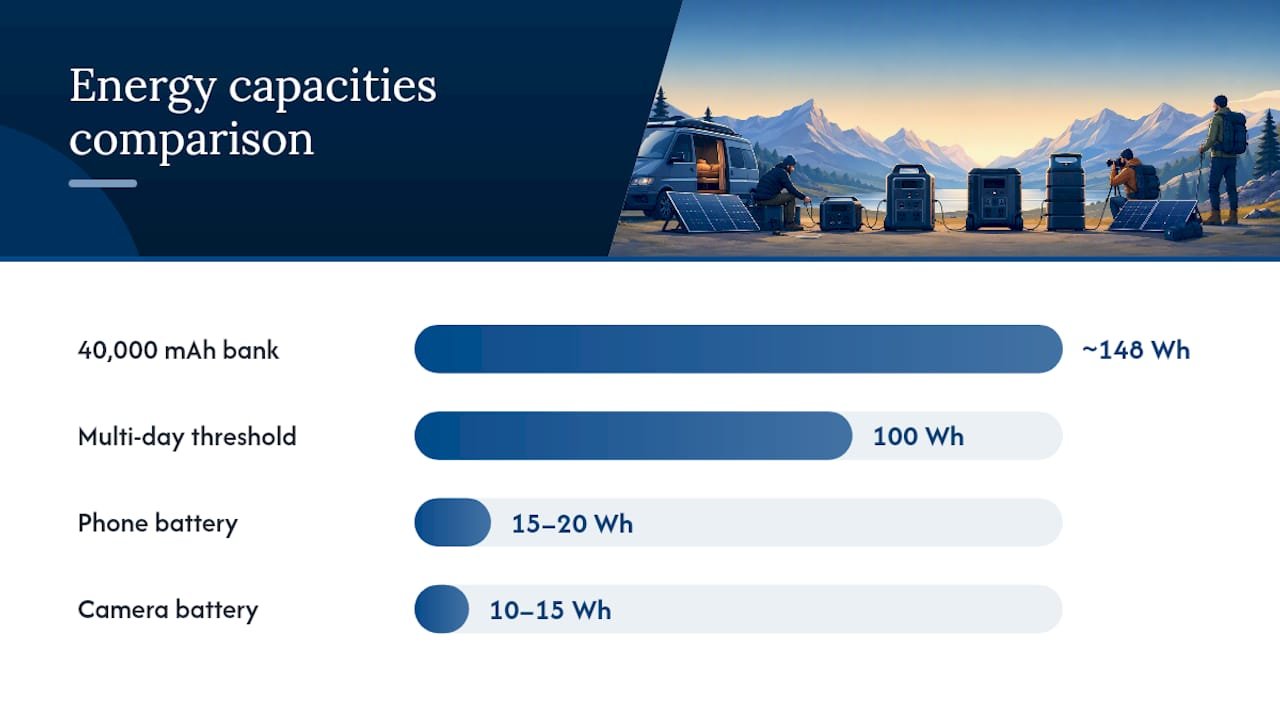
- Capacity and output: 40,000 mAh (about 148 Wh) with 100W peak delivery
- Charging port: USB-C PD, ideally rated for 65W or higher
- Solar companion: a 40W+ foldable panel for daytime top-ups
- Ruggedness: IP67 water resistance and drop protection for field abuse
One thing to set straight early: solar panels are best treated as a buffer that refills your bank, not a live power source for your phone or camera. Output swings too much with cloud cover, panel angle, and dust for direct charging to be dependable, a point REI’s own gear guidance makes clear to backpackers every season.
Key Takeaways
A 40,000 mAh, 100W-class power bank paired with a 40W+ solar panel gives reliable multi-day off-grid charging when solar tops up the bank rather than devices directly.
| Point | Details |
|---|---|
| Lead with capacity and output | Choose a bank near 40,000 mAh / 148 Wh with 100W output to cover multiple devices across several days. |
| Treat solar as a buffer | Use a 40W+ panel to refill the power bank during the day, not to charge devices directly. |
| Check the input spec | Fast USB-C PD input lets you fully recharge the bank overnight before a trip. |
| Watch the airline rule | Batteries over 100 Wh often need airline approval, so confirm limits before flying internationally. |
| Pick Ifory for the field | The Ifory 40,000 mAh / 100W bank adds IP67 durability, an LED display, and a built-in flashlight to the core specs this guide recommends. |
Table of Contents
- Why a High-Capacity Power Bank Fits Off-Grid Needs
- How Does Off-Grid Charging Actually Work?
- What Should You Check Before Buying a Power Bank?
- How Fast Does Solar Recharge a Power Bank?
- How Do You Keep a Lithium Power Bank Safe in the Field?
- Which Setup Fits Your Trip?
- Get Your Off-Grid Charging Kit Sorted Before Your Next Trip
- Frequently Asked Questions
- Sources
Why a High-Capacity Power Bank Fits Off-Grid Needs
Most phones hold a 15 to 20 Wh battery, so a high-capacity bank such as those around 40,000 mAh can provide multiple full phone charges before it runs dry, with plenty left for a camera battery or two. A mirrorless camera battery typically needs 10 to 15 Wh per charge, and laptops draw far more, which is why output wattage matters as much as raw capacity. A bank rated at 100W can actually keep a laptop running while it charges, not just trickle power into it.
Large power banks above 20,000 mAh and 100 Wh are the threshold where multi-day, multi-device use becomes realistic instead of a stretch. Below that, you’re rationing power by day two.
| Spec | Why it matters in the field |
|---|---|
| 40,000 mAh / ~148 Wh | Covers multiple devices across several days without a recharge |
| 100W USB-C PD output | Fast enough to run or quick-charge a laptop, not just a phone |
| IP67 rating | Survives rain, splashes, and dust without failing |
| Anti-drop structure | Handles the drops and knocks that happen on trail or boat decks |
| Integrated flashlight | One less item to pack, one more backup if headlamps die |
| LED display | Shows exact charge percentage instead of a vague four-dot guess |
Pro Tip: Check the input spec, not just the output. A 40,000 mAh / 100W-class bank that accepts fast USB-C PD input can go from empty to full overnight on a wall charger, which matters more than people expect before a trip.
For photographers and boaters specifically, multiple ports matter more than raw capacity. Charging a phone, a camera battery grip, and a GPS unit simultaneously means you want at least two or three usable outputs, not one high-wattage port and nothing else.
How Does Off-Grid Charging Actually Work?
Solar panels feed a controller, the controller feeds the battery inside your power bank, and the bank feeds your devices through USB-C or USB-A. Each step loses a little energy to heat and conversion inefficiency, which is normal and expected. That’s the whole chain, and understanding it explains why plugging your phone straight into a solar panel is a bad habit even when it technically works.
A rough rule of thumb: a 20W panel produces about 20 Wh per hour of direct, overhead sun. Peak sun hours, not daylight hours, are what count, and most regions only offer four to six of those on a clear day. Tilt the panel wrong, let clouds roll in, or let dust build up on the cells, and that output drops fast.
- Solar panel generates raw DC power that varies by the minute
- A regulator or MPPT controller smooths that power before it reaches the battery
- The battery stores usable energy measured in Wh, not just mAh
- Your device draws from the battery through a negotiated PD or USB output
Lithium cells age more slowly when they avoid deep discharge cycles, and shallow, frequent charging is also just faster to squeeze in during a short sunny window.*
What Should You Check Before Buying a Power Bank?
Skip the marketing copy and go straight to the spec sheet. Here’s the order to check things in:
- Usable capacity in Wh, not just mAh. Multiply mAh by the nominal voltage (usually 3.7V for lithium cells) to get a real number.
- Peak output wattage. A bank can have huge capacity and still fail to run a laptop if the output caps at 18W.
- USB-C PD support and its wattage. This is the fast lane, both for charging your bank and for your bank charging your devices.
- Number and type of ports. Multiple simultaneous outputs beat one big one for groups or multi-device kits.
- Input recharge speed. A bank that only accepts 10W input will take most of a day to refill at home.
- Pass-through charging, meaning it can charge devices while it’s plugged in itself.
- Weight and dimensions, since a 40,000 mAh bank runs close to a pound and a half.
- IP rating and drop protection, not a vague “water-resistant” claim.
- Warranty length and whether support is actually reachable.
Watch for these red flags: a capacity number with no Wh conversion listed anywhere, an input spec that’s missing entirely, no stated IP rating (as opposed to a specific number like IP67), and a warranty page that dead-ends in a contact form nobody answers.
Airlines matter here too. Batteries over 100 Wh often require airline approval, and most carriers cap carry-on batteries at 160 Wh outright, with nothing allowed in checked luggage. A 40,000 mAh bank near 148 Wh usually clears security without drama, but check your specific airline before an international flight. If you fly constantly, it’s worth having a smaller backup bank under 100 Wh that never needs a second look at the gate.
- Photographers: prioritize USB-C PD output up to around 100W for camera and drone battery chargers
- Boaters: look for DC or 12V-style output alongside USB, plus a sealed IP rating
- Multi-day campers: weight-to-capacity ratio matters more than squeezing out extra mAh
How Fast Does Solar Recharge a Power Bank?
Panel wattage times peak sun hours gives you a rough Wh estimate, and that math is the whole story. A 20W panel in five hours of good sun produces around 100 Wh, which is enough to take a drained phone from zero to full a few times over but barely dents a 148 Wh bank.
| Panel wattage | Approx. Wh per peak sun-hour | Time to meaningfully top a 40,000 mAh (~148 Wh) bank |
|---|---|---|
| 20W | ~20 Wh | 2 to 3 full sunny days for a substantial top-up |
| 40W | ~40 Wh | About a full day of strong sun for a solid top-up |
| 100W | around 100 Wh | Roughly one long sunny day for a near-full charge |
These numbers assume ideal conditions. Cloud cover, a poorly angled panel, or shade from tree cover routinely cut real output by a third or more, and built-in panels on compact power banks are usually the weakest link, often needing several clear days to matter at all. Treat any built-in solar cell as an emergency backup, not your main plan.
- A 20W panel is fine for keeping a phone topped up on a weekend trip
- A 40W+ foldable panel is the sweet spot for meaningfully feeding a 40,000 mAh bank
- A 100W panel is overkill for solo trips but earns its weight at a basecamp with multiple devices
Pro Tip: If you’re serious about solar, pick a panel with a built-in MPPT controller. It squeezes more usable Wh out of the same sunlight than a basic regulator, especially on hazy days when every watt counts.
How Do You Keep a Lithium Power Bank Safe in the Field?
Keep cells cool, avoid charging them in direct sun on a hot dashboard or tent roof, and store any bank you’re not using soon at roughly 40 to 60% charge rather than full or empty. That single habit does more for long-term battery health than anything else on this list.
- Use the charger the manufacturer specifies; mismatched or cheap third-party bricks can undercharge or overheat a pack
- Never charge a bank that’s visibly wet, swollen, or damaged, even if it still powers on
- Remember IP67 covers temporary immersion, not indefinite submersion. Don’t leave it at the bottom of a dry bag underwater for hours
- Watch for unusual heat during charging. That’s the earliest warning sign of a failing cell
Beyond safety, a little maintenance stretches the life of any bank. Wipe down USB ports after sandy or salty trips, check the rubber seals on IP-rated models for grit buildup, and if you run two banks in rotation, alternate which one handles the bulk of the charging so neither ages faster than the other.
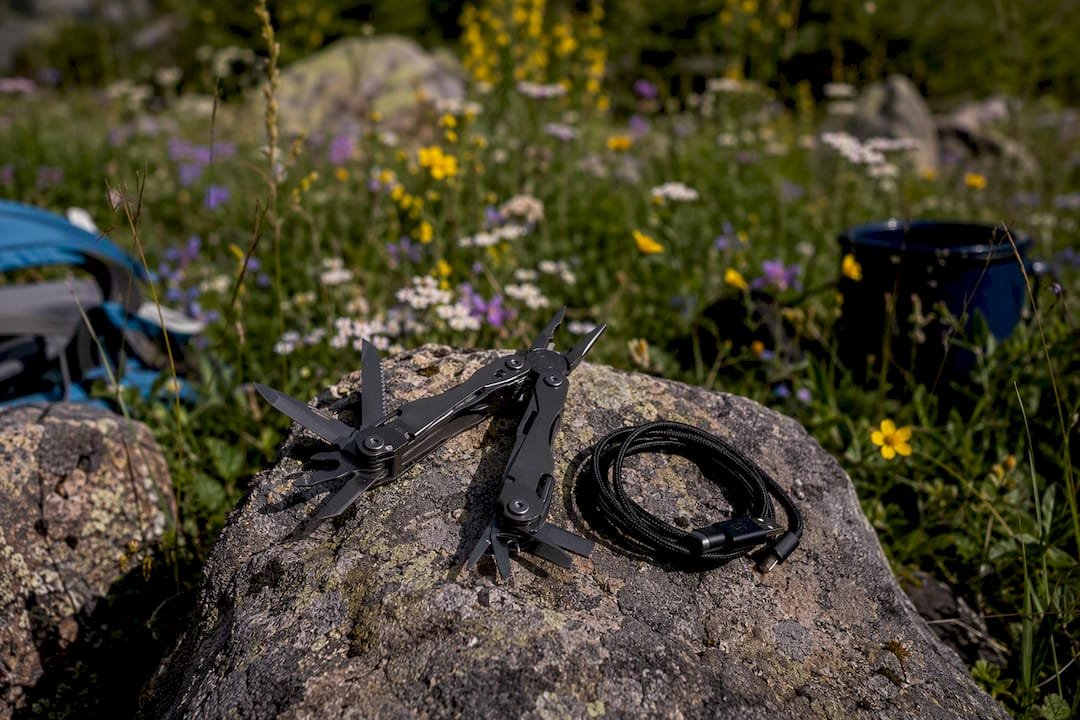
Pro Tip: Pack a compact multi-tool and a spare USB-C cable that matches your bank’s input port. A frayed cable is a small thing to forget and a real problem three days from the trailhead.
Which Setup Fits Your Trip?
Different trips call for different kits, and packing the wrong one either wastes weight or leaves you short on power.
- Day hike: a compact 10,000 to 20,000 mAh bank, a basic USB-C cable, no panel needed unless you’re out past sunset.
- Multi-day basecamp: a 40,000 mAh / 100W-class bank plus a 40W foldable panel, spare cables, and a plan for any 12V accessories like a small cooler.
- Photography or remote work in the field: prioritize 65 to 100W USB-C PD output, bring an extra bank if you’re shooting for days, and keep an eye on in-camera battery percentage rather than guessing.
- Boating: a sealed, IP67-rated bank in a dry box, DC compatibility for any 12V electronics onboard, and a backup bank in case the main one takes a splash.
- Match bank capacity to trip length, not to the biggest number on the shelf
- Bring one more cable than you think you need
- If you’re running a panel, secure it against wind. A flipped panel on a boat deck is a fast way to lose daylight charging hours
A Field-Tested Recommendation
I’ve watched enough trip photos ruined by a dead camera battery to trust one rule: bring more capacity than you think you’ll need, and make sure it can survive getting wet. A 40,000 mAh, 100W-class bank with an IP67 rating, an LED display, and a built-in flashlight, like Ifory’s outdoor model, covers that rule without extra guesswork.
Get Your Off-Grid Charging Kit Sorted Before Your Next Trip
Ifory’s power bank is built specifically for the trips this guide covers: multi-day camping, boating, and shoots far from an outlet. Pair the 40,000 mAh / 100W power bank with the 40W foldable solar panel and you have the exact setup recommended above, ready to order today.

Three reasons to grab it now:
- 40,000 mAh capacity and 100W PD output cover phones, cameras, and laptops without rationing power
- IP67 waterproofing and an anti-drop structure mean it survives rain, splashes, and the occasional fall off a rock
- A built-in LED display shows exact charge level, and the integrated flashlight covers you if a headlamp dies
Browse the full Ifory power bank lineup to compare models and find the one that matches your next trip.
Frequently Asked Questions
Can a solar panel charge my phone directly instead of going through a power bank?
It can technically work, but output swings too much with cloud cover and panel angle to charge safely and consistently. Running solar into a bank first, then the bank into your phone, is the setup REI recommends for this reason.
How many days will a 40,000 mAh power bank last while off grid?
For a single phone user checking a camera occasionally, expect four to six days of moderate use before needing a recharge, though heavy camera or laptop use will shorten that window.
Is a 40,000 mAh power bank allowed on flights?
At roughly 148 Wh, it falls under the range where many airlines require prior approval rather than an automatic ban, so check your specific carrier before departure.
What size solar panel actually keeps up with a 40,000 mAh bank?
A 40W or larger foldable panel is the practical minimum for a meaningful daily top-up. Anything smaller works but takes several sunny days to matter.
Does an IP67 rating mean I can submerge the power bank in a lake?
No. IP67 covers temporary immersion, such as a splash or brief dunk, not extended underwater exposure. Keep it in a dry bag if you’re near water for long stretches.
Sources
- Choosing Solar Chargers for Backpacking | REI Expert Advice
- How to Charge a Solar Power Bank | DIY Clean Energy