
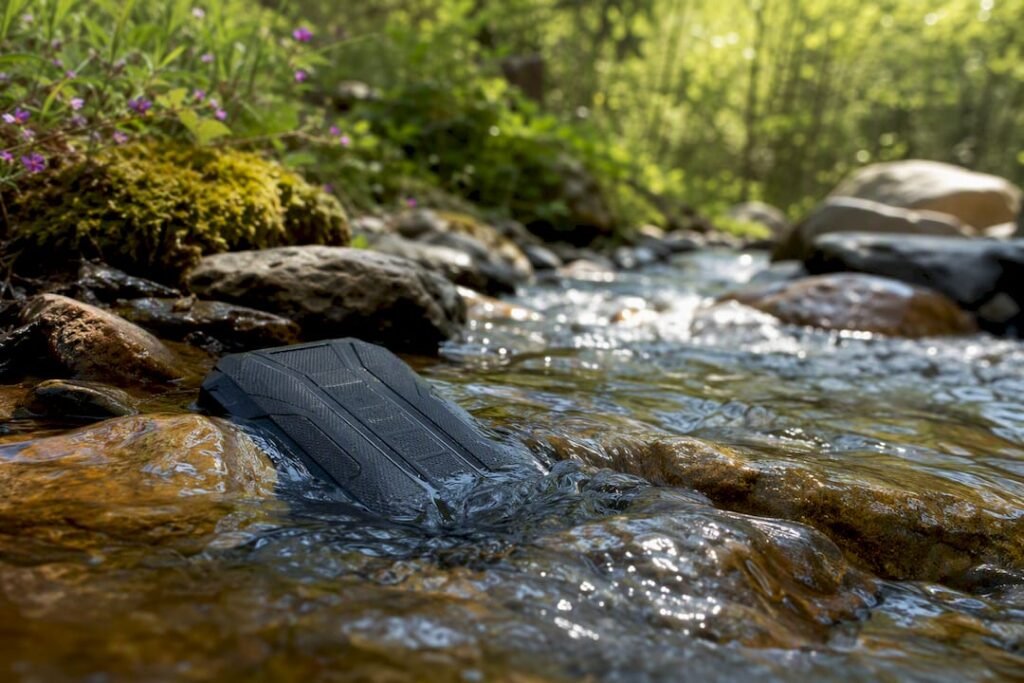
IP67 means a device can survive dropping into 1 meter of water for 30 minutes and coming out fine. IP68 means continuous underwater use, but only at the depth and duration the manufacturer actually tested and states. Neither number tells you anything about pressure jets, saltwater, or how the seal holds up after your device has been dropped a dozen times.
Before you trust either rating on a spec sheet, check three things:
- The declared IP68 depth and duration, since “IP68” alone means nothing without those two numbers
- Whether a third party verified the test, or if it’s only the manufacturer’s own claim
- Warranty language excluding liquid damage, which tells you how much the company actually stands behind the rating
Key Takeaways
IP67 guarantees a fixed 30-minute dunk at 1 meter, while IP68 only means as much as the manufacturer’s specific depth and duration claims, so always verify the datasheet before assuming either rating covers your situation.
| Point | Details |
|---|---|
| IP67 test is fixed | Immersion at 1 meter for 30 minutes, identical across every certified product. |
| IP68 test varies by brand | Depth and duration are manufacturer-defined, so two IP68 products can differ enormously. |
| Both are dust-tight | The first digit (6) is identical for IP67 and IP68, covering solids only. |
| Jets and saltwater aren’t included | Look for IP69K or dual ratings if pressure washing or ocean exposure is likely. |
| Seals degrade over time | Drops, age, and repairs can quietly void a device’s original water resistance. |
Table of Contents
- IP67 vs IP68: How the IP Code Actually Works
- What IP67 Actually Tests
- What IP68 Actually Tests (And Why You Have to Check the Fine Print)
- The Real Differences, and the Misconceptions That Trip People Up
- How to Choose Between IP67 and IP68 When You’re Buying
- What IP67 Looks Like in a Real Product
- The Gap Between the Rating on the Box and the Rating in Practice
- Ready to Buy? Get a Power Bank Built for Real Outdoor Use
- Frequently Asked Questions
- Sources
IP67 vs IP68: How the IP Code Actually Works
Both ratings come from IEC 60529, the international standard that governs how “ingress protection” gets tested and labeled. The code always has two digits, and each one measures something completely different.
- First digit (0 to 6): protection against solids, like dust and debris. A 6 is the top score, meaning fully dust-tight.
- Second digit (0 to 9): protection against liquids, ranging from light dripping to high-pressure jets to full immersion.
An “X” in place of either digit means that axis wasn’t tested at all, not that it failed. You’ll see this on cheaper products that only bother testing water resistance and skip the dust test entirely.
Here’s the part buyers miss: both IP67 and IP68 start with a 6, meaning both are equally dust-tight. The entire difference between them lives in the second digit, and it comes down to how long and how deep a device can sit in water. IEC 60529 also has firm limits. It doesn’t test for temperature extremes, corrosion, or mechanical impact, which matters more than most spec sheets let on.
What IP67 Actually Tests
The IP67 test is specific and fixed: a device gets submerged in 1 meter of static fresh water for 30 minutes, with no harmful water getting inside. That’s it. Not a range, not a suggestion, one exact procedure every manufacturer follows the same way.
That covers a lot of real-world accidents:
- Dropping your phone in a puddle or toilet
- Getting caught in a downpour on a hike
- A power bank falling into a kayak’s bilge water for a few minutes
But IP67 was never built for sustained underwater use. It says nothing about pressure jets, boat wakes, or what happens if the device sits at the bottom of a lake overnight. Saltwater exposure isn’t part of the test either, so corrosion risk near the ocean is a separate concern entirely.
Pro Tip: If you’re near water constantly, not just occasionally near it, don’t assume IP67 covers you. Ask specifically whether the product has been tested for repeated exposure, not just a single 30 minute dunk.

What IP68 Actually Tests (And Why You Have to Check the Fine Print)
IP68 covers continuous immersion, but there’s no universal depth or time baked into the standard. The manufacturer sets those parameters and reports them, which means one company’s IP68 device might be tested at 1.5 meters for 30 minutes, while another claims 3 meters for 24 hours.
That range is enormous, and the IEC standard doesn’t require a single fixed benchmark for the “8” rating the way it does for IP67. Two products can carry the identical “IP68” label while surviving wildly different real-world scenarios.
Before trusting an IP68 claim, verify:
- The exact depth and duration listed on the official datasheet, not just marketing copy
- Whether an independent lab tested those numbers, or if it’s a self-reported figure
- Whether the test used fresh water or saltwater, since IEC 60529 testing defaults to fresh water unless stated otherwise
An IP68 declaration with no depth or duration attached is close to meaningless for a buyer trying to compare products. Engineers sourcing components routinely negotiate exact test parameters with suppliers for this exact reason, because “IP68” by itself answers nothing about the scenario you actually care about.
The Real Differences, and the Misconceptions That Trip People Up
The biggest myth around these ratings is that IP68 means “fully waterproof, no exceptions.” It doesn’t. It means tested to a specific depth and time, in fresh water, under lab conditions that don’t resemble a beach trip or a pressure washer.
A few things worth knowing before you shop:
- IP68 doesn’t cover high-pressure jets. That’s a separate test entirely, covered by IPX5, IPX6, or IP69K depending on pressure and temperature.
- Seals degrade. Drops, age, and repairs can all quietly void the water resistance a device shipped with, even if the rating printed on the box never changes.
- Saltwater and chemical exposure fall outside standard IP testing, since the lab procedure uses fresh water only.
Manufacturers achieve these ratings through different engineering approaches, and the method matters for durability. Conformal coating handles splash and light jet protection up to roughly IPX6, but true IP67 or IP68 protection usually requires sealed enclosures or potting. Potting is effective, but it also means the device can’t be opened for repair and runs hotter internally, a real trade off for anyone expecting a long service life.
| Factor | IP67 | IP68 |
|---|---|---|
| Dust protection | Fully dust-tight | Fully dust-tight |
| Immersion depth | 1 meter (fixed by standard) | Manufacturer-defined, varies by product |
| Immersion time | 30 minutes (fixed by standard) | Manufacturer-defined, varies by product |
| Pressure jets | Not tested | Not automatically covered, needs separate IPX6/IP69K rating |
| Saltwater | Not tested | Not tested unless separately verified |
The decision rule is simple: match the rating to your actual exposure risk, not the bigger number. A higher IP rating usually costs more and complicates design, so buying more protection than you need is just wasted money if you’re never taking the device underwater.
How to Choose Between IP67 and IP68 When You’re Buying
- Define your actual exposure. Are you dealing with rain and splashes, one accidental dunk, or hours of continuous submersion? Be honest about the worst realistic case, not the best one.
- Pull the datasheet, not the marketing page. Look for the exact depth and duration behind any IP68 claim, and check whether a third-party lab verified it.
- Look for dual ratings if you face multiple threats. A device rated IP66/IP68 handles both pressure jets and immersion, which matters if you’re near boat decks or pressure washers.
- Read the warranty’s fine print. Liquid damage exclusions tell you how confident the company really is in its own rating, and whether saltwater testing was ever part of the picture.
Pro Tip: Call or email support and ask directly for the third-party test report behind an IP68 claim. If the company can’t produce one, treat the number as a marketing claim, not an engineering guarantee.
What IP67 Looks Like in a Real Product
Ifory’s power bank carries an IP67 rating alongside 40,000mAh capacity, an anti-drop structure, a real-time LED display, and a built-in flashlight. That combination targets one specific problem: keeping outdoor gear charged without babying it.
In practice, that IP67 rating means the power bank shrugs off:
- Sudden rain during a hike or camping trip
- A splash from a kayak paddle or a dropped water bottle
- A brief fall into a puddle, stream, or tide pool
It’s not built for sustained underwater use, and no IP67 device should be treated that way. The anti-drop housing matters just as much here, since a rugged shell that survives a fall onto rock does more for real-world reliability than a marginally higher water rating ever would.
A power bank rated IP67 is built for the accidents that actually happen outdoors, rain, spray, a dunk in a puddle, not for living at the bottom of a lake.
The Gap Between the Rating on the Box and the Rating in Practice
Most buying guides treat IP68 as automatically superior to IP67, and that’s the wrong instinct. A vague IP68 claim with no stated depth or duration tells you less than a precise IP67 rating with a fixed, testable procedure behind it. Specificity beats a bigger number.
The conventional advice, “always buy the higher IP rating if you can afford it”, ignores what that number costs you in practice. Higher immersion ratings often mean potted, sealed electronics that can’t be repaired and run warmer under load. For a power bank you’re recharging daily and tossing in a backpack, a well-engineered IP67 device with a genuinely rugged shell often serves you better than an IP68 unit rated for depths you’ll never see.
What actually matters is matching the rating to your specific risk. Ask what test backs the number, not just what the number says. A manufacturer that publishes exact depth, duration, and test conditions has already done more homework than one that slaps “waterproof” on the box and hopes you don’t ask questions.
Ready to Buy? Get a Power Bank Built for Real Outdoor Use
If you’re heading somewhere with rain, splash, or the occasional dunk in your future, Ifory’s IP67 power banks are built around exactly that scenario, not lab conditions you’ll never encounter. The 40,000mAh capacity and 100W fast charging mean you’re not choosing between ruggedness and actually useful power, and the anti-drop housing backs up the water rating with real physical durability. Check the full lineup to find the model that matches your trip.
Frequently Asked Questions
Is IP68 always better than IP67?
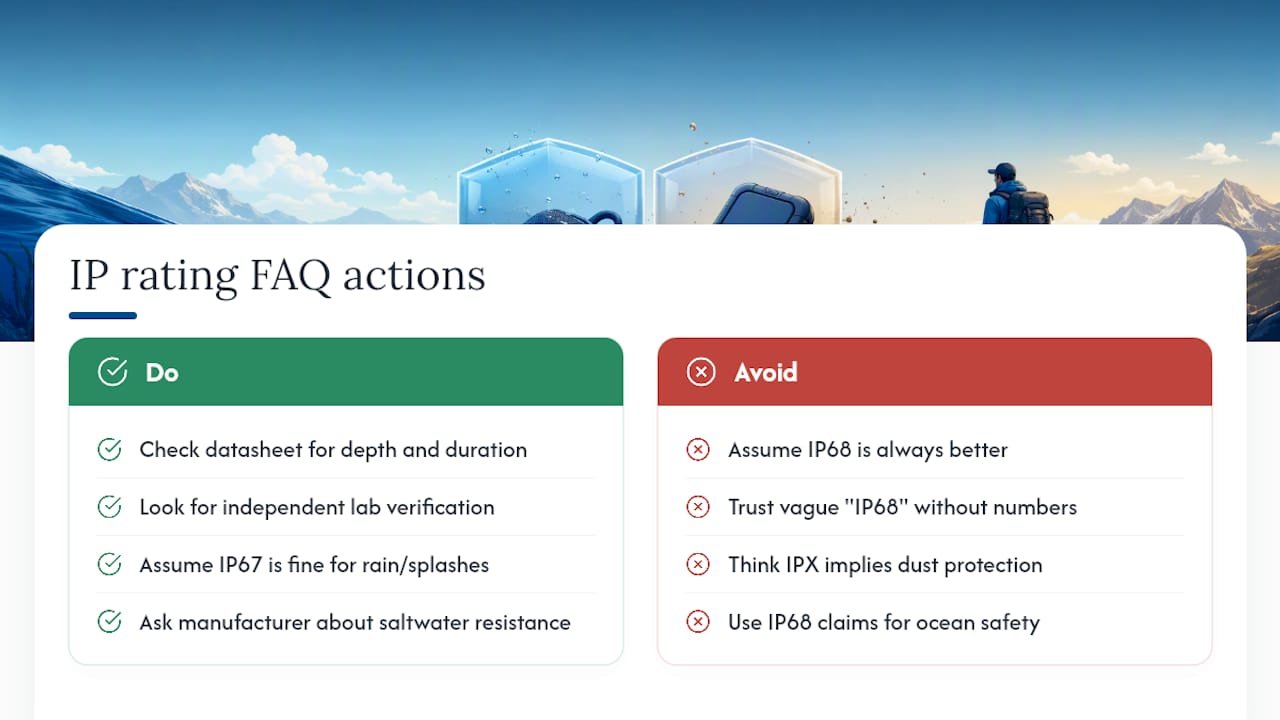
Not automatically. IP68 only beats IP67 if the manufacturer’s declared depth and duration actually exceed what IP67 guarantees. A vague IP68 claim with no stated parameters can offer less real protection than a clearly documented IP67 rating.
Can I use an IP67 power bank in the rain?
Yes. Rain, splashes, and brief spills fall well within what an IP67 waterproof rating is built to handle, since the certification test involves full submersion, a far more demanding scenario than a rain shower.
Does IP68 mean a device is safe in the ocean?
Not necessarily. Standard IP68 testing uses fresh water, not saltwater, so corrosion resistance near the ocean needs separate verification from the manufacturer.
What does the “X” mean in an IP rating like IPX7?
It means that particular axis, solids or liquids, wasn’t tested at all. An IPX7 rating tells you nothing about dust resistance, only that the liquid immersion test was performed.
How do I know if a product’s IP68 claim is legitimate?
Check the official datasheet for the exact depth and duration, and look for mention of independent lab verification. If a company only advertises “IP68” with no numbers attached, treat the claim skeptically.
Sources
- IP code – Wikipedia
- IP Rating for Electronics: The IP67 & IP68 Design Guide – PCBSync
- How IP rating testing works under IEC 60529 | Eurotech