
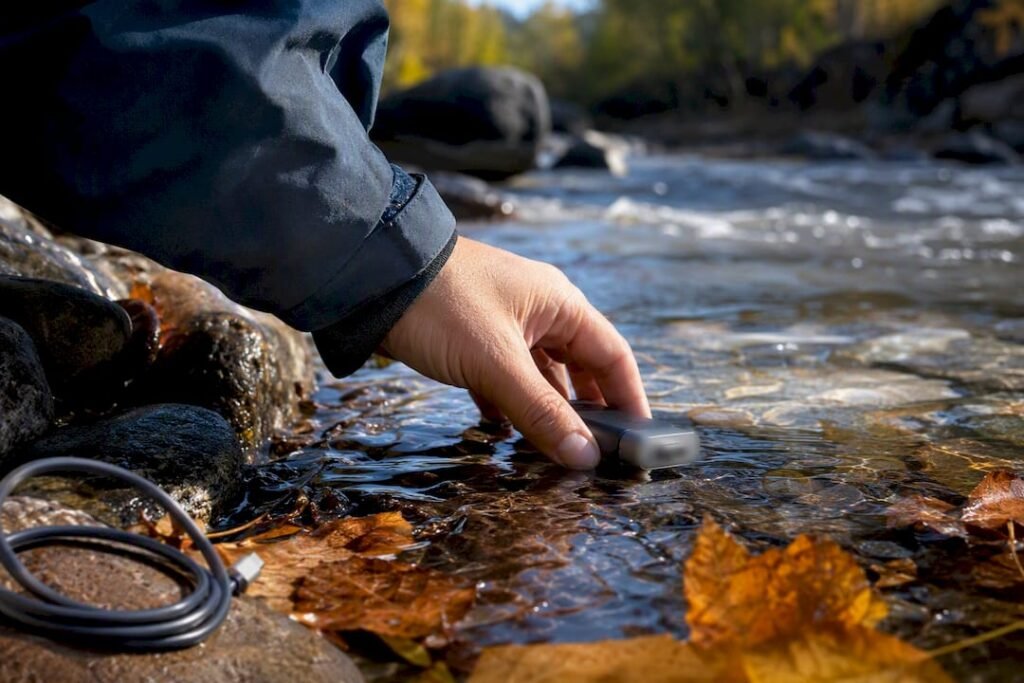
For most outdoor power banks, IP67 is the practical minimum and IP68 only matters if the maker states an exact depth and duration. Skip vague “waterproof” marketing and check the actual IP code before you buy.
Here’s the quick mapping:
- IP65/IP66: rain and splashes only, fine for commuting or a covered camp table.
- IP67: survives accidental short immersion, roughly 1 meter for 30 minutes in freshwater. This covers most hiking, camping, and general outdoor use.
- IP68: built for deliberate or extended immersion, but only as good as the manufacturer’s published test numbers.
A port cover left open or a worn gasket erases any of these ratings the moment water gets in.
Key Takeaways
Most outdoor activities need an IP67-rated power bank, not a device marketed simply as “waterproof” with no test data behind it.
| Point | Details |
|---|---|
| Check the IP code | Ignore “waterproof” marketing and look for a specific rating like IP65, IP67, or IP68. |
| IP67 fits most trips | Covers rain, splashes, and roughly 1 meter of accidental immersion for 30 minutes. |
| IP68 needs documentation | Only trust it if the manufacturer states exact depth and duration tested. |
| Maintain the seal | Inspect port covers and gaskets each season; rinse freshwater after saltwater exposure. |
| Never charge wet | Power off, dry fully with desiccant for 48+ hours, then test with a low-power device. |
Table of Contents
- Waterproof vs Water Resistant: How IP Codes Actually Work
- Matching Your Activity to the Right Rating
- Why Seals, Ports, and Salt Wear Down Any Rating
- What to Do the Moment Your Power Bank Gets Wet
- Where Ifory Fits the Outdoor Protection Standard
- The Real Lesson Behind Waterproof Marketing Claims
- Ready for a Power Bank Built for the Outdoors?
- Frequently Asked Questions
- Sources
Waterproof vs Water Resistant: How IP Codes Actually Work
“Waterproof” and “water resistant” are not technical terms. Neither one appears in the IEC 60529 standard that manufacturers actually test against, which is why two products can both claim to be “waterproof” while offering wildly different protection.
The IP code format is two digits: the first covers dust and solid particles, the second covers water. For power banks, the second digit is what matters:
- IPX4: splash resistant from any direction, but not submersible.
- IPX5: withstands low-pressure water jets.
- IPX6: withstands powerful jets, closer to what you’d face in a downpour or a wave splash on a boat deck.
- IPX7: temporary immersion, typically around 1 meter deep for 30 minutes.
- IPX8: continuous immersion beyond IPX7 conditions, but the standard requires the manufacturer to specify the exact depth and time tested.
- IPX9K: high-pressure, high-temperature washdowns, a rating built for industrial equipment rather than consumer electronics.
A number without documentation is just a guess. An IP67 rating means immersion at roughly 1 meter for 30 minutes in freshwater under controlled lab conditions, at standard temperature. IP68 has no fixed benchmark; a brand claiming IP68 needs to tell you the depth and the time, or the number is essentially meaningless. Any device labeled simply “waterproof” with no IP code attached should be treated as unverified marketing, not a spec.
Matching Your Activity to the Right Rating
You don’t need the highest-rated device on the shelf. You need the one that matches what you’re actually going to do to it, and buying more protection than your activity requires usually means paying for extra bulk and weight you’ll carry for nothing.
- Commuting and day-to-day carry. IPX4 to IPX6 handles rain, sweat, and the occasional spilled coffee. You’re not dunking anything here.
- Hiking and camping. IP67 is the sweet spot. Stream crossings, sudden downpours, and a power bank dropped in a puddle at a campsite all fall within that 1 meter, 30 minute window.
- Paddling and boating. IP67 covers spray and brief dunks, but if you’re regularly capsizing kayaks or working around open water, look for a documented IP68 rating with a stated depth, and pair it with a floating dry bag regardless of the rating on the box.
- Photography in wet conditions. Your power bank rarely touches water directly, so IP65 or IP67 is usually enough. Save your money for weatherproofing on the camera body itself.
- Emergency and survival kits. IP67 minimum, since these units often sit in a pack for months and then get used in the worst conditions imaginable.
Higher ratings generally mean thicker seals, heavier housings, and higher prices. That’s a fair trade for a boater who’s regularly near open water; it’s overkill for someone who mostly worries about rain on a trailhead.
Pro Tip: A $10 dry bag or a tethered pouch does more to protect your electronics than jumping from IP67 to IP68 ever will. Habits close the gap that ratings alone can’t.
Why Seals, Ports, and Salt Wear Down Any Rating
An IP rating describes a brand new device tested once in a lab. It says nothing about what happens after six months of sand in the charging port or a winter spent in a cold truck bed. Seal integrity is what actually determines real-world protection, and gaskets degrade with age no matter what number is printed on the box.
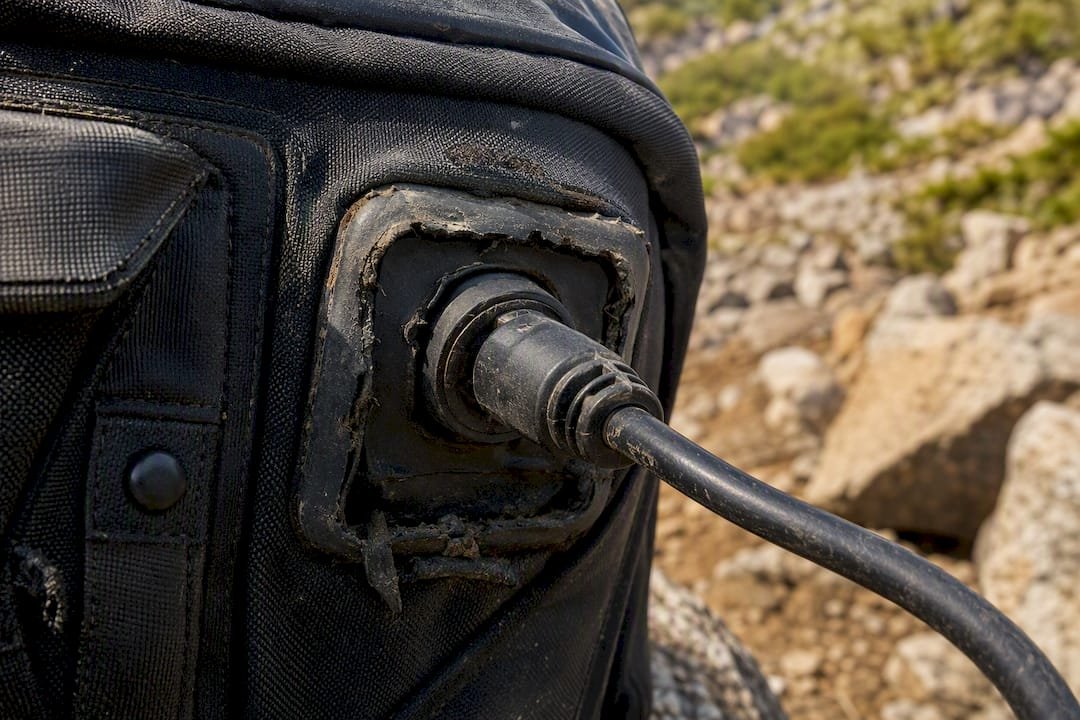
Saltwater is the biggest threat outdoor gear owners underestimate. IP testing typically happens in freshwater at standard room temperature, and saltwater accelerates corrosion and gasket breakdown well beyond what the original test accounted for. Temperature swings do similar damage, since rubber seals stiffen in the cold and lose the flexibility that keeps water out.
A short maintenance routine keeps a rating meaningful instead of theoretical:
- Check that every port cover clicks fully shut before you leave dry ground.
- Rinse the exterior with fresh water after any saltwater exposure, then dry it completely.
- Never plug in a charging cable while the device or your hands are wet.
- Inspect rubber gaskets each season and replace or retire a unit once a seal looks cracked or compressed.
Pro Tip: Boaters should treat “rinse after every trip” as non-negotiable, the same way you’d rinse fishing reels or outboard motors after a day on saltwater.
What to Do the Moment Your Power Bank Gets Wet
Even a properly rated device can end up in water it wasn’t built for. Speed matters here more than technique.
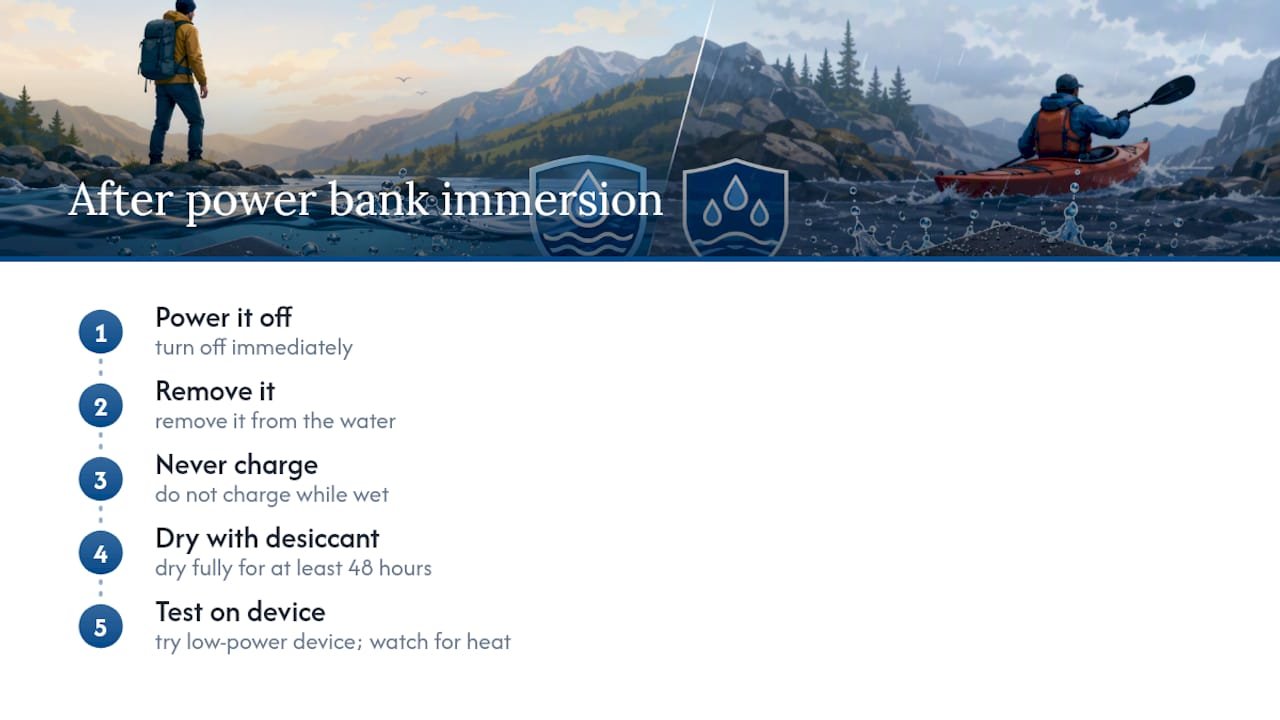
- Power it off immediately and pull it out of the water. Don’t wait to see if it “seems fine.”
- Skip the charger entirely. Charging a wet device is how a minor dunk turns into a fire risk.
- Dry the exterior, open every port cover, and seal it in a container with a desiccant packet or silica gel for at least 48 hours.
- Once dry, test it with a low-power device first, a phone or a small light rather than a laptop, and watch for unusual heat or a voltage drop before trusting it with anything valuable.
If it runs hot, smells odd, or the output feels weak, retire it. That’s a cheaper decision than the alternative.
Where Ifory Fits the Outdoor Protection Standard
Ifory built its power bank around the IP67 standard this guide keeps pointing to, rather than a vague waterproof label with nothing behind it.
- IP67 rating for accidental drops in puddles, sudden rain, and stream crossings.
- 40,000mAh capacity with 100W fast charging, enough for multi-day trips without rationing power across devices.
- Multiple USB-C and USB-A ports for charging a phone, headlamp, and camera battery at once.
- Anti-drop housing built for the same rocky trails and boat decks where water exposure happens.
- Real-time LED display so you can check remaining capacity without guessing.
- Integrated flashlight that covers the gap when your headlamp dies at camp.
IP67 covers the situations most campers, hikers, and casual boaters actually run into: rain, splashes, and a brief dunk, not a deliberate swim. It’s not rated for sustained saltwater immersion or for charging while wet, and no IP67 device should be treated that way. For trips built around solar charging in the field, Ifory’s solar-compatible power bank extends that same protection to multi-day setups where wall outlets aren’t an option. Full specs live on the waterproof power bank product page if you want the exact numbers before buying.
The Real Lesson Behind Waterproof Marketing Claims
Most of the confusion around “waterproof vs water resistant” isn’t really about water. It’s about marketing language filling a vacuum that a proper spec sheet should occupy. Brands know “waterproof” sounds reassuring, so they use it even when the only thing backing the claim is a splash test.
What the research actually supports is narrower and more useful: check the IP number, check whether the manufacturer states depth and duration for anything claiming IP68, and treat the rating as a lab result, not a lifetime guarantee. Conventional advice tends to stop at “buy something waterproof,” which is close to useless without a number attached.
The bigger gap is maintenance. A brand-new IP67 device and a two-year-old one with a sand-clogged port cover are not equally protected, even though the sticker says the same thing. Readers should prioritize checking their own gear’s seals over chasing a higher IP number they’ll rarely need. For boaters especially, pairing a properly rated device with sound onboard electronics practices matters more than which digit follows the letters “IP” on the box.
Ready for a Power Bank Built for the Outdoors?
If you camp, hike, paddle, or shoot photos in unpredictable weather, an IP67-rated power bank removes one more thing to worry about in the field. Ifory’s 40,000mAh power bank lineup pairs that rating with 100W fast charging and a built-in flashlight, so a dead battery and a dead headlamp stop being two separate problems. For trips where reliability matters most, like backcountry emergencies or overnight camps, the emergency power bank with flashlight is built specifically for that scenario.
Frequently Asked Questions
Is a water-resistant power bank good enough for camping?
It depends on the rating behind “water resistant.” IPX4 to IPX6 handles rain and splashes but not immersion. For camping near streams or in unpredictable weather, an IP67-rated device gives you a real margin against accidental dunks.
What’s the actual difference between waterproof and water resistant for electronics?
There’s no legal or technical definition tied to those words alone. The only reliable measure is the IP code from IEC 60529, since a device rated IP67 has passed a specific immersion test while one just labeled “water resistant” may only have been splash tested.
Do I need IP68 for boating?
Only if you’re regularly submerging gear or working around heavy spray for extended periods. Most recreational boaters do fine with IP67 paired with a dry bag, since the combination of habit and rating outperforms chasing the highest number available.
Can saltwater damage an IP67 or IP68 power bank?
Yes. IP testing uses freshwater, and saltwater accelerates corrosion on ports and seals faster than the rating accounts for. Rinsing with fresh water after any ocean exposure meaningfully extends the life of the seal.
What should I do if my power bank falls in water?
Power it off immediately, remove it from the water, and never charge it while wet. Dry it fully with a desiccant for at least 48 hours before testing it on a low-power device and watching for unusual heat.
Sources
- IEC — IP ratings
- Waterproof Power Bank IP Ratings Explained | KEUTEK
- What Does ‘Waterproof Power Bank’ Actually Mean? (IP67 vs IP68 Explained)
- Intertek — ingress protection guidance