
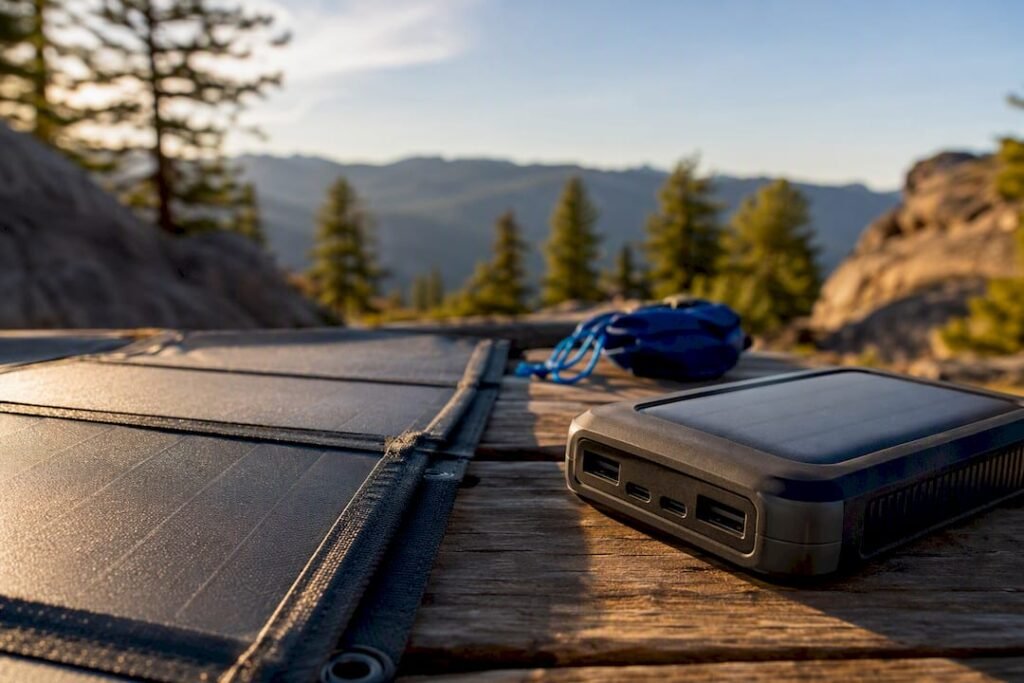
For most trips, a high-capacity power bank should be your primary charging tool, with a folding solar panel added only for extended off-grid stretches. Integrated solar power banks look appealing on a store shelf, but they belong in the “nice backup” category, not the “count on this” category. Products with large capacity and fast charging fit the primary role well, and pairing one with a separate solar panel covers the rest.
TL;DR:
- Power banks with at least 40,000mAh capacity and 18W or higher PD output are best suited for frequent or multi-device use outdoors.
- Integrated solar panels produce minimal watt-hours, often less than 10% of a smartphone battery in two days of sun, limiting their practical recharging ability.
- For multi-day off-grid trips, pairing a separate 20-40 watt folding solar panel with a large, fast-charging power bank significantly extends device uptime.
- High ratings like IP67 or IP68 ensure durability against dust and water, which are essential for rough outdoor conditions.
- Proper maintenance, such as avoiding deep discharge and keeping surfaces clean, prolongs the lifespan of both power banks and solar panels.
Table of Contents
- Solar vs Power Bank: Comparing Capacity, Speed, and Durability
- When Should a Power Bank Be Your Primary Charger?
- When Is Solar Worth Adding to Your Kit?
- What Features Actually Matter When You’re Buying?
- How to Pair a Power Bank and Solar Panel in the Field
- Keeping Your Charging Gear Working for Years
- Why I’d Still Pack a Bank Before a Panel
- Get a Rugged, Ready Setup With Ifory
- Sources
Solar vs Power Bank: Comparing Capacity, Speed, and Durability
The numbers tell most of the story here. A power bank’s rated capacity in milliamp hours (mAh) is not what you actually get to use; the gap trips up a lot of buyers.
Take a 40,000mAh bank. Multiply that by the nominal battery voltage (about 3.7V) and divide by 1,000, and you get roughly 148 watt-hours of stored energy. But voltage conversion and cable resistance eat into that. Realistically, expect somewhere in the 70 to 85% range to actually reach your device, meaning that 40,000mAh unit delivers closer to 100 to 125 usable watt-hours in practice, not the full 148.
Solar tells a rougher story. A single-panel solar power bank, tested under normal outdoor conditions, often produces less than 1.5 watt-hours over two full days, according to BGR’s testing of solar power banks. Multi-panel units do better, landing around 6 to 9 watt-hours over the same stretch. For context, a modern smartphone battery holds around 14.5 watt-hours. Even the better multi-panel integrated units can’t fully recharge a phone in two days of sun.
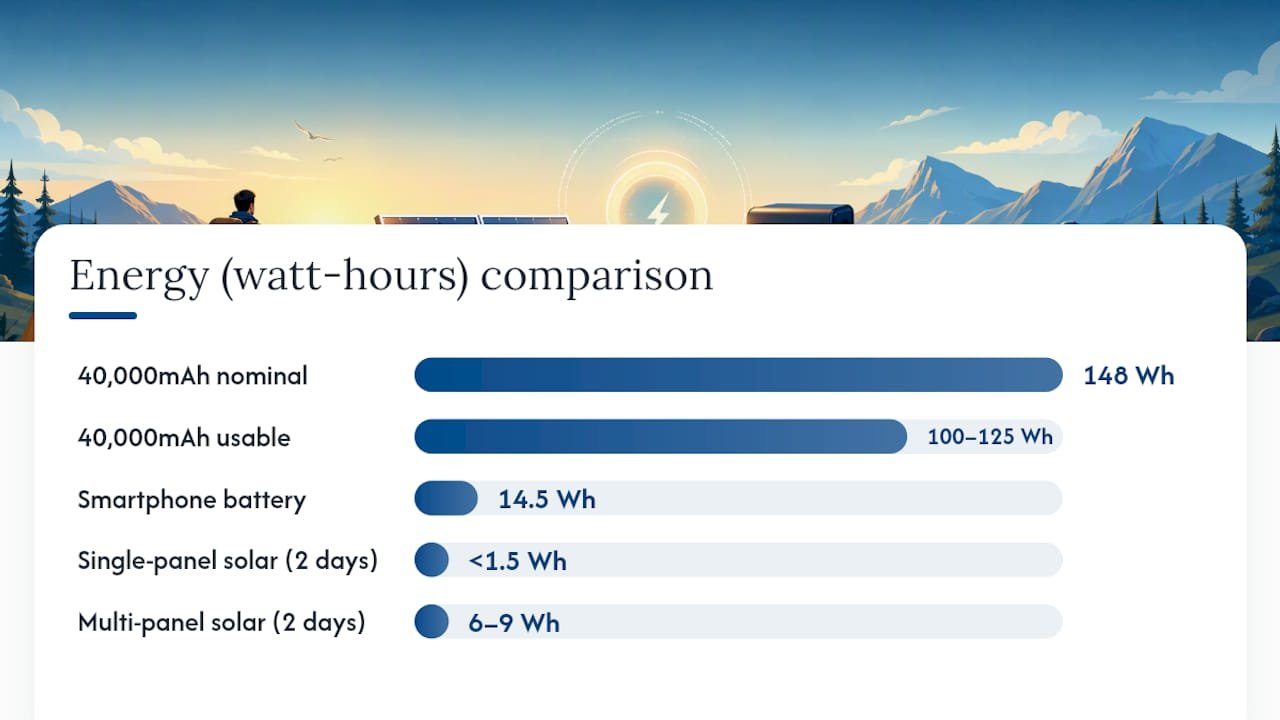
Statistic Callout: Two days of direct sunlight on a typical single-panel solar power bank yields less than 1.5 watt-hours, less than 10% of one smartphone charge.
Here’s how the two options stack up across the factors that actually matter in the field:
- Usable energy: Power banks deliver near their rated capacity minus conversion loss; integrated solar panels add only a marginal trickle.
- Recharge speed: Wall charging via USB-C PD can refill a large bank in a couple of hours; solar panels recharge over days, not hours.
- Durability: Look for IP67 or IP68 ratings; both indicate real water and dust resistance, with IP68 tolerating deeper submersion.
- Reliability: A charged bank works regardless of weather; solar output depends entirely on sun angle and cloud cover.
- Cost per use: A bank’s value comes from charge cycles over its lifespan; solar panels add cost upfront with a slower payoff in convenience, not raw dollars.
Pro Tip: When a product page says “solar charging,” check whether the panel charges the internal battery or claims to charge your phone directly. Direct-to-device solar claims are almost always marketing gloss over a trickle of power, as BGR’s analysis makes clear.
When Should a Power Bank Be Your Primary Charger?
Day hikes, weekend trips, and anything with a return to civilization within 48 hours all favor a straightforward power bank. Weight is predictable, output is predictable, and you’re not gambling on weather.
- Short trips and day hikes: You know exactly how much charge you’ll use, so pack a bank sized to that estimate rather than overbuying capacity you’ll carry but never touch.
- Match capacity to your devices: A 10,000mAh bank covers a phone for a couple of days; 20,000mAh handles a phone plus a camera or GPS unit; 40,000mAh supports multi-device groups or laptop top-offs.
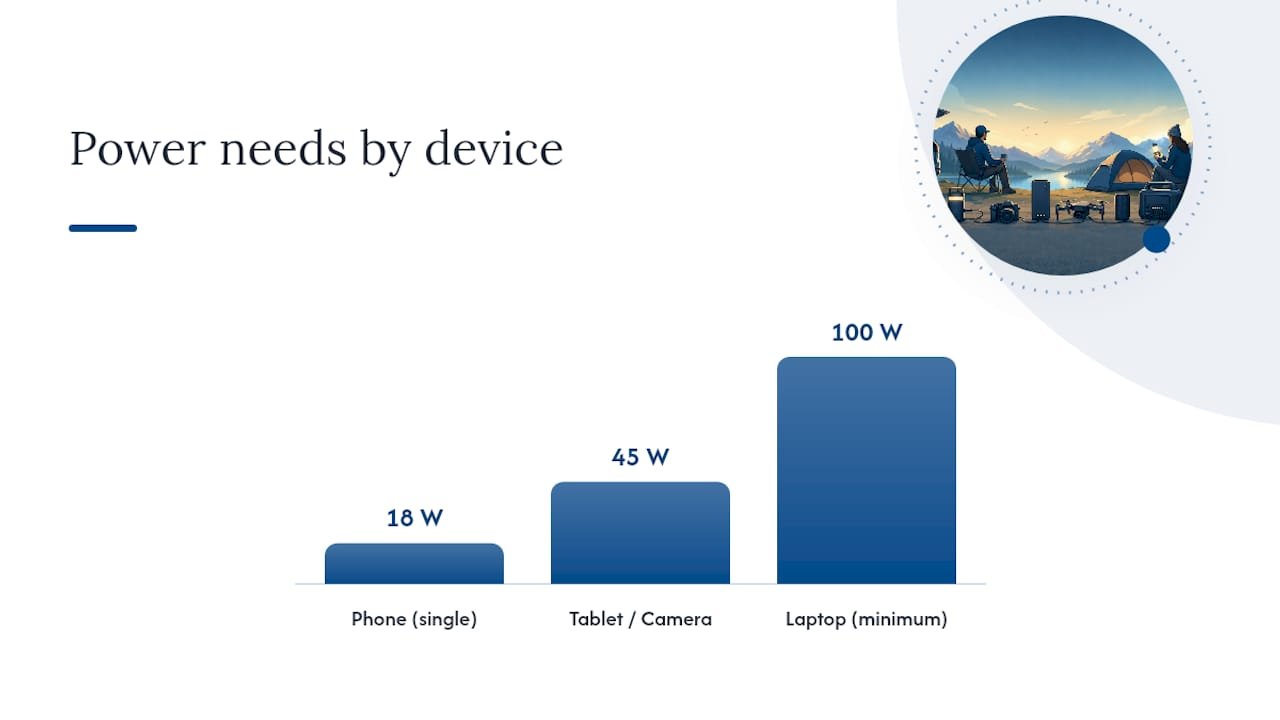
- Prioritize USB-C PD output: Older 5W or 10W bricks struggle with modern phones and are useless for laptops. Look for 18W as a baseline, 45W for laptop-capable charging, and 100W if you’re running power-hungry gear like a laptop or camera rig at speed.
- Confirm the durability specs: An IP67 rating means the bank survives dust and temporary submersion, which matters more than people expect once a bank ends up at the bottom of a wet pack.
Brand explainers from EcoFlow’s comparison of solar chargers and power banks back this up directly: power banks fit short, predictable trips, while solar comes into play for longer, off-grid stretches.
Pro Tip: Check a bank’s low-temperature charging cutoff before a cold-weather trip. Many lithium batteries throttle or stop charging below freezing, which catches winter campers off guard.
When Is Solar Worth Adding to Your Kit?
Solar earns its place on multi-day trips with real sun exposure and no resupply options nearby. Think five-day backcountry routes, van life stretches between towns, or extended kayak trips where an outlet simply doesn’t exist.
The mistake most buyers make is expecting an integrated solar panel bolted onto a power bank to do this job. It can’t. Those tiny panels are built for convenience, not output, and REI’s own expert advice on solar chargers for backpacking recommends pairing a dedicated folding panel with a separate battery instead of relying on built-in cells.
Statistic Callout: Multi-panel integrated solar power banks average just 6 to 9 watt-hours of output over two days in real conditions, according to BGR, well under half a smartphone’s typical battery capacity.
For actual off-grid recharging, look at standalone folding panels rated 20 to 40 watts. These fold flat, weigh little more than a rain jacket, and generate enough real wattage in good sun to meaningfully refill a bank over the course of a day.
A few things to weigh before you add one to your pack:
- Folding panels only perform near their rated output in direct, unobstructed sun, not through tree cover or on cloudy days.
- Leaving any lithium battery in direct sun for extended periods raises internal temperature, which shortens lifespan and can trigger a protective charging cutoff, per battery safety research.
- Panels charge batteries far more efficiently than they charge devices directly, since devices need stable, regulated voltage that raw solar input doesn’t reliably provide.
What Features Actually Matter When You’re Buying?
Spec sheets throw a lot of numbers at you. Most of them matter less than four or five key figures.
Start with energy math. Convert mAh to Wh by multiplying by voltage (roughly 3.7V for most cells) and dividing by 1,000, then mentally discount that number by 15 to 30% for real-world conversion loss. That’s the number that predicts how many phone charges you’ll actually get, not the mAh printed on the box.
Charging speed comes next. An 18W PD output is fine for a single phone. Anything running a tablet or camera setup wants 45W. If a laptop is part of your kit, 100W output isn’t optional, it’s the floor.
- IP rating: IP67 tolerates dust and brief submersion; IP68 goes further, holding up to deeper or longer water exposure, which matters for kayaking, rafting, or coastal trips.
- Shock protection: An anti-drop structure or reinforced casing prevents a fall onto rock or a boat deck from ending your trip’s power supply.
- Solar input wattage: For a standalone panel, 20W supports light phone top-ups; 40W supports faster recharging of a large bank in good sun, following the pairing logic REI recommends.
- Temperature management: Look for charging cutoffs or thermal regulation, since heat is the single biggest factor shortening lithium battery life.
- Multiple ports: USB-C and USB-A output together let you charge a phone and a headlamp or GPS unit simultaneously without swapping cables.
Pro Tip: Don’t just check peak wattage. Check whether that wattage applies per port or total output split across all ports. A bank advertising 100W might only deliver 18W per device once you plug in three things at once.
How to Pair a Power Bank and Solar Panel in the Field
Trip length should decide your setup, not brand preference. A weekend trip rarely needs solar at all; a multi-day expedition almost always benefits from it.
- Weekend trips (1 to 3 nights): A 10,000 to 20,000mAh bank alone usually covers phone, headlamp, and GPS needs without adding panel weight.
- Multi-day trips (4 to 7 nights): Pair a 20,000mAh or larger bank with a 20 to 40W folding panel, a combination gear comparisons consistently recommend for good-sun conditions.
- Extended expeditions or off-grid stretches: Go with a larger bank, such as a 40,000mAh unit, paired with a 40W or larger panel to keep pace with daily device draw.
- Daily workflow: Charge the bank from the panel during peak sun hours, keep both out of direct heat when not actively charging, and top off devices from the bank overnight rather than waiting for a full battery.
Field-test summaries across outdoor gear guides consistently land on the same conclusion: a dependable bank plus a separate folding panel outperforms any single integrated unit, both for reliability and total watt-hours delivered. For a deeper look at building this kind of setup, Ifory’s guide to off-grid charging walks through pairing logic in more detail.
Pro Tip: Pack the panel where it gets grabbed first, not buried at the bottom. A panel you never unfold because it’s inconvenient to reach is dead weight.
Keeping Your Charging Gear Working for Years
Power banks and solar panels both degrade faster with neglect than with use. The habits that protect them are simple but easy to skip.
For power banks, avoid letting the internal cells sit fully drained for long stretches between trips. Storing a bank at around 40 to 60% charge during off-season months slows the natural capacity loss that all lithium batteries experience over time. Keep banks out of hot cars and direct sun when not actively charging, since heat is the fastest way to shave years off a battery’s usable life.
For solar panels, the panel’s efficiency drops if the surface collects dust, sand, or salt spray, so a quick wipe with a dry cloth before each use keeps output closer to rated wattage. Check the folding hinges and connector cables periodically for cracks or fraying, since these tend to fail before the solar cells themselves do.
Both devices benefit from avoiding extreme cold storage, which can cause condensation inside battery compartments once the gear warms back up. A dry stuff sack or a dedicated pouch does more for longevity than most people assume. None of this is complicated, but skipping it is exactly how a two-year-old bank starts holding half its original charge.
Why I’d Still Pack a Bank Before a Panel
Stored power is predictable. Solar isn’t. That’s the whole argument, and it holds up regardless of how good next year’s panels get. A charged bank works at 2 a.m. in the rain; a panel works only when the sun cooperates.
I’d rather carry a bank with real PD output and an IP67 rating, then add a folding panel only when the trip actually demands off-grid days. A high-capacity, fast-charging, rugged power bank fits that primary role: real usable capacity, fast recharge before you leave, and rugged enough for a pack that gets dropped. Use the checklist above before you buy anything, and let trip length, not marketing copy, decide whether solar earns a spot in your bag.
— Mats
Get a Rugged, Ready Setup With Ifory
Ifory built its lineup around exactly the primary role this guide recommends: a bank you charge fully before leaving, then trust in the field. The Ifory 40,000mAh 100W power bank delivers fast USB-C PD charging, multiple ports for splitting power across devices, an IP67 rating for wet or dusty conditions, a real-time LED display so you’re never guessing at remaining charge, and a built-in flashlight for camp use after dark.

For readers planning multi-day trips, Ifory’s 40W portable solar panel pairs directly with the bank for the hybrid setup this article recommends: stored power as your base, solar as your extension when the trip runs long. If durability and drop protection matter more than anything else in your kit, browse the full power bank lineup and pick the capacity that matches your next trip’s length.
Sources
- Do phone power banks with solar panels actually work? — BGR
- Choosing solar chargers for backpacking | REI expert advice
- Solar charger vs. power bank: Which one do you really need? — EcoFlow
- PMC article on battery behavior and safety