

Watts measure how much electrical power something uses; amps measure how much current flows to deliver that power. The two are linked by one formula, P = V × I, which means power equals voltage times current — so if you know two of the three values, you can always solve for the third using I = P ÷ V at a known voltage (like 230 V for most household circuits).
TL;DR:
- Converting watts to amps requires dividing the wattage by the fixed household voltage, which is typically 230 V in Europe or 120 V in North America.
- A 1,000 W device on a 230 V circuit draws about 4.3 amps, while the same device on 120 V draws roughly 8.3 amps, increasing the current load.
- Appliances with motors or coils may draw more current than simple watt-to-amp calculations suggest due to the power factor affecting real power versus apparent power.
- Using tools like clamp meters or wattmeters provides more accurate measurements of actual power consumption than relying solely on nameplate ratings.
- When planning circuits or estimating energy costs, it is more important to consider wattage and run time than amps alone, as energy use in kilowatt-hours determines your electricity bill.
Table of Contents
- Watts vs Amps: What Volts, Current, and Resistance Actually Mean
- How to Convert Watts to Amps (and Amps to Watts)
- Watt Ratings for Common Appliances Converted to Amps
- Why Watts and Amps Don’t Always Line Up on AC Power
- How to Measure Watts and Amps Without Guessing
- Sizing Portable Power: From mAh to Watts and Amps
- How Power Consumption Turns Into Your Energy Bill
- When to Think in Watts vs When to Think in Amps
- Single-Phase vs Three-Phase Power: Does It Change the Formula?
- Getting the Math Right Matters More Than Memorizing Numbers
- Sources
Watts vs Amps: What Volts, Current, and Resistance Actually Mean
Picture electricity moving through a wire the way water moves through a hose. Voltage is the water pressure pushing things along. Current, measured in amps, is how much water actually flows past a given point per second. Resistance is how narrow the hose is, and power in watts is the total work that flowing water can do, like turning a wheel or filling a bucket.
Three formulas tie all of this together, and once you know them, you stop needing to memorize conversions and start being able to derive them on the spot:
- Ohm’s Law: V = I × R (voltage equals current times resistance)
- Power formula: P = V × I (watts equal volts times amps)
- Rearranged for current: I = P ÷ V (amps equal watts divided by volts)
That second formula is the one that matters most for the watts vs amps question, because it’s the direct bridge between the two units. Ohm’s Law and the power formula together let you calculate any missing value in the equation as long as you have the other two.
Here’s the part that trips people up: household voltage in most countries is treated as a fixed number. Whether you’re plugging in a lamp or a space heater, the wall socket is still delivering roughly the same voltage, whether that’s 230 V in Germany and most of Europe or 120 V in North America. Because voltage stays constant, the relationship between watts and amps on a normal household circuit simplifies down to a single division problem. That’s why so many appliance labels list watts, but electricians think in amps. They’re describing the same electrical event from two different angles.
How to Convert Watts to Amps (and Amps to Watts)
The math here is genuinely simple once you see it laid out. You’re just rearranging P = V × I depending on which value you’re missing.
- To find amps from watts: divide watts by volts. I = P ÷ V.
- To find watts from amps: multiply amps by volts. P = V × I.
- To convert watts to kilowatts: divide by 1,000 (so 1,500 W becomes 1.5 kW), which matters when you’re later calculating energy costs in kWh.
Try it with real numbers. A 1,000 W space heater running on a 230 V circuit draws 1,000 ÷ 230, which comes out to about 4.3 amps. Bump that heater up to a heavier-duty 2,400 W unit on the same 230 V circuit, and you’re now pulling 2,400 ÷ 230, or roughly 10.4 amps, which is close to what a lot of dedicated heater circuits are rated for.
Switch to a 120 V system, the standard in North American homes, and the same wattage draws more current because the voltage pushing it is lower. A 1,500 W hair dryer on 120 V pulls 1,500 ÷ 120, or 12.5 amps, which is a big chunk of a typical 15 amp household circuit.
Drop down to 12 V, the kind of voltage you’d find in a car, boat, or a portable power setup, and small wattages suddenly mean much bigger amp draws. A 100 W device running on 12 V pulls 100 ÷ 12, or about 8.3 amps, which is why 12 V wiring needs thicker gauge cable than a household outlet running the same wattage.
| Load | Voltage | Amps Drawn |
|---|---|---|
| 1,000 W heater | 230 V | 4.3 A |
| 2,400 W heater | 230 V | 10.4 A |
| 1,500 W hair dryer | 120 V | 12.5 A |
| 100 W device | 12 V | 8.3 A |
The Electrical Safety First units calculator confirms this same relationship: amps times volts equals watts, and you can always isolate whichever variable you’re missing.
Watt Ratings for Common Appliances Converted to Amps
Appliance nameplates almost always list watts, but your circuit breaker only cares about amps. Converting between the two at a standard 230 V supply tells you how much of a circuit’s capacity any single device is actually using.
A few things worth knowing before you start adding appliances to one outlet:
- The number on a plug or fuse (such as “13 A”) indicates the maximum current rating of the socket or fuse, not the actual current draw or the breaker rating behind the wall.
- Watts and amps are the same underlying fact expressed in two different units at a fixed supply voltage, which is exactly why dividing by 230 works so consistently for standard European and UK circuits.
- Two high-draw appliances sharing one circuit add up fast: a 2,200 W kettle and a 1,200 W toaster running together pull almost 15 amps combined, which is enough to trip a standard 15 amp breaker.
That kettle-and-toaster scenario is the single most common reason a kitchen breaker trips mid-morning. Neither appliance is faulty. The circuit is just doing exactly what it’s designed to do when asked to carry more current than it’s rated for.
Why Watts and Amps Don’t Always Line Up on AC Power
Everything above assumes a clean, direct relationship between watts and amps, and for resistive loads like heaters and kettles, that holds up well. Motors, pumps, and anything with a coil inside behave differently on AC power, because of a factor called power factor.
Apparent power, measured in volt-amps (VA), is what you get from S = V × I alone. Real power, in watts, is what the device actually converts into useful work, and the two only match perfectly when power factor equals 1. The formula becomes P = V × I × PF.
Here’s why that matters practically: a motor rated at 1,000 W but running at a power factor of 0.8 doesn’t draw 1,000 ÷ 230 amps. It draws 1,000 ÷ (230 × 0.8), which works out to about 5.4 amps instead of 4.3 amps. That’s a real jump in current for the same wattage on the nameplate, and it’s why motor-driven appliances sometimes trip breakers that a simple watts ÷ volts calculation says should be fine.
How to Measure Watts and Amps Without Guessing
Reading a nameplate gets you an estimate. Measuring gets you the real number, and three tools cover almost every situation you’ll run into at home.
- Clamp meter: clips around a wire without breaking the circuit and reads current directly in amps.
- Wattmeter: plugs inline with a device and reports real power draw in watts, factoring in power factor automatically.
- Multimeter: measures voltage, resistance, and (with the right leads) current, making it the most versatile option for troubleshooting.
Clamp meters read current without disconnecting anything, which makes them the safer, faster choice for checking what an appliance is actually pulling.
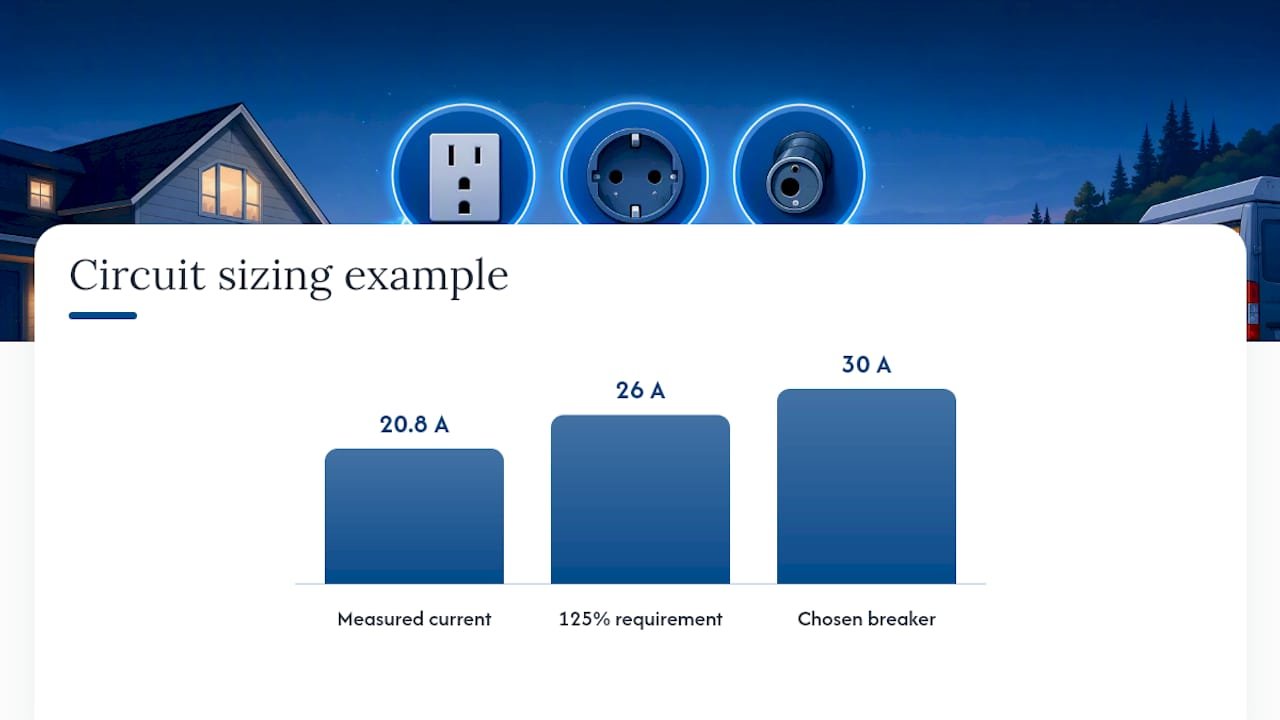
For sizing a breaker on a continuous load, electricians apply a 125% safety margin to the calculated current. A 5,000 W heater on a 240 V circuit draws about 20.8 amps at full tilt; multiply that by 1.25 and you get 26 amps, which means you’d size the circuit to the next standard breaker up, typically 30 amps.
Pro Tip: Never open a panel or measure a live conductor without insulated gloves and a rated meter. If you’re unsure whether a circuit can handle a new load, call a licensed electrician instead of guessing.
Sizing Portable Power: From mAh to Watts and Amps
Power banks list capacity in milliamp hours (mAh), which isn’t directly comparable to the watts and amps you’ve been calculating so far. The bridge is watt hours (Wh): Wh = (mAh ÷ 1000) × nominal voltage.
Take a 40,000 mAh power bank at a typical 3.7 V cell voltage: 40,000 ÷ 1,000 × 3.7 gives you 148 Wh of stored energy. When that energy comes out through a 5 V USB port, you can push roughly 148 ÷ 5, or close to 29.6 amp hours of output at that voltage, though real-world efficiency losses trim that slightly.
- Nominal voltage matters because a pack rated the same in mAh can store very different amounts of actual energy depending on cell voltage.
- Ifory’s mAh to Wh conversion guide walks through this math with more worked examples for anyone comparing power banks by spec sheet alone.
- If you’re running several devices off one pack, Ifory’s guide to charging multiple devices covers how port output gets divided across simultaneous loads.
How Power Consumption Turns Into Your Energy Bill
Watts measure power at an instant. Your utility bill measures energy over time, in kilowatt hours, and confusing the two is one of the most common mistakes people make when they try to estimate running costs. A 1,000 W device isn’t a fixed cost. It’s a fixed rate.
Run that 1,000 W appliance for one hour and you’ve used 1 kWh of energy. Run it for three hours and you’ve used 3 kWh. The formula is simply kWh = kW × hours, which means the same device can cost wildly different amounts depending purely on how long it stays switched on.
This is also why amps alone can’t tell you what something costs to run. Current tells you how much a device is straining a circuit right now; it says nothing about duration. Two appliances pulling the identical 10 amps, one running for ten minutes and one running for ten hours, produce vastly different bills despite having the same instantaneous draw.
If you want to estimate a real cost, convert the appliance’s wattage to kilowatts, multiply by the hours it actually runs, then multiply by your utility’s rate per kWh. A 2,000 W heater run for four hours uses 8 kWh. At a typical German household electricity rate, that adds up fast over a heating season, which is exactly why wattage and run time matter more to your bill than amperage does on its own.
When to Think in Watts vs When to Think in Amps
The two units answer different questions, and knowing which one you actually need saves a lot of confusion.
Reach for watts when you’re comparing energy use, estimating running costs, or checking whether a device will do the job you need (a 1,200 W microwave heats faster than a 700 W one, full stop). Appliance shopping, energy bills, and generator sizing by total load all live in watt-land.
Reach for amps when the question is about wiring, circuits, or fuses. Breakers are rated in amps. Extension cords are rated in amps. Battery packs and solar setups often spec their charging current in amps because that’s what determines charge time and cable gauge. If you’re asking “will this trip my breaker” or “can this cable handle it,” you’re asking an amps question, even if the appliance label only shows watts.
A quick gut check: if the number you’re comparing changes based on how long something runs, you’re really talking about energy, and watts (or watt hours) is the right lens. If the number is about what a wire or breaker can physically handle at any given moment, amps is your unit. Most confusion in this whole topic comes from mixing those two timeframes up rather than any real difficulty with the math itself.
Single-Phase vs Three-Phase Power: Does It Change the Formula?
Most homes run on single-phase power, where the standard P = V × I formula applies cleanly, whether that’s 230 V in most of Europe or 120 V in North America. Everything covered so far in this article assumes single-phase, and for the vast majority of household appliances, that assumption holds.
Three-phase power shows up in larger installations: workshops, commercial buildings, EV fast chargers, and heavy machinery. It delivers power across three alternating currents instead of one, and the formula picks up a factor to account for that: P = V × I × √3 for balanced three-phase loads (roughly 1.732 for the square root of 3).
The practical effect is that three-phase systems can deliver much more power through comparatively lower current per phase, which is exactly why industrial equipment and fast EV chargers often run on three-phase supply. A charger rated for a given kW output on three-phase draws noticeably less current per line than the same power delivered over single-phase. Anyone comparing EV charger specs runs into this directly. Converting a charger’s kW rating into the amps it actually needs depends heavily on whether the installation is single-phase or three-phase, and skipping that step is a common sizing mistake for home charging setups.
For anything running off a standard wall outlet or a portable power bank, though, three-phase math simply doesn’t apply. It only becomes relevant once you’re dealing with dedicated high-power circuits.
Getting the Math Right Matters More Than Memorizing Numbers
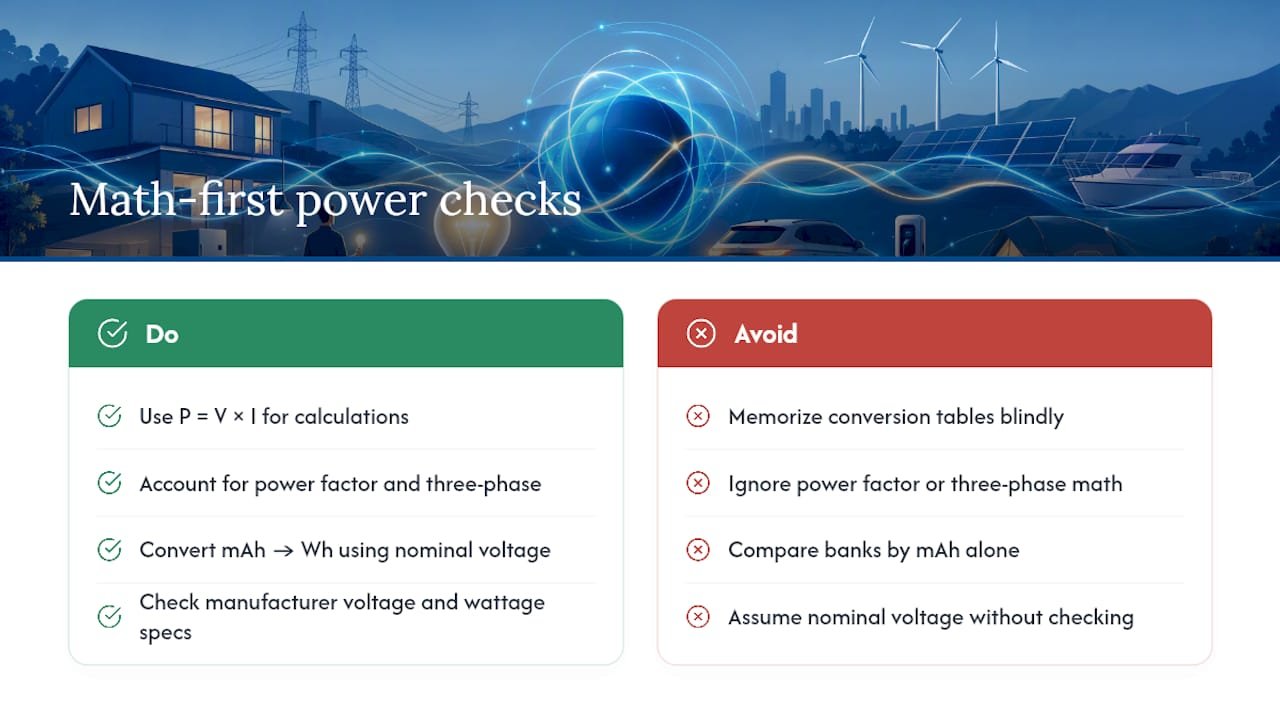
Most confusion around watts and amps doesn’t come from bad math. It comes from people trying to memorize conversion tables instead of understanding that P = V × I is the only formula doing any real work here. Once that clicks, every appliance label, every breaker rating, and every power bank spec sheet turns into a two-step calculation instead of a mystery.
The area where I think most guides fail readers is treating power factor and three-phase math as afterthoughts. They’re not edge cases. Anyone shopping for an EV charger, running a workshop, or troubleshooting why a motor trips a breaker that “should” handle the load runs straight into these nuances, and skipping them leaves people with a formula that works for kettles but fails for exactly the appliances that cause real problems.
For portable power specifically, the mAh to Wh to amps chain trips people up because manufacturers rarely explain which nominal voltage they used to calculate a battery’s advertised capacity. That single number changes every downstream calculation. If you’re comparing power banks by capacity claims alone, you’re missing the variable that actually determines how much real-world power you’re getting.
If you’re shopping for portable power with these numbers in mind, Ifory’s 40,000mAh power bank lineup is built around the same math covered here, with real wattage and output specs listed rather than capacity numbers alone. For anyone heading somewhere off-grid, the emergency power bank with integrated flashlight is worth a look specifically because it pairs the capacity math with the IP67 waterproofing and drop protection that matter once you’re actually outdoors and away from a wall outlet.
— Mats
Sources
- Amps, Watts & Volts Calculator — Electrical Safety First
- Electrical units and measurements for volts, amps, watts, kWh, and AWG — EleCalculator
- Watts, volts, amps and ohms explained — Family Handyman
- Volts, amps and watts: what is the difference? — North Shore Electricals
- Amps vs volts vs watts — Galvin Power