

Most 40,000mAh power banks fall into three bands: budget packs with basic ports, mid-range packs with better build and fast charging, and premium packs with 100W output and rugged protection. The feature that most often justifies paying more is high-wattage USB-C Power Delivery combined with weather and drop protection. If you need both, our Ifory Powerbank at 99 EUR sits in the premium group.
TL;DR:
- Testing puts usable capacity at about 82% to 87% of the advertised 40,000mAh, so compare watt hours rather than milliamp hours alone.
- Premium models add 100W output, but outdoor buyers should verify an IP rating and drop protection rather than trust a tier label.
- Compare the full checkout cost, including a suitably rated USB-C cable, a capable wall charger, shipping, returns, and useful accessories.
- For a fixed departure date, favor in stock local listings; overseas orders and preorders can face slower delivery or uncertain dispatch dates.
Table of Contents
- Price bands explained: what counts as low, typical, and premium
- What drives price: technical and practical factors that change cost
- How to evaluate a specific offer: a shopper’s checklist
- Timing and places to find the best price
- Total cost of ownership: accessories, cables, and shipping
- Typical timeframe from purchase to delivery
- Why a rugged 40,000mAh 100W pack makes sense for outdoor use
- Ifory Powerbank: built for the premium band
- FAQ
- Sources
Price bands explained: what counts as low, typical, and premium
Retail prices for this capacity class move with features more than with the number on the label, so it helps to benchmark any offer against the feature set you get at each level. We do not quote hard price bands for every brand here, because current pricing shifts by seller and season. One reference point: a ZDNET review of a 40,000mAh/144Wh pack described a price near $150 as a reasonable buy given its size and specs.
Here is what shoppers usually find at each level:
- Low end: basic USB-A and USB-C ports, little or no high-wattage Power Delivery, plain plastic shells, and a simple LED indicator. Fine for phones and tablets, weak for laptops.
- Mid-range: USB-C Power Delivery in the 45W to 65W area, sturdier construction, a more informative display, and some brand support after the sale.
- Premium: 100W Power Delivery or equivalent, an IP rating such as IP67, an LCD showing live power status, active cooling, and compact high-density cells.
- What blurs the lines: a pack can carry a premium sticker price and still skip waterproofing, or look cheap and hide slow recharging. Read the spec list, not the tier name.
A useful habit is to write down the three features you truly need before you open any product page. That list decides which band you are shopping in, and it keeps a flashy discount on the wrong pack from pulling you off course.
What drives price: technical and practical factors that change cost
Several attributes push the price up, and some matter more than others depending on how you travel and what you charge.
- Usable capacity: the advertised 40,000mAh is measured at the cell voltage, not at the output voltage your device sees. Watt-hours (Wh) give a fairer comparison across models.
- Maximum output: moving from 65W to 100W requires stronger charging circuitry and better thermal design, which adds cost. Our explainer on USB-C PD and power bank checks covers how that handshake works.
- Ports: more ports that can run at the same time, and a mix of USB-C and USB-A, raise the bill of materials.
- Ruggedization: IP ratings, anti-drop structure, and a built-in flashlight add real cost, and they matter most outdoors.
- Cells, cooling, and support: quality cells, active cooling, and a clear warranty cost more up front and tend to pay off over years of use.
Independent testing shows why the Wh figure matters. A Techtest review of the Anker 347 PowerCore 40K recorded a best-case usable capacity of 34,648 mAh (128.2 Wh), which is roughly 87% of the advertised capacity, and the same testing showed real-world results commonly landing around 82–87%.
Real-world takeaway: a 40,000mAh label usually delivers somewhere around 82–87% of that figure in practice, so compare Wh and output wattage rather than mAh alone.
Premium models also lean on features like high single-port wattage and live stats. Android Central’s coverage of high-capacity power banks notes single-port output of up to 140W in some models, along with TFT displays and real-time monitoring, which is the kind of hardware that lifts a price tag.
How to evaluate a specific offer: a shopper’s checklist
Use this sequence when you compare product pages. It takes a few minutes and filters out most poor-value deals.
- Match output to your devices. A phone needs far less than a laptop. If you plan to charge a laptop, our guide to USB-C laptops off grid shows what output to look for.
- Look for Wh or a usable capacity statement. If the page only shows mAh, treat the claim with caution and assume real output will be lower.
- Plan for the real-world haircut. Expect usable capacity around 82–87% of the label, as the testing above suggests, and size your pack accordingly.
- Confirm the build you need. If you will be outdoors, check for an IP rating and an anti-drop design instead of assuming them.
- Check recharge time. A 40,000mAh pack that takes a full day to refill is a poor fit for fast turnarounds, so look for fast-recharge support.
- Add warranty, returns, and shipping to the price. The cheapest listing can cost more once these are counted.
- Count bundles as value. A solar panel or cables included in the order change the effective price.
Pro Tip: Divide the price by the stated Wh to get a cost per watt-hour, then compare that figure across offers. It cuts through marketing language faster than any spec sheet.
Timing and places to find the best price
Where you buy affects both the price and what happens if something goes wrong. The usual channels are brand direct stores, direct-to-consumer websites, major marketplaces, and specialty electronics retailers. Each has trade-offs in speed, support, and return handling.
- Brand and D2C stores: usually the clearest warranty and the most accurate spec sheets, with occasional launch pricing.
- Marketplaces: wide choice and frequent promotions, but seller quality varies, so check reputation and return terms.
- Specialty retailers: helpful for comparing models side by side and sometimes for bundles.
- Seasonal sales and open-box stock: holiday and summer sale windows can lower prices, and refurbished or open-box units can cost less, though warranty coverage may be shorter.
- When a price looks too low: check shipping and return fees, warranty length, and who is actually selling the unit.
Compare bundle pricing against the single-unit price, because an add-on you will use anyway can be better value than a small discount on the pack alone.
Total cost of ownership: accessories, cables, and shipping
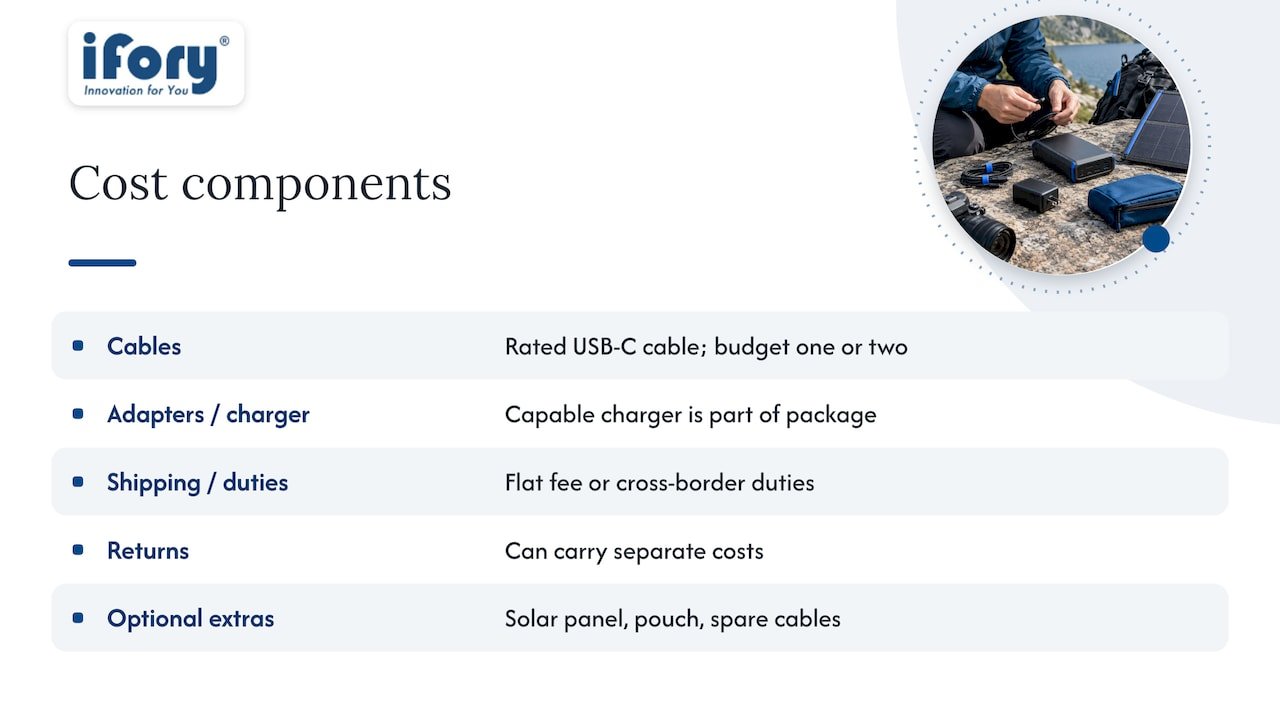
The sticker price is only the first line of the real cost. A 100W pack is only useful if the rest of the chain can carry 100W, and that is where small purchases add up.
Start with cables. A cable rated for lower wattage will quietly limit your charging speed, so a high-output pack often needs a properly rated USB-C cable, sometimes one with an electronic marker chip. Our write-up on USB PD profiles and a buying checklist explains which cable and charger combinations fit which output levels. If you already own good cables, this cost drops to zero, but if you are starting fresh, budget for one or two.
Next come adapters and a wall charger. Recharging a large pack from a weak charger stretches the refill time considerably, so a capable charger is part of the package. Our comparison of 65W versus 100W chargers shows how much headroom to leave above your device’s needs.
Then there is shipping. Some sellers include it, others charge a flat fee or add duties for cross-border orders, and returns can carry their own costs. A pack that looks cheaper on the product page can end up pricier at checkout. Finally, consider the optional extras: a solar panel for multi-day trips, a protective pouch, and spare cables. Add them to the price you are comparing so you judge the full kit instead of one component.
Typical timeframe from purchase to delivery
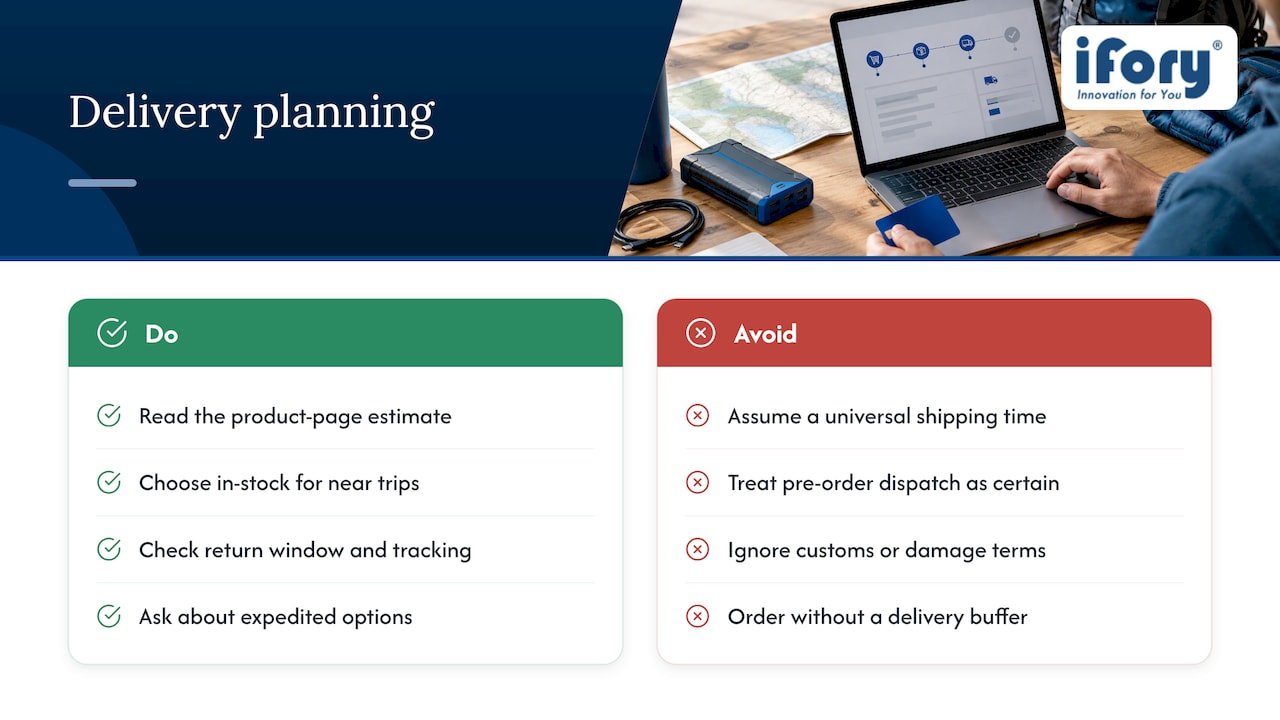
Delivery time is easy to overlook when you are comparing prices, yet it changes whether an offer is actually useful for your trip. We do not publish a universal shipping figure here, because timing depends on the seller, the destination, and current stock, so read the delivery estimate on the specific product page before you commit.
A few patterns help you read those estimates. Items shown as in stock at a local or regional warehouse generally arrive faster than items shipped from overseas, and the checkout page usually shows the best estimate once you enter your address. Pre-order and backorder listings are a different case: the price can look attractive, but the dispatch date is uncertain, and it can slip. If you have a departure date, treat any pre-order as a risk and build in a buffer, or choose an in-stock alternative.
It also pays to check the return window before ordering, so that a delayed or unsuitable pack does not leave you stuck. Confirm whether tracking is provided, who handles customs for cross-border orders, and what happens if the parcel arrives damaged. If your trip is close, ask the seller about expedited options and compare the extra cost against the benefit. Planning delivery alongside price keeps you from winning a discount and losing the trip.
Why a rugged 40,000mAh 100W pack makes sense for outdoor use
I think the premium band is easy to dismiss until you spend a few days off grid. Multi-day trips, a laptop for editing, or a camera that drains fast are exactly where a bigger, tougher pack earns its price. The trade-off is weight, so plan your load honestly and decide whether the extra capacity is worth carrying. For buyers who need 100W and real protection against water and drops, our Ifory Powerbank fits that brief, and I would rather pay once for the right pack than twice for the wrong one.
— Mats
Ifory Powerbank: built for the premium band
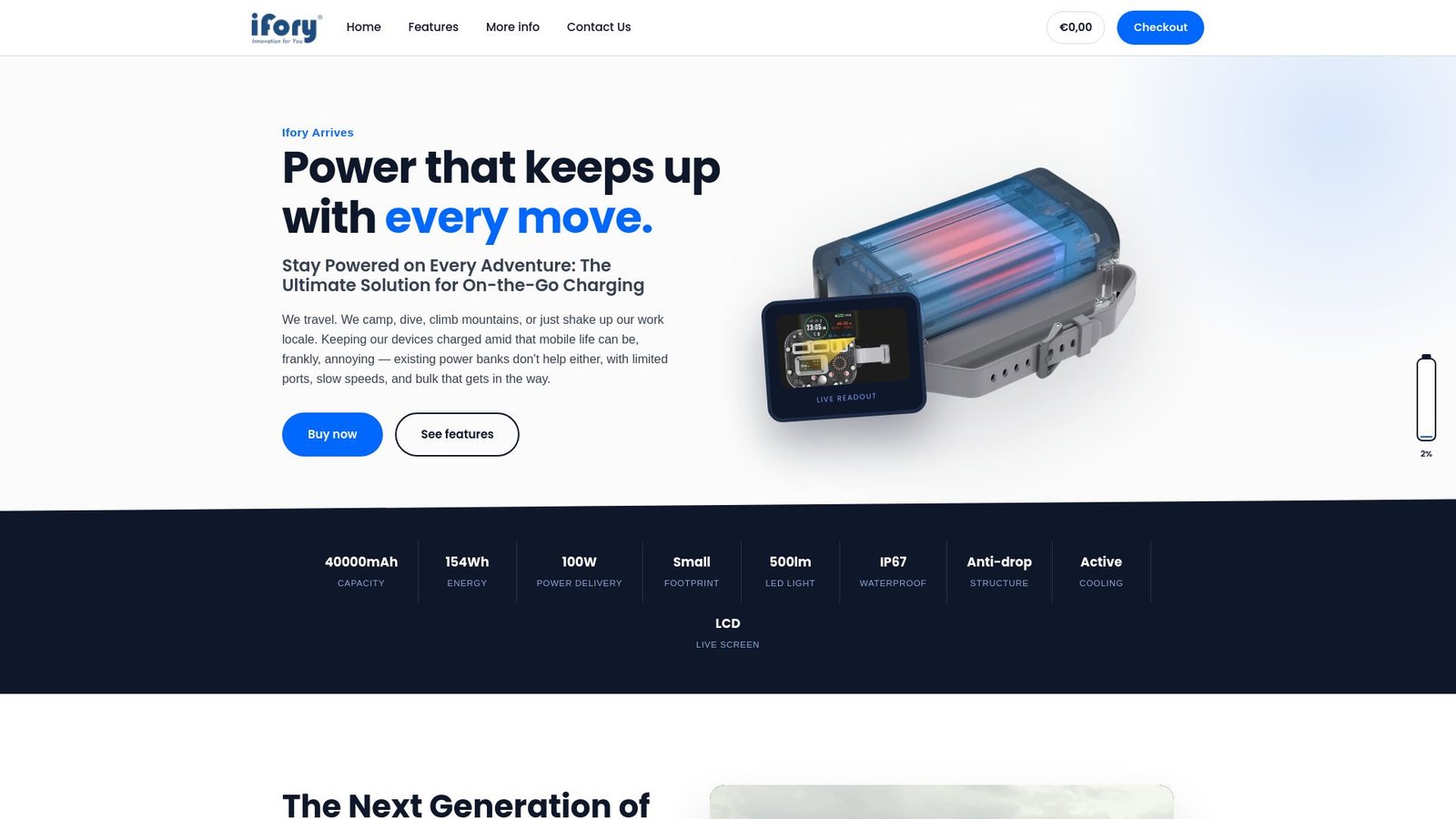
We designed our Ifory Powerbank for people who need real power away from outlets. At 99 EUR one-off, here is what you get:
- 40,000mAh capacity for multi-day use
- 100W fast charging for phones, tablets, and many USB-C laptops
- Water protection and an anti-drop structure
- LCD display that shows live power status
- Integrated flashlight for camp and trail
Those features are what separate the premium band from basic packs, and outdoor buyers feel the difference when conditions turn rough. You can see the full details on our high-capacity power bank page, or go straight to the shop to order, where you can also add a portable solar panel.
FAQ
How much does a 40,000mAh power bank usually cost?
Prices vary by features more than by capacity, from budget packs with basic ports to premium units with 100W output and rugged protection. One review of a 40,000mAh/144Wh pack treated a price near $150 as reasonable for its specs. Our Ifory Powerbank is listed at 99 EUR one-off.
How much of 40,000mAh can I actually use?
Expect less than the label. Testing of a 40,000mAh pack measured about 87% usable capacity in the best case, with real-world results commonly around 82–87%. Comparing Wh figures gives a fairer picture than mAh.
Is a higher price worth it for a 40,000mAh power bank?
It can be, if you need features that matter in the field: high-wattage output, waterproofing, and drop protection. If you only charge a phone at home, a simpler pack may be enough. Match the features to how you will use it.
What should I check before buying a high-capacity power bank?
Check output wattage, stated Wh or usable capacity, port count, recharge time, and the warranty and return terms. Add shipping and any cables you need to the price, so you compare the full cost.
Sources
- Ankers größte Powerbank im Test, Anker 347 PowerCore 40K 40000mAh – Techtest
- This 40,000mAh power bank is the most versatile accessory I’ve tested to date – see for yourself | ZDNET
- Best portable high-capacity power banks, including 50,000mAh+ chargers | Android Central