
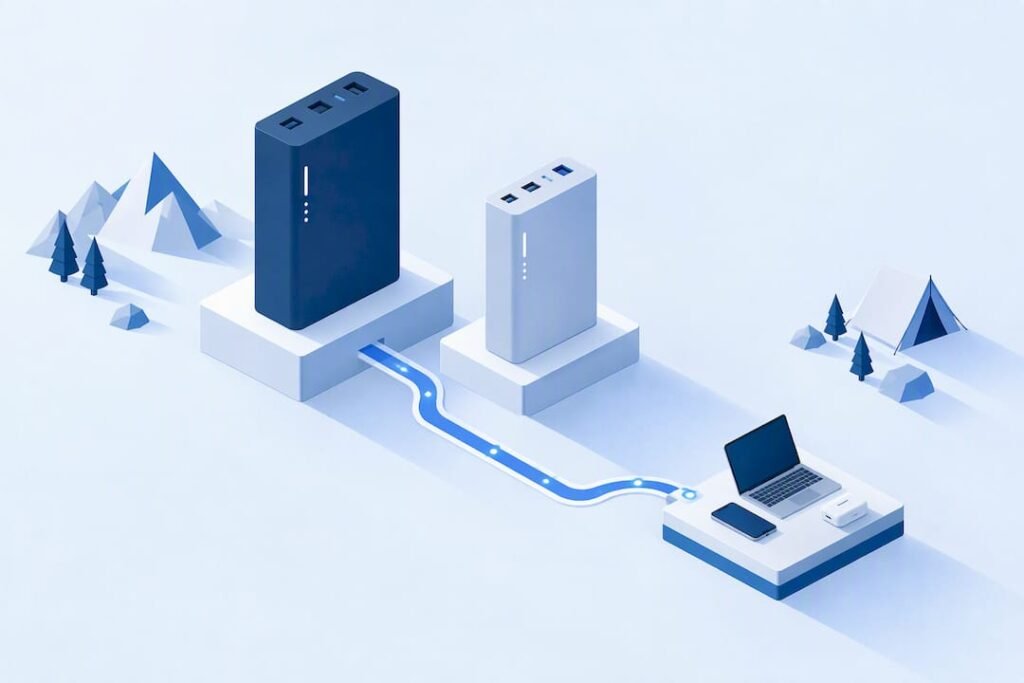
For most daily users, a high-capacity bank can balance capacity and portability. Choose a larger bank only if you need extended off-grid use or group charging. Either way, check the Watt-hour rating, since that figure, not raw mAh, determines what you can carry on a plane and how your device actually performs.
TL;DR:
- Realistic conversion efficiency is about 60% to 85%, so estimate energy conservatively in cold conditions, with older cables, or when charging high draw devices.
- For laptops, prioritize sustained Power Delivery output: a bank that throttles after a brief peak can charge more slowly than its headline wattage suggests.
- A 40,000mAh bank holds about 148Wh, so airline approval may be required; carry it on board, never in checked baggage, and confirm your carrier’s rules.
- Choose extra capacity for extended trips or group charging; daily phone users may prefer a lighter bank, especially when outlet access is limited.
- For overnight refills, check the bank’s input wattage as well as its capacity, since slow input can leave a large bank short by morning.
Table of Contents
- How mAh converts to Watt-hours and what that matters for your charges
- Why wattage matters more than mAh for some devices
- Size, weight, and portability: the cost of an extra 10,000mAh
- Travel rules: Watt-hours decide what flies, not mAh
- A quick decision framework for choosing your capacity
- Comparing recharge times between the two capacities
- Cost differences and value for money
- Durability and design in higher-capacity banks
- How capacity affects charging multiple devices at once
- Why outdoor users often choose higher-capacity rugged banks
- Ifory: when the 40,000mAh Ifory power bank is the right pick
- FAQ
- Sources
How mAh converts to Watt-hours and what that matters for your charges
Manufacturers print mAh on the box because it sounds impressive, but Watt-hours (Wh) are what actually describe energy storage. The rough formula is mAh multiplied by voltage, divided by 1,000: a lithium cell runs at about 3.7 volts nominal, so a 10,000mAh cell holds around 37Wh. That baseline scales directly, so larger-capacity banks hold more Watt-hours.
Those are the numbers printed on the battery label, not what reaches your phone. Converting battery voltage up to USB output, and accounting for heat and circuit losses, burns a meaningful share of that energy. Independent testing from ChargingGearLab puts realistic efficiency between about 60% and 85%, meaning delivered capacity is routinely lower than the labeled mAh suggests.
Applied to real devices, the gap becomes concrete:
- A high-capacity bank delivers less energy than its rating suggests, enough for several full phone charges depending on battery size.
- A larger bank delivers less energy than its rating suggests, which can cover a phone for multiple days or split power across a tablet and phone.
- Colder conditions, older cables, or higher-draw devices can reduce efficiency, so budget conservatively.
A high-capacity power bank holds more rated energy, but realistic delivered output is lower after conversion losses, according to tested efficiency ranges. If you want to map that to your own phone’s battery size before buying, our runtime estimate guide walks through the math in three steps.
Why wattage matters more than mAh for some devices
Raw capacity tells you how long a bank lasts, not how fast it charges anything. For a laptop, the deciding factor is sustained Power Delivery (PD) output, not the number printed on the side of the bank. Testing from Tom’s Hardware, which evaluated 13 power banks ranging from 10,000 to 25,000mAh and 20W to 220W, found that PD wattage and sustained output predicted real charging performance far better than capacity alone.
A few practical rules follow from that:
- Phones mostly need capacity, since many phones do not use the highest output levels, so extra wattage goes unused.
- Laptops benefit from sustained high-wattage PD output to charge at a usable rate, and a bank that advertises a high peak wattage but throttles under load will charge slower than its spec sheet implies.
- A 40,000mAh bank with weak PD output can be a worse laptop charger than a smaller bank built around sustained delivery, because thermal throttling cuts the gap between a brief power surge and what the bank can sustain for 30 minutes straight.
Check the sustained wattage figure, not just the headline number, before assuming a bigger battery means faster charging. Our breakdown of what 100W output actually means for different devices covers this in more detail.
Size, weight, and portability: the cost of an extra 10,000mAh
Extra capacity does not come free. A higher-capacity bank typically weighs noticeably more and takes up more pocket or bag space than a lower-capacity model, since the added cells need housing, wiring, and often a sturdier shell to protect them.
That tradeoff suits some routines and not others:
- Campers, photographers hauling multiple camera batteries, and groups splitting one bank across several people benefit from the extra runtime enough to justify the bulk.
- Daily commuters and light travelers who mainly top up a phone between outlets usually find a lower-capacity bank covers their needs without the added weight in a bag or jacket pocket.
Pro Tip: On multi-day trips, pack the power bank near the center of your bag rather than in a side pocket. It balances the load and protects the unit from impact during transit.
Travel rules: Watt-hours decide what flies, not mAh
Airlines do not care what the box says in mAh. Aviation guidance from IATA sets the threshold at 100Wh for carry-on without special approval. Between 100Wh and 160Wh, a power bank may still be carried with airline approval and quantity limits, and anything above 160Wh is not permitted for passenger carriage at all and must ship as cargo.
Translating the earlier conversions, a bank whose Watt-hour rating is between 100Wh and 160Wh may require airline approval, so confirm the rules for your specific bank before you fly.
Before any flight, work through this checklist:
- Find the Wh rating printed on the device itself, not just the mAh figure.
- Confirm your specific airline’s policy, since limits inside the 100 to 160Wh band vary by carrier.
- Pack the bank in carry-on luggage only, never in checked baggage.
- Protect the terminals from contact with metal objects, such as keys or coins, during transit.
- Check how many spare batteries your airline allows, including any limits that apply when approval is granted.
For a deeper look at the travel rules, see our guide on flying with a power bank. If you are traveling internationally and sorting out connectivity alongside battery rules, this travel tech checklist from Lumo eSIM Store covers the other gear worth packing.
A quick decision framework for choosing your capacity
Matching capacity to your actual use case avoids both underbuying and hauling around dead weight.
- Phone-only daily users: a lower-capacity bank may cover multiple charges while remaining easier to carry.
- Power users who occasionally charge a laptop: prioritize sustained PD output over raw capacity, whatever the bank’s capacity.
- Extended off-grid trips or group charging: a higher-capacity bank with strong PD output may make sense, since the extra Wh covers several devices across days without a wall outlet.
Before buying, ask yourself how many phone charges you actually need between outlets, whether any device demands sustained high wattage, whether you will fly with the bank, and how much extra weight you are willing to carry.
| Use case | Recommended capacity | Key factor |
|---|---|---|
| Daily phone charging | A capacity suited to your needs | Portability over runtime |
| Laptop charging on the go | High-PD bank | Sustained wattage, not mAh |
| Extended off-grid or group use | Higher-capacity bank | Total Wh and port count |
If your trips are usually short, buying a higher-capacity bank may add weight you will not use.
Comparing recharge times between the two capacities
Bigger batteries take longer to refill, and the gap between 30,000mAh and 40,000mAh is noticeable at the wall outlet. Assuming both banks accept a comparable input rate, the higher-capacity unit holds more energy, so topping it up from empty takes proportionally longer, potentially stretching a long recharge into an overnight job.
Input wattage matters as much as capacity here. A bank that only accepts 18W input will crawl toward full regardless of its size, while one that accepts 65W or 100W input cuts recharge time significantly even at the larger 40,000mAh capacity. If overnight charging at a hotel or campsite outlet is your only window, check the input spec before capacity, since a high-capacity bank with slow input can leave you short the next morning.
Practically, this means multi-day travelers should plan recharge stops around outlet access rather than clock time alone. If your trip has unpredictable access to power, recharge flexibility can matter more than the extra stored energy.
Cost differences and value for money
Capacity and price scale together, but not perfectly, since larger banks also carry heavier protective shells, more substantial internal wiring, and often more ports, all of which add to the bill. A higher-capacity bank typically costs more upfront than a lower-capacity model from the same product line, reflecting both the added cells and the sturdier build many higher-capacity units use.
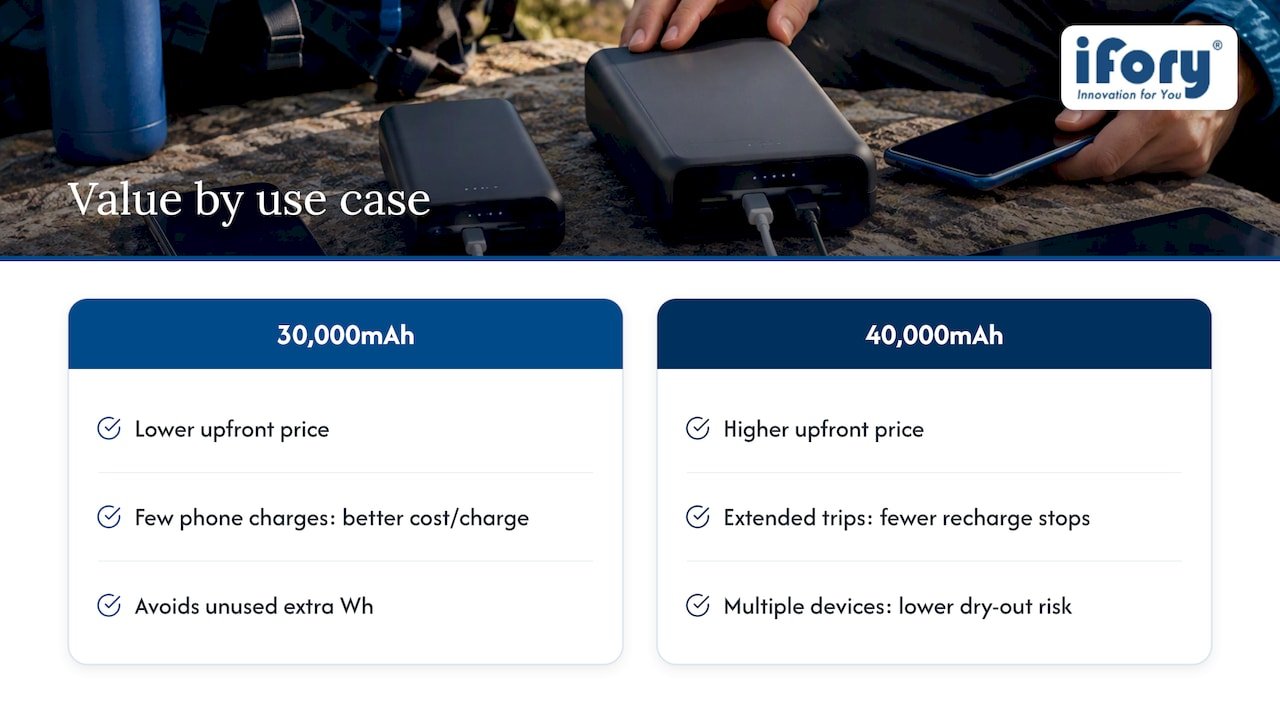
The value calculation depends on how fully you use that extra capacity. For a user who charges a phone only a few times on a trip, the extra Wh in a 40,000mAh bank goes unused, making the 30,000mAh option the better value on a cost-per-charge basis. For someone genuinely running multiple devices across an extended off-grid trip, the 40,000mAh bank’s higher price buys fewer recharge stops and less risk of running dry, which can outweigh the higher sticker price.
Think in terms of cost per Wh actually delivered to your devices, not cost per mAh printed on the box. A bank that costs more but holds its charge longer, charges faster, and survives rough handling can be better value over its lifespan than a cheaper bank you replace sooner. Our guide on expected power bank lifespan breaks down how storage habits affect how long either capacity actually lasts before performance drops.
Durability and design in higher-capacity banks
Packing more cells into one housing raises the stakes for build quality. A higher-capacity bank can generate more heat during fast charging and discharging because more energy is moving through the circuitry, which makes thermal management and casing design more important than on a smaller unit.
Look for a few specific design signals on any higher-capacity bank:
- A rugged outer shell rated for drops, since a larger bank falling from the same height carries more momentum than a smaller one.
- Weather resistance, which matters more outdoors where higher-capacity banks tend to travel.
- Active or passive cooling design, since sustained high-wattage charging without adequate heat dissipation can shorten cell life over repeated cycles.
A bank built for outdoor use should hold up to the kind of handling that daily commuting rarely tests: getting dropped on a trail, rained on at a campsite, or packed against rocks and gear in a backpack. That is a different design brief than a slim bank meant to live in a jacket pocket, and it is worth checking a manufacturer’s stated drop and water ratings rather than assuming size alone implies toughness.
How capacity affects charging multiple devices at once
Splitting output across several ports divides your total wattage, and this is where raw capacity starts to matter again. A higher-capacity bank with multiple USB-C and USB-A ports can keep multiple devices charging at once for longer than a lower-capacity bank attempting the same job, simply because there is more total energy to divide.
But port count and total wattage both cap how fast that simultaneous charging happens. A bank whose ports share a limited PD budget will slow each device down as more ports draw power at the same time, regardless of how many Wh sit in the battery. If you regularly charge multiple devices simultaneously, check whether the bank’s total output wattage, not just its port count, can cover both loads without throttling either one.
For group trips, this can be a clear case for choosing a higher-capacity bank over a lower-capacity one: more total Wh means more total device-charges available before anyone needs to find an outlet, which matters more when several people are drawing from the same bank across a weekend.
Why outdoor users often choose higher-capacity rugged banks
Multi-day trips change the math. When you are charging a phone, a camera, and a headlamp over an extended trip without an outlet in sight, the extra Wh in a 40,000mAh bank stops being excess and starts being the margin between staying charged and going dark. Group trips add another layer, since one rugged bank with several ports can cover a handful of devices instead of everyone carrying their own.
That is the scenario where a 40,000mAh bank with genuine 100W PD, an IP67 rating, and a built-in flashlight earns its weight. Even so, check the Wh label and sustained output spec before buying, since capacity alone never tells the full story.
— Mats
Ifory: when the 40,000mAh Ifory power bank is the right pick

For readers who land on 40,000mAh after running the numbers above, we built the Ifory Powerbank around that exact use case: 40,000mAh capacity, 100W fast charging, multiple ports for simultaneous device power, an IP67 waterproof rating, a real-time LED display, and an integrated flashlight, all in a compact, anti-drop shell. It fits photographers, boaters, and multi-day outdoor travelers who need one rugged bank to cover a group or a week off-grid. Check out the high-capacity power bank for every adventure to see current specs and place an order.
FAQ
How long does a 40,000mAh power bank last?
A 40,000mAh power bank holds roughly 148Wh of rated energy, which translates to several full phone charges across multiple days depending on your phone’s battery size and how many other devices you charge. Real-world runtime depends heavily on conversion efficiency and how many ports you use simultaneously.
Is a 40,000mAh power bank good?
A 40,000mAh power bank is a strong choice for multi-day off-grid trips, group charging, or anyone running a phone, tablet, and camera gear without regular access to outlets. For daily phone-only use, the extra capacity usually adds unnecessary size and weight compared to a 30,000mAh bank.
How long will a 30,000mAh battery last?
A 30,000mAh power bank holds roughly 111Wh of rated energy, enough for several phone charges over a few days of typical daily use. Actual runtime depends on your phone’s battery capacity and the bank’s charging efficiency, which commonly falls between 60% and 85%.
Can I fly with a 40,000mAh power bank?
A 40,000mAh power bank holds roughly 148Wh, which sits near the top of the 100 to 160Wh band that requires airline approval under IATA guidance. Confirm your specific airline’s policy before departure, carry it in your carry-on bag, and never pack it in checked luggage.
Sources
- We tested 13 power banks to help you choose the best one – from 10-25K mAh and 20-220W, see how each behaves when charging and discharging a powerful laptop | Tom’s Hardware
- Passengers travelling with lithium batteries
- How to Choose the Perfect Power Bank… | ChargingGearLab