
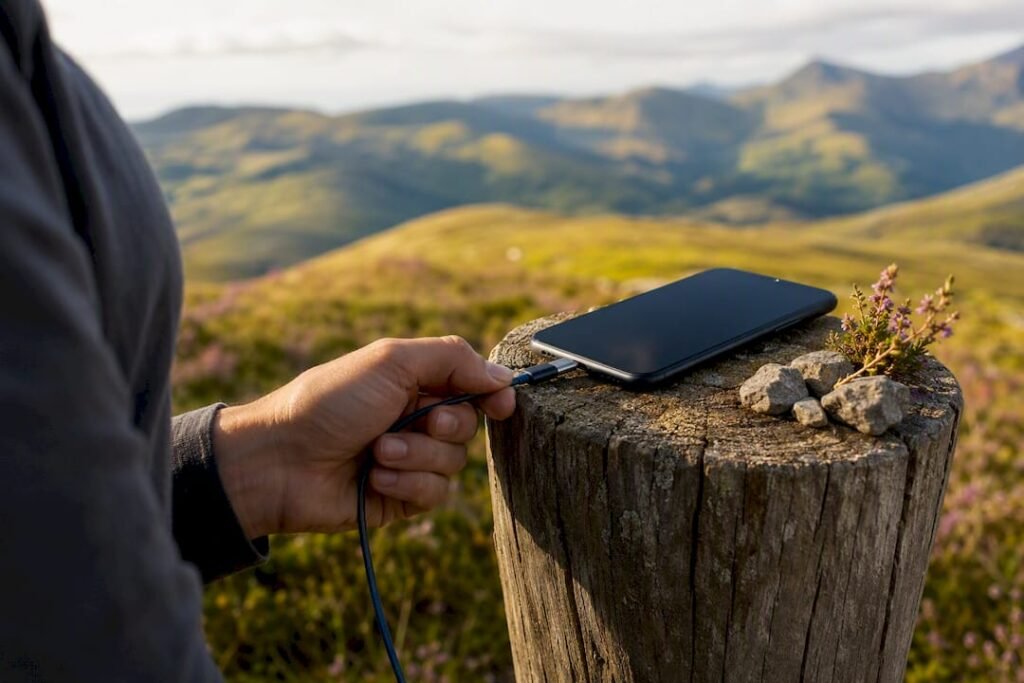
Fast charging can accelerate specific aging mechanisms, mainly lithium plating and heat-driven side reactions, but only under adverse conditions like high current combined with cold or hot cells. Modern battery management systems and tapered charging curves limit most practical damage for everyday use. The real fix isn’t avoiding fast charging altogether. It’s using it when you need it, keeping the battery out of heat and extreme states of charge, and watching your battery health readout over time.
TL;DR:
- Fast charging accelerates battery aging mainly under high current, cold temperatures, or high states of charge, but modern systems mitigate most damage during typical use.
- Heat from fast charging, especially above 40°C, significantly increases side reactions and the risk of lithium plating, which can cause capacity loss and dendrite growth.
- Using certified cables, avoiding direct heat exposure, and limiting fast charging to necessary situations help reduce long-term battery degradation.
- Battery health declines faster with frequent high-power DC fast charging, as shown in fleet studies, though controlled lab tests highlight thermal management as a key factor.
- Keeping daily charge levels between 20% and 80%, and monitoring battery health indicators, minimizes aging without sacrificing convenience.
Table of Contents
- What Fast Charging Does to Battery Chemistry
- What Actually Drives Battery Wear (More Than Wattage Does)
- How Modern Chargers and Devices Limit the Damage
- What the Research Actually Shows
- Charging Rules That Actually Protect Your Battery
- How to Check If Fast Charging Is Hurting Your Battery
- Balancing Convenience With Long-Term Battery Health
- A Power Bank Built to Fast Charge Without the Guesswork
- Sources
What Fast Charging Does to Battery Chemistry
Every time you charge a lithium-ion cell, ions have to physically migrate from the cathode, through the electrolyte, and insert themselves into the graphite anode. Push more current through that process and you create overpotential, essentially a traffic jam at the anode surface where lithium ions arrive faster than the graphite can absorb them cleanly.
When that jam gets bad enough, ions stop inserting into the graphite and instead deposit as metallic lithium on the surface. That’s lithium plating, and it’s the aging mechanism scientists worry about most. Plated lithium doesn’t just reduce usable capacity; it can grow into dendrites, needle-like structures that risk piercing the separator between electrodes. Plating risk climbs sharply under three conditions:
- High charging current relative to the cell’s design limit
- Cold temperatures, which slow ion mobility and worsen the traffic jam
- High state of charge, where the graphite anode has less room left to accept lithium
Fast charging also generates heat directly through internal resistance, and that heat speeds up unrelated side reactions, like electrolyte breakdown, that quietly consume active lithium over time. Cell architecture matters here too. Batteries built with thicker electrodes or standard graphite anodes tolerate high current worse than cells engineered with silicon-doped anodes or thinner electrode coatings, which is part of why fast-charge tolerance varies so much between a budget phone and a flagship one.
What Actually Drives Battery Wear (More Than Wattage Does)

Charging speed gets the headlines, but it’s rarely the biggest lever. Temperature does more damage than current alone. Live Science’s rundown of the research on this points to roughly 20 to 25°C as the safest charging window, with risk climbing meaningfully once cell temperature crosses 40°C.
State of charge matters just as much.
Fleet-scale data backs this up at a larger scale. Geotab’s analysis of electric vehicle fleets found that frequent use of DC fast charging above 100 kW correlated with roughly 3% annual battery degradation, compared with a lower rate for vehicles charged predominantly on slower AC systems. Over eight years, that gap compounded into vehicles losing a notably higher capacity than the AC-charged group.
Power banks carry their own extra risk factors worth naming separately:
- Pass-through charging (charging the power bank while it simultaneously charges a device) stresses the cell and the conversion circuitry at once
- DC-DC voltage conversion inefficiency generates heat even before the cell itself gets hot
- Cheap or long cables add resistance, which shows up as wasted heat rather than delivered power
How Modern Chargers and Devices Limit the Damage
Every lithium-ion cell charges in two phases: constant current, where it accepts maximum safe amperage, then constant voltage, where the rate tapers sharply as the cell approaches full. It isn’t a flaw. It’s the battery management system protecting the cell during the riskiest part of the charge curve.
The BMS does more than manage the taper. Charging standards matter here too: USB Power Delivery (USB-PD) and Qualcomm Quick Charge negotiate voltage and current between charger and device, but that negotiation only works as intended with certified cables. A cheap cable with high resistance wastes power as heat regardless of what the charger is rated for.
A few settings are worth enabling if your device offers them:
- A charging limit toggle capped around 80% to 90% for daily use
- Adaptive or optimized overnight charging
- Any manufacturer-specific “battery care” or slow-charging mode for stationary overnight charging
Pro Tip: If your phone or laptop has an optimized charging feature, leave it on permanently rather than toggling it off for convenience. It costs you nothing in daily usability and quietly does the temperature and SOC management for you.
What the Research Actually Shows
The evidence here spans three very different scales, and it’s worth being honest about what each one can and can’t tell you. Geotab’s fleet study is the largest dataset, tracking real EVs over years of use, and it found a clear correlation between frequent high-power DC fast charging and faster capacity loss. But EV packs use active liquid cooling and hundreds of cells in parallel. A phone battery has none of that thermal buffering, so the absolute numbers don’t transfer directly, even if the underlying mechanism does.
At the lab level, a cell and pack study published in the Journal of Power Sources found something specific: individual cells tested in isolation showed only minor fade under fast charging, but full packs under passive (non-liquid) thermal management showed significantly higher capacity fade. The same study found that resting a pack before or after a fast-charge session measurably reduced the damage. That’s a strong argument for not fast charging immediately after a device has been sitting in a hot car or a sunny backpack.
- EV fleet data: real-world scale, confounded by cooling systems phones don’t have
- Cell/pack lab studies: controlled conditions, show thermal management is the deciding variable
- Multi-phone longevity tests: closest analog to actual consumer use
Multi-phone testing from outlets covering long-term device use consistently finds that phones with well-implemented fast charging keep internal temperatures under roughly 40°C during typical sessions, though implementation quality varies noticeably between brands. The honest gap in the data: nobody has published a large, controlled, multi-year study isolating fast charging as the single variable across thousands of consumer phones. Everything available is either fleet-scale, cell-scale, or short-term device testing.
Charging Rules That Actually Protect Your Battery
- Keep daily charging in the 20% to 80% range. This single habit does more for longevity than any charger you buy. Reserve full 0 to 100% charges for days you actually need the range.
- Match charging speed to the situation. Use fast charging when you’re leaving in twenty minutes and need the range; use slow or standard charging overnight or whenever time isn’t the constraint.
- Use certified cables and chargers. A USB-PD certified cable rated for the wattage you need avoids the resistance losses that generate excess heat at the connector.
- Never fast charge in direct heat. A phone on a car dashboard in July, or a power bank sitting in direct sun, is already starting from an elevated temperature before you add charging heat on top.
- Avoid habitual pass-through charging on power banks. Charging the bank and a device simultaneously stacks two heat sources on one set of cells; use it as an occasional convenience, not a routine.
Pro Tip: If you must fast charge a hot device, let it cool for ten to fifteen minutes first. That short delay is exactly what the pack-level lab research found reduces degradation from back-to-back fast-charge sessions.
How to Check If Fast Charging Is Hurting Your Battery
Your phone’s battery health percentage (found in iOS Settings under Battery Health, or via third-party apps like AccuBattery on Android) is the simplest early-warning tool. A drop of a few percentage points over a year is normal; a sudden five-point drop in a month is not, and it’s worth tracking month to month rather than reacting to a single reading.
Watch for these warning signs, which point toward plating or cell degradation rather than normal wear:
- A sudden capacity drop unrelated to a software update
- Physical swelling in the battery or case, which is a stop-charging-immediately signal
- Persistent overheating even during light use, not just heavy charging
- Charging that stalls or behaves erratically at a consistent percentage
A steadily lengthening time at the same charger and cable is a meaningful signal something’s degrading, even without a repair diagnosis confirming it. If you see swelling or repeated overheating, stop fast charging that device and have the battery evaluated.
Balancing Convenience With Long-Term Battery Health

Perfect battery care isn’t realistic, and treating every charge like a laboratory experiment misses the point. Occasional fast charging when you’re rushing out the door costs you a small, measurable fraction of lifespan.
What matters more is consistency: avoid the extremes, keep an eye on your health percentage, and don’t fast charge a device that’s already hot. Perfect habits matter less than avoiding the worst ones.
— Mats
A Power Bank Built to Fast Charge Without the Guesswork
Ifory is the practical answer for readers who want fast charging without babysitting heat and pass-through risk. Its 40,000mAh power bank delivers 100W through USB-PD, but the multi-port layout means you’re not forced into a single pass-through habit. You can charge the bank overnight and pull power to your phone or laptop the next day, which sidesteps the stacked-heat scenario that damages cells fastest.

The IP67 waterproof rating and anti-drop housing matter more than they may sound like marketing points; a power bank that survives a splash or a fall keeps its internal cell architecture intact, which is where actual capacity fade starts. The real-time LED display shows exact charge levels rather than a vague four-bar guess, so you can see when it’s worth topping up versus letting it sit. Think of Ifory as your backup for the moments fast charging is genuinely necessary, on a trail, at a trailhead, mid-shoot, not a replacement for the daily habits that protect the battery in your phone or laptop. Browse the full power bank lineup and pick the capacity that matches your next trip.
Sources
Key references behind this article: Geotab’s EV fleet degradation study, the cell/pack fast-charging study, Live Science’s mechanism explainer, and How-To Geek’s habit-focused testing.
- Geotab EV battery health degradation fast charging study
- Does fast charging damage your battery more than regular charging? | Live Science
- Study on implications of direct current fast charging on pack and cell