
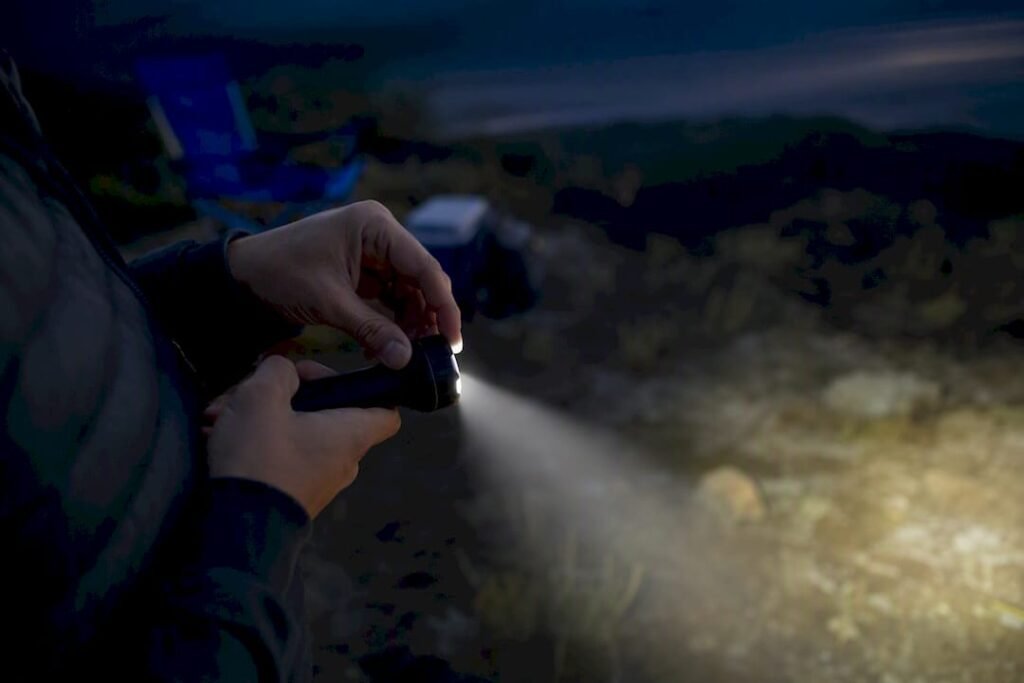
A lumen is the total amount of visible light a source throws off in every direction. That’s it. No formula required to use the number, just a sense of scale: 1 to 20 lumens covers reading in bed or finding a dropped key, 20 to 150 lumens handles walking the dog or fumbling with a fuse box, 150 to 500 lumens is the everyday-carry sweet spot for most people, 500 to 1,500 lumens is search-and-rescue or wide-area campsite territory, and anything north of 1,500 lumens is specialized, short-burst, or both.
- 1–20 lm: nightstand tasks, reading a map up close
- 20–150 lm: dog walks, checking a breaker box, basic camp chores
- 150–500 lm: general EDC, hiking at night, most emergency kits
- 500–1,500 lm: search, signaling, large-area illumination
- 1,500+ lm: tactical or industrial use, rarely sustained for long
Once you know your band, check two more things before buying: whether the number is an ANSI/PLATO FL1 rated figure or an OTF (out-the-front) reading, and whether the listing includes a candela or beam-distance figure. Those two data points separate an honest spec sheet from a marketing number.
TL;DR:
- Verify that lumen ratings are ANSI/PLATO FL1 rated and include candela or beam distance figures to ensure accurate specifications.
- Prioritize sustained runtime graphs over peak lumen numbers, as many flashlights step down output shortly after initial high bursts.
- Be cautious of marketing claims based solely on emitter lumens; actual out-the-front (OTF) lumens often are lower due to optical losses.
- Pairing a 500-lumen flashlight with a high-capacity power bank offers practical, reliable use for extended outdoor trips and emergencies.
Table of Contents
- What a Lumen Rating Actually Measures
- Lumens vs. Candela vs. Lux: Which One Actually Matters?
- Real-World Lumen Ranges and What They Actually Look Like
- Why Peak Lumens Rarely Tell the Whole Story
- How to Choose the Right Lumen Level for Your Needs
- ANSI/PLATO FL1 and Spotting Inflated Claims
- Ifory’s Integrated 500-Lumen Light: A Case for Combined Gear
- Key Takeaways
- What Buyers Consistently Get Wrong About Brightness
- Sources
What a Lumen Rating Actually Measures
A lumen is a unit of luminous flux, the total quantity of visible light a source emits in all directions at once. It has nothing to do with watts. Watts measure electrical power going in; lumens measure visible light coming out. An old incandescent bulb wasted most of its wattage as heat, so comparing watts across bulb types was always misleading. Lumens fixed that by measuring what your eyes actually receive.
The formal relationship is simple even if it looks technical at first glance: 1 lumen equals 1 candela times 1 steradian (1 lm = 1 cd·sr). A steradian is just a unit of solid angle, a slice of a sphere. You don’t need to do that math to buy a flashlight, but it explains why two lights can share the exact same lumen rating and look completely different in your hand. One spreads that flux across a wide angle; the other focuses it into a narrow cone. Total output is identical. Perceived brightness at 50 feet is not.
Old incandescent bulbs give you a mental anchor for these numbers. A 60-watt bulb produces roughly 890 lumens, and a 40-watt bulb produces around 460 lumens, according to standard lumen equivalence figures). So when a flashlight box says “450 lumens,” picture the lamp on your desk at home, not a stadium spotlight. That mental shortcut alone will save you from both overbuying and underbuying.
- Lumens = total visible light output, measured in every direction
- Watts = electrical input, not a brightness measurement
- 1 lm = 1 cd·sr, the formal definition tying flux to intensity and angle
- A 60W bulb ≈ 890 lm; a 40W bulb ≈ 460 lm, useful mental anchors
Lumens vs. Candela vs. Lux: Which One Actually Matters?
Lumens tell you total output. Candela tells you how far that light reaches in a specific direction. Lux tells you how bright a surface looks once the light lands on it. Confusing these three is the single biggest reason people buy the wrong flashlight.
Candela measures luminous intensity in a specific direction, which is why manufacturers use peak candela to calculate advertised beam distance. A flashlight can have a modest lumen count but a huge candela rating if all that light gets focused into a tight beam by a deep reflector. That’s how a 300-lumen thrower can out-distance a 1,000-lumen flood light.
Lux measures lumens per square meter landing on a surface, which is why lux drops fast as you back away from the light source. It’s the metric photographers and cinematographers actually care about, since it describes illumination at a specific point rather than the light’s total output.
The beam angle is the hinge between all three. A narrow beam concentrates the same lumen output into a smaller area, spiking candela and throw distance. A wide beam spreads it out, sacrificing distance for a broader wash of usable light close to you.
- Candela = intensity in one direction, drives beam distance
- Lux = lumens per square meter, describes brightness at a surface
- Narrow beams trade spill for throw; wide beams trade throw for coverage
Pro Tip: If the product listing only advertises lumens with zero mention of candela or beam distance, treat that as a red flag, not a feature. Honest manufacturers publish both because throw and flood serve different jobs.
Decide first whether you need reach (candela, for scanning a backyard or signaling across a lake) or coverage (lumens and lux, for lighting a tent interior or a work area). That single question eliminates half the flashlights on any shelf.
Real-World Lumen Ranges and What They Actually Look Like
Numbers on a box mean little until you attach them to something you’d actually do with a flashlight. Retail buying guidance from outdoor retailers consistently maps lumen count to task in roughly these bands.
- 1 to 20 lumens. A moonlight or nightlight mode. Good for reading a map without wrecking your night vision, checking on a sleeping kid, or navigating a dark hallway. Nearly worthless outdoors beyond a few feet.
- 20 to 150 lumens. Everyday utility range. Enough to walk a trail at a comfortable pace, find something dropped in tall grass, or work under the hood of a car at night. Most keychain and pocket lights sit here.
- 150 to 500 lumens. The practical everyday-carry sweet spot. This range lights a campsite, illuminates a room during a power outage, and throws a usable beam 50 to 100 yards depending on the reflector. Most quality EDC flashlights and headlamps peak somewhere in this band.
- 500 to 1,500 lumens. Demanding outdoor use: search patterns, signaling for help, lighting up a wide area like a driveway or work site. Beam distance in this range can stretch several hundred yards if the light is built for throw rather than flood.
- 1,500+ lumens. Specialized or tactical use. Impressive on paper, but these outputs are rarely sustained, and the beam is often so intense up close that it’s counterproductive for reading a map or lighting a tent.
Two practical wrinkles matter here. First, perceived brightness up close is deceptive, a 1,000-lumen light aimed at a white wall three feet away feels blinding, but that same light at 100 yards might barely outperform a 300-lumen thrower with a tighter beam. Second, higher lumen counts almost always cost you runtime, which brings up the next issue: what happens after the first 30 seconds.
Why Peak Lumens Rarely Tell the Whole Story
Peak lumen numbers are often a snapshot, not a promise. Most modern LED flashlights run a thermal step-down: they blast out their advertised peak for a short burst, then throttle down as the emitter and driver heat up. A flashlight rated at over 1,000 lumens may only sustain that output briefly before stepping down to a cooler, dimmer mode for longer use.
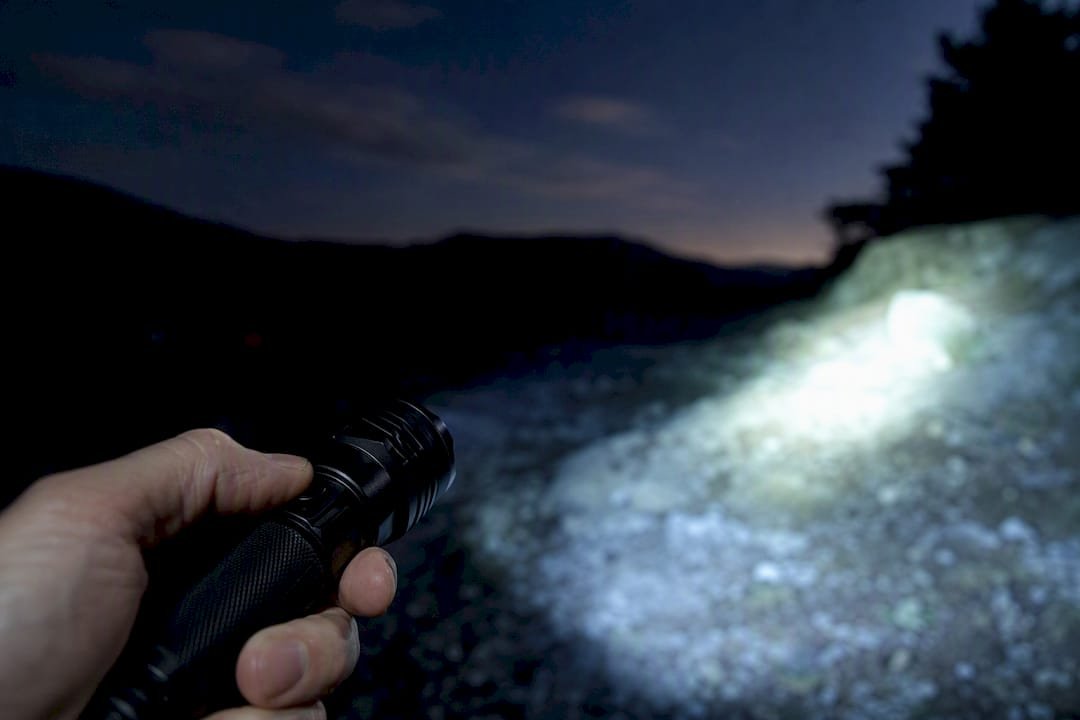
This isn’t a defect. It’s physics. LEDs lose efficiency and lifespan when they run hot, so a well-engineered driver protects the emitter by stepping output down automatically. The problem is marketing, brands advertise the peak number because it’s the bigger, more exciting figure, and plenty of buyers never see the sustained-output data hiding in the fine print or a third-party review.
Battery chemistry compounds this. A flashlight running on a rechargeable lithium-ion cell will generally sustain higher output longer than the same light on alkaline batteries, since lithium-ion handles high current draw with less voltage sag. Capacity matters too: a larger cell simply has more energy to spend before the light dims.
Reviewers who test with integrating spheres consistently find that many flashlights step down 10 to 20 percent within the first few minutes of hitting turbo mode, regardless of what the box claims. Runtime graphs, not peak numbers, show you what the light actually does once it’s warmed up.
- Ask for a runtime graph, not just a peak lumen figure
- Look for “regulated” in the driver description, a sign output stays consistent rather than fading linearly
- Larger battery capacity generally buys longer sustained output at a given brightness
How to Choose the Right Lumen Level for Your Needs
Pick your lumen target the same way you’d pick a car engine size: by the job, not the bragging rights. Here’s the order that actually works.
- Name your primary use case. Reading in a tent, walking a dog, working on a car engine, and searching a wooded trail all call for different lumen bands and different beam shapes.
- Pick a lumen band and a beam type. Match your task to one of the ranges above, then decide if you want a flood beam (wide, close-range coverage) or a spot beam (narrow, long-range throw).
- Check the OTF and FL1 numbers. OTF lumens reflect what actually exits the lens after optical losses, which is always lower than the raw emitter spec. Confirm the listing references ANSI/PLATO FL1 testing rather than an unverified marketing figure.
- Confirm candela and sustained runtime. A peak lumen number with no runtime graph and no beam-distance figure is a low-confidence listing, according to flashlight-buying guidance from outdoor retailers.
- Review the extras that make daily use pleasant. Color rendering index (CRI) affects how natural colors look under the beam; a usable low mode under 10 to 20 lumens saves your night vision and your battery.
Pro Tip: If you only remember one rule, remember this: a flashlight with a sensible 200 to 500 lumen main mode and a genuine moonlight mode under 10 lumens will outperform a “5,000 lumen” light that can’t sustain half that number for more than a minute.
Before checkout, run through modes and interface (does it require memorizing a click pattern?), battery type (proprietary cell versus standard AA or 18650), and IP rating for weather resistance. Those four details decide whether the light is a pleasure to use or a drawer ornament.
ANSI/PLATO FL1 and Spotting Inflated Claims
The ANSI/PLATO FL1 standard exists because lumen claims used to be the Wild West. FL1 specifies that output gets measured 30 to 120 seconds after turn-on, past the initial spike, which is meant to reflect real usable brightness rather than a flash of peak current.
The other distinction worth knowing: emitter lumens describe what the raw LED chip is rated for in a lab, while OTF (out-the-front) lumens describe what survives the lens, reflector, and driver losses to actually leave the flashlight. A 1,000-lumen emitter might deliver 800 OTF lumens once you account for those losses. Any listing that only cites emitter specs is quietly inflating its number.
- Look for an explicit “ANSI FL1” reference or logo on the packaging or listing
- Prefer listings with runtime graphs over listings with a single peak number
- Treat unusually cheap lights claiming absurd lumen counts as a near-certain red flag
Ifory’s Integrated 500-Lumen Light: A Case for Combined Gear
An integrated light only earns its keep if the lumen number is actually useful rather than a marketing headline. Ifory’s outdoor power bank pairs a 500-lumen flashlight with a 40,000mAh battery and 100W fast charging, which lands squarely in the everyday-carry sweet spot described above, bright enough for camp chores and emergencies without the short-burst limitations of a 1,500-plus turbo mode.
- 500-lumen built-in light, sitting in the practical general-outdoor-use band
- 40,000mAh capacity for extended trips off the grid
- 100W fast charging across multiple devices from one unit
- IP67 waterproof rating and anti-drop protection for rough handling
The pairing matters more than either spec alone. A flashlight with no backup power is useless once its cell dies mid-trip, and a battery pack with no light source leaves you fumbling in the dark to find your phone. Combining both in one waterproof, drop-resistant unit removes one more thing to pack and one more thing to forget.
Key Takeaways
Matching a flashlight’s lumen rating to your actual task, and verifying that number through ANSI/PLATO FL1 or OTF data, matters more than chasing the highest peak figure on the box.
| Point | Details |
|---|---|
| Match lumens to task | Use 20–150 lm for close chores, 150–500 lm for everyday carry, 500–1,500 lm for demanding outdoor work. |
| Distinguish lumens from candela | Lumens measure total output; candela and beam distance determine how far a light actually throws. |
| Distrust unverified peak numbers | Confirm ANSI/PLATO FL1 or OTF figures rather than trusting raw emitter specs on the box. |
| Runtime beats raw peak output | Check runtime graphs since many lights step down 10 to 20 percent within minutes of hitting turbo mode. |
| Consider combined-utility gear | A light paired with reliable battery capacity, like Ifory’s power bank lineup, solves two problems in one device. |
What Buyers Consistently Get Wrong About Brightness
The biggest mistake I see in flashlight shopping isn’t ignorance, it’s misplaced trust in a single number. People assume higher lumens automatically means a better light, and manufacturers happily lean into that assumption by printing peak-burst figures where a sustained-output number would tell the truer story. The gap between “3,000 lumens” on the box and what that light actually delivers 90 seconds later is where most buyer’s remorse comes from.
Conventional advice tends to stop at “buy more lumens for more brightness,” which is technically true and practically useless. The better question is always runtime at a usable brightness, not peak brightness for a few seconds. A 300-lumen light that holds steady for two hours beats a 1,200-lumen light that dies down to 200 lumens after ninety seconds, for almost every real task outside of search-and-rescue work.
If you take one thing from this guide, prioritize verified sustained output and a real low mode over headline lumen counts. That’s the difference between a flashlight you trust and one you merely admire on a shelf.
— Mats