
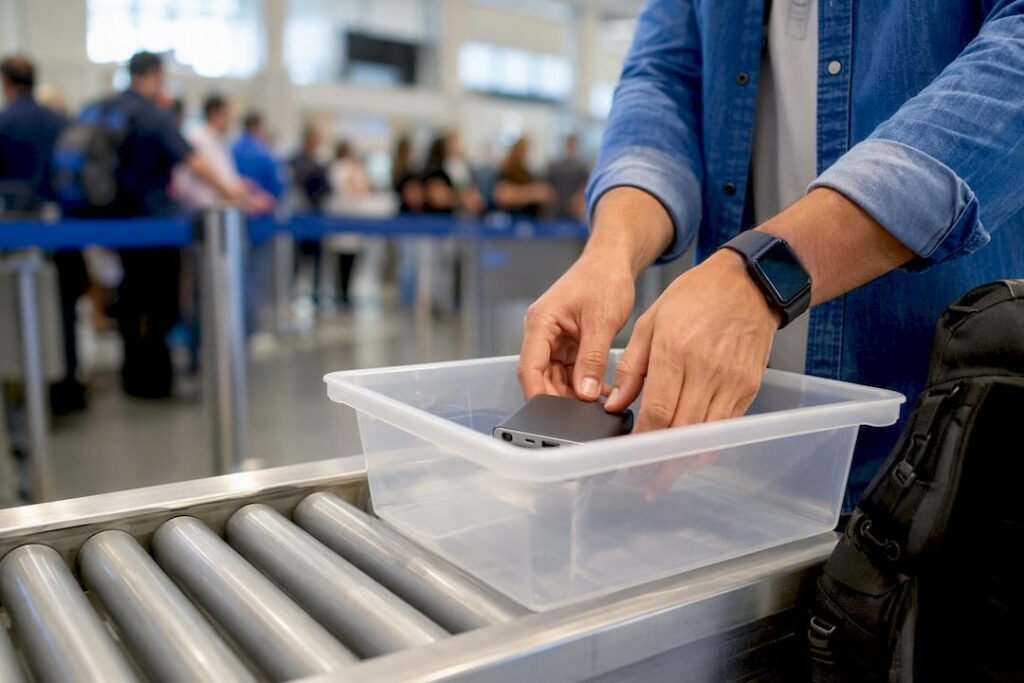
Yes, you can bring a power bank on a plane, but only under specific conditions. The rule that matters most: airlines only allow power banks in carry-on luggage, never in checked bags. Beyond that, the Federal Aviation Administration and international guidance sort every power bank into three watt-hour bands.
- 0 to 100 Wh: permitted, no airline approval needed
- 101 to 160 Wh: allowed only with airline approval
- Over 160 Wh: prohibited on passenger aircraft, full stop
Many carriers limit the number of power banks per passenger, and an increasing number of airlines ban charging devices from power banks during flights. That last detail catches a lot of travelers off guard in 2026, since it wasn’t standard practice even two years ago.
Key Takeaways
Power banks fly in carry-on only, within three watt-hour bands, and 2026 airline policies increasingly restrict onboard charging and overhead storage.
| Point | Details |
|---|---|
| Know your watt-hour band | 0 to 100 Wh needs no approval, 101 to 160 Wh needs airline sign-off, over 160 Wh is banned outright. |
| Carry-on only, always | Power banks and spare lithium batteries are never allowed in checked baggage. |
| Convert mAh before you pack | Divide mAh by 1,000, then multiply by voltage (usually 3.7V) to get the real Wh figure. |
| Charge to 30% before flying | Lower state of charge reduces thermal risk and matches most operators’ recommendations. |
| Check Ifory’s display before boarding | The Ifory 40,000mAh power bank’s LED screen lets you verify charge level and specs at a glance. |
Where to Confirm the Latest Power Bank Airplane Rules
- ICAO: New power bank restrictions
- IATA: Passengers traveling with lithium batteries
- FAA PackSafe: Airline passengers and batteries
Always check your specific airline’s website too. Carrier policy is often stricter than the baseline government rules.
Table of Contents
- What Are the Baseline Power Bank Airplane Rules?
- How Do Airline Policies Differ From the Baseline Rules?
- How Do You Convert mAh to Wh for Your Power Bank?
- What Are the Best Practices for Packing a Power Bank Safely?
- What Happens if Security Flags Your Power Bank?
- Why the Real Risk Isn’t the Rules, It’s the Guesswork
- Sources
What Are the Baseline Power Bank Airplane Rules?
The ICAO framework that most national aviation authorities and airlines follow breaks lithium battery devices into the same three tiers: under 100 Wh needs nothing special, 101 to 160 Wh needs a green light from the airline, and anything above 160 Wh doesn’t fly, period. The FAA mirrors this almost exactly in its own PackSafe guidance, which is why the rule feels consistent whether you’re flying out of Chicago or Frankfurt.
Carry-on only is mandatory. Spare lithium batteries and power banks are not allowed in checked baggage because a thermal event in the cargo hold is harder to detect and manage than one in the cabin. That’s the entire logic behind the rule: if something goes wrong, someone needs to be able to see it, grab it, and act.
Every legitimate power bank sold today should have passed UN 38.3 testing, a battery of tests covering altitude simulation, thermal cycling, vibration, shock, and short circuit resistance. It’s the baseline safety bar that makes a battery eligible for air transport in the first place. You won’t need to prove this yourself at the gate, but it’s worth knowing that a power bank without any safety certification markings is a red flag, not just a paperwork gap.
Quick recap of the numbers that govern almost every itinerary:
- 0 to 100 Wh: no approval required, standard carry-on item
- 101 to 160 Wh: airline approval required in advance
- Over 160 Wh: not permitted on passenger flights, no exceptions
- Typical quantity cap: two power banks per passenger for the higher-capacity tier
How Do Airline Policies Differ From the Baseline Rules?
The federal and international thresholds set the floor, not the ceiling. Individual airlines routinely layer stricter rules on top, and the differences matter more than most travelers expect. Lufthansa Group, for instance, announced a policy starting January 15, 2026 that bans using or charging power banks entirely during flight, caps passengers at two units in carry-on, and restricts storage to the seat pocket, on your person, or under the seat, never in overhead bins or checked luggage.
If your power bank falls in the 101 to 160 Wh range, don’t assume you’re covered just because it’s under the legal maximum. Here’s the practical sequence:
- Check the airline’s dangerous goods or “battery and power bank” page before you pack.
- Call customer service with the exact model number and its printed Wh rating in hand.
- Ask for written or emailed confirmation of approval, not just a verbal yes.
- Keep that confirmation accessible on your phone or printed for check-in and the gate.
Pro Tip: Screenshot the airline’s approval email and save it to your phone’s offline photo storage, not just your inbox. Gate agents move fast, and you don’t want to be hunting for Wi-Fi to prove you’re cleared.
How Do You Convert mAh to Wh for Your Power Bank?
Watt-hours, not milliamp-hours, are what regulators care about, and the conversion is simple: Wh = (mAh ÷ 1,000) × voltage. Most lithium-ion power banks run on a nominal 3.7V cell, so that’s the default multiplier unless the manufacturer states otherwise.
That third row surprises a lot of people. A 40,000mAh unit sounds like a mid-range gadget, but the math pushes it into the approval tier, not the “pack it and forget it” tier.
- Look for the Wh rating printed directly on the device or its original box.
- If only mAh is listed, calculate it yourself using the formula above.
- Multi-cell, high-capacity designs sometimes run on a higher nominal voltage than 3.7V, which pushes the real Wh figure even higher than a quick mental estimate suggests, so check the label rather than assuming.
mAh to Wh: the common capacities, worked out
At the usual 3.7V nominal, here is where the everyday sizes land. Find yours and you have your answer in one look.
Capacity Watt-hours Can you fly with it? 5,000mAh 18.5 Wh Yes — no approval needed 10,000mAh 37 Wh Yes — no approval needed 20,000mAh 74 Wh Yes — no approval needed 26,800mAh 99.2 Wh Yes — just under the line 30,000mAh 111 Wh Only with airline approval 40,000mAh 148–154 Wh Only with airline approval 45,000mAh+ 166 Wh+ No — banned from passenger aircraft That fifth row explains something you may have noticed while shopping: 26,800mAh is everywhere. It is not a coincidence or a manufacturing quirk. It is the largest round capacity that still squeezes under 100 Wh at 3.7V, so it became the default for anyone building a power bank meant to pass a gate without a conversation.
Can you fly with the Ifory 40,000mAh? Yes — with approval
We would rather tell you this plainly than let you find out at a gate. The Ifory 40,000mAh power bank is rated 154.4 Wh. That puts it in the middle band: allowed in carry-on, but only with your airline’s approval in advance, and it counts as one of the two larger batteries you are permitted to carry.
It is also a worked example of the warning above. Multiply 40,000mAh by 3.7V and you get 148 Wh. The real figure is 154.4 Wh, because the pack runs at a higher nominal voltage than the 3.7V shorthand assumes. Both numbers sit in the approval band, so the conclusion is the same — but if a pack were near the 160 Wh ceiling, that gap is the difference between flying and confiscation. Read the printed Wh rating. Never trust the arithmetic alone.
Getting approval is usually a short email or a form on the airline’s dangerous goods page, done days before you travel rather than at check-in. If you would rather not have that conversation at all, a power bank at or below 26,800mAh stays under 100 Wh and needs nothing from anyone.
What Are the Best Practices for Packing a Power Bank Safely?
Reducing your power bank’s charge before you fly is one of the simplest things you can do, and it’s not just a courtesy to the plane. IATA’s lithium battery guidance recommends keeping state of charge at or below 30% for transport, since a battery with less stored energy has less fuel available if something goes wrong internally.
Here’s a practical checklist to run through the night before you pack:
- Charge (or discharge) your power bank to roughly 30% or less before the flight.
- Cover exposed terminals with tape or store the unit in a dedicated pouch to prevent short circuits.
- Keep it in original packaging if you still have it. That packaging usually shows the certification markings clearly.
- Separate spare batteries from loose metal objects like keys or coins in your bag.
- Store the power bank on your person, in the seat pocket, or under the seat, following the storage pattern more airlines are now requiring rather than defaulting to the overhead bin.
Don’t plug your power bank into the aircraft’s outlet to top it off, and don’t use it to charge your phone if your carrier has banned in-flight use. If a device ever feels unusually hot, starts swelling, or produces any smoke or odor, tell a flight attendant immediately rather than trying to handle it yourself.
Pro Tip: A cheap silicone battery sleeve does double duty. It protects the terminals from short circuits and cushions the unit against drops, which matters if your rules-compliant power bank is also expensive.
What Happens if Security Flags Your Power Bank?
Airport security will only let a power bank through in carry-on, and screening staff can ask you to show the Wh rating on the spot. If you can’t produce it, even a fully compliant device can be delayed or denied. That’s a real risk, confirmed by ICAO’s own guidance, which is why keeping the original packaging or a photo of the label matters more than people assume.
If your carry-on gets gate-checked because of overhead bin space, remove your power bank and any spare batteries before handing over the bag. A bag rejected for carriage because of an undeclared battery is a bigger headache than losing five minutes at the gate.
- Keep the power bank on your body or in a small pouch you carry personally, never buried in a checked or gate-checked bag.
- Have your airline approval documentation ready if your unit falls in the 101 to 160 Wh range.
- Expect confiscation, not just a warning, if a device exceeds 160 Wh or shows no verifiable rating.
What Ifory Looks for in a Travel-Ready Power Bank
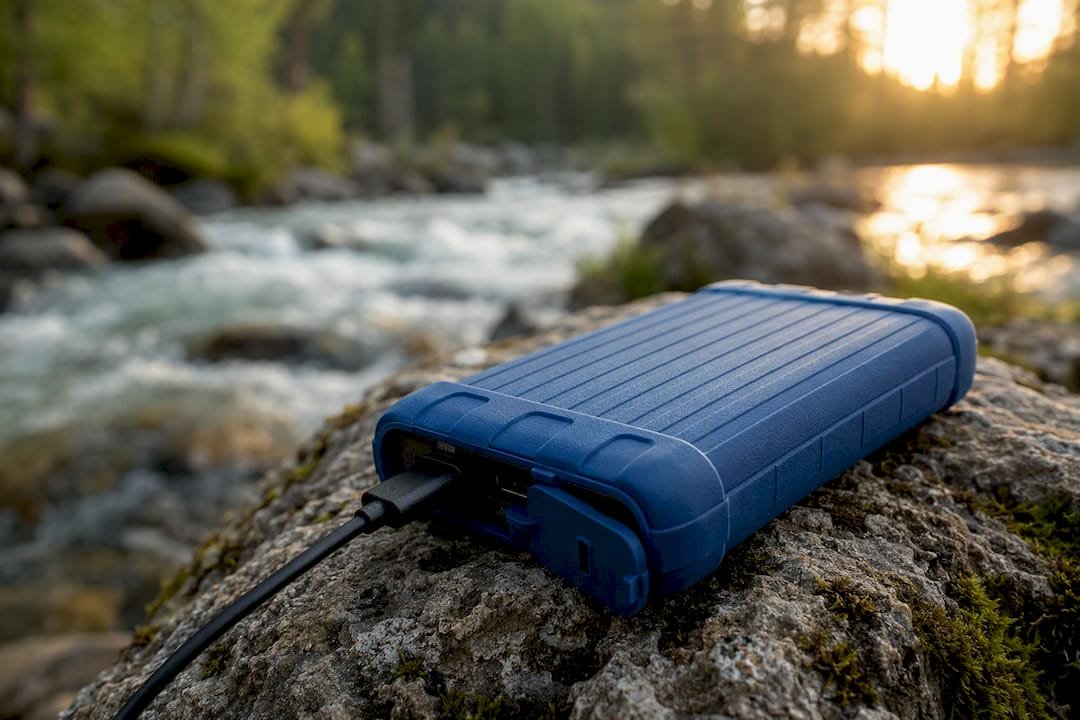
A power bank built for travel should make compliance effortless, not something you have to dig for. That means a clearly printed Wh rating, overload and short circuit protection, a casing rugged enough to survive gate handling, and a display that shows charge level at a glance so you can hit that 30% target before boarding. Ifory’s approach to its 40,000mAh unit reflects that thinking, prioritizing visible specs over vague marketing claims.
Before any flight, run this quick check on your own power bank:
- Is the Wh rating printed and legible?
- Does it show a recognized safety certification mark?
- Can you check the state of charge without guessing?
A device you can’t verify at a glance is a device you’ll be arguing about at the gate.
Why the Real Risk Isn’t the Rules, It’s the Guesswork
Most of the confusion around power bank airplane rules doesn’t come from the regulations themselves. ICAO, IATA, and the FAA all draw the same lines, and they’ve been fairly stable for a while. The real problem is that most travelers never check their own device’s Wh rating until they’re standing in the security line, sweating over a bag search.
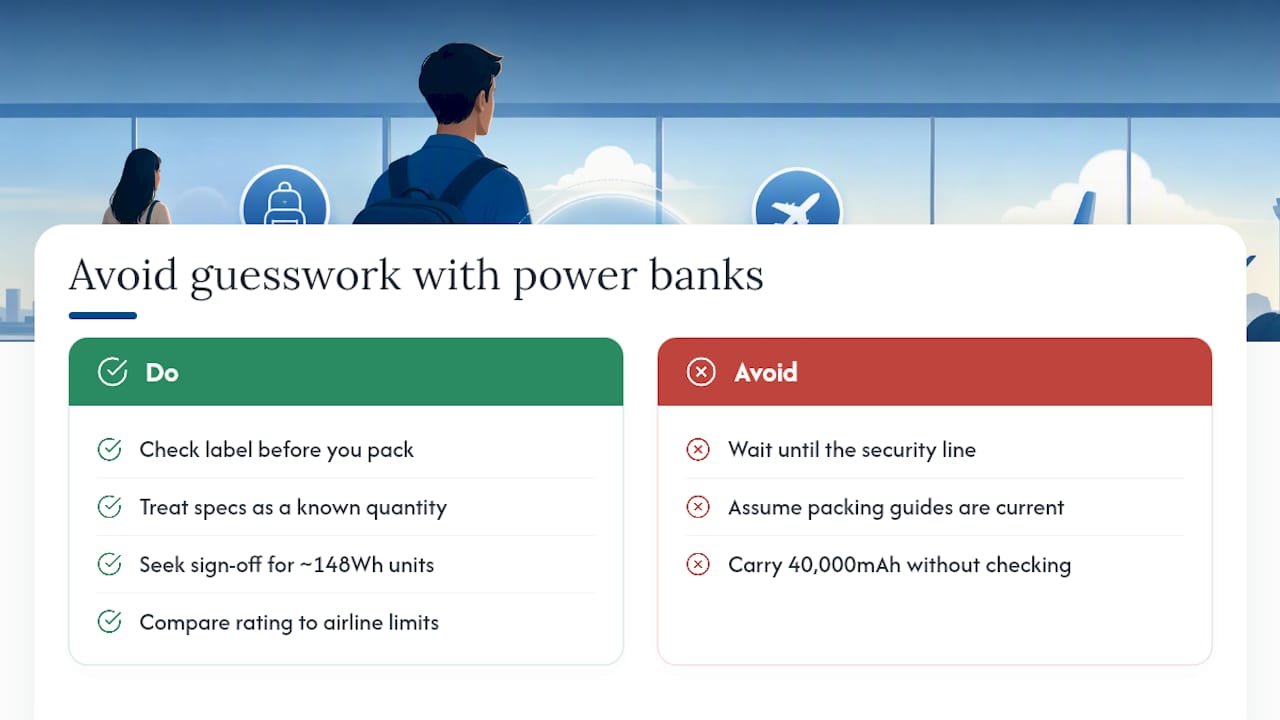
Conventional packing advice tends to focus on the wrong worry: “will they take it away?” The better question is whether you’d even know your own power bank’s rating if asked. A 40,000mAh unit sitting at roughly 148 watt-hours needs airline sign-off, and plenty of frequent flyers carrying exactly that capacity have no idea they’re in the approval tier at all.
If there’s one thing worth prioritizing above everything else in this guide, it’s checking the label before you pack, not after you’re flagged. Airlines like Lufthansa are tightening onboard charging and stowage rules faster than most packing guides update, so treating your power bank’s specs as a known quantity, not an afterthought, is what actually keeps a trip moving instead of stalling at a checkpoint.
— Mats
A Power Bank That Makes Compliance Simple
Its IP67 waterproof rating and anti-drop casing mean it survives gate handling and outdoor use equally well, and the multi-port, 100W fast-charging setup means one device covers a phone, tablet, and camera battery without extra cables cluttering your carry-on.

If you’re heading into a trip and want a unit with clearly marked specs and travel-grade durability, check out the Ifory 40,000mAh 100W power bank and confirm it fits your airline’s approval requirements before you fly.
Sources
- New power bank restrictions will safeguard international aviation | ICAO News
- Passengers travelling with lithium batteries guidance | IATA (2025–2026)
- Airline passengers and batteries | FAA PackSafe