

Pass-through charging lets a power bank or USB-C hub draw power from a wall outlet while simultaneously feeding output to your phone, laptop, or camera. It solves a real problem: one outlet, two charging jobs. But it comes with a tax. Efficiency drops, heat rises, and cheap circuitry can shorten a battery’s working life over time.
The verdict: use pass-through for short, occasional windows like airport layovers or a crowded desk with one free plug. Skip it as a daily habit. A power bank like Ifory, built around 100W USB Power Delivery (PD) and a real battery management system, handles the load far better than a budget unit with a single shared circuit.
- Good use: topping off your phone overnight while the bank also charges from a wall adapter
- Bad use: running pass-through for 8+ hours daily as your permanent charging setup
- Key factor: whether the bank explicitly lists pass-through or power-path support on its spec sheet
Key Takeaways
Pass-through charging trades some speed and battery longevity for the convenience of running one outlet instead of two, and the quality of the bank determines how steep that trade-off actually is.
| Point | Details |
|---|---|
| Definition matters | Pass-through means the bank charges itself and powers a device at once, using power-path routing, not true simultaneous cell access. |
| Efficiency varies widely | Efficiency during pass-through typically runs high on well-designed banks, but drops noticeably on cheaper units, with the lost energy released as heat. |
| Heat is the tell | Banks commonly run 5 to 10°C hotter during pass-through, and sustained heat is the main driver of long-term battery wear. |
| Gear matching is non-negotiable | Use a PD-capable adapter matched to your bank’s wattage and an e-marked cable for anything above 60W. |
| Ifory fits the outdoor case | Ifory’s 100W PD, multi-port layout, and IP67 build address the heat and exposure challenges pass-through creates in the field. |
Table of Contents
- How Does Pass-Through Charging Actually Work?
- What Are the Real Benefits of Pass-Through Charging?
- What Are the Downsides and Risks?
- How Do You Check If a Power Bank Really Supports Pass-Through?
- When Should You Actually Use Pass-Through Charging?
- How Ifory’s Design Handles Pass-Through Demands
- Why the Marketing Around Pass-Through Oversimplifies Everything
- Get a Power Bank Built for Real Pass-Through Use
- Sources
How Does Pass-Through Charging Actually Work?
Pass-through charging doesn’t mean your device draws power straight from the wall while bypassing the battery entirely. It means the bank’s power-path circuit routes incoming current to both the internal cells and the output port at once, using a form of rapid time-sharing rather than true simultaneous flow. The battery management system, or BMS, is the traffic controller here. It decides how much current goes where, monitors cell voltage and temperature, and cuts or throttles output if something looks unsafe.
That prioritization logic explains a lot of the “why is this so slow” complaints you’ll find online. A technical breakdown from Power Bank Tests confirms that well-engineered banks use power-path management to split current intelligently rather than simply doubling up demand on a single converter.
Three variables determine what speed you actually get:
- Adapter wattage. A 100W bank plugged into a 20W adapter will never hit its rated speed, no matter what the box promises.
- PD negotiation. The bank, cable, and adapter all handshake over USB PD to agree on a voltage and current profile before any real power moves.
- Cable e-marker chip. Cables rated above 60W need an embedded e-marker chip to legally and safely carry that load. A non-e-marked cable caps your speed regardless of how capable your hardware is.
Efficiency during pass-through typically runs high on well-designed banks, but drops noticeably on cheaper units, with the lost energy released as heat. That gap is the entire story of why some power banks feel warm to the touch and others feel genuinely hot.
What Are the Real Benefits of Pass-Through Charging?
The obvious win is outlet math. One plug covers your bank and your phone instead of forcing you to choose. That matters more than it sounds like it should when you’re at an airport gate with two outlets and forty people around them.
Pass-through also lets you “triage” charging priority. Many banks route power to the connected device first and only top up their own cells once that device is satisfied, so your phone reaches full charge before the bank does.
- A phone at 20 percent plugged into a pass-through bank, which is itself plugged into the wall, often reaches full charge in under two hours while the bank continues topping up afterward
- A desk with a single power strip slot can run your laptop charger and your power bank as a relay instead of forcing a device-swap routine
- Overnight charging at a campsite generator or shared outlet means your bank refills while your headlamp or GPS unit stays powered
For frequent flyers dealing with layovers and gate changes, a bank that supports clean pass-through removes one more variable from an already chaotic travel day.
What Are the Downsides and Risks?
Nothing about pass-through is free. The convenience comes out of three budgets: speed, heat, and battery life.
- Speed: expect noticeably slower charging than plugging your device directly into the wall, since incoming power gets split between the battery and the output port
- Heat: many models run hotter during pass-through than during normal charging or discharging alone, according to the same Power Bank Tests analysis
- Efficiency loss: the 10 to 15 percentage point gap between good and poor designs isn’t cosmetic; it’s wasted energy that shows up as wasted heat inside a sealed housing
- Battery wear: low-end banks without proper thermal management risk accelerated degradation over repeated pass-through cycles
Battery chemistry changes the math here. EcoFlow’s technical explainer notes that high-end designs using LFP (LiFePO4) chemistry paired with intelligent BMS logic absorb pass-through stress far better than standard lithium-ion cells in cheap units. That’s part of why manufacturer guidance matters: some brands explicitly warn against running pass-through for extended sessions, while others engineer around the problem and stay quiet about the limitation entirely because there isn’t one.
How Do You Check If a Power Bank Really Supports Pass-Through?
Not every bank on the market supports this feature, and using it on a unit that doesn’t can cause real problems. HowToGeek’s explainer points out that unsupported banks may disable output entirely, overheat, or throttle speeds unpredictably when input and output are connected at once.
Run through this before you buy or before you rely on a bank for a long session:
- Check the spec sheet for explicit language. Look for “pass-through,” “power-path,” or “UPS mode” listed by name, not implied.
- Match adapter wattage to the job. A 100W-rated bank needs an adapter close to that rating to deliver full pass-through performance, and the adapter should be PD-capable.
- Confirm the cable is e-marked for anything above 60W. Check the packaging or the connector housing for the rating.
- Run a short test. Plug in both ends, monitor the bank’s surface temperature after 20 to 30 minutes, and confirm the connected device is actually charging at a reasonable speed rather than trickling.
Pro Tip: If your bank’s output cuts out the moment you connect a charger, or the case gets hot enough to be uncomfortable within minutes, stop. That’s the hardware telling you it wasn’t built for this.
When Should You Actually Use Pass-Through Charging?
A few rules of thumb keep pass-through safe and useful rather than a slow-motion battery killer. Keep sessions short when possible. If you’re going to run pass-through for hours at a time on a regular basis, a bank built on LFP chemistry handles that repeated stress better than standard lithium-ion. Avoid using it in direct sun or in a hot car, since ambient heat stacks on top of the heat already generated internally.
- Airport layover: fine for an hour or two while your phone tops up
- Field reporting or remote fieldwork: prioritize the connected device and let the bank finish last
- Temporary power outage: pass-through through a 65 to 100W PD adapter keeps a laptop alive while the bank slowly refills
Always reach for an e-marked cable rated for your target wattage. Anything less bottlenecks the whole chain regardless of what your adapter or bank can technically do. And if you’re near a real outlet with no urgency, direct wall charging is still the faster, cooler, lower-wear option. Save pass-through for when you genuinely need two things happening on one plug.
Pro Tip: Keep a dedicated 100W e-marked cable in your bag just for pass-through sessions. Mixing a thin, low-rated cable into your kit is the single most common reason people think their “high-speed” bank feels slow.
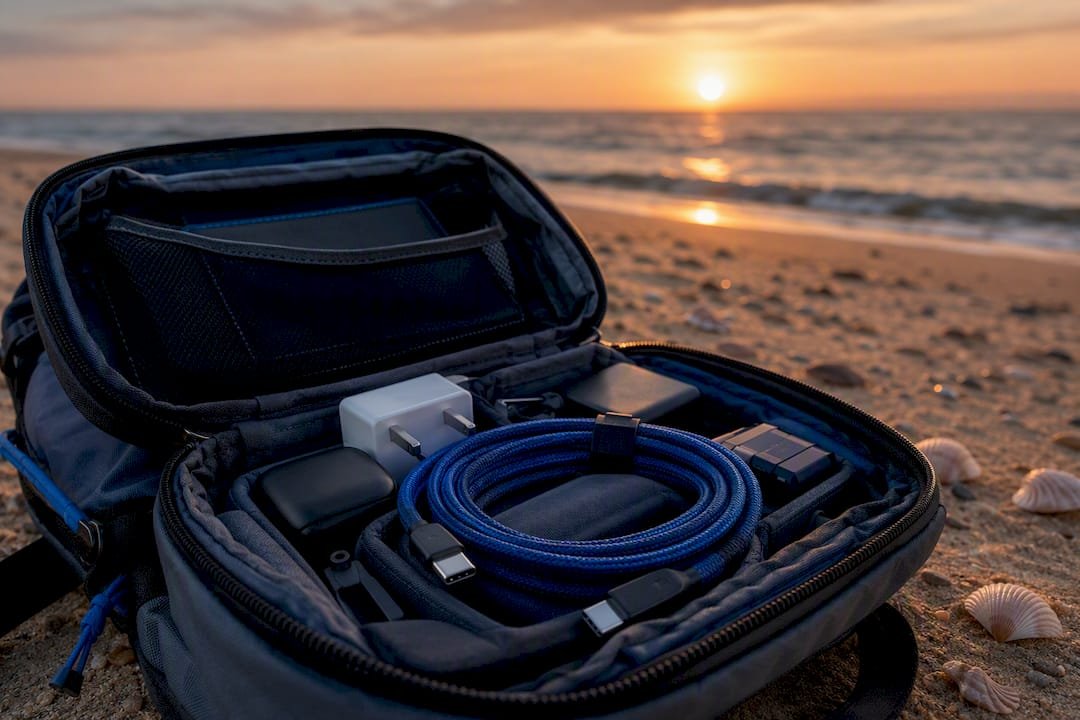
How Ifory’s Design Handles Pass-Through Demands
Outdoor use adds variables that indoor charging never deals with: heat, moisture, drops, and long stretches without an outlet in sight. Ifory’s 40,000mAh design was built around those conditions specifically.
- 100W PD input and output gives the power-path circuit enough headroom to handle a phone, a camera, and the bank’s own recharge cycle without starving any of them
- Multi-port layout means pass-through sessions don’t force a single device to hog the only available output
- IP67 waterproof and anti-drop construction matters for pass-through specifically, since thermal dissipation and environmental exposure both stress a bank harder during simultaneous charge and discharge
- Real-time LED display shows input and output status at a glance, so you can catch a throttling or overheating pattern before it becomes a problem
A bank that only performs well on a lab bench isn’t much use halfway up a trail or on a boat deck. Ifory’s ruggedized build targets exactly that gap between marketing specs and field reality.
Why the Marketing Around Pass-Through Oversimplifies Everything
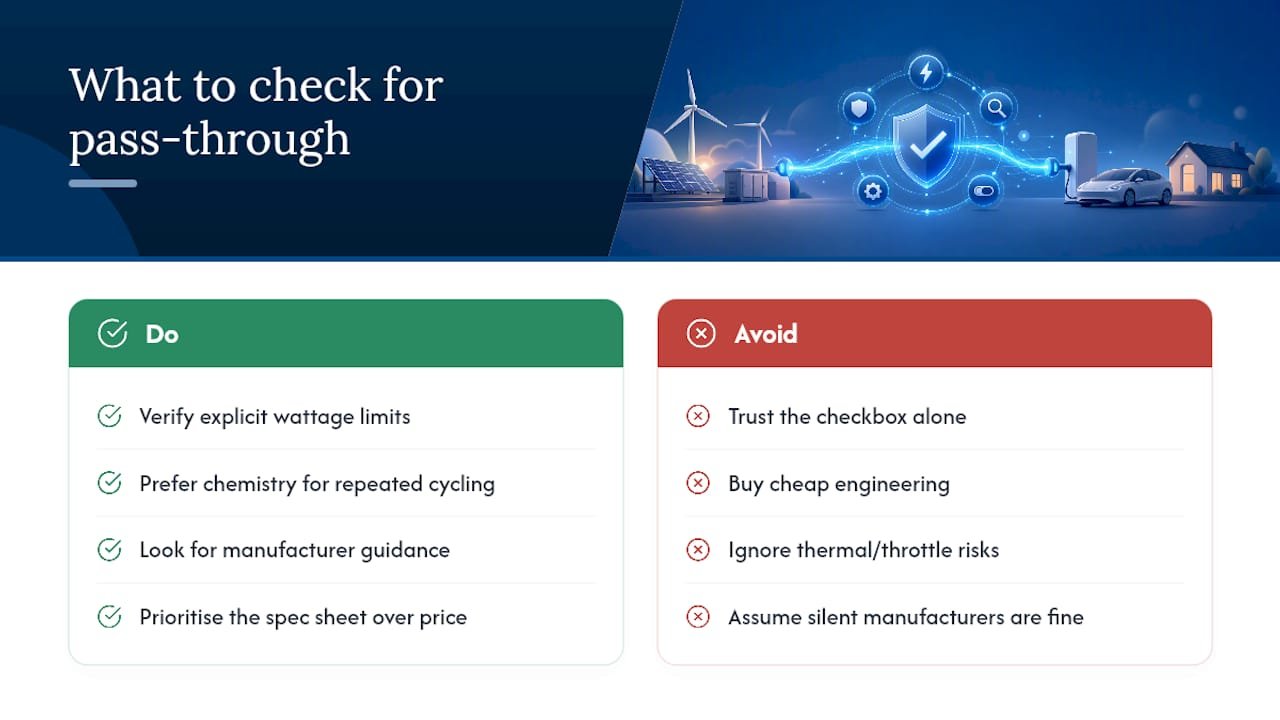
Most product listings treat pass-through as a checkbox feature: either a bank has it or it doesn’t. That framing hides the part that actually matters, which is how well the power-path circuit and BMS handle the load once you’re using it. A bank that “supports” pass-through on paper can still run hot, throttle unpredictably, or wear down faster if the underlying engineering is cheap.
The conventional advice, “just check if it has pass-through,” isn’t wrong so much as incomplete. The better question is whether the bank names its wattage limits explicitly, whether it uses chemistry suited to repeated cycling, and whether the manufacturer gives you real guidance instead of silence. Readers who prioritize the spec sheet over the feature checkbox end up with fewer surprises and cooler, longer-lasting hardware. That’s the filter worth applying before anything else, including price.
— Mats
Get a Power Bank Built for Real Pass-Through Use
If you’ve made it this far, you already know that “supports pass-through” and “supports it well” are two different claims. Ifory closes that gap with hardware built for the load, not just a spec sheet checkbox: 40,000mAh capacity, 100W PD across multiple ports, and a BMS designed to manage heat rather than ignore it.

What makes it fit the reader coming from this guide is the environment it’s built for. Outdoor charging rarely happens in ideal conditions, and Ifory’s IP67 rating and anti-drop housing mean pass-through sessions at a campsite or on a boat don’t come with the added risk of moisture or impact damage on top of normal thermal stress. The integrated flashlight and real-time display round out a design meant for people who need power away from a wall outlet, not just convenience next to one.
Browse the current power bank lineup to compare capacity and wattage options, or go straight to the 100W fast-charging model built around the specs this article covers.
Sources
- What Is Pass-Through Charging, and How Does It Work?
- Pass-Through Charging: How It Actually Works | Power Bank Tests
- Pass-Through Charging: Efficient, Safe Power Banks Explained