

The formula is simple: Wh = (mAh × V) / 1000. Take a 5,000 mAh battery with a typical lithium cell voltage of 3.7 V, and you get 18.5 Wh (5,000 × 3.7 ÷ 1000). That’s the whole calculation.
mAh measures electric charge, how much current a battery can push out over time. Wh measures energy, the actual work that charge can do. You can’t convert one to the other without knowing voltage, because energy always depends on both how much charge you have and the pressure pushing it.
A 5,000 mAh battery at 3.7 V stores 18.5 Wh. Change the voltage and the energy figure changes too, even if the mAh rating stays identical.
Key Takeaways
Converting mAh to Wh always comes down to one formula, Wh = (mAh × V) / 1000, and getting the voltage right is what separates an accurate energy figure from a misleading one.
| Point | Details |
|---|---|
| Use the right formula | Wh = (mAh × V) / 1000; multiply mAh by voltage, then divide by 1,000. |
| Use cell voltage, not USB output | Lithium cells run at 3.6–3.7 V nominal; using 5 V overstates energy by roughly 35 percent. |
| Watch the 100 Wh threshold | Many airlines cap carry-on power banks near 100 Wh, which is why 27,000 mAh packs (99.9 Wh) are common. |
| Reverse conversion works too | mAh = (Wh × 1000) / V lets you find capacity limits for a target Wh, like 27,027 mAh at 100 Wh. |
| Ifory’s 40,000 mAh pack converts to 148 Wh | Built for outdoor basecamp use with 100 W charging and IP67 waterproofing, not for carry-on flight limits. |
Table of Contents
- The mAh to Wh Conversion Formula, Step by Step
- Why Voltage Matters More Than Most People Realize
- Quick Reference: Common Power Bank Capacities Converted
- How to Find the Correct Voltage for Your Battery
- Converting Wh Back to mAh
- Why Watt-Hours Matter Beyond the Math
- See the Conversion Applied: The 40,000 mAh Ifory Power Bank
- Frequently Asked Questions
- Sources
The mAh to Wh Conversion Formula, Step by Step
Converting battery capacity isn’t complicated once you know which numbers belong in the equation. Follow this order every time:
- Find the mAh rating. Check the battery label, product listing, or spec sheet.
- Find the correct voltage. For most lithium power banks, that’s the nominal cell voltage of 3.6–3.7 V, not the USB output voltage.
- Multiply mAh by voltage. This gives you milliwatt-hours.
- Divide by 1,000. That converts milliwatt-hours into watt-hours.
Worked example: 3,000 mAh × 3.7 V ÷ 1,000 = 11.1 Wh. The math takes about ten seconds once you have the two numbers in hand. You can also flip the arrangement to Wh = (mAh ÷ 1000) × V, a form some calculators use for cleaner display, and you’ll land on the same answer either way.
Pro Tip: Round to one decimal place for consumer specs. Battery voltage varies slightly between cells and drops as the battery discharges, so pretending you have precision beyond a tenth of a watt-hour is misleading, not accurate.
Why Voltage Matters More Than Most People Realize
Here’s where a lot of mAh to Wh conversions go wrong: using the wrong voltage. Power banks and phone batteries are rated in mAh at the cell level, meaning the number printed on the box reflects the battery’s internal chemistry, not what comes out of the USB port. Lithium-ion and lithium-polymer cells run at a nominal 3.6–3.7 V, while the USB output you actually charge devices with is boosted to 5 V, 9 V, 12 V, or even 20 V for fast-charging protocols.
If you multiply mAh by 5 V instead of 3.7 V, you’ll overstate the battery’s real energy content by roughly 35 percent, which matters if you’re checking airline limits or comparing specs honestly.
Common nominal voltages by battery type:
- Li-ion / LiPo single cell: 3.6–3.7 V
- Lead-acid battery: 12 V
- Multi-cell lithium packs: 7.4 V (2 cells in series), 11.1 V (3 cells in series)
Pro Tip: For airline or transport calculations, always use the pack’s nominal voltage as printed by the manufacturer. If it isn’t listed, 3.7 V is the safe default for most consumer power banks.
Quick Reference: Common Power Bank Capacities Converted
Once you know the formula, the fastest way to check a battery’s energy content is against a reference chart. Here’s how the most common power bank sizes convert at 3.7 V:
| Capacity (mAh) | Watt-Hours (Wh) at 3.7 V |
|---|---|
| 5,000 | around eighteen and a half |
| 10,000 | around thirty-seven |
| 20,000 | about seventy-four |
| 27,000 | close to one hundred |
| — | somewhat over one hundred |
| 40,000 | roughly one hundred and forty-eight |
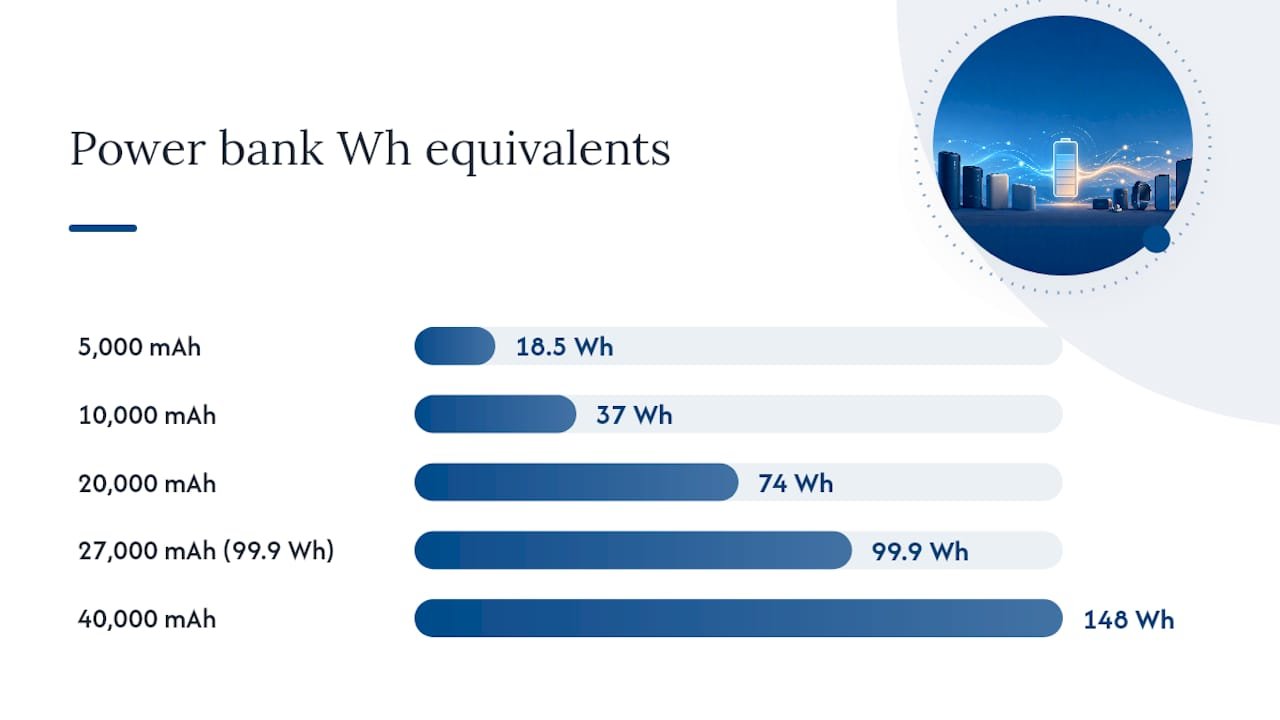
Walking through two of these by hand: 10,000 mAh × 3.7 V ÷ 1,000 = 37 Wh. And a 20,000 mAh pack with 3.7 V cells lands at exactly 74 Wh, a figure you’ll see repeated across battery spec sheets because it’s such a common capacity tier.
Notice the 27,000 mAh row. At 99.9 Wh, it sits right under the 100 Wh threshold many airlines use for carry-on power banks. That’s not a coincidence. Manufacturers frequently size packs at 27,000 mAh specifically to stay compliant while maximizing capacity.
How to Find the Correct Voltage for Your Battery
You can’t convert mAh to Wh accurately without the right voltage, and that number isn’t always obvious. Check these sources in order of reliability:
- The battery or device label, usually printed directly on the pack or inside the battery compartment.
- The manufacturer’s spec sheet or product page, which lists voltage alongside capacity.
- The battery datasheet, if you’re working with a standalone cell rather than a finished product.
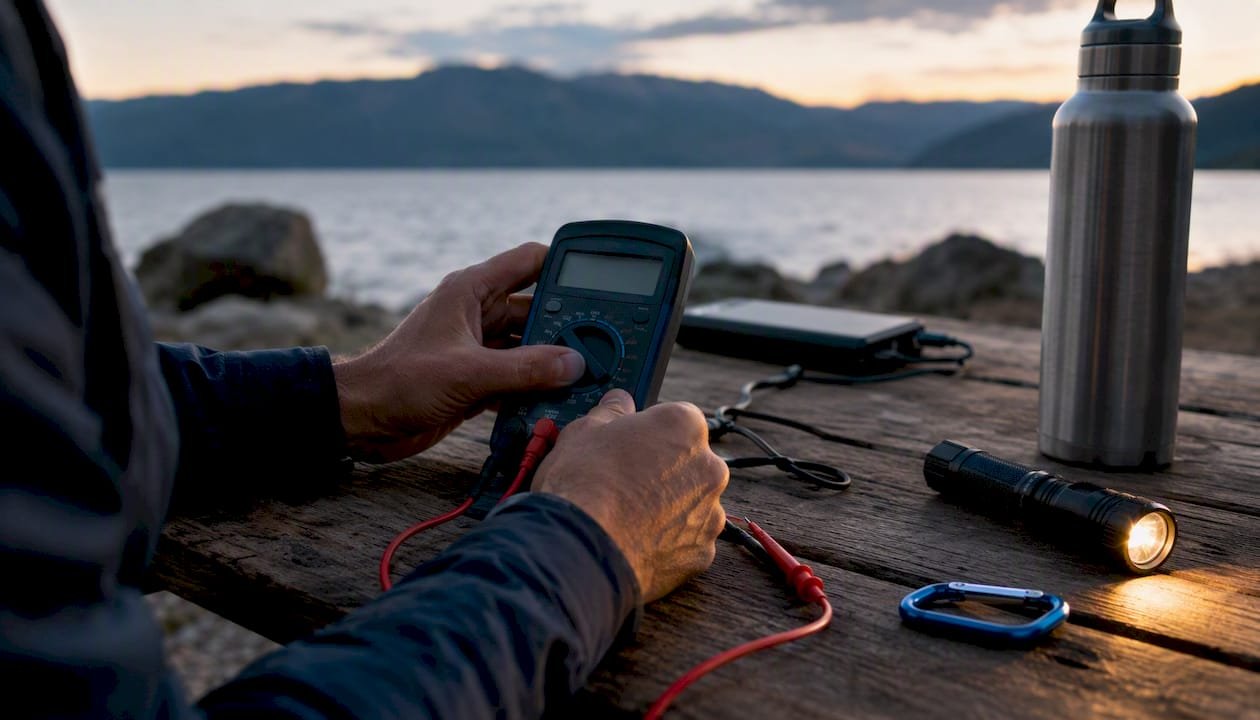
- A multimeter, set to DC voltage, touched across the battery terminals.
If you’re measuring yourself, know the difference between resting voltage (what you read with nothing connected) and loaded voltage (which dips slightly under an active draw). Use the resting, nominal figure for capacity math.
Pro Tip: Never disassemble a sealed battery pack just to check voltage; punctured lithium cells are a fire hazard. For multi-cell assemblies, use the printed pack voltage (like 7.4 V or 11.1 V) rather than trying to guess at individual cell counts.
Converting Wh Back to mAh
Sometimes you need to work backward, say, you know an airline’s 100 Wh limit and want to know the maximum mAh capacity that fits under it at a given voltage. The reverse formula is just as straightforward:
mAh = (Wh × 1000) / V
- Start with your target Wh figure (100 Wh, for example).
- Multiply by 1,000 to get milliwatt-hours (100,000).
- Divide by your nominal voltage (3.7 V), giving you approximately 27,027 mAh.
At 3.7 V, 100 Wh equals about 27,027 mAh. Round down, not up, when you’re calculating against a hard regulatory ceiling.
If you’re buying or building a pack meant to stay under a specific energy limit, give yourself a buffer. A pack rated at 27,000 mAh is technically under 100 Wh, but manufacturing tolerances mean actual capacity can run slightly higher than advertised.
Why Watt-Hours Matter Beyond the Math
Converting mAh to Wh isn’t just an academic exercise. It solves real problems travelers and buyers run into constantly.
Airlines and transport authorities regulate lithium batteries by energy content, not charge, because Wh reflects actual fire risk and stored energy regardless of a battery’s voltage or size. Most carriers cap carry-on power banks around 100 Wh, though limits vary by airline and route, so check your specific carrier before you fly.
Wh also gives you an honest way to estimate runtime. Take your converted Wh figure, apply a usable-energy factor of roughly 85 percent to account for conversion losses, then divide by your device’s wattage draw. A 74 Wh pack powering a 10 W device gives you roughly 6.3 hours of runtime (74 × 0.85 ÷ 10).
- Use Wh, not mAh, when comparing batteries across devices that run at different voltages.
- A 10,000 mAh battery at 3.7 V holds less real energy than a 5,000 mAh battery at 11.1 V, despite the smaller mAh number.
Pro Tip: When two power banks list different mAh ratings, convert both to Wh before deciding which one actually holds more usable energy.
One traveler’s habit worth copying
Anyone who’s packed a power bank for a flight and gotten stopped at security knows the feeling: you thought you did the math right, and now you’re explaining voltage to a TSA agent. The travelers and outdoor users who never run into that problem are the ones who check the actual printed voltage before converting, instead of assuming 3.7 V applies to everything.
Round conservatively. If your calculation lands at 99.5 Wh, don’t treat that as safely under 100 Wh, treat it as a pack you should double check against your airline’s actual policy before you travel.
See the Conversion Applied: The 40,000 mAh Ifory Power Bank
Run the numbers on Ifory’s own 40,000 mAh power bank and you get 148 Wh (40,000 × 3.7 ÷ 1,000), a figure that puts it well above airline carry-on limits and squarely in “built for basecamp, not the overhead bin” territory.

That kind of capacity is exactly what outdoor use demands: multiple device charges over several days without a wall outlet in sight. Ifory pairs that 40,000 mAh cell with 100 W fast charging, so you’re not waiting around for a slow trickle, an IP67 waterproof rating that shrugs off rain and river crossings, and a real-time LED display so you’re never guessing how much energy you have left. A built-in flashlight rounds it out for anyone who’s ever fumbled for a headlamp at a campsite.
If your trip involves flying, you’ll want a smaller pack for the plane and something like the 40,000 mAh model for basecamp or overland travel where airline Wh limits don’t apply. Browse the full Ifory power bank lineup or check the 40,000 mAh 100W power bank directly to see current specs and pricing.
Frequently Asked Questions
How many Wh is 10,000 mAh?
At the standard 3.7 V lithium cell voltage, 10,000 mAh converts to 37 Wh (10,000 × 3.7 ÷ 1,000).
How many Wh is 20,000 mAh?
A 20,000 mAh battery at 3.7 V equals 74 Wh, a common figure since 20,000 mAh is one of the most widely sold power bank capacities.
How many Wh is 40,000 mAh?
At 3.7 V, 40,000 mAh converts to 148 Wh, well above the 100 Wh airline carry-on threshold, which makes packs this size better suited to car camping or basecamp use than flying.
Why do I need to know the voltage to convert mAh to Wh?
Because mAh measures charge and Wh measures energy, and energy depends on both charge and voltage. Skipping the voltage step, or using the wrong one, gives you a number that looks precise but isn’t accurate.
Can I bring a 27,000 mAh power bank on a plane?
At 3.7 V, 27,000 mAh converts to just under 100 Wh, close to the common airline limit, but rules vary by carrier so confirm with your specific airline before you fly.
Sources
- mAh to Watt-hours (Wh) conversion calculator
- mAh to Wh Calculator | WireResult
- mAh to Wh Calculator | Purely Energy
- mAh to Watt-Hours: The Power Bank Conversion Guide (2026) – Clutch