
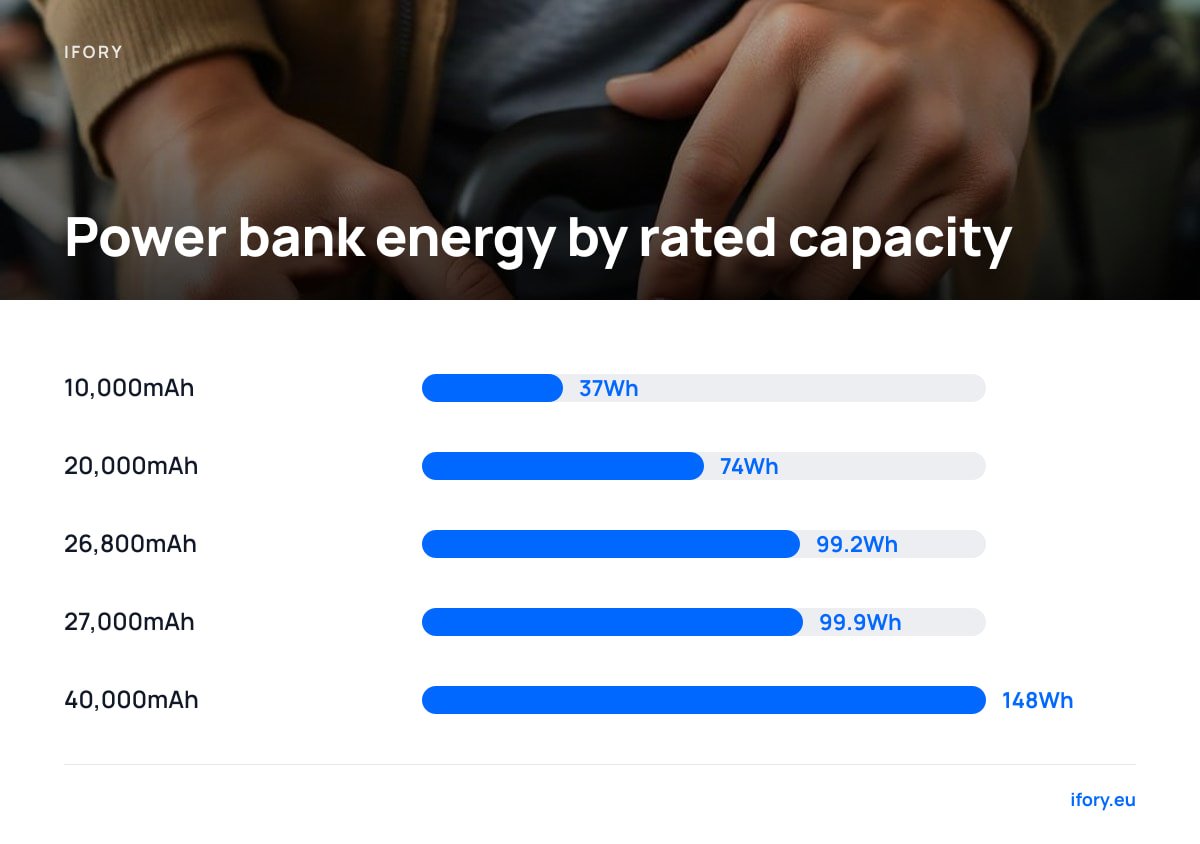
Power bank capacity is printed in mAh, but the number that tells you what you get is watt-hours: multiply mAh by 3.7 volts and divide by 1,000. A 20,000mAh pack holds about 74Wh and delivers roughly 55Wh to your devices after conversion losses, which is around three phone charges. The same math decides whether the pack can fly, because airlines draw their line at 100Wh, or about 27,000mAh.
TL;DR:
- mAh is measured at the battery cell's roughly 3.7V, so Wh = mAh x 3.7 / 1000 is the only fair way to compare packs or check airline limits.
- Expect to get about 65 to 85 percent of the rated energy out of the USB port. A 20,000mAh bank behaves like a 10,000 to 12,000mAh bank at 5V.
- Airlines cap carry-on power banks at 100Wh (about 27,000mAh) without approval, and 160Wh with airline approval. Power banks never go in checked bags.
- A phone-only weekend needs 10,000 to 20,000mAh. A multi-day trip with a laptop or console needs 27,000 to 40,000mAh, plus solar once you pass three days.
- Check real capacity with an inline USB-C power meter, not a phone app.
Table of Contents
- Power Bank Capacity Explained: What a Portable Power Bank Stores, in mAh and Wh
- What a 20,000mAh Power Bank Actually Holds, and How Many Charges That Is
- Power Bank Capacity Chart: 10,000 to 40,000mAh Side by Side
- Can You Take a Power Bank on a Plane? The 100Wh Rule and the 160Wh Exception
- How to Check Power Bank Capacity: Why Apps Can't Do It and What Can
- Power Bank Capacity Calculator: Sizing for a Multi-Day Trip
- The Best Power Bank Capacity for Camping and Trekking: My Picks
- Get 148Wh of Laptop-Ready Power for Off-Grid Trips
- Frequently Asked Questions
- Sources
Power Bank Capacity Explained: What a Portable Power Bank Stores, in mAh and Wh
A portable power bank is a lithium-ion battery pack with a charging circuit and USB ports attached. It stores energy in cells, then steps the voltage up or down to charge your phone, tablet or laptop. The capacity on the label is almost always in milliamp-hours (mAh), which counts charge, not energy.
Charge only becomes energy once you multiply by voltage, and the voltage inside the pack is not the voltage coming out of the port. Lithium-ion cells run at a nominal 3.6 to 3.7 volts, according to Battery University, while a basic USB port delivers 5V. A mAh figure only means something at a stated voltage, and packs advertise it at the cell voltage because that gives the bigger number.
The formula you need:
- Watt-hours (Wh) = mAh x 3.7 / 1000
- Usable Wh = Wh x 0.65 to 0.85, depending on cable, output voltage and load
- Phone charges = usable Wh / your phone's battery Wh (most current phones are 15 to 19Wh)
Wh lets you compare a 10,000mAh pack to a 40,000mAh one, check an airline limit, or work out whether a pack can refill a laptop.
What a 20,000mAh Power Bank Actually Holds, and How Many Charges That Is
A 20,000mAh power bank stores 74Wh (20,000 x 3.7 / 1000). At the 5V a plain USB port outputs, that is 14,800mAh of theoretical capacity. After conversion losses, plan on roughly 10,000 to 12,000mAh delivered at 5V, or about 55Wh.
Loss comes from voltage conversion, heat and the cable. Fast-charging at higher voltages is usually more efficient than trickling 5V into a phone, but the pack never gets close to 100 percent.
A 20,000mAh power bank holds about 74Wh and delivers closer to 55Wh. That is three phone charges, not the four or five the label math suggests.
So how much charge does a power bank hold in practice? Divide usable Wh by your phone's battery. With a 17Wh phone, 55Wh gives you about 3.2 full charges. Your phone does not always charge from 0 to 100, so real-life "charges" are often partial top-ups, and the count looks higher if you top up at 30 percent.
Power Bank Capacity Chart: 10,000 to 40,000mAh Side by Side
This chart assumes 3.7V cells, 75 percent delivery efficiency and a 17Wh phone. Your numbers will drift with temperature, cable quality and charging speed.
| Rated capacity | Energy (Wh) | Usable (about 75%) | Full phone charges | Carry-on status |
|---|---|---|---|---|
| 10,000mAh | 37Wh | 28Wh | 1 to 2 | No approval needed |
| 20,000mAh | 74Wh | 55Wh | 3 | No approval needed |
| 26,800mAh | 99.2Wh | 74Wh | 4 | Just under the 100Wh line |
| 27,000mAh | 99.9Wh | 75Wh | 4 | Just under the 100Wh line |
| 40,000mAh | 148Wh | 111Wh | 6 | Airline approval, 2 max |
What 10,000mAh Gets You
A 10,000mAh power bank is a one-day insurance policy. It covers a phone and a headlamp for a weekend, or one dead phone and a half-charged watch. It will not meaningfully charge a laptop, and it will only top a tablet up once.
Where 27,000mAh Comes From
Packs rated 26,800 or 27,000mAh turn up again and again, and the reason is the airline rule. At 3.7V, 27,000mAh is 99.9Wh, the largest pack you can carry onto a plane without asking permission. Manufacturers size to it.
Can You Take a Power Bank on a Plane? The 100Wh Rule and the 160Wh Exception
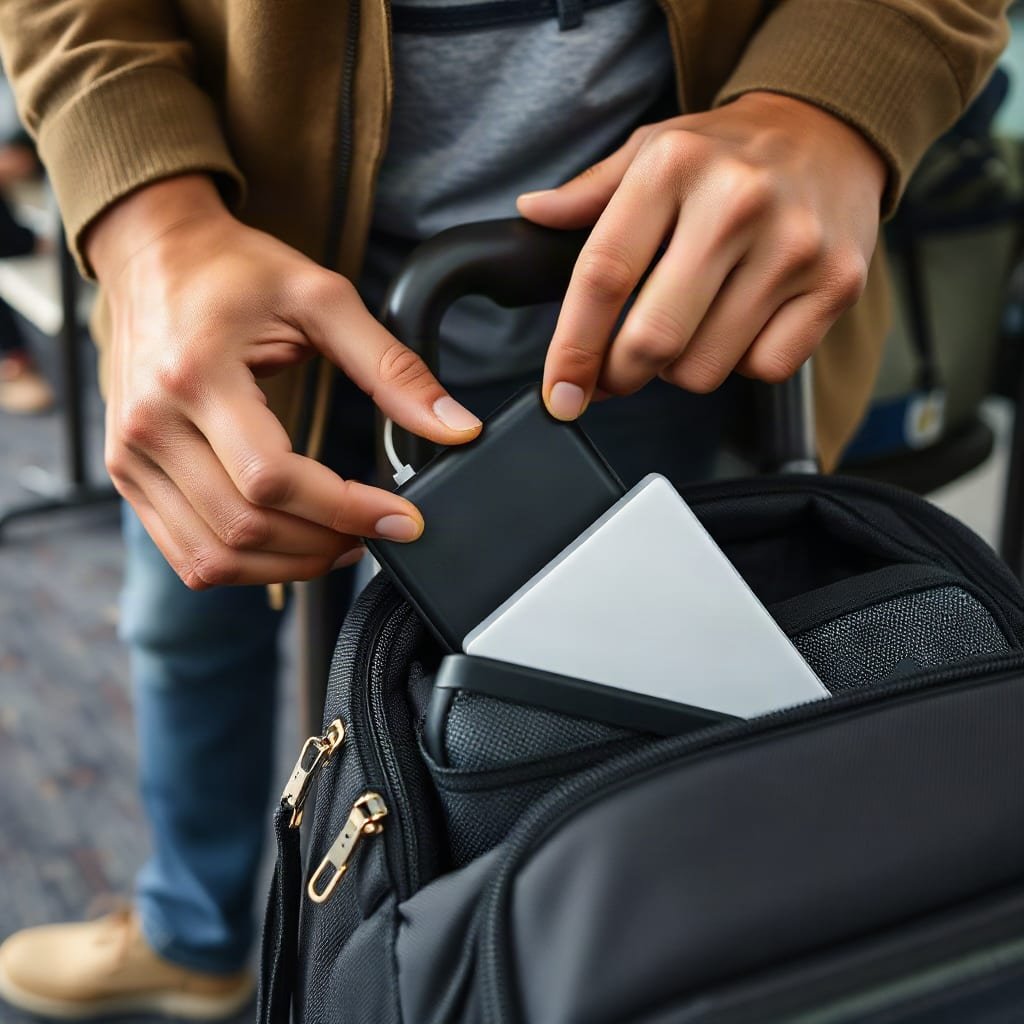
Yes, with three conditions. The FAA's PackSafe guidance says spare lithium batteries, which includes power banks, must travel in carry-on baggage only. Packs up to 100Wh need no special approval. Packs between 101 and 160Wh need airline approval, and you are limited to two. Anything over 160Wh is not allowed in the passenger cabin. The IATA lithium battery guidance that airlines follow draws the same lines.
100Wh in carry-on, no approval. 160Wh with airline approval, two spares maximum. Checked bags, never.
Three practical points follow:
- Do the Wh math yourself. If a pack only lists mAh, a gate agent will calculate Wh from the voltage. Have the figure ready or choose a pack with Wh printed on the label.
- In-flight use is a separate rule. Several airlines restrict using power banks during the flight even when carrying them is fine. Check your carrier's policy before departure.
- Short-circuit protection matters. Keep ports covered or pack the bank in its pouch so nothing touches the terminals.
A 40,000mAh pack (148Wh) is flyable, but only with approval, and only two per traveler. Ask before you reach the airport, and keep the confirmation handy.
How to Check Power Bank Capacity: Why Apps Can't Do It and What Can
A phone app cannot tell you the capacity of a power bank. Apps read the phone's own battery and charge rate, not the pack's cells, so any "power bank capacity checker" that claims otherwise is guessing from charging speed. The tests that work are physical.
Method 1: The Inline USB-C Meter
An inline USB-C power meter sits between the bank and a load and counts the Wh that flow through. Charge the bank fully, discharge it into a steady load until it shuts off, then read the accumulated Wh. Compare it to the label. A healthy pack lands around 65 to 85 percent of the rated Wh.
Pro Tip: Run the test at the output you will actually use. A pack can deliver 80 percent of its rating into a laptop at 20V and only 65 percent into a pair of earbuds drawing a trickle at 5V, because low currents can trigger auto shut-off and conversion losses weigh more. Test at your real load, not the maximum.
Method 2: The Charge-Count Test
Fully drain a phone, charge it from the bank to 100 percent, and repeat until the bank dies. Multiply the number of charges by your phone's battery Wh. It is rough and it takes an evening, but it needs only devices you already own.
Red Flags on the Label
- Rated higher than physically possible. A pack the size of a deck of cards claiming 30,000mAh is not holding that.
- mAh only, no Wh and no voltage. Reputable packs list all three.
- No safety certification marks. Look for CE marking for the EU and a stated cell protection scheme.
Power Bank Capacity Calculator: Sizing for a Multi-Day Trip
You can build your own power bank capacity calculator on paper. Add up what you will use per day, multiply by the days, add a 30 percent loss allowance, and convert to mAh. Typical battery sizes:
| Device | Typical battery |
|---|---|
| Phone | 15 to 19Wh |
| Headlamp (rechargeable) | 3 to 7Wh |
| Tablet | 25 to 40Wh |
| Handheld game console | 16 to 50Wh |
| 14-inch laptop | 50 to 70Wh |
Example for a three-day trek: one phone charge a day (17Wh), a headlamp top-up (4Wh) and a camera and watch (4Wh) is 25Wh a day. Over three days that is 75Wh. Add 30 percent for losses and you need about 98Wh, which is 26,400mAh at 3.7V. A 27,000mAh pack is the right size, with almost nothing to spare.
Now add a laptop. One full 60Wh refill costs roughly 80Wh with losses, and you are past 175Wh. This is where a 40,000mAh pack stops being excessive. For the wattage side of laptops, see our guide on whether a power bank can charge a MacBook Pro, and the handheld console charging guide covers gaming.
The Best Power Bank Capacity for Camping and Trekking: My Picks
There is no single best power bank capacity, but each trip has a right one. I would choose like this:
- Day hikes and weekend car camping with just a phone: 10,000 to 20,000mAh. I would take 20,000mAh. The weight difference is small and the extra charge gives you a margin for cold nights, when batteries drain faster.
- Three-day treks with a phone, headlamp and camera: 27,000mAh. This is the sweet spot for weight against energy.
- A week out, or any trip with a laptop, tablet or console: 40,000mAh plus solar. Without a way to refill, even 148Wh runs out. A foldable panel makes a finite battery renewable. See the solar panel kit buying guide for panel sizes and what each one can run.
Weight is the trade-off. Capacity scales close to linearly with cell mass, so a 148Wh pack carries about twice the cells of a 74Wh pack. If you are counting grams on a fast-and-light route, leave unused capacity at home. If you will be 4 days from a socket with a laptop, do not carry less.
Solar panels deliver well below their rated wattage in real conditions, because of angle, haze and clouds. Plan on about half of the label or less, and read what a panel really delivers in our solar panel phone charger breakdown.
Get 148Wh of Laptop-Ready Power for Off-Grid Trips
When the math above puts you past 100Wh, you need a bigger pack, and Ifory built one for that. The Ifory 40,000mAh 100W Power Bank is 148Wh at 3.7V, charges a laptop over USB-C Power Delivery at up to 100W (the USB spec reaches 100W with a 20V, 5A connection and a suitable cable), and runs a phone, tablet and console on the same trip. Pair it with the 40W PD portable solar panel and you can refill in daylight. The bundle often comes with the panel free, and shipping is free with 30-day returns, so check the product page for the current price.
One limit: at 148Wh this pack sits in the 101 to 160Wh band, so airlines require approval and cap you at two. Ask your carrier before you fly. It is also bigger and heavier than a 20,000mAh bank, so if your trip is a phone and a headlamp, the smaller one is the smarter buy.
Frequently Asked Questions
Can I bring power banks on planes?
Yes, in carry-on baggage only. Packs up to 100Wh (about 27,000mAh) need no approval, packs from 101 to 160Wh need airline approval and are limited to two, and anything above 160Wh is not allowed in the cabin.
What is a portable power bank?
A portable power bank is a rechargeable lithium-ion battery with USB ports and a charging circuit. You charge it from a wall socket or solar panel, then use it to recharge phones, tablets or laptops when no outlet is available.
How much charge does a power bank hold?
Multiply the mAh rating by 3.7 and divide by 1,000 to get watt-hours, then expect to get roughly 65 to 85 percent of that out of the ports. A 10,000mAh bank gives about 1 to 2 phone charges, and a 20,000mAh bank gives about 3.
What is the actual capacity of a 20,000mAh power bank?
It stores about 74Wh. At the 5V a standard USB port outputs, that equals roughly 14,800mAh in theory and 10,000 to 12,000mAh after conversion losses, which is why it charges a typical phone about three times.
How do I check the real capacity of a power bank?
Use an inline USB-C power meter that counts watt-hours. Charge the bank fully, drain it into a steady load until it shuts off, and read the total. Phone apps cannot measure it because they only see the phone's own battery.
Sources
- Lithium Batteries (PackSafe) | Federal Aviation Administration
- Lithium Battery Guidance for Passengers and Shippers | International Air Transport Association
- BU-205: Types of Lithium-ion | Battery University
- USB Power Delivery | USB Implementers Forum