

A big-name laptop power bank is worth buying when its USB-C output matches your laptop's own charger and its battery stays under 100Wh for flights. Wattage decides whether your laptop charges at all. Watt-hours decide how long it lasts and whether an airline lets it on board. The model number on the label matters more than the brand, because recalls and quality problems are tracked per model.
TL;DR:
- Match the power bank's USB-C output to your laptop charger (65W, 100W, 140W). Too little and the laptop charges slowly or not at all.
- Convert mAh to Wh before you compare: 25,000mAh is about 92.5Wh, which is roughly one full charge of a 13-inch ultrabook after losses.
- Recalls are issued per model. Check the model number against the US CPSC and the EU Safety Gate before you buy or keep using one.
- Airlines care about watt-hours, not output watts. Under 100Wh travels freely in carry-on; 100 to 160Wh needs airline approval.
- A "triple 100W" label does not mean 300W. Output is shared across ports, so check the spec for the combined figure.
Table of Contents
- How to Pick a Laptop Power Bank: Wattage First, Capacity Second
- How Many Charges a Power Bank Really Gives You
- How Long It Takes to Charge a Power Bank
- Are Big-Brand Power Banks High Quality? What Recalls Tell You
- Can a 165W Laptop Power Bank Go on a Plane?
- Built-In Cables, Triple 100W Ports and Other Spec-Sheet Traps
- Reading a Deal: Price Per Watt-Hour
- Get a 40,000mAh, 100W Power Bank Built for Laptops That Live Off-Grid
- Frequently Asked Questions
- Sources
How to Pick a Laptop Power Bank: Wattage First, Capacity Second
Look at your laptop's wall charger. The number printed on it (45W, 65W, 100W, 140W) is the output you need from the power bank's best USB-C port. A bank that delivers 30W can still top up a 65W laptop, but the laptop may drain as fast as it charges when you are working on it.
Capacity comes second. Once the port is strong enough, the remaining question is how many hours of laptop you want in your bag. A bank with a high-wattage port and a small cell, such as a 10,000mAh pocket model, will push 65W for a short time and then empty.
Here is how the common sizes line up:
- 10,000mAh (about 37Wh). Fine for phones and earbuds. It can nudge a laptop along at 30W, but it will not give you a meaningful laptop charge.
- 20,000mAh (about 74Wh). The lowest capacity that makes sense for a laptop. Most carry 65W ports.
- 25,000mAh (about 92.5Wh). The largest size that stays under the 100Wh airline line, which is why 100W to 165W models cluster here.
- 40,000mAh (about 148Wh). Built for multi-day trips. It needs airline approval to fly, which I cover below.
If your laptop is a MacBook Pro, read Can a Power Bank Charge a MacBook Pro? The Honest Answer first. The 16-inch models can draw up to 140W, and most banks cannot supply that.
How Many Charges a Power Bank Really Gives You
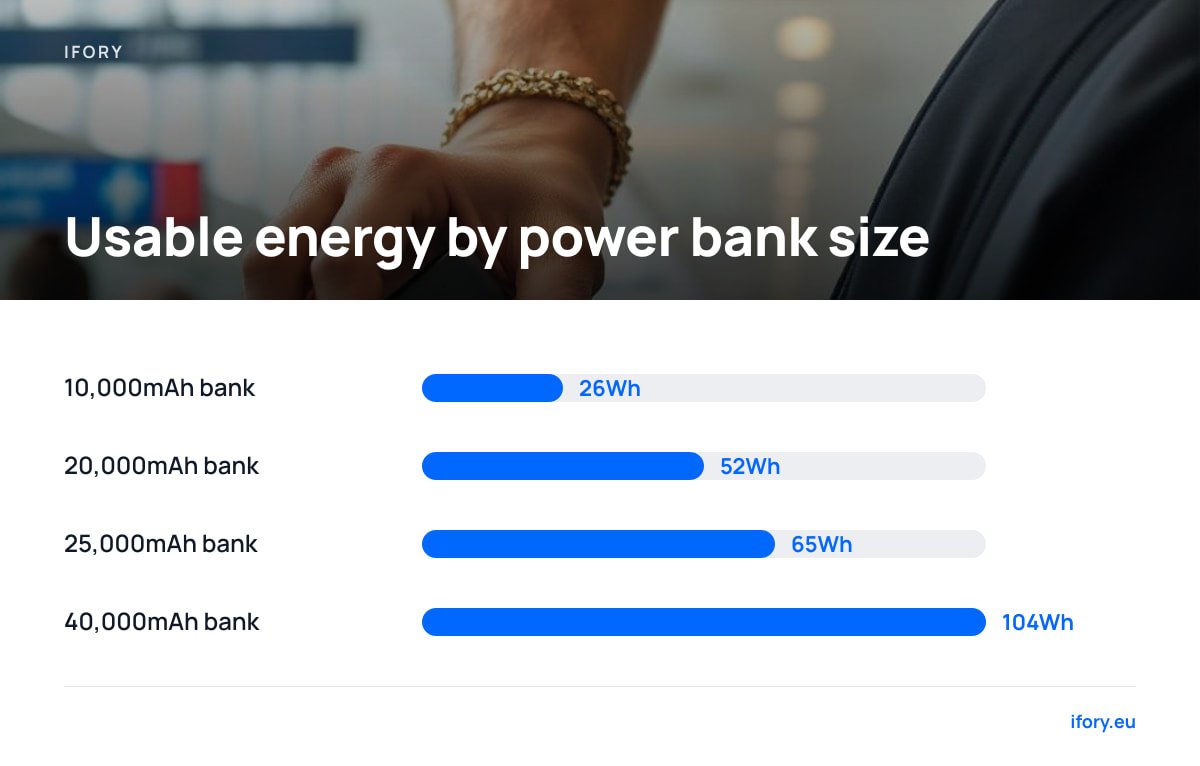
The mAh figure on the box is measured at the battery cell's internal voltage, about 3.7V. When the bank converts that to 5V, 9V or 20V for your device, you lose energy as heat. Plan on 65% to 85% of the rated capacity actually reaching your device.
Using 70% as a middle figure, here is what to expect:
| Rated capacity | Rated energy | Usable energy (about 70%) | Phone charges (about 13Wh battery) | 13-inch ultrabook charges (about 53Wh battery) |
|---|---|---|---|---|
| 10,000mAh | 37Wh | 26Wh | about 2 | about 0.5 |
| 20,000mAh | 74Wh | 52Wh | about 4 | about 1 |
| 25,000mAh | 92.5Wh | 65Wh | about 5 | about 1.2 |
| 40,000mAh | 148Wh | 104Wh | about 8 | about 2 |
The table also answers the common question about a 10,000mAh bank. It gives you about two full charges of a current phone and only half of a thin laptop. When someone says a 10,000mAh bank "charges a laptop," they mean it will take a laptop from 10% to roughly 45%.
A 25,000mAh power bank holds about 92.5Wh on paper and delivers closer to 65Wh to your laptop, which is a little over one full charge of a 13-inch ultrabook.
How Long It Takes to Charge a Power Bank
Charge time is energy divided by input power, plus losses. The formula is: watt-hours ÷ input watts × 1.2. The 1.2 covers the 15% to 25% lost as heat, and the last 10% of a charge always slows down.
| Bank size | Energy | At 30W input | At 100W input |
|---|---|---|---|
| 10,000mAh | 37Wh | about 1.5 hours | not supported on most models |
| 20,000mAh | 74Wh | about 3 hours | about 1 hour |
| 25,000mAh | 92.5Wh | about 3.7 hours | about 1.1 hours |
| 40,000mAh | 148Wh | about 5.9 hours | about 1.8 hours |
These are estimates, and they only apply if the bank accepts that input. Check the "input" line on the spec sheet, which is often lower than the output. Plenty of 100W-output banks accept only 30W to 65W back in, which turns an overnight recharge into a 4-hour wait you did not plan for.
The charger matters as much as the bank. A 20W phone brick will take more than 6 hours to refill a 25,000mAh bank, however fast the bank claims to be.
Are Big-Brand Power Banks High Quality? What Recalls Tell You
Mostly yes. The large brands publish recall notices, replace units and keep model numbers traceable. Still, a famous name does not protect any single model.
The brand behind most searches for this term is a good example. In June 2025 the US Consumer Product Safety Commission announced a recall of roughly 1.1 million units of one of its 10,000mAh power banks, citing overheating that could cause fire and burn injuries. That answers the "why is it being recalled" question: one model, one cell-quality problem, a large installed base. The rest of the range was not part of it.
Lithium-ion packs fail the same way across the whole industry: a manufacturing defect inside a cell, an internal short, heat with nowhere to go. Quality is therefore a model-by-model call. Do these:
- Read the label. Find the model number (a letter-number code on the back) and search it with the word "recall."
- Check both registers. The US CPSC covers American sales. Europeans should also look at the EU Safety Gate, the rapid alert system for dangerous non-food products.
- Look for the paperwork. A legitimate bank carries a CE mark in Europe, and its cells should have passed UN 38.3 transport testing (part of the UN Manual of Tests and Criteria), which airlines and carriers rely on.
If your bank is more than three years old, swells, gets hot at idle or smells sweet or chemical, retire it. Internal resistance rises as cells age, and an old bank runs hotter under a laptop load than it did when new.
Can a 165W Laptop Power Bank Go on a Plane?

Yes, as long as the battery energy is under 100Wh. The 165W figure is how fast it can output power, while airlines regulate how much energy is stored in it.
The FAA's PackSafe guidance sets the rules that most airlines worldwide follow: power banks go in carry-on only, never checked baggage. Under 100Wh is allowed without special approval. Between 100Wh and 160Wh you need the airline's approval, and the limit is usually two spare batteries. Above 160Wh is not allowed.
100Wh is the line: a 25,000mAh bank (about 92.5Wh) boards freely, while a 40,000mAh bank (about 148Wh) needs the airline's permission.
Two checks before you pack:
- Find the Wh printed on the bank. If it only prints mAh, multiply by 3.7 and divide by 1,000. If the number is close to 100, ask the airline in advance.
- Check in-flight use. Several airlines now restrict or ban using a power bank during the flight itself, even where carrying it is fine. Read your carrier's policy.
For a complete size-and-rules checklist, see Travel Power Bank Guide: Pick the Right Size Before You Fly.
Built-In Cables, Triple 100W Ports and Other Spec-Sheet Traps
Spec sheets are written to sell, so read them like a contract.
"Triple 100W" is not 300W
Multi-port banks share a single power budget. A bank with three ports labeled 100W typically gives 100W to one port and drops sharply as you add a second device. Look for the "total output" line. If a laptop and a phone are both plugged in, expect the laptop to get 65W or less.
Built-in cables save weight and cost you repairs
A retractable cable means you never forget one. When the cable frays, though, the bank loses a port. A bank with a spare USB-C port gives you a fallback.
Peak versus sustained output
Some banks hit their peak wattage only for a short burst, or only while the battery is full. Reviews that log output over a full discharge are worth more than the headline figure.
Pro Tip: Test with the cable you will actually carry. USB-C cables above 60W (3A) need to be rated for 5A with an e-marker chip. A phone cable in your bag can quietly cap a 100W bank at 60W, and the laptop will report "slow charging" with no other explanation.
Reading a Deal: Price Per Watt-Hour
Sale prices on power banks make small models look cheap and large models look expensive. Divide the price by the watt-hours to compare them. A bank at €90 holding 92.5Wh costs about €0.97 per Wh. A 10,000mAh bank at €30 holds 37Wh and costs about €0.81 per Wh, which looks cheaper per Wh but delivers less than a single laptop charge.
Add a second check: output per euro on the best port. A 20,000mAh bank with a 65W port costs less than a 25,000mAh one with a 100W port, and it is the better buy if your laptop charger is 65W. You only pay for wattage your laptop can use.
My pick for most laptop owners is a 20,000 to 25,000mAh bank whose best port matches the laptop charger. If you are away from outlets for days, skip the middle sizes and go straight to a 40,000mAh bank, because one big battery beats two small ones that each need a recharge.
Get a 40,000mAh, 100W Power Bank Built for Laptops That Live Off-Grid
If your laptop goes where outlets do not, the numbers above point to the same answer: more watt-hours and a 100W port. The Ifory 40000mAh 100W Power Bank holds about 148Wh by the standard 3.7V calculation, which is roughly two charges of a 13-inch ultrabook, and its 100W USB-C port covers most 14-inch laptop chargers. It is rugged enough for camping and climbing trips. Pair it with the 40W portable solar panel to add charge in daylight; a full refill from sun alone will take more than one good day. See Solar Panel Kit Buying Guide: Sizes, Prices and What Runs What for realistic expectations.
The limits: at about 148Wh it sits above the 100Wh airline line, so you need airline approval before flying with it. Confirm the Wh rating on the label or product page. A 100W port also will not fully feed a 140W 16-inch laptop at peak load. Check the current price and the bundle promotion with the free solar panel on the product page. Shipping is free in the EU and returns run 30 days.
Frequently Asked Questions
Are Anker power banks high quality?
Big-name brands generally build to a higher standard than unbranded banks, with traceable model numbers and published recall processes. Quality still varies by model, so check the specific model number against the US CPSC and EU Safety Gate lists before you buy.
Why is Anker being recalled?
In June 2025 the US Consumer Product Safety Commission announced a recall of about 1.1 million units of one 10,000mAh power bank model over an overheating and fire risk. It covered one model, not the whole range, so find the model number on your unit and check it against the recall notice.
How long does it take to charge a power bank?
Divide the bank's watt-hours by its input wattage and add about 20% for losses. A 25,000mAh (92.5Wh) bank takes about 3.7 hours on a 30W input and about 1.1 hours on 100W, if the bank accepts that input. A 20W phone charger will take more than 6 hours.
Is a 165W power bank allowed on a flight?
The 165W figure is output speed, which airlines do not regulate. Battery energy is what counts: under 100Wh is allowed in carry-on without approval, and 100 to 160Wh needs airline approval. A 25,000mAh bank is about 92.5Wh, so it normally qualifies.
How many charges does a 10,000mAh power bank give?
About two full charges of a current smartphone, since the bank delivers roughly 26Wh of its 37Wh rated capacity after conversion losses. For a thin 13-inch laptop it gives about half a charge.
Sources
- Recalls and product safety | U.S. Consumer Product Safety Commission
- Safety Gate: the EU rapid alert system for dangerous non-food products | European Commission
- Lithium batteries (PackSafe) | Federal Aviation Administration
- Transport of Dangerous Goods | United Nations Economic Commission for Europe