
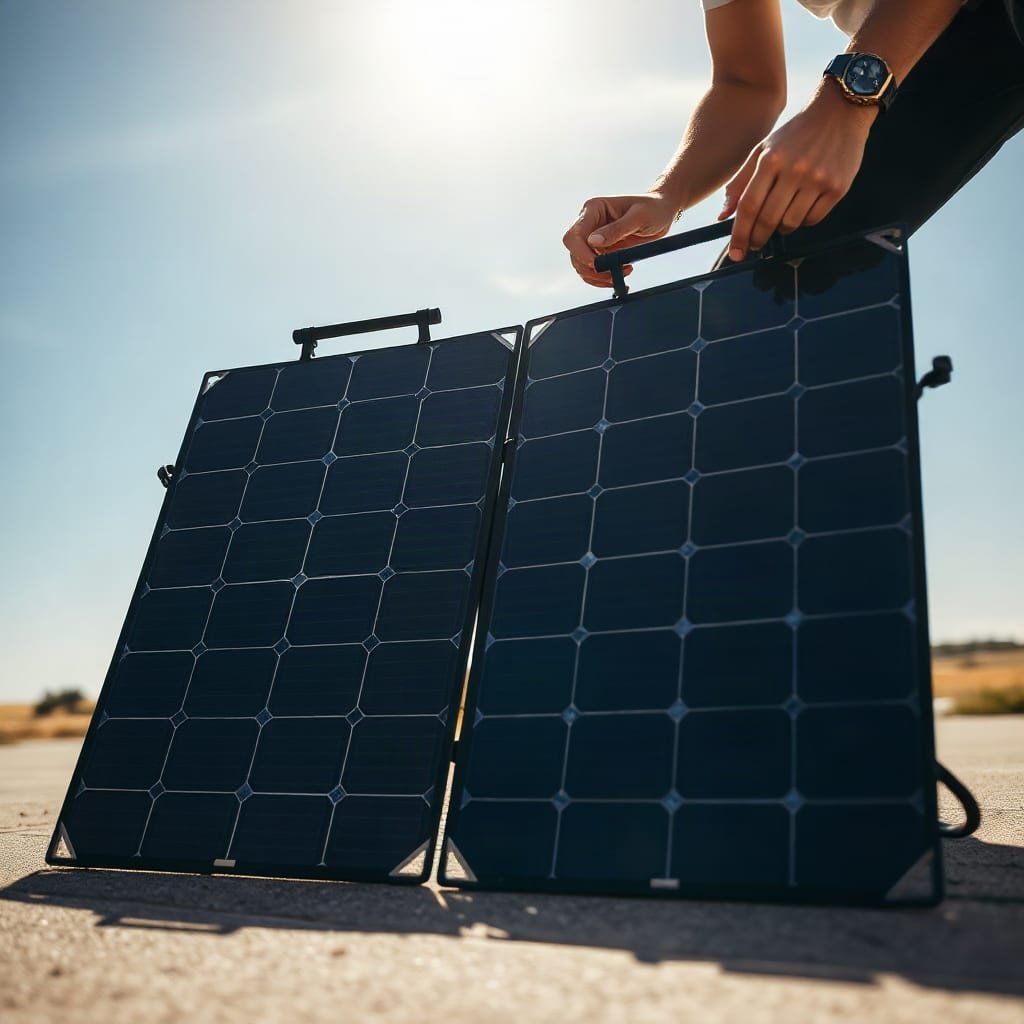
A solar panel kit is a matched package of panels, mounting hardware and usually an inverter, sold together so the parts are sized for each other. The question to ask when buying is where the kit stops: a roof kit is "complete" only up to the point of wiring into your building, while an off-grid kit either includes a battery or leaves you to size and buy storage yourself. Most price and performance surprises come from that gap.
TL;DR:
- A kit is panels plus racking plus inverter, and often a charge controller; the battery is frequently sold separately.
- Budget roughly EUR 1 to 1.6 per watt for hardware-only kits, and up to double that once storage is included.
- A 5kW array produces about 16 to 22 kWh on a good day, which covers a 1.5 ton inverter AC in daylight but not through the night without a battery.
- A fridge plus a TV needs roughly 1.5 to 2.5 kWh a day, so 600 to 900W of panels and 2 to 3 kWh of storage.
- Self-install is realistic for off-grid and portable kits, and rarely realistic for grid-tied roof systems that need permits and a certified connection.
Table of Contents
- What a Solar Panel Kit Actually Includes, and Where "Complete" Stops
- Solar Panel Kit Price: What Each Size Band Actually Buys
- Can You Buy Solar Panels and Install Them Yourself?
- Can I Run a 1.5 Ton AC on a 5kW Solar System?
- How Many Solar Panels Do You Need to Run a Fridge and TV?
- Kit With Battery or Without? The Trade-off Nobody Prices In
- Portable Kits for Camping, Van Life and Emergency Backup
- Get a Solar Kit That Fits in a Daypack
- Frequently Asked Questions
- Sources
What a Solar Panel Kit Actually Includes, and Where "Complete" Stops

A kit is a bill of materials someone else has already matched. The panels, the racking, the DC isolators and the connectors all fit each other, which removes the most common beginner error: buying a 400W panel and a charge controller rated for 20A when the panel's short-circuit current sits above it.
Contents vary by kit type:
- Panels. Monocrystalline silicon is the default in 2024-era kits. Panels sold in the EU should carry IEC 61215 for design qualification and IEC 61730 for safety, so check the IEC standards listed on the datasheet before you trust a bargain listing.
- Mounting and racking. Roof hooks and rails for a house, adjustable legs for a portable fold-out, or Z-brackets for a van. Cheap kits often ship panels only and leave racking as an extra line item.
- Inverter or charge controller. Grid-tied kits include a grid inverter. Off-grid kits include an MPPT charge controller, or a hybrid inverter that handles solar input and battery charging in one box.
- Battery. Present in a "kit with battery" listing, absent from most entry-level ones. This is the single largest cost difference between two kits that look similar on a product page.
- Balance of system. Cables, fuses, a DC breaker, a combiner box, sometimes a monitoring dongle. Small parts, but the ones that fail first when they are underspecced.
"Complete" in a product title means complete for a specific use. A complete off-grid cabin kit and a complete grid-tied roof kit share panels and almost nothing else.
Solar Panel Kit Price: What Each Size Band Actually Buys
Indicative hardware ranges, mid-2024 to 2025 European pricing. Storage pushes every band upward, often by 40 to 80 percent.
| Kit size | Hardware-only range (EUR) | Realistic daily yield | What it runs |
|---|---|---|---|
| 400W portable | 350 to 700 | 1.2 to 1.8 kWh | Laptop, phones, camera batteries, a small 12V fridge |
| 1kW | 700 to 1,400 | 3 to 4.5 kWh | Fridge, lights, router, TV, laptop |
| 3kW | 2,500 to 5,000 | 9 to 13 kWh | A small home's essentials plus a small AC |
| 5kW | 4,000 to 8,000 | 15 to 22 kWh | Most of a home's daytime load, one 1.5 ton AC in daylight |
| 10kW | 8,000 to 15,000 | 30 to 44 kWh | Whole-home load, heat pump, EV top-up |
Those yield figures assume 3.5 to 4.5 peak sun hours and about 75 to 80 percent system efficiency after inverter losses, wiring losses and heat. In northern Europe in December, a 5kW roof array can drop to 5 to 8 kWh a day. The same array in southern Spain in July clears 25 kWh.
A 5kW kit in Lisbon and a 5kW kit in Helsinki are the same product and two different power plants. Size your battery for December, not for the brochure.
The tax credit question
The U.S. residential clean energy credit covered 30 percent of installed cost. Under the 2025 budget legislation it expires for property placed in service after December 31, 2025, so confirm current status on the IRS residential clean energy credit page before you build a payback model around it. It never applied to European buyers, who work with national VAT treatment and local grants instead. If you are buying in the EU, price the kit without any credit and treat a grant as upside.
Can You Buy Solar Panels and Install Them Yourself?
For off-grid kits, yes. Panels, an MPPT controller and a battery in a shed or a van are within reach for anyone comfortable with DC wiring. A 400W portable kit is closer to plugging in a laptop than to electrical work.
For grid-tied roof systems, self-install is usually blocked by permits and inspections more than by wiring skill. You need a building permit in most jurisdictions, a grid connection application, and a signed-off electrical inspection before the meter turns backward. In Germany the grid connection must be registered and the AC side installed by a registered electrician. Insurers also treat unpermitted roof work as a reason to decline a claim, which is a bigger risk than the labor cost you saved.
If you want a professional for the roof side, the NABCEP certification is the recognized credential in the United States. In the EU, ask for the national electrical qualification and proof that the inverter carries grid-code certification for your country.
Can I Run a 1.5 Ton AC on a 5kW Solar System?
Yes in daylight, and it depends on the battery after sunset. The numbers:
- 1.5 ton is a cooling rating, not a power rating. It means about 5.3 kW of heat removal. A modern inverter-driven compressor draws roughly 1.4 to 1.8 kW of electricity while running, so eight hours of cooling is about 11 to 14 kWh.
- A 5kW array makes 15 to 22 kWh on a good summer day. That clears a 12 kWh cooling load with margin, as long as the AC runs when the sun is up.
- Startup surge is the trap. Fixed-speed compressors pull 2 to 3 times running current at startup, so a 1.6 kW unit can spike to 4 or 5 kW. Your inverter must handle that surge or the AC will trip it every time.
- Heat costs you output. Panel output falls about 0.3 to 0.4 percent per degree Celsius of cell temperature above 25°C, and rooftop panels in July run 20 to 30°C above ambient. A 5kW array on a hot roof is effectively a 4.2 to 4.5kW array at midday.
An eight-hour night of 1.5 ton cooling needs 11 to 14 kWh of stored energy. That is a 12 to 15 kWh lithium battery, which typically costs more than the 5kW array feeding it.
If you want overnight AC, size the battery first and the panels second. If you want daytime-only cooling in a well-insulated room, 5kW of panels plus a 5kW hybrid inverter is a workable, affordable configuration.
How Many Solar Panels Do You Need to Run a Fridge and TV?
About 1.5 to 2.5 kWh a day for the pair, which is 600 to 900W of panels and 2 to 3 kWh of battery. Appliance age and duty cycle drive the wide range.
| Load | Typical daily energy | Notes |
|---|---|---|
| Fridge-freezer (A-rated, 250L) | 0.8 to 1.5 kWh | Older units run 2 to 3 kWh; duty cycle drives this |
| LED TV, 4 hours | 0.2 to 0.4 kWh | 50 to 100W draw |
| Router and modem, 24 hours | 0.15 to 0.25 kWh | Always-on loads add up quietly |
| Phone and laptop charging | 0.1 to 0.2 kWh | Small but daily |
Add a 20 to 30 percent margin for cloudy stretches. Two 400W panels or four 200W panels cover the load in most of Europe from March to October. In December, budget double.
Pro Tip: Measure before you buy. A plug-in energy meter on the fridge socket for one week gives you the real number, and that number is often half what the label suggests. The bigger hidden variable is panel voltage in cold weather: a panel's open-circuit voltage rises as temperature falls, and a string that sits comfortably under your charge controller's input limit at 20°C can exceed it on a frosty morning. Check the Voc temperature coefficient on the datasheet and leave 15 percent headroom.
Kit With Battery or Without? The Trade-off Nobody Prices In
A kit without a battery is cheaper and simpler to ship. It also assumes you already own storage or only need daytime power. A kit with a battery costs more but removes the sizing mistake that ruins most first builds.
- Lithium iron phosphate is the default. Expect 3,000 to 6,000 charge cycles and 10 or more years of usable life. Lead-acid alternatives cost less up front and about three times more per usable kilowatt-hour over their life, because you can only discharge them to 50 percent.
- Check the inverter's idle draw. A 5kW hybrid inverter can pull 30 to 60W doing nothing, which is 0.7 to 1.4 kWh a day, or most of a small kit's output.
- Confirm expansion headroom. A kit you cannot add a second battery to in two years is a kit you will replace.
- Watch the certification. Cheap grid-tied kits often ship inverters without the grid-code certificate your utility requires, which can turn a bargain into a return.
Related reading if your kit feeds small devices instead of a house: what a solar panel phone charger actually delivers in sunlight is a useful reality check on rated versus real output.
Portable Kits for Camping, Van Life and Emergency Backup
A folding 40 to 100W panel paired with a high-capacity power bank is a different product category from a roof kit, and it is the one most people actually need first. The panel weighs 1 to 3 kg, folds into a backpack, and charges over USB-C PD or a 12V output.
Check two things before buying. First, whether the panel outputs native USB-PD or only a 12V barrel jack, which decides whether your laptop can use it directly. Second, whether the bank's watt-hour rating clears airline limits. Most carriers cap carry-on lithium batteries at 100Wh and require airline approval between 100 and 160Wh, as covered in our guide to power banks over 100Wh on planes. A 40,000mAh bank at 3.7V nominal is 148Wh, so it falls into that approval band.
A 40W folding panel in real European summer sun produces 25 to 32W, not 40W. Plan on a full sunny day to refill a large power bank from flat.
Get a Solar Kit That Fits in a Daypack
If the problem you actually have is keeping a laptop, phone and camera alive on a three-day trek or a week in a van, a roof kit is the wrong tool. Ifory sells a 40,000mAh 100W power bank paired with a 40W folding solar panel, and the bundle ships with the panel included in the promotion. The bank's 100W PD output is enough to charge a 14-inch laptop at full speed, and the panel tops it back up over a sunny day so you are not hunting for a wall socket every 48 hours. Free shipping and a 30-day return window cover the "will it actually work for my trip" question.
One caveat: 40W of panel will not run a fridge, an AC or anything with a compressor, and it will not fully recharge the bank in one short winter afternoon. Check the spec sheet before you buy, including ours, and match the panel's real-world output to your devices rather than to the number on the box. If you are unsure whether a 100W bank will drive your specific laptop, our test numbers on 100W banks and gaming laptops are the place to start.
Frequently Asked Questions
Can you buy solar panels and install them yourself?
Yes for off-grid and portable kits. Panels, an MPPT charge controller and a battery do not require a licensed trade in most countries. Grid-tied roof systems are different: they need a building permit, a grid connection application and an inspection, and in many EU countries the AC connection must be made by a registered electrician.
Can I run a 1.5 ton AC on a 5kW solar system?
In daylight, usually yes. A 1.5 ton inverter AC draws about 1.4 to 1.8 kW while running, roughly 11 to 14 kWh over eight hours, and a 5kW array produces 15 to 22 kWh on a good summer day. Running it overnight requires 12 to 15 kWh of battery storage, which costs more than the array.
Is the 30% solar tax credit going away in 2026?
The U.S. residential clean energy credit expires for property placed in service after December 31, 2025 under the 2025 budget legislation. Check the IRS page for current status before you rely on it. It never applied to EU buyers, who rely on national VAT rules and local grants instead.
How many solar panels do I need to run a fridge and TV?
Around 600 to 900W of panels and 2 to 3 kWh of battery for a modern fridge, an LED TV and a router, which comes to about 1.5 to 2.5 kWh a day. That is two 400W panels or four 200W panels. Double the panel count if you need to get through a northern European winter.
What is the difference between a kit with a battery and one without?
A kit without storage is cheaper and only gives you power while the sun is up. A kit with a battery adds 40 to 80 percent to the cost and lets you use the energy at night. Lithium iron phosphate storage lasts 3,000 to 6,000 cycles, while lead-acid needs to be kept above 50 percent charge to survive.
Are cheap solar kits worth it?
Sometimes, if you check three things: panel certification to IEC 61215 and IEC 61730, a charge controller rated above the panel's short-circuit current, and grid-code certification on any inverter that connects to a utility. Kits that skip those steps cost more over five years than the savings on day one.
Sources
- Residential Clean Energy Credit | Internal Revenue Service
- Electricity use in homes | U.S. Energy Information Administration
- IEC 61215 and IEC 61730 photovoltaic standards | International Electrotechnical Commission
- NABCEP certification | North American Board of Certified Energy Practitioners
- Solar panel buying guidance | EnergySage