
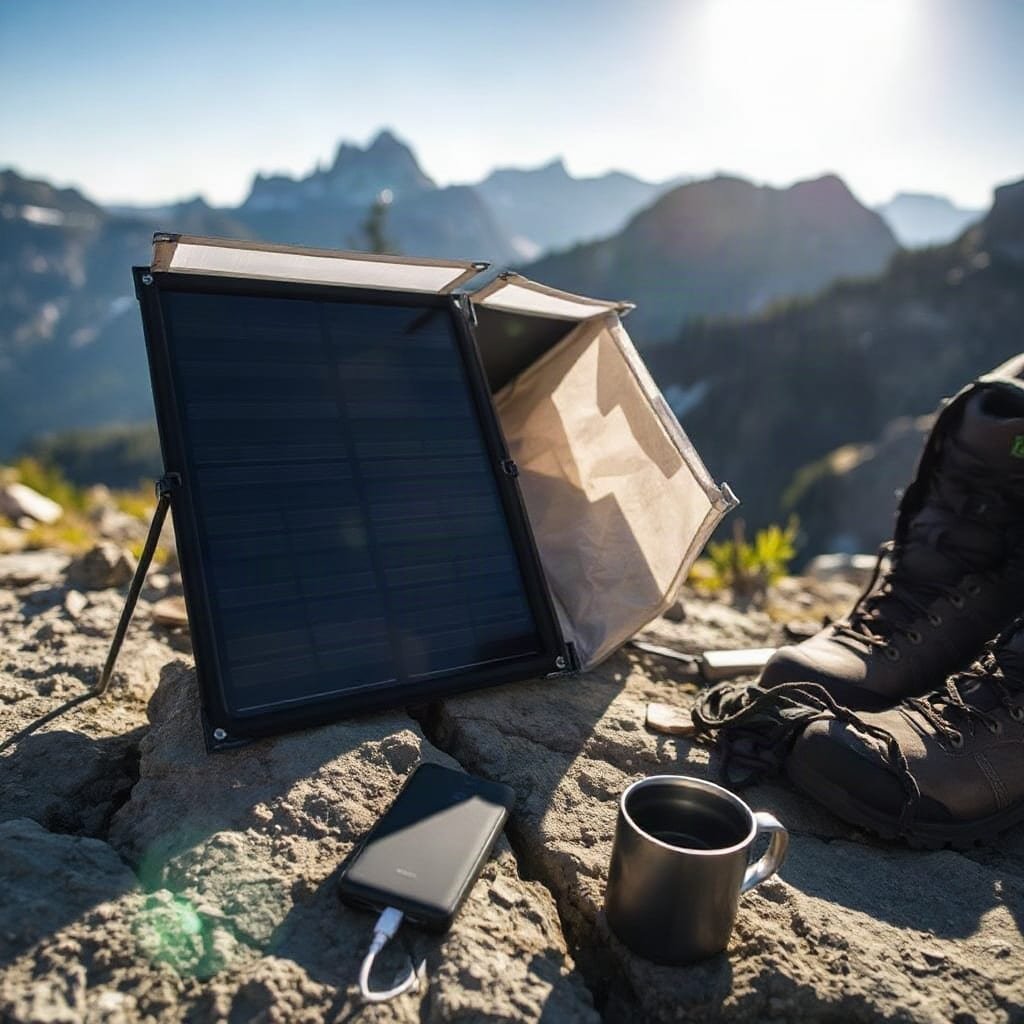
A good solar cell phone charger is a foldable panel rated at 20 watts or more that feeds a power bank, which then charges your phone. The small panel built into a power bank makes about 1 watt at best, so filling the battery takes days. A 40W foldable panel in strong sun can refill roughly one phone per hour.
TL;DR:
- Panel wattage decides everything. Plan on 50 to 70 percent of the label rating in clear sun, and much less under cloud.
- Panels built into power banks make roughly 0.5 to 1 watt. They work as emergency trickle chargers only.
- Connect the panel to a power bank and the bank to your phone. A direct panel-to-phone link drops out whenever a cloud passes.
- A 40W panel can charge a laptop through a USB-C power bank, but expect about 3.5 hours of strong sun to fill a 60 Wh laptop battery.
- On trips under three days, a big bank often beats carrying a panel. Solar pays off from day three or four.
Table of Contents
- What a Good Solar Cell Phone Charger Delivers in Real Watts
- Why the Panel Built Into Your Power Bank Won't Save You
- How to Use a Solar Phone Charger Without Wasting Half the Sun
- Can You Charge a Laptop With a Solar Charger?
- Weather, Heat and Shade: What Cuts Output Fastest
- Choosing a Portable Solar Charger Power Bank for Camping and Backpacking
- Where to Find Deals on Solar Panel Chargers, and What to Check Before You Buy
- Get a 40,000mAh Power Bank and 40W Solar Panel Built for Off-Grid Days
- Frequently Asked Questions
- Sources
What a Good Solar Cell Phone Charger Delivers in Real Watts
A phone battery holds about 17 Wh (a 4,500mAh cell at roughly 3.8V). Solar charging comes down to how many watt-hours reach that cell per hour of daylight.
The number on the panel label is a lab result. The IEC defines standard test conditions in IEC 60904-3: 1,000 watts per square meter of sunlight at a 25 °C cell temperature. Your campsite will rarely match that. Hot cells, a sun angle off perpendicular and haze all take a cut, and the cable and bank take another (around 20 percent is a fair estimate for conversion loss).
A panel rated 40W will usually put 20 to 28W into your bank. Plan around 60 percent of the label.
Here is what that looks like in practice, assuming 50 to 70 percent of rated output and 80 percent conversion efficiency:
| Panel type | Typical rating | Realistic clear-sky output | Phone charges (17 Wh) per hour of sun |
|---|---|---|---|
| Built into a power bank | 1W or less | 0.3 to 0.7W | About 0.02 |
| Small foldable | 10W | 5 to 7W | About 0.3 |
| Mid foldable | 20W | 10 to 14W | About 0.5 |
| Large foldable | 40W | 20 to 28W | About 1 |
A good solar phone charger needs at least 20W of panel, a USB-C output with Power Delivery (or at least 18W on USB-A), a battery in the chain to buffer the sun, and a fabric or laminate build that survives being clipped to a pack. The rest is packaging.
Why the Panel Built Into Your Power Bank Won't Save You
Those cheap "solar power banks" are the most common trap in this category. The panel is a few square inches of silicon, so output tops out around 0.5 to 1W in perfect conditions. A 10,000mAh bank holds about 37 Wh.
At 1 watt, filling a 10,000mAh bank needs about 37 hours of perfect, direct sun.
That is a week of camping with the bank sitting in a window. The built-in panel is fine as a last-resort trickle when you are stranded, but it adds a little weight and a failure point. If solar is your actual plan, use a separate, larger panel that you can aim at the sun while the bank sits in the shade. Our solar panel kit buying guide covers sizes and prices in more depth, and the Amazon-focused piece on what actually works shows how to read listings that overpromise.
Area matters more than efficiency. Most commercial silicon panels convert between 15 and 23 percent of sunlight. Doubling the area doubles the watts, so a big foldable always beats a clever small one.
How to Use a Solar Phone Charger Without Wasting Half the Sun
Setup takes about two minutes, and most of the gain comes from doing it right.
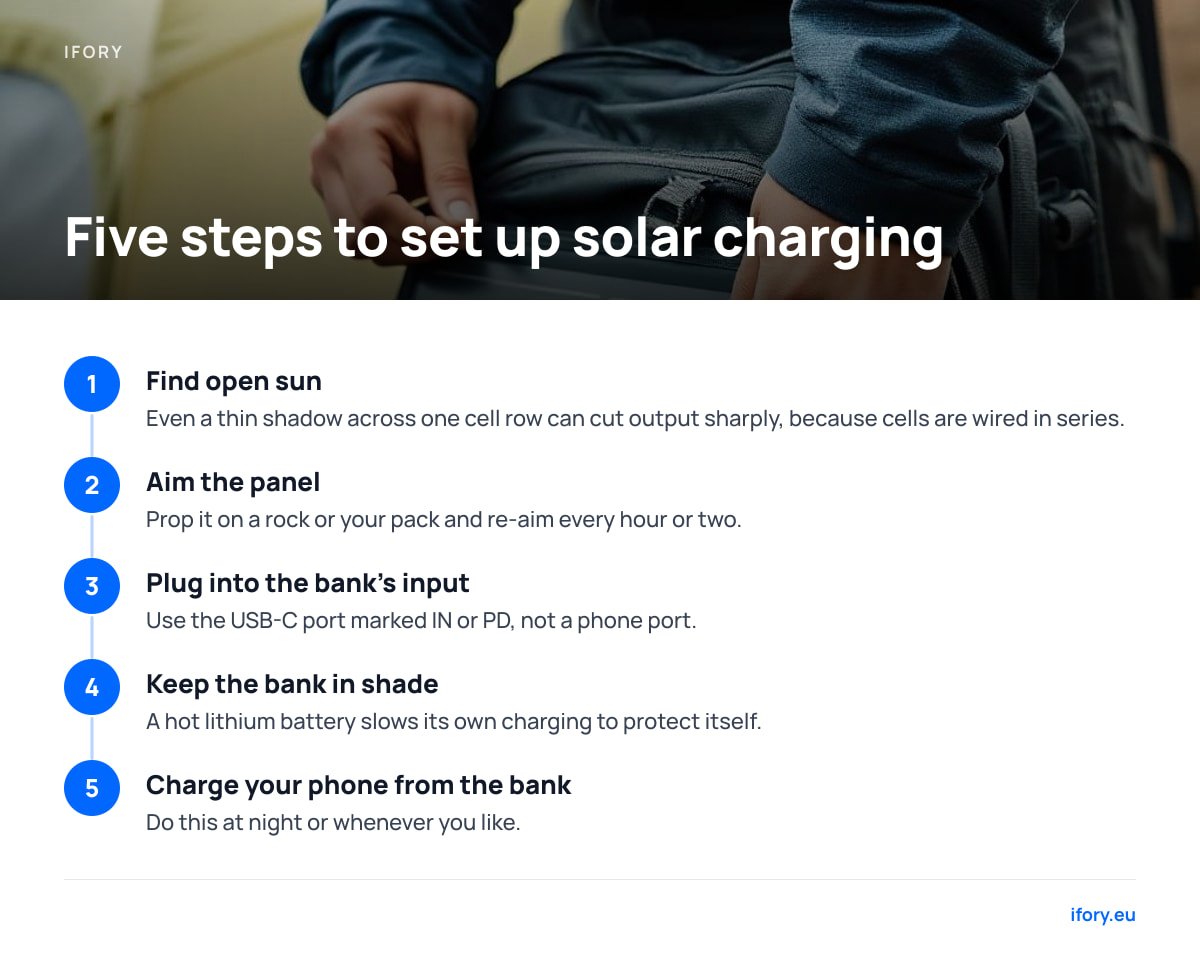
- Find open sun. Even a thin shadow across one cell row can cut output sharply, because the cells are wired in series. A tent pole shadow matters.
- Aim the panel at the sun. Output follows the cosine of the angle off perpendicular. At 60 degrees off, you get half the power. Prop it on a rock or your pack and re-aim every hour or two.
- Plug the panel into the power bank's input. Use the USB-C port marked IN or PD, not a phone port.
- Keep the bank out of the sun. A hot lithium battery slows its own charging to protect itself. Slide it into the shade of the pack or tent.
- Charge your phone from the bank, at night or whenever you like.
Pro Tip: Never plug your phone straight into the panel if you can avoid it. When a cloud passes, panel voltage sags, the phone drops the connection, and many phones then take minutes to renegotiate or never restart without you unplugging them. A power bank rides through the dip and keeps accepting whatever the sun gives it. This is the biggest reason people say their solar charger "randomly stops."
Can You Charge a Laptop With a Solar Charger?
Yes, with two conditions: the laptop must charge over USB-C, and the energy has to go through a battery first.
USB Power Delivery allows up to 100W at 20V and 5A on a certified cable, which covers most ultralight and mid-size laptops. A 40W panel cannot supply that directly, and it does not need to. It fills the bank, and the bank delivers 65W or 100W when the laptop asks. This is the same logic we used in the guide to charging a MacBook Pro from a power bank.
The arithmetic is plain. A 60 Wh laptop battery needs about 3.5 hours of strong sun from a 40W panel at 22W effective and 80 percent conversion. If you work on the laptop meanwhile, it draws power too, so the time stretches. A 20W panel makes laptop charging a two-day job. For a laptop-based remote-work setup, I would not go below 40W of panel.
Check the cable before blaming the panel. A 100W charge needs a cable rated for 5A, and a basic phone cable will cap you at 60W or less.
Weather, Heat and Shade: What Cuts Output Fastest
Three things reduce what you collect, in rough order of damage.
- Cloud cover. Heavy overcast often drops output to a quarter of clear-sky levels or less. A 40W panel under thick cloud behaves like a 10W panel, so a rainy week needs a bigger bank.
- Panel angle. A panel lying flat at 8 a.m. can lose more than half its potential. Tilting it toward the sun is free power.
- Heat. Silicon loses efficiency as it warms, and a panel baking on dark rock gives less than one on cool grass with airflow. On a hot day, prop the panel up so air can pass behind it.
Rain does not harm most panels, but the plug and the bank need protection. The IEC's IP rating system rates enclosures against dust and water, and a rating such as IP67 means dust-tight and survives immersion to 1 meter for 30 minutes. Look for the rating on the bank, not just the panel, and check whether it covers the ports when they are in use.
Choosing a Portable Solar Charger Power Bank for Camping and Backpacking
I take a position here: on a trip shorter than three days, leave the panel at home. Three full phone charges is about 51 Wh, which a 20,000mAh bank (roughly 74 Wh) covers with room to spare. The panel adds weight, fiddling and a need for good weather. From day three or four onward, or if you carry a camera, tablet or laptop, solar starts to earn its place.
For backpacking, size the setup to your devices:
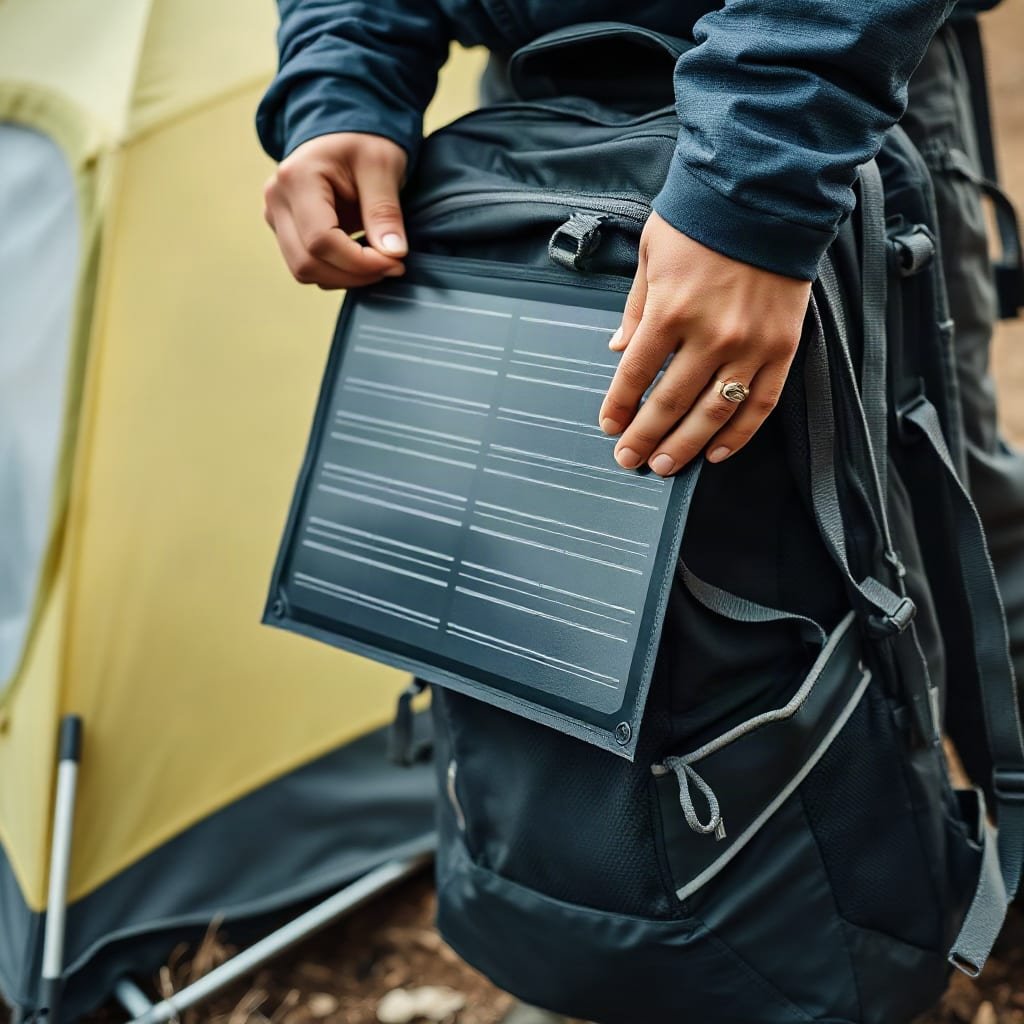
- Phone only, ultralight. A 10 to 20W foldable and a 10,000mAh bank. Clip the panel to the outside of your pack while walking, and expect to gather a few watt-hours a day.
- Phone plus camera or GPS. A 20W panel and 20,000mAh bank. The panel refills about half a bank over a good day in camp.
- Remote work or a long expedition. A 40W panel and a bank near 40,000mAh. It is heavy, so it suits a van, a boat or a base camp, not a thru-hike.
If you fly, mind the battery limits. IATA guidance on lithium batteries allows spare batteries, including power banks, up to 100 Wh in carry-on baggage, and 100 to 160 Wh with airline approval. Our travel power bank guide walks through how to calculate Wh from mAh, and the capacity explainer shows why the number on the box overstates what you actually get.
Where to Find Deals on Solar Panel Chargers, and What to Check Before You Buy
Search results for "solar cell phone charger for sale" and "near me" produce a lot of noise. A few habits help.
- Compare price per real watt. Divide the price by the panel's honest rating (not the bank's mAh). A 10W panel at a bargain price is still 10W.
- Distrust listings without voltage and current. A real panel lists something like 21.88V and 2.19A, not just "solar charger 20000mAh."
- Time your purchase. Outdoor gear is discounted most in spring pre-season and the late-year sales weeks.
- Look for bundles. Buying panel and bank together often costs less than buying them separately, and you know they work as a pair.
- Buy locally when you want to handle it. Outdoor shops let you check the folded size and fabric, but they often show less spec detail than a brand's own page. Take a photo of the label.
- Check the return window. Thirty days lets you test it in real sun before you commit.
Get a 40,000mAh Power Bank and 40W Solar Panel Built for Off-Grid Days
Tiny panels do not gather enough sun, and phones, tablets and laptops need a battery between the sun and the device. Ifory sells that pairing. The 40,000mAh, 100W power bank charges a laptop and a phone at the same time, and the companion Portable Solar Panel (PD 40W, 21.88V/2.19A) refills it away from outlets. In strong sun the panel supplies roughly 20 to 28W, which means about one phone charge per hour. The power bank and solar panel bundle currently comes with a free solar panel promotion, plus free shipping and 30-day returns, so you can test the setup in real conditions.
One limit to know before you fly: 40,000mAh works out to about 148 Wh at the standard 3.7V cell rating, which is above the 100 Wh carry-on threshold and requires airline approval. Check the Wh label on our spec sheet and your airline's rules first. Refilling the bank from empty takes about two days of good sun with this panel, so treat solar as a daily top-up and not a fast recharge.
Frequently Asked Questions
What is a good solar phone charger?
A good solar phone charger is a foldable panel of at least 20W that feeds a power bank with USB-C Power Delivery. The battery in the middle absorbs the ups and downs of sunlight. Avoid models that rely only on a small panel built into the bank.
Can I charge my laptop with a solar charger?
Yes, if the laptop charges over USB-C and you route the power through a bank. A 40W panel in strong sun charges a 60 Wh laptop battery in about 3.5 hours, ignoring any use while charging. Use a 5A-rated cable if your laptop needs more than 60W.
Where can I find deals on portable solar panel chargers?
Compare price per real watt, and check seasonal sales in spring and late in the year. Bundles that include the power bank often cost less than buying separately. Always confirm a 30-day return window so you can test the panel in real sun.
How do you use a solar phone charger?
Place the panel in open sun and angle it toward the sun. Plug it into the power bank's input, keep the bank in the shade, and charge your phone from the bank. Re-aim the panel every hour or two.
How long does a solar cell phone charger take to charge a phone?
With a 40W panel in clear sun, about one hour per phone. A 20W panel takes closer to two hours, and a built-in bank panel takes many hours even for a small top-up. Cloud and a poor angle can double those times.
Sources
- USB Power Delivery | USB Implementers Forum
- Lithium Batteries Guidance | International Air Transport Association (IATA)
- IP Ratings | International Electrotechnical Commission (IEC)
- IEC 60904-3 Standard Test Conditions for Photovoltaic Devices | International Electrotechnical Commission (IEC)