
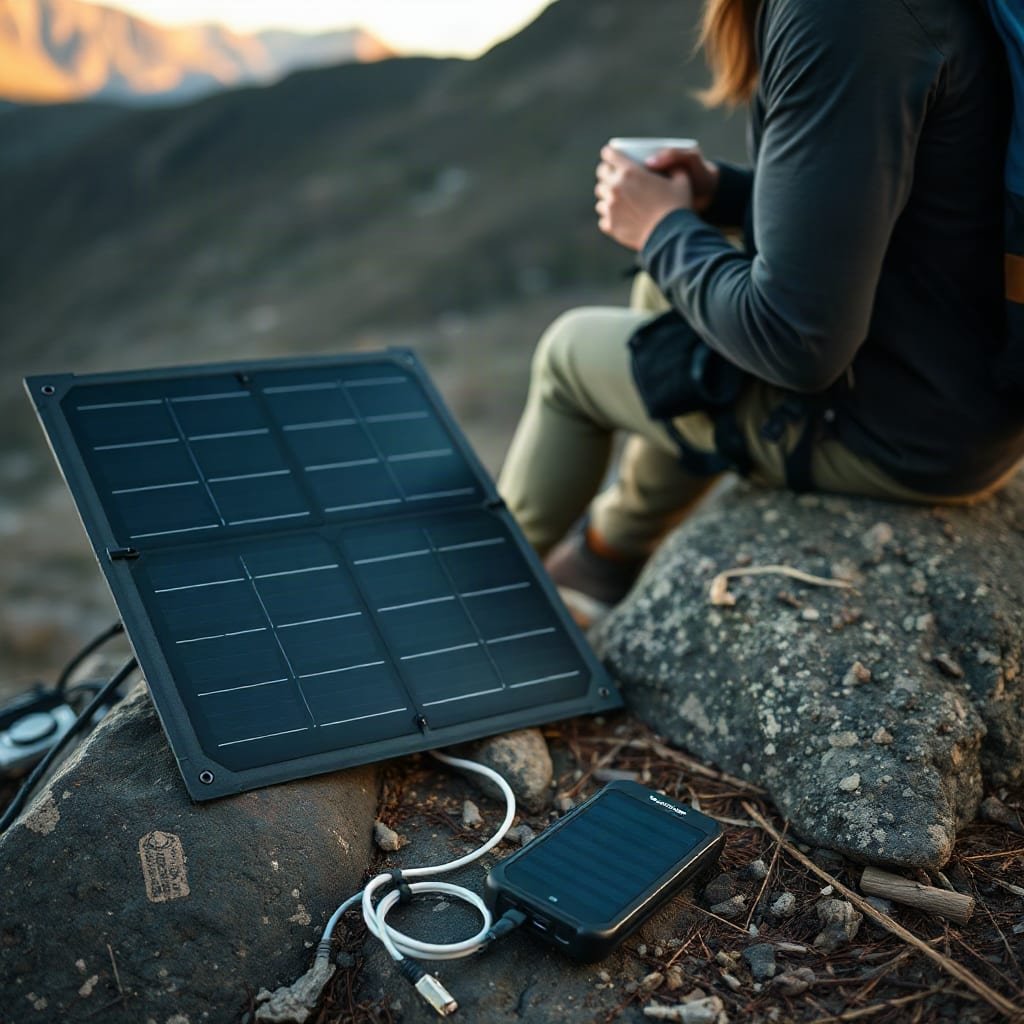
Solar power for cell phones works, and panel size decides how well. A phone needs about 15 Wh for a full charge, so a 10 to 20 watt folding panel in direct sun refills it in roughly one to three hours. Phones with a solar cell built in do not deliver anything useful, and the tiny panels on most solar power banks only trickle. Buy a separate panel and charge a power bank with it.
TL;DR:
- Panel size is everything. A phone battery holds roughly 15 Wh, and a 10 to 20 W folding panel in real sun refills it in one to three hours.
- Built-in panels are a trickle. A 20,000mAh power bank with a 1.5 W built-in cell needs around 50 hours of perfect sun to fill.
- Plan for half the rating. A panel rarely delivers more than 50 to 70 percent of its label, and overcast skies cut that sharply.
- Lifespan is about cycles. A lithium power bank rated for 500 cycles lasts about 16 months charged daily and nearly ten years charged weekly.
- Check IP rating and watt-hours. IP67 covers dunking, and anything above 100 Wh needs airline approval.
Table of Contents
- Solar Power for Cell Phones: Does a Solar-Powered Phone Exist?
- How Many Watts of Solar Does It Take to Charge a Phone?
- Why Solar Power Banks With Built-In Panels Disappoint
- How Long Do Solar Power Banks Last?
- Best Portable Solar Panel for Camping: Match the Watts to the Trip
- Solar Phone Charging Cost: Pennies of Electricity, Real Money for Hardware
- Waterproof Solar Power Banks and Flight Rules: Check These Two Specs
- Get a 40,000mAh Power Bank and 40W Solar Panel Built for Off-Grid Weeks
- Frequently Asked Questions
- Sources
Solar Power for Cell Phones: Does a Solar-Powered Phone Exist?
A few handsets have shipped with a small solar cell on the back or under the screen, but none became a mainstream product, and the arithmetic explains why. The back of a phone is roughly 100 square centimeters. Full sun delivers about 1,000 watts per square meter, so that surface receives around 10 W of sunlight. A good silicon cell converts about 20 percent of it, which leaves a ceiling near 2 W, and only if the phone lies flat, uncovered, at noon.
A modern phone battery holds about 15 Wh. At a realistic 1 W from a phone-sized cell, you wait 15 hours of direct sun for one charge, with the screen off and no case. Your phone also spends most of its life in a pocket.
The workable design keeps the solar cell off the phone. A separate panel can be bigger, aimed at the sun, and left in the grass while the phone stays in the shade, where it runs cooler. Our deeper breakdown of what a solar panel phone charger really delivers in sunlight walks through real-world output.
How Many Watts of Solar Does It Take to Charge a Phone?
You need at least 5 W to charge a phone at all, and 10 to 20 W to do it comfortably. The table below assumes the panel delivers 60 percent of its rated power and that cable and conversion losses take another 15 percent, which is a fair middle estimate for clear skies.
| Panel rating | Realistic output | Time to fully charge a 15 Wh phone |
|---|---|---|
| 5 W | about 3 W | about 6 hours |
| 10 W | about 6 W | about 3 hours |
| 20 W | about 12 W | about 1.5 hours |
| 40 W | about 24 W | under 1 hour (the phone's own limit takes over) |
Sunlight varies more than most buyers expect. The European Commission's Joint Research Centre runs PVGIS, a free tool that gives monthly solar radiation for any location in Europe. Run your campsite through it and compare July with a shoulder month. A sunny July day in southern Spain delivers several times the energy of a December day in northern Europe, where daily averages can fall well under one full-sun hour.
Heavy cloud can cut output to a fraction of the clear-sky figure, commonly 10 to 25 percent. A 10 W panel under overcast skies may give you 1 W, which only maintains a phone battery.
Why Solar Power Banks With Built-In Panels Disappoint
A power bank with a panel glued to its shell is sold as a self-sufficient charger. The panel is the problem: a few square inches of cell produce roughly 1 to 2 W in perfect sun.
A 20,000mAh power bank holds about 74 Wh. A 1.5 W built-in panel needs roughly 50 hours of perfect sun to fill it.
Built-in panels still have a use. They can top up a bank by a few percent over a week on a sunny windowsill or pack lid, which is enough to send a text or run a map during an emergency. Don't rely on one to replenish a trip.
20,000mAh versus 50,000mAh
Capacity labels use cell voltage, around 3.7 V, so the watt-hours are what matter. Our guide to what mAh really gets you explains the conversion.
- 20,000mAh (about 74 Wh). Four or five phone charges. Fine for a weekend, easy to carry on a plane, and refillable from a wall outlet overnight.
- 50,000mAh (about 185 Wh). More than ten phone charges, which is good for a home blackout kit. It exceeds the 160 Wh limit airlines apply to passenger flights, and no folding panel will refill it in a day.
- For home use. Charge the bank from the wall and keep it topped up. Use solar as the backup for a multi-day outage, not the daily source.
How Long Do Solar Power Banks Last?
The solar cell outlasts the battery. Battery University explains that lithium-ion wear comes from charge cycles, heat and long stretches at full charge. Many consumer cells are rated for around 300 to 500 full cycles before capacity drops to roughly 80 percent, though better cells go further.
In calendar terms:
- Daily full cycles. 500 cycles is about 16 months before you notice a shorter runtime.
- Weekly full cycles. The same bank lasts nearly ten years, and age begins to matter more than use.
- Heat. A bank cooking on a dashboard or black rock ages faster than the same bank kept in a bag.
Keep a bank you will not use for months at roughly 40 to 60 percent charge in a cool place. On a folding panel, the cell laminate usually outlives the cable, connector and stitching, so inspect those before a trip.
Best Portable Solar Panel for Camping: Match the Watts to the Trip
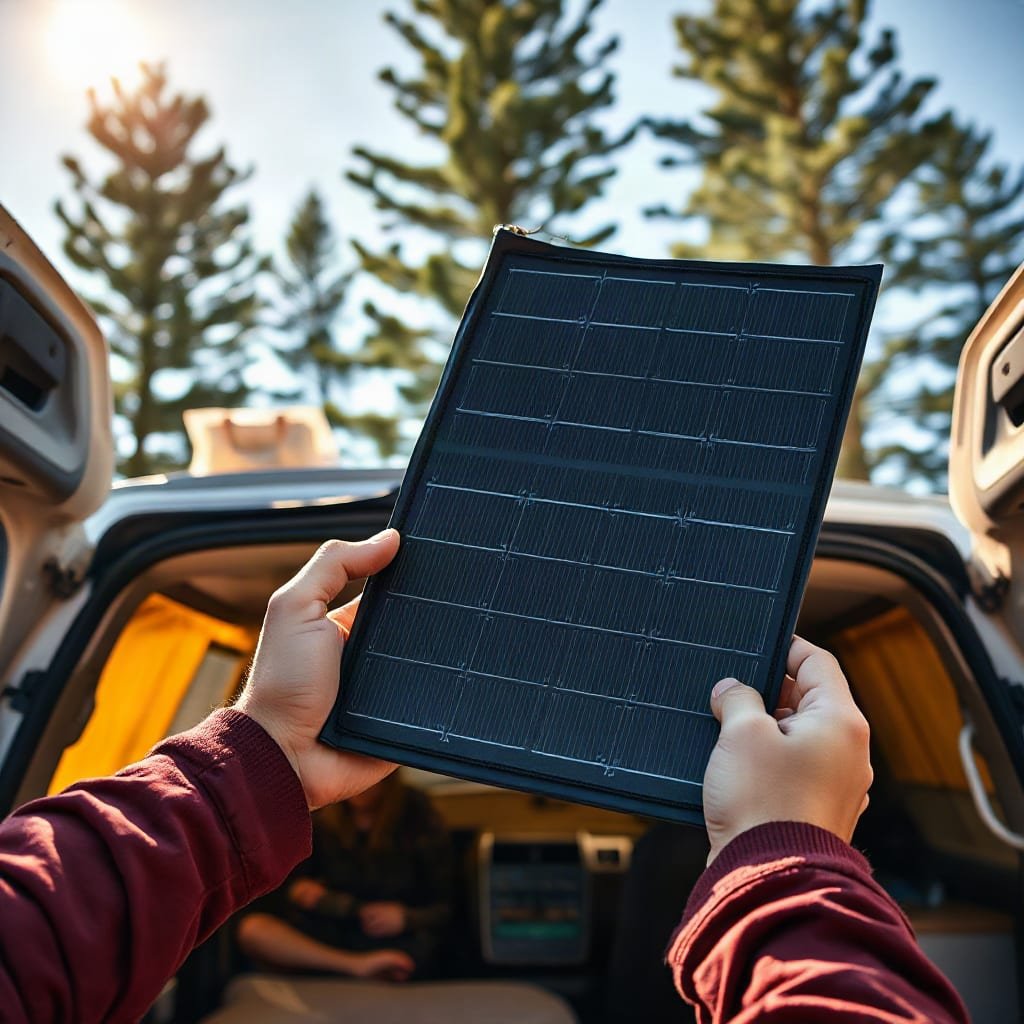
There is no single best panel. The right one depends on how many devices you run and how many sunny hours you can count on. My picks:
- Solo weekend, phone and headlamp. A 10 to 20 W folding panel. Light, cheap, and enough for one phone per day.
- Two people, or a phone plus camera, watch and speaker. 28 to 40 W. A USB-C PD output matters here, because it charges quickly and handles more than one device through a bank.
- Week-long trip or a laptop. 40 W with a high-capacity bank. See our laptop power bank guide for the wattage a laptop expects.
Whatever the size, look for a kickstand or eyelets so you can angle the panel at the sun, a USB-C output instead of a bare lead, and a water-resistance rating written as an IP number rather than "splash-proof".
Pro Tip: Plug the panel into a power bank and charge the phone from the bank, not straight from the panel. A passing cloud drops a panel's voltage, and many phones stop charging and take a minute to restart. The bank smooths those dips, and you get the energy even when you are not standing next to the panel.
Solar Phone Charging Cost: Pennies of Electricity, Real Money for Hardware
Solar will not save you money on phone charging. A full charge is about 0.015 kWh, so even at €0.30 per kWh a phone costs under half a cent to charge from the wall. You would need thousands of charges to repay a panel.
You buy a panel to charge a phone where there is no outlet. Hardware prices range widely. A basic 10 to 20 W panel costs far less than a 40 W PD panel with a high-capacity bank. Pay for the watts and ports you will actually use, and skip capacity you will not recharge.
For a wider look at how solar chargers fit into a trip, see our solar power phone charger guide.
Waterproof Solar Power Banks and Flight Rules: Check These Two Specs
Waterproofing is rated by the IEC's IP code, defined in IEC 60529.
1 meter, 30 minutes. That is the entire scope of the IP67 immersion test as defined by IEC 60529.
IP67 means dust-tight and survives a brief dunk, not a swim. Check that the rating covers the whole unit, because a bank can be IP67 while a connected folding panel is rated lower or not rated at all. Open port covers also void the claim until they are closed.
Flight rules turn on watt-hours. IATA's lithium battery guidance allows power banks in carry-on luggage only, and banks above 100 Wh need airline approval. Anything over 160 Wh does not fly on passenger aircraft. Our travel power bank guide covers how to pick a size before you pack.
Get a 40,000mAh Power Bank and 40W Solar Panel Built for Off-Grid Weeks
Phones need tens of watt-hours, and panels deliver watts only when the sun is out. Ifory pairs a rugged 40,000mAh, 100W fast-charging power bank with a 40W PD portable solar panel (listed at 21.88V/2.19A), so the panel can fill a big bank and the bank can feed phones, tablets and a laptop at any hour. At a typical 3.7V cell rating the bank holds about 148 Wh, which is roughly seven or eight phone charges. The bundle comes with a free solar panel promotion, free shipping and 30-day returns.
Read the limits before you buy. A 40W panel realistically gives 20 to 25 W, so refilling the bank from empty takes about 8 to 10 hours of strong sun, or two good days. The bank's roughly 148 Wh also falls in the 100 to 160 Wh band, so you need airline approval to fly with it. Check the label and spec sheet on your unit for the exact figures.
Frequently Asked Questions
Does a solar-powered phone exist?
A few phones have shipped with small solar cells, but none worked well enough to catch on. A phone's back surface can collect about 2 W at best, so a full charge takes many hours of perfect sun. A separate panel with a power bank is far more practical.
How long do solar power banks last?
The battery wears out before the solar cell. Many lithium cells are rated for about 300 to 500 full cycles before dropping to roughly 80 percent capacity, which is about 16 months of daily use or nearly ten years of weekly use. Heat shortens that, and storing at 40 to 60 percent charge helps.
What is the best portable solar panel for camping?
A 10 to 20 W panel suits a solo weekend with one phone. For two people, extra gadgets or a laptop, a 40 W panel with USB-C PD output feeding a large power bank is the better choice.
How many watts of solar to charge a phone?
A phone charges from about 5 W, but 10 to 20 W of panel rating is the comfortable range. At 60 percent real output, a 10 W panel fills a 15 Wh phone battery in about three hours of direct sun, and a 20 W panel in about 90 minutes.
Are solar power banks with built-in panels worth it?
As an emergency trickle, yes. A built-in panel makes about 1 to 2 W in perfect sun, so a 20,000mAh bank would need around 50 hours to fill. Treat them as backup, and charge the bank from a wall outlet or a separate panel.
Sources
- PVGIS Photovoltaic Geographical Information System | European Commission Joint Research Centre
- BU-808: How to Prolong Lithium-based Batteries | Battery University (Cadex Electronics)
- IP Ratings (IEC 60529) | International Electrotechnical Commission
- Lithium Batteries | International Air Transport Association (IATA)