
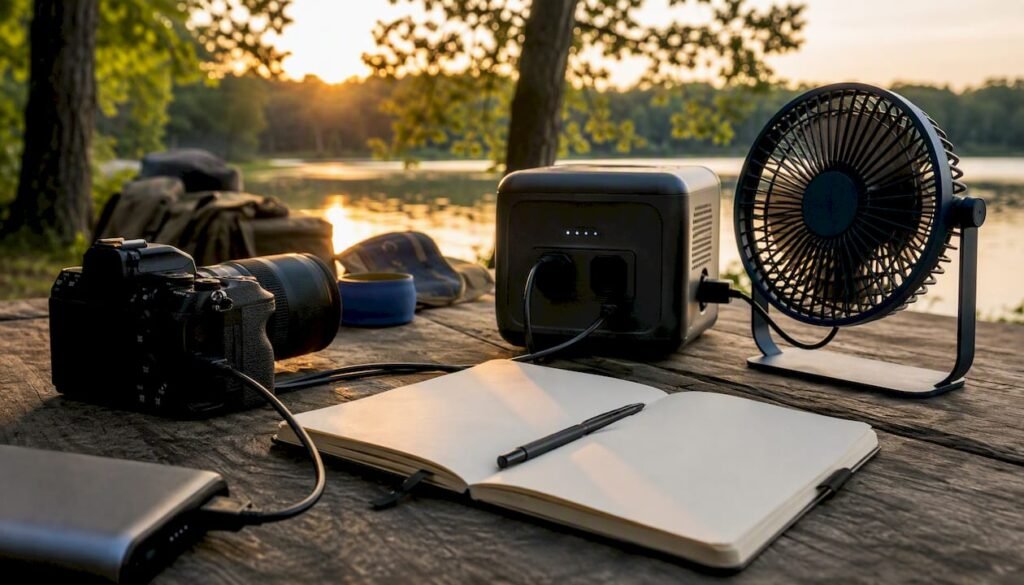
For everyday mobile charging, a power bank wins on portability and price. For running appliances, a CPAP machine, or a mini-fridge at a basecamp, you need a portable power station. The core technical split is simple: power banks deliver DC power through USB ports (typically 5W–100W), while power stations add an inverter that produces AC mains output and carry far larger capacities measured in watt-hours.
The fastest way to pick:
- Phone or tablet only → power bank (10,000–20,000mAh covers most personal needs)
- Multiple appliances, CPAP, or small fridge → portable power station (250Wh+ with AC output)
- Mixed needs: daily carry plus weekend basecamp → both, used as a system
A 10,000mAh bank holds roughly 36–37Wh of usable energy (mAh × 3.7V ÷ 1,000). A 20,000mAh model lands around 74Wh. Most portable power stations start at moderate capacity levels suitable for appliances — a completely different league for anything that plugs into a wall socket.
Key Takeaways
A power bank covers USB-powered personal electronics; a portable power station is required the moment you need AC output, appliance-level watts, or multi-day Wh capacity beyond what a bank can hold.
| Point | Details |
|---|---|
| Match device type to output | USB-only loads (phones, laptops) → power bank; AC appliances or medical devices → power station. |
| Size by watt-hours, not mAh | Estimate energy needs by multiplying device wattage by usage duration, adding a margin for losses, and selecting a power source with sufficient capacity. |
| PD wattage determines speed | A 100W USB-C PD port charges a laptop in under an hour; an 18W port takes most of the day. |
| Airline rules are strict | Power banks must travel carry-on only; under 100Wh needs no approval; power stations are generally prohibited on aircraft. |
| Ifory for field-ready capacity | The Ifory 40,000mAh, 100W, IP67 bank covers multi-device charging in rugged conditions without station-class weight. |
Table of Contents
- What does a power bank actually do, and when should you use one?
- What is a portable power station, and when does it become necessary?
- How do they compare side by side?
- How do you choose the right one for your needs?
- When a high-capacity power bank like Ifory is the right choice
- Safety, transport, and regulatory notes you need to know
- What field use actually teaches you about this choice
- Ifory: built for adventurers who need serious power without the bulk
- Sources
What does a power bank actually do, and when should you use one?
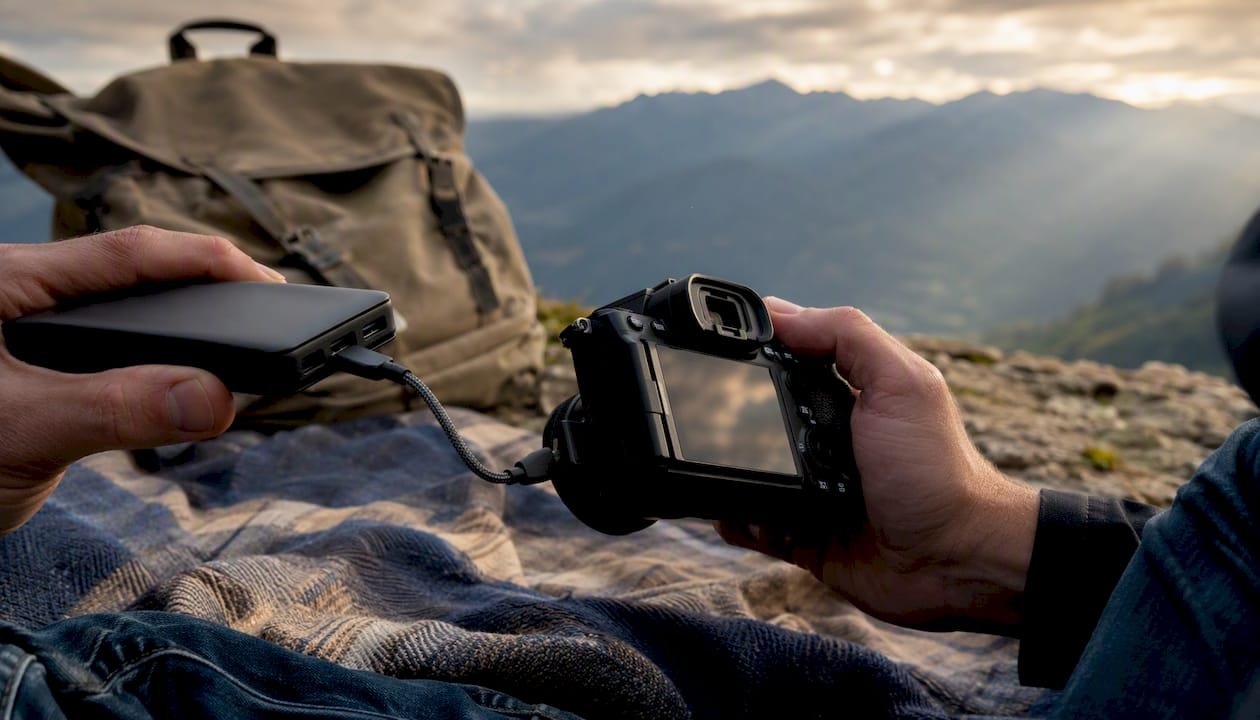
A power bank is a rechargeable lithium-ion battery pack that outputs DC power through USB-A and USB-C ports. No inverter, no AC outlet. Output ranges from a basic 5W trickle up to 100W via USB-C Power Delivery (PD), which is fast enough to charge most laptops at a meaningful rate.
Capacity in practice
The mAh-to-Wh conversion matters because device batteries are rated in Wh, not mAh. Multiply mAh by the cell voltage (3.7V) and divide by 1,000. A typical 10,000mAh bank yields an amount of usable energy equivalent to a small device battery — enough for one full charge of most modern smartphones, or a partial top-up of a thin laptop. A 20,000mAh model covers multiple phone charges and can meaningfully extend a laptop’s day. Buyer guides confirm 10,000–20,000mAh as the practical sweet spot for personal use, with larger banks becoming noticeably heavier without proportional gains for most travelers.
What actually determines real-world usefulness is port quality, not just raw mAh. Long-form consumer testing shows that USB-C PD support and accurate LCD readouts matter more than headline capacity for day-to-day flexibility. A 20,000mAh bank with a weak 18W output charges a laptop at a crawl; one with 100W PD does it in under an hour.
Pros and cons
Advantages:
- Pocket-to-backpack portability; lighter models under 200g fit in a jacket pocket
- No setup required; plug in and charge
- Wide device compatibility via USB-C PD and USB-A
- Affordable entry price relative to capacity
Limitations:
- No AC output; cannot power appliances, power tools, or medical equipment that requires a wall socket
- Capacity ceiling is practical around 25,000–40,000mAh before size and weight become a real trade-off
- Recharge time from wall can be slow on lower-end models without fast input charging
Airline and transport rules
Most airlines follow IATA guidelines: power banks up to 100Wh are permitted in carry-on luggage without prior approval. Banks between 100Wh and 160Wh may be allowed with airline permission. Higher-capacity devices are usually restricted from air transport. Airline rules prohibit power banks in checked baggage. A power bank for iPhone travel that stays under 100Wh avoids all approval friction.
What is a portable power station, and when does it become necessary?
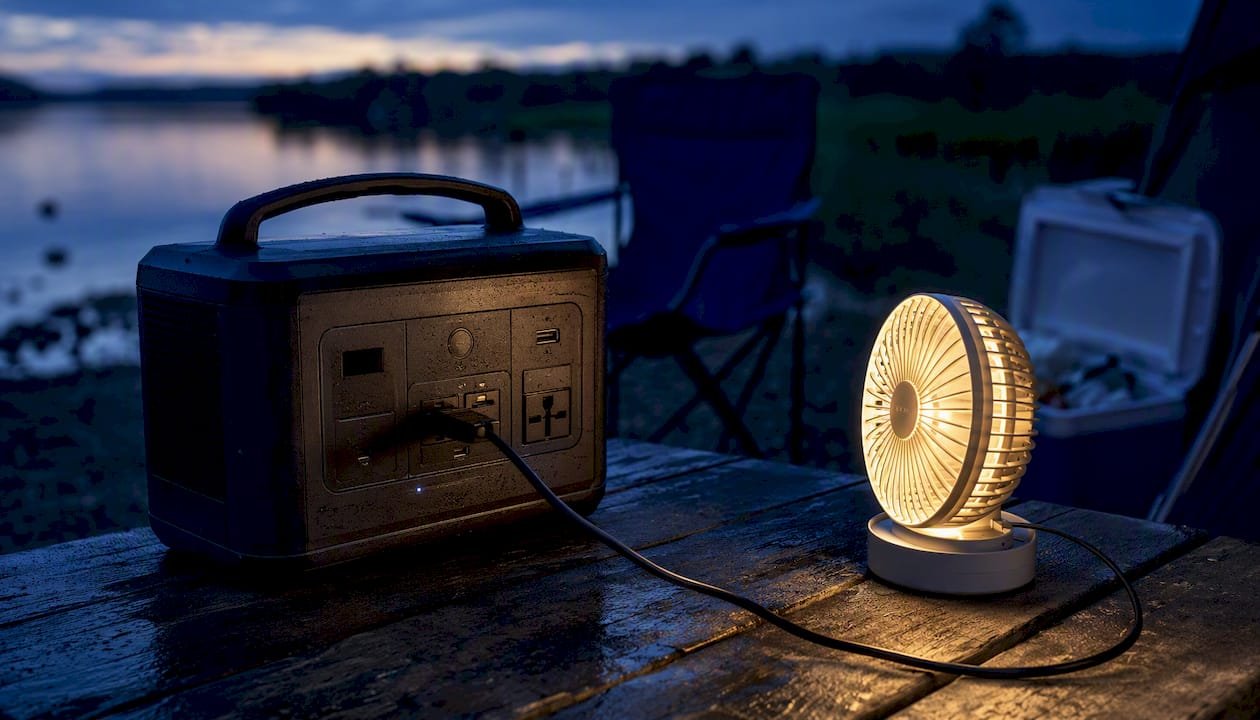
A portable power station is a large-capacity battery pack with a built-in inverter. That inverter is the key difference: it converts stored DC energy into 120V AC power, the same output as a standard wall socket. Typical capacities run from 250Wh on the compact end to well over 2,000Wh for home-backup-grade units. Continuous output ratings commonly span 200W to 3,000W depending on the inverter.
What those watt-hours actually run
Runtime math: divide the station’s usable Wh by the device’s wattage. A 500Wh station running a 50W mini-fridge delivers roughly 8–10 hours of runtime after accounting for inverter conversion losses (typically 10–15%). The same station charges a 60Wh laptop battery about six times, or keeps a phone alive for days. Portable power station comparisons consistently show that AC outlets and surge capacity are what separate stations from banks — a bank simply cannot start a compressor fridge or a CPAP with a heated humidifier.
One detail many buyers miss: stations often list a “peak” watt rating alongside continuous output. A blender or power drill draws far more at startup than during steady operation. The continuous rating is what you size against for sustained loads; the peak rating covers those startup surges.
Ports and connectivity
Most stations offer a mix of AC outlets, USB-C PD, USB-A, a 12V DC car port, and sometimes an Anderson or XT60 connector for solar input. Running multiple devices simultaneously draws from the same Wh pool, so total load matters more than any single port’s rating.
Charging methods
Wall charging is fastest, often 4–8 hours for a mid-size station. Car charging is slower (typically 8–15 hours via 12V). Solar input varies by panel wattage and sunlight conditions; a 100W panel in direct sun might add 50–70W of real input after losses. Sizing guides recommend calculating device watt-hours first, then adding 10–15% for conversion losses before selecting a station.
Pros and cons
Advantages:
- AC output powers appliances, medical devices, and tools
- Large Wh capacity for multi-day or emergency use
- Multiple simultaneous outputs across different port types
- Solar-compatible for off-grid recharging
Limitations:
- Heavy (often 5–15+ kg for mid-to-large models); not practical for daily carry
- Significantly higher cost than power banks
- Slower to recharge without a high-wattage input source
- Overkill for users who only need to charge phones and laptops
How do they compare side by side?
Comparisons of portable power stations and power banks consistently land on the same deciding factors: output type (AC vs DC), capacity scale, and weight. The table below captures the practical differences across the dimensions that matter most at purchase time.
| Category | Power Bank | Portable Power Station |
|---|---|---|
| Best for | Daily mobile carry, travel, phones/laptops | Camping basecamp, emergency backup, appliances |
| Capacity unit | mAh (10,000–40,000mAh typical) | Wh (a diverse capacity range designed for longer operation with appliances) |
| Max continuous output | 5W–100W (USB-C PD) | continuous output levels suitable for running small to medium appliances |
| Typical ports | USB-C PD, USB-A | AC outlets, USB-C PD, USB-A, 12V DC, solar input |
| Portability / weight | lightweight devices portable in pockets or small backpacks | 3kg–20kg+; carry handle or wheeled |
| Charging methods | Wall (USB-C), car adapter | Wall, car, solar panel |
| Typical cost range | $20–$100 | a cost range reflecting more capable and larger capacity devices |
| Airline restrictions | Carry-on only; under 100Wh no approval needed | Generally prohibited on aircraft |
A few points worth calling out explicitly. First, mAh and Wh are not interchangeable. A 40,000mAh bank holds roughly 148Wh — less than the smallest entry-level power station. Second, the output rating matters as much as capacity: a station rated at 200W continuous cannot run a 1,500W space heater, regardless of how many Wh it stores. Third, power stations are the quiet, safe indoor option for short outages; generators are the right call only when sustained, high-wattage loads demand it.
Pro Tip: Always check the inverter’s continuous watt rating, not just the peak. And on a power bank, verify the USB-C PD wattage per port — some banks advertise 100W total but only deliver it when a single device is connected; add a second device and both ports drop.
How do you choose the right one for your needs?
Start with what you need to power, not with a capacity number.
- List every device you plan to run. Phone, laptop, camera, router, CPAP, fridge — write them all down.
- Find the continuous wattage for each device. Check the label or spec sheet. Sum them if you’ll run multiple simultaneously.
- Estimate daily watt-hours. Multiply each device’s watts by the hours per day you’ll use it. Add them together.
- Add 15% for conversion losses. Inverters and charging circuits are not 100% efficient.
- Match to a device with equal or higher Wh capacity and a continuous output rating that covers your peak simultaneous load.
Example: Laptop (45W × 4h = 180Wh) + phone (10W × 2h = 20Wh) + travel router (6W × 8h = 48Wh) = 248Wh. A 300Wh station covers a weekend; a 40,000mAh power bank (~148Wh) covers the phone and router but not the laptop for a full day.
If your total wattage stays under 100W and you only need USB outputs, a high-capacity power bank handles it. Cross 100W continuous or add any AC device, and you need a station.
Questions to ask before buying
- Does the power bank list per-port PD wattage, or just total output?
- Does the station list continuous vs peak inverter watts separately?
- What is the recharge input wattage? (Determines how fast it refills from solar or wall)
- What battery chemistry does it use? LFP (lithium iron phosphate) cells typically last significantly more charge cycles than standard lithium-ion.
- Are safety certifications listed? (UN 38.3, CE, FCC, RoHS)
Red flags
- Capacity listed only in mAh for a device claiming to run appliances
- No per-port PD wattage listed
- Recharge time claims that seem implausibly fast relative to input wattage
- Missing or vague safety certifications
When a high-capacity power bank like Ifory is the right choice
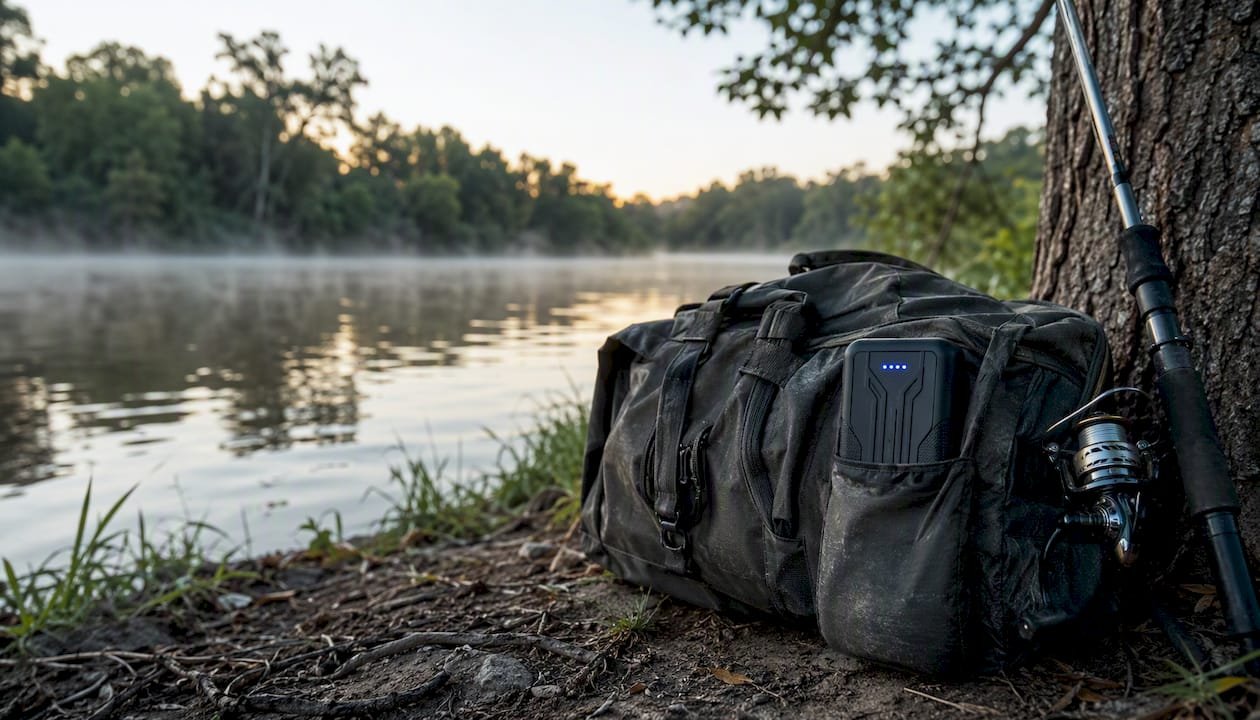
If your load stays in the USB-output zone — phones, tablets, cameras, laptops, headlamps, GPS units — and you need a device that survives the field, a high-capacity power bank is the sharper tool. The Ifory 40,000mAh power bank sits at the upper end of what a bank can deliver without crossing into power-station territory.
| Spec | Ifory detail |
|---|---|
| Capacity | 40,000mAh (~148Wh estimated) |
| Max output | 100W USB-C PD |
| Ports | Multi-port USB-C and USB-A |
| IP rating | IP67 waterproof |
| Flashlight | 500 lumens integrated |
| Display | Real-time LCD power status |
| Build | Anti-drop structure |
The IP67 rating means it survives submersion in up to 1 meter of water for 30 minutes — relevant for kayaking, rain-soaked hikes, or boat trips where a standard bank would be a liability. The 500-lumen flashlight is not a gimmick; it replaces a separate headlamp for camp tasks or emergencies. The LCD display shows remaining capacity as a percentage, which matters when you’re rationing power across three days off-grid.
Pro Tip: Pair Ifory with a compatible 40W portable solar panel for multi-day basecamp use. In good sunlight, a 40W panel can meaningfully offset daily draw from phones and cameras, extending your effective runtime without adding station-class weight. To protect the battery long-term, avoid storing it fully charged or fully depleted — keep it between 20–80% for storage periods over a week.
Safety, transport, and regulatory notes you need to know
Portable power devices carry real risks when mishandled. These rules apply to both banks and stations.
- Never crush, puncture, or short-circuit a lithium battery. Thermal runaway from physical damage can cause fire.
- Store at partial charge (around 40–60%) for long-term storage. Full charge or full discharge accelerates cell degradation.
- Ventilate during charging. Don’t charge inside a sealed bag or under a pillow; heat buildup shortens lifespan and raises safety risk.
- Airline carry-on rules: banks under 100Wh need no approval; 100–160Wh may require airline permission; above 160Wh is generally prohibited. Power banks are never allowed in checked luggage.
- Power stations are generally prohibited on commercial aircraft due to their size and capacity.
- Look for these certifications: UN 38.3 (shipping safety test), CE (European conformity), FCC (US radio/electrical), and RoHS (restricted hazardous substances). A device missing all of these warrants skepticism.
- CPAP and medical devices: verify both the continuous watt draw and the startup surge wattage before relying on a portable station. Some CPAP models with heated humidifiers draw 100–200W continuously; the station’s inverter must handle that load without throttling.
What field use actually teaches you about this choice
The conventional wisdom says “get the biggest capacity you can afford.” Field use teaches the opposite lesson.
Weight is a constraint that shows up on mile three of a hike, not at the trailhead. A 700g bank that charges everything you actually carry beats a 1.2kg bank with capacity you never use. The same logic applies to stations: a 500Wh unit you can carry to a campsite beats a 1,500Wh unit that stays in the car.
The second lesson is that fast PD ports solve more problems than extra mAh. A 30-minute charge window at a trailhead shelter is worth far more if your bank can push 65W than if it trickles at 18W. Real-world flexibility comes from output speed, not just stored energy.
The workflow that holds up across most scenarios: a compact, high-capacity power bank for daily carry and travel, plus a modest station with solar input for extended off-grid stays. They serve different jobs. Trying to make one device do both usually means compromising on both.
Ifory: built for adventurers who need serious power without the bulk
Most adventurers don’t need a 20-pound power station. They need something that charges every device in their pack, survives a downpour, and doesn’t require a separate flashlight. That’s the gap the Ifory 100W power bank fills.

At 40,000mAh with 100W USB-C PD output, IP67 waterproofing, and an integrated 500-lumen flashlight, Ifory is built for the reader who needs multi-device charging capacity in a form factor that fits a daypack. The LCD display shows exactly how much power remains, so you’re never guessing mid-trip. Pair it with Ifory’s 40W portable solar panel and you have a self-sustaining power system for basecamp use without station-class weight.
Browse the full Ifory power bank range to find the model that fits your load and your adventure.
Sources
- Review: Four portable power banks that go the extra mile – INIU Cougar P63, Journey Fortix 10K, Belkin BoostCharge Hybrid, Anker Prime A110B
- The best power banks keep your essentials alive without unnecessary bulk
- Portable Power Stations vs Generators: Which Portable Power Option Is Right for You?