

In Germany you get a 24-month statutory warranty for new power banks, and the seller, not the manufacturer, is your first contact. A separate, voluntary manufacturer guarantee may exist alongside it, but it never replaces your legal rights. For the first 12 months, the burden of proving a defect was not already present sits with the seller.
TL;DR:
- For contracts since January 1, 2022, sellers must show during the first 12 months that a defect arose after delivery; afterward, buyers must prove its origin.
- A professional seller may shorten coverage on used goods to 12 months only if the reduction is clearly disclosed before purchase.
- Write the seller named on your invoice, request repair or replacement first, and set a reasonable response deadline of 10 to 14 days.
- Manufacturer guarantees are voluntary and may require receipts, serial numbers, or troubleshooting, but their exclusions do not cancel statutory claims against the seller.
- After month 12, dated photos, repair records, and diagnostic reports can support your claim; an expert report may help if the seller disputes the defect.
Table of Contents
- Statutory Warranty (Gewährleistung) and What It Covers
- Manufacturer Guarantees Versus Statutory Rights: What’s the Difference
- How to File a Warranty Claim Step by Step
- Timelines, Proof, and Why the First 12 Months Matter Most
- What to Check Before You File a Claim
- Keeping an Ifory Power Bank Covered and Running Safely
- Why Asserting Your Rights Beats Accepting a Quiet Fix
- Get Warranty Support for Your Ifory Power Bank
- FAQ
- Sources
Statutory Warranty (Gewährleistung) and What It Covers
The statutory warranty, called Gewährleistung, is a legal guarantee built into German consumer law. For new goods bought from a professional seller, it runs for 24 months from the date of delivery, and no retailer can shorten or waive it on new products. The only exception is used goods sold by a professional seller, where the period can legally be reduced to 12 months, but only when the seller clearly discloses this reduction before the sale.
This protection exists independently of any marketing promise printed on the box. It is tied to the purchase contract, which means your point of contact is always the business you bought the power bank from, whether that is a retailer’s own store, a marketplace listing or an online shop. The manufacturer is not automatically on the hook here, even though many sellers try to redirect frustrated customers that way.
When a power bank turns out to be genuinely defective, you have several remedies under German law, and they apply in a specific order:
- Repair or replacement (Nacherfüllung): your first and primary right, letting you choose between a fix or a new unit in most cases.
- Price reduction: available when repair or replacement fails, is refused, or is unreasonable.
- Rescission of the contract: canceling the purchase and getting your money back when the above remedies do not resolve the defect.
- Damages: compensation for losses directly caused by the defect, where applicable.
These remedies, along with the seller’s obligations, sit at the core of German sales law covered under §§ 437 and 439 BGB, as summarized by consumer protection authorities. The seller cannot simply tell you to “contact the manufacturer” and consider their obligation finished. They remain your contractual partner until the defect is resolved through one of the remedies above.
One practical detail trips up a lot of buyers: a seller sometimes offers a quick fix framed as a favor rather than a formal repair under Gewährleistung. That distinction matters because it can affect how later disputes are documented, which we cover later in this guide.
Manufacturer Guarantees Versus Statutory Rights: What’s the Difference
A manufacturer guarantee, called Garantie in German, is a completely separate promise from the statutory warranty. It is voluntary: no law requires a manufacturer to offer one, and when they do, they set their own duration, scope and conditions. A power bank brand might promise 12, 24 or 36 months of coverage, structure it around battery capacity loss, or limit it to manufacturing defects only.
Because a guarantee is a private commercial promise, its terms carry real formal requirements. According to guidance from the Verwaltungsportal Bund, a valid guarantee declaration for contracts concluded after January 1, 2022, must be provided in text form, at the latest by the time of delivery, and must include:
- The scope and duration of the guarantee, stated clearly.
- The name and address of the guarantee provider.
- A statement confirming that your statutory rights remain unaffected by the guarantee.
Many recent contracts fall under the extended consumer protections introduced in 2022, according to legal analysis of the reform, which strengthened the burden-of-proof window from 6 to 12 months. For any purchase made since then, this window works in your favor regardless of whether a manufacturer guarantee exists at all.
Manufacturers typically attach their own procedural requirements to a guarantee claim: the original purchase receipt, the product’s serial number, sometimes a basic troubleshooting checklist completed before they accept a return, and exclusions for damage caused by misuse, unauthorized repairs or normal wear, as outlined in their warranty practices. None of these conditions override your statutory rights. If a manufacturer denies a guarantee claim because you lost the box or skipped a diagnostic step, you can usually still pursue Gewährleistung through the seller.
Always ask for the guarantee declaration in writing before relying on verbal promises from a sales assistant or a product page bullet point. A guarantee that is never documented in text form is difficult to enforce later, and its absence is itself a point of leverage in a dispute.
How to File a Warranty Claim Step by Step
When a power bank fails, how you document and report the problem in the first few days often decides how smoothly the claim goes.
Start with safety. If the device feels hot, has swollen, smells unusual or shows any sign of battery damage, stop using it immediately and move it away from flammable materials. Photograph the swelling or discoloration before you do anything else, since this becomes part of your evidence.
- Collect your evidence first. Gather the original invoice or order confirmation, the product’s serial number, clear photos or video of the defect, the original packaging if you still have it, and any error messages or firmware logs the device displayed.
- Identify the correct contact. For a statutory claim, that is the seller named on your invoice, not necessarily the brand on the device itself.
- Send it through a traceable channel. Email with a read receipt or registered mail both work; keep a copy of everything you send.
- Track the seller’s response time. A professional seller should acknowledge your claim within a few business days and propose a remedy within a couple of weeks.
- Escalate if they refuse or stay silent. Contact your local Verbraucherzentrale for a template letter, consider alternative dispute resolution, or pursue a small claims court filing (Amtsgericht) as a last resort.
- Request an expert report when the defect is disputed. This matters most for claims made after the 12-month mark, when the burden of proof shifts to you.
Pro Tip: Keep every message in one folder, including timestamps, since a consistent paper trail is often what convinces a seller to settle rather than argue.
A reasonable deadline is the detail most buyers skip. German law expects you to give the seller a fair chance to remedy the defect before escalating, but “fair” does not mean indefinite. Two weeks is standard for a straightforward repair or replacement decision on a product as simple as a power bank. If the seller asks for more time to send the unit to a lab, that is reasonable too, but get the new timeline in writing.
Timelines, Proof, and Why the First 12 Months Matter Most
The single biggest factor shaping how easy your claim is turns out to be timing, specifically the 12-month burden-of-proof window known as Beweislastumkehr.
For purchase contracts concluded since January 1, 2022, the seller must prove that a defect did not already exist at the time of delivery during the first 12 months after purchase. Before that reform, the window was only 6 months. In practice, this means that if your power bank stops holding a charge properly in month 8, the seller carries the burden of showing the fault came from misuse, not a manufacturing issue. After month 12, that burden flips to you.
| Period after purchase | Who must prove the defect’s origin | What helps your case |
|---|---|---|
| First 12 months | Seller | Basic proof of purchase and a clear defect description |
| Months 12 to 24 | Buyer | Serial number records, repair notes, diagnostic reports, dated photos |
This is why saving documentation early, even before anything goes wrong, pays off. Keep the original receipt, note the serial number somewhere searchable, and if the unit ever goes in for a repair, keep the service center’s written notes. These records are exactly what tips a dispute in your favor once you are past the 12-month mark described in Verbraucherzentrale guidance.
One more detail matters: sending a device back for repair or replacement can pause the statutory limitation period while it is away from you, and depending on the outcome, part of the warranty clock may restart. Keep track of exact dates the item left your possession and when it came back, since these gaps can extend your effective coverage window.
What to Check Before You File a Claim
Not every malfunction is a covered defect, and not every exclusion printed in a warranty card is actually legal. A little pre-claim screening saves time.
Common clauses that sellers cite, and what they actually mean:
- “Battery degradation is normal wear and not covered.” True for gradual capacity loss over years of normal use, but a battery that fails outright within months is a different matter.
- “Opened or repaired by a third party voids the guarantee.” This can be valid for the voluntary guarantee, but it does not automatically cancel your statutory rights if the defect existed at delivery.
- “The guarantee limits your legal rights.” Any clause attempting this is void. A valid guarantee declaration must explicitly confirm that statutory rights remain untouched, as required by formal declaration rules.
Before writing to anyone, check three things: who the seller actually is on your invoice (a marketplace listing often routes payment through a third party), whether your purchase counts as a private consumer purchase rather than a business-to-business one, and whether you have saved every piece of communication so far.
Pro Tip: If a warranty card or product description claims it overrides your statutory rights, treat that as a red flag rather than a limitation, since such language typically has no legal effect in Germany.
Keeping an Ifory Power Bank Covered and Running Safely
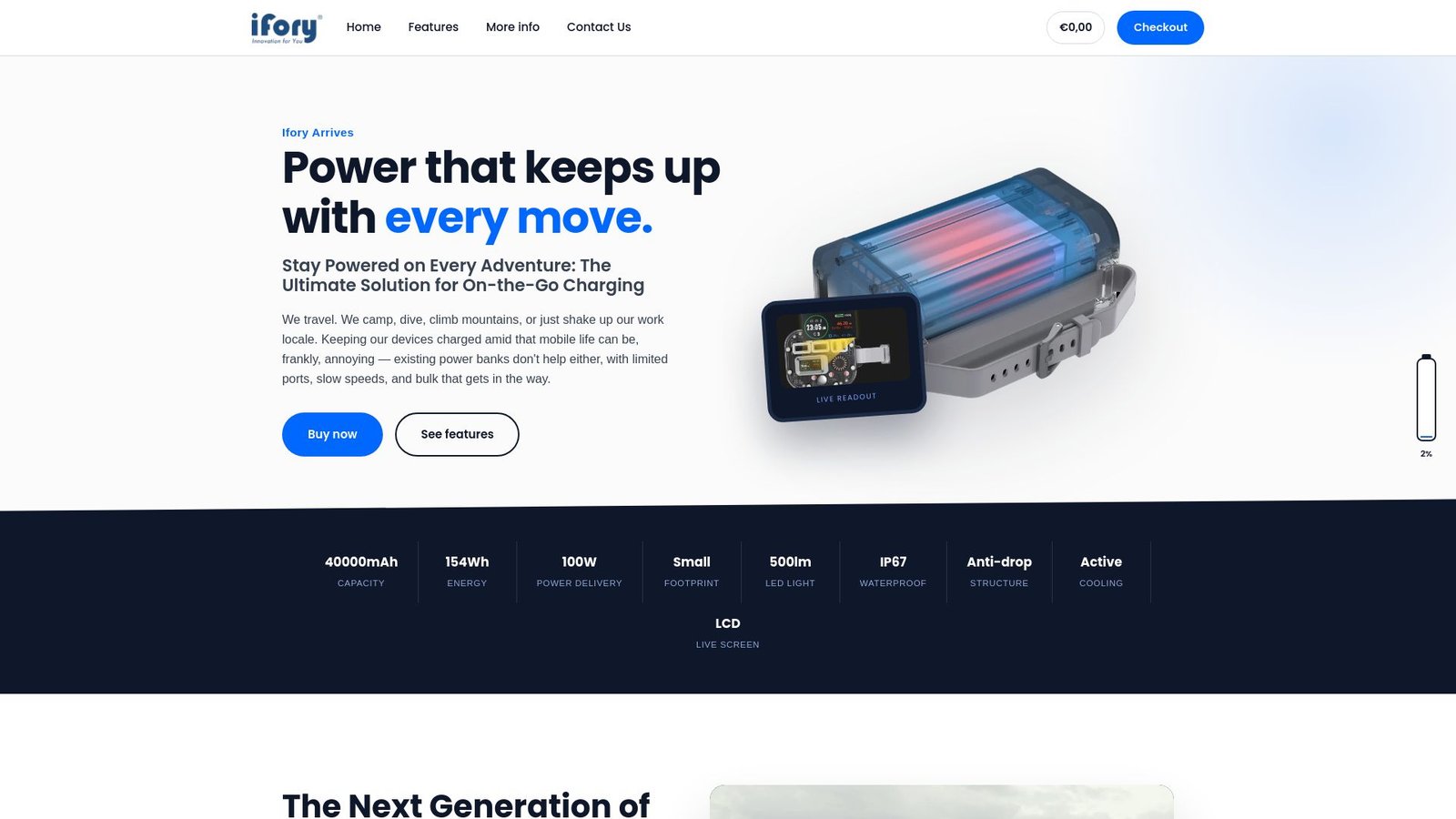
An Ifory power bank is built around a 40,000mAh capacity, 100W fast charging across multiple ports, an IP67 waterproof rating, an anti-drop structure, a real-time LED display and an integrated flashlight, features aimed at outdoor conditions where standard power banks tend to struggle. These same features also shape what a typical defect looks like: port seal failures, display malfunctions, or charging inconsistencies after heavy field use.
If you ever notice swelling, unusual heat or a smell while using one, stop charging immediately and document the issue with photos before contacting anyone. For a smooth claim, we recommend having the following ready:
- Your original order confirmation or receipt showing purchase date and seller.
- The unit’s serial number, usually printed on the base or inside the battery compartment.
- Clear photos or a short video showing the specific defect.
- A short written description of when the issue started and what you were doing when it occurred.
Our support team can be reached through the contact page, and warranty terms are listed alongside the product page for reference. A complete submission with the items above typically moves faster than a bare complaint, since it gives our team everything needed to assess the defect on the first review.
Why Asserting Your Rights Beats Accepting a Quiet Fix
A seller offering a quick, unexplained repair “as a courtesy” can feel like good service, but it sometimes sidesteps the formal Gewährleistung process entirely. Once that happens, you may lose the paper trail that would have protected you if the same defect returns. Insist on a written note of what was done and under what legal basis, even for a fix that seems minor.
The most useful habit we have seen work is simple: write everything down as it happens, not from memory afterward. Verbraucherzentrale’s sample letters and its Umtausch-Check tool exist precisely because most disputes come down to who kept better records. Germany’s consumer protections are strong on paper. They only work in practice when you use them deliberately instead of accepting whatever a seller offers first.
— Mats
Get Warranty Support for Your Ifory Power Bank
We built the Ifory Powerbank for the moments standard chargers give up: wet trails, drops onto rock, long days off-grid. Its IP67 rating, anti-drop structure, 100W multi-port charging and built-in flashlight are designed for exactly the outdoor use where failures are most likely to happen far from a repair shop.
If you ever need support, reach our team with these ready:
- Your order confirmation and the unit’s serial number.
- Photos or a short video of the issue.
- A brief note on when and how the problem started.
Browse the full power bank and solar panel lineup or reach our team directly through the contact page to start a support request today.
FAQ
Do power banks have warranty protection in Germany?
Yes. New power banks sold in Germany carry a 24-month statutory warranty through the seller, separate from any optional manufacturer guarantee. This legal protection cannot be waived by the retailer on new goods.
How long does a typical manufacturer power bank guarantee last?
Manufacturer guarantees are voluntary, so duration varies by brand and is set entirely by the provider rather than by law. Always check the written guarantee declaration for the exact duration and conditions rather than assuming a standard length.
How do I file a manufacturer guarantee claim?
Contact the guarantee provider listed in the written declaration, and include your receipt, the serial number, and a clear description of the defect. If the manufacturer denies the claim, you can usually still pursue the seller directly under the statutory warranty, since that right exists independently.
Are charging cables covered under the same warranty rules?
Cables sold as part of a purchase follow the same statutory framework as the device itself, with the 24-month period applying to new goods. Any additional guarantee duration for cables specifically depends on what the seller or manufacturer states in writing, so check the declaration rather than assuming a fixed term.
Sources
- Defective products: consumer rights and guarantees (Verwaltungsportal Bund)
- Verbraucherzentrale
- Gewährleistung: defect months and burden of proof (Reklamation24 blog)