
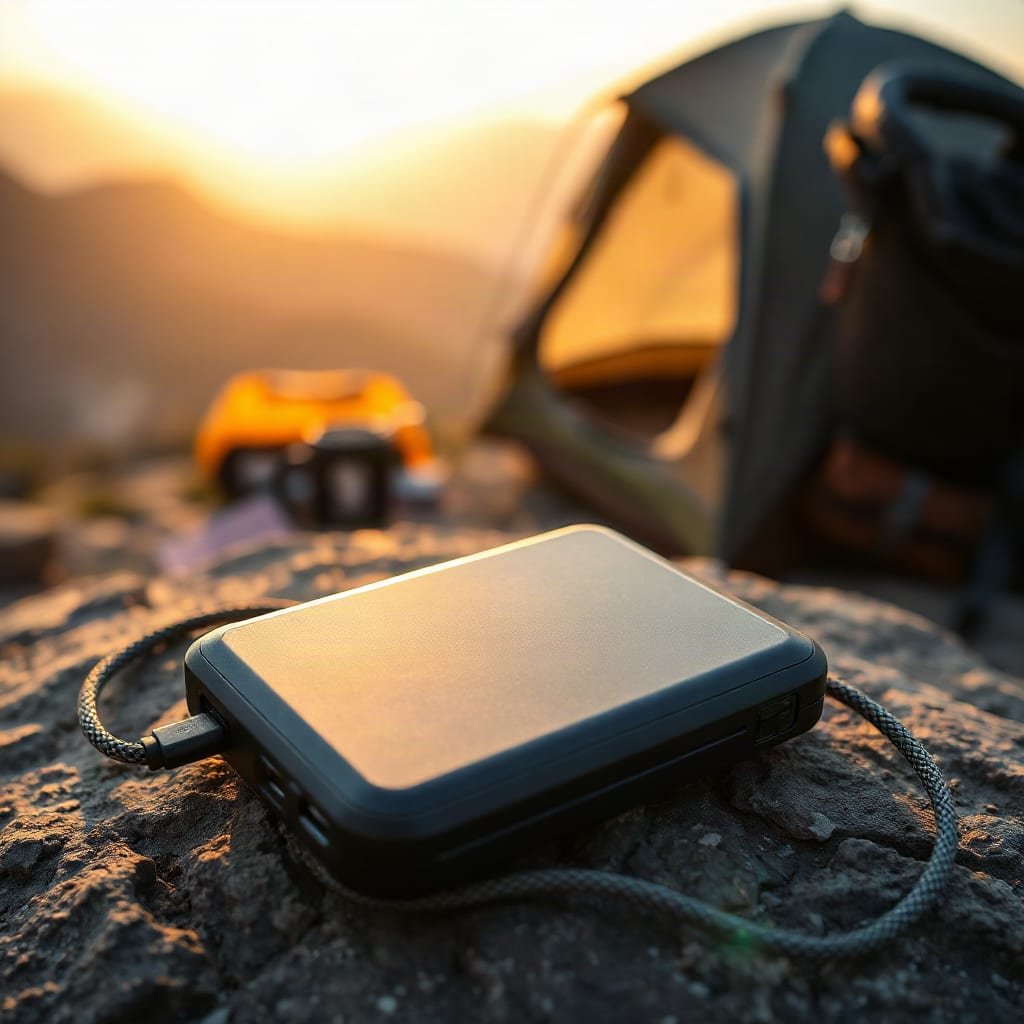
A rugged power bank for outdoor use needs three things on its spec sheet: a stated IP rating, a capacity in watt-hours that covers your trip, and enough output wattage to run your biggest device. "Rugged" on a box is marketing, while an IP number is a tested claim. For a weekend of phones, 20,000mAh is plenty. For laptops, cameras or multi-day trips, you want about 40,000mAh (148Wh) plus a solar panel.
TL;DR:
- "Rugged" has no legal definition. Look for an IP rating (IP65 to IP67 is the useful range) and a stated drop-test height.
- Capacity in mAh hides voltage. Convert to watt-hours (mAh x 3.7V / 1000) and expect about 70% of that to reach your devices.
- A 50,000mAh bank is roughly 185Wh, which gives about 8 phone charges or 2 laptop charges, and it is too big to carry on a plane.
- Cold hurts outdoor power banks more than water does. Below freezing, keep the bank against your body and charge it only after it warms up.
- Pick a 20,000mAh bank for weekends, a 40,000mAh 100W bank plus a 40W solar panel for multi-day trips, and a power station only when you are car camping.
Table of Contents
- What Makes a Power Bank Rugged, and Which Claims to Ignore
- Rugged Power Bank for Outdoor Use: Matching Capacity to Your Trip
- How Long Will a 50,000mAh Power Bank Last?
- Cold, Salt and Sand: Where Outdoor Power Banks Actually Fail
- Power Bank or Portable Power Station: Where the Line Falls
- Are Power Banks Safe Indoors, in Tents and in Your Pack?
- Solar Recharging: How Much Sun a 40,000mAh Bank Needs
- Get a 40,000mAh, 100W Power Bank That Survives the Trip
- Frequently Asked Questions
- Sources
What Makes a Power Bank Rugged, and Which Claims to Ignore
A power bank is a rechargeable lithium battery with charging circuitry and USB ports, built to refill your phone, laptop or camera when no outlet is nearby. A rugged one adds a sealed shell, protected ports and a case that survives being dropped on rock. But "rugged," "military-grade" and "tough" are not defined by anyone.
Two labels you can check:
- IP rating. The IEC's IP code, defined in IEC 60529, uses two digits. The first is dust (6 means dust-tight) and the second is water (7 means temporary immersion). IP67 is the number to look for on a bank that rides in a pack.
- Drop and shock claims. "MIL-STD-810" is a set of US Department of Defense test methods, not a certificate. A seller who writes it without naming the method (for example, the drop procedure) has told you very little. Ask for a drop height onto a hard surface.
IP67 means 1 meter of water for 30 minutes. It says nothing about salt water, hot springs or a running tap.
Many "waterproof" claims fall apart there. Check that the ports are sealed or capped, because a sealed shell with an open USB-C port is only as waterproof as the port. Gaskets also age, so a bank that survived a lake in year one may not in year four.
Rugged Power Bank for Outdoor Use: Matching Capacity to Your Trip
Capacity is printed in mAh, but the number that compares fairly across banks is watt-hours (Wh). Multiply mAh by 3.7 volts and divide by 1,000. Real-world delivery is about 70% of that figure, because voltage conversion and cable losses eat the rest. A typical phone battery holds about 15Wh and a thin laptop about 60Wh.
| Bank size | Approx. Wh | Approx. weight | Phone charges | Laptop charges | Best for |
|---|---|---|---|---|---|
| 10,000mAh | 37Wh | 200 g | 1 to 2 | 0 | Day hikes |
| 20,000mAh | 74Wh | 400 g | 3 | 0 to 1 | Weekend trips |
| 40,000mAh | 148Wh | 800 g | 7 | 1 to 2 | Multi-day, remote work |
| 50,000mAh | 185Wh | 1 kg or more | 8 to 9 | 2 | Basecamp, car trips |
| 1,000Wh station | 1,000Wh | 10 kg or more | 50 or more | 12 or more | Car camping, home backup |
Weights are rough class averages, and charge counts assume 70% efficiency for banks.
My pick for most people is the 20,000mAh class on a weekend and the 40,000mAh class for anything longer. Past 40,000mAh the weight climbs faster than the benefit, and you hit airline limits (more on that below). Output matters as much as size. The USB Power Delivery specification tops out at 100W for standard cables (20V at 5A), and that level needs a cable with an e-marker chip. If you plan to run a laptop, read our explainer on what the watts and protocols mean before you buy.
How Long Will a 50,000mAh Power Bank Last?
It lasts as long as the Wh it holds divided by what you draw. A 50,000mAh bank at 3.7V is about 185Wh, and about 130Wh is usable after losses. That gives you:
- Phone use. Roughly 8 to 9 full charges of a 15Wh phone.
- Laptop use. About 2 hours at a full 65W draw, or two full charges of a 60Wh laptop.
- Low-power gear. A 10W load such as a headlamp plus a GPS watch runs for about 13 hours.
- Handheld console. A 25W draw gives about 5 hours.
A 50,000mAh bank is about 185Wh, which is above the 160Wh ceiling for airline carry-on.
The FAA's lithium battery guidance allows spare batteries between 100Wh and 160Wh only with airline approval (two maximum), and bans anything above 160Wh from passenger flights. A 40,000mAh bank sits at 148Wh, under that line. We cover the details in our guide to flying with a 40000mAh power bank. If you fly to your trailhead, skip the 50,000mAh class.
Cold, Salt and Sand: Where Outdoor Power Banks Actually Fail
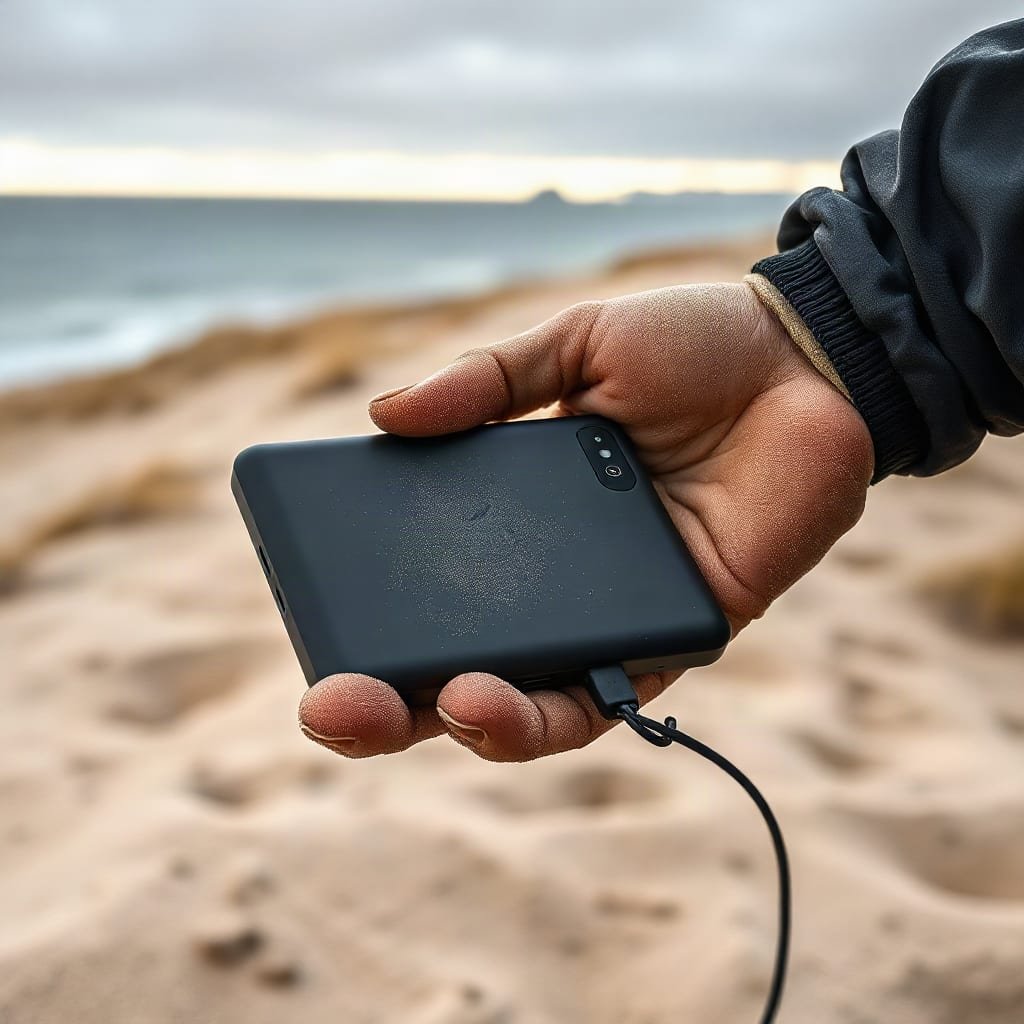
Water gets the attention, but temperature does more damage to a trip.
Cold
Lithium-ion cells lose usable capacity as they cool, and a bank in a freezing tent can deliver noticeably less than its label. Charging lithium cells below 0°C (32°F) can harm them, and most quality banks refuse to charge when frozen.
Pro Tip: Sleep with your power bank in the foot of your sleeping bag or an inside jacket pocket. Charge your devices from it in the morning while it is still warm, and let a frozen bank warm to above freezing before you plug a solar panel into it. A bank kept at body temperature can give you noticeably more usable energy on a winter night than the same bank left in a pack outside.
Salt and sand
IP67 is tested in fresh water. After a coastal day, rinse the bank with fresh water, dry the ports and leave it with the caps open for an hour. Sand in a USB-C port often kills divers' and kayakers' gear, so keep the port cap closed whenever the bank is not in use.
Heat
A bank on a dashboard or in direct summer sun can reach temperatures that age the cells quickly. Keep it shaded in a pack, and do not charge it while it is hot to the touch.
Power Bank or Portable Power Station: Where the Line Falls
If you are searching for a 1000W or 3000W portable power station, you are shopping for a different job. A station is a battery with an AC inverter, sized for running a fridge, a kettle or home backup. A bank charges USB devices. A station is a car-camping tool, and a bank rides in your pack.
How long do stations last? Two answers apply:
- Per charge. Runtime equals watt-hours times about 0.85, divided by your load. A 1,000Wh station running a 50W fridge lasts about 17 hours. At a 1,000W load (a kettle or hair dryer) it lasts under an hour.
- Over their life. Stations with LiFePO4 cells are commonly rated for 2,000 to 3,500 charge cycles, while stations with NMC cells are usually rated for 500 to 1,000. Check the cycle rating on the spec sheet, since it varies by model.
For home backup, a 3000W station is a sound choice if you need to run appliances, and it will be heavier than anything you would take backpacking. Local pickup and same-day delivery make sense for a station you need before a storm. A bank is rarely an emergency purchase, so you can order one with time to read the spec sheet and the return policy.
Are Power Banks Safe Indoors, in Tents and in Your Pack?
Yes, if the bank is a quality unit used sensibly. The risk with any lithium battery comes from damage, heat and poor cells, not location. A few habits keep that risk low:
- Charge on a hard surface. Do not charge a bank under a pillow, on a sofa cushion or inside a closed bag.
- Retire swollen or dented units. A bulging case means internal gas. Stop using it and take it to a battery recycling point.
- Look for transport testing. Reputable banks pass UN 38.3, the lithium battery transport test, and carry CE marking for sale in the EU.
- Avoid overnight charging beside bedding. Charge during the day when you can watch it, particularly in a tent.
Keep the bank out of a hot car and away from stoves in your pack. Those two situations do more harm than the tent itself.
Solar Recharging: How Much Sun a 40,000mAh Bank Needs
A solar panel turns a bank into an off-grid system, but the arithmetic is less generous than the label. A 40W panel rarely delivers 40W. In good sun and at a decent angle, plan on about 25 to 30W, which is my own field rule of thumb. A 148Wh refill then takes roughly 6 to 7 hours of strong sun, so plan on a day and a half for a full refill. Clouds and shade can cut output by half or more.
Pitch the panel facing the sun, tilt it to the sun's angle and re-aim every hour or two. Do not leave the bank in direct sun while it charges. Our USB-C solar charger guide explains what wattage works outdoors, and the phone-sized panel guide covers lighter setups. If you are comparing models, the power bank review guide lists the specs worth checking.
Get a 40,000mAh, 100W Power Bank That Survives the Trip
Most banks that are tough enough for outdoors are too small for a laptop, and most banks big enough for a laptop are too fragile or too heavy. Ifory built its 40,000mAh, 100W bank for that middle ground. It holds 148Wh, which is about seven phone charges or one to two laptop charges, and its 100W USB-C output runs a laptop or a handheld console. The 40W portable solar panel (PD, listed at 21.88V and 2.19A) refills it off-grid, and the bank and panel are sold as a bundle with a free solar panel promotion while it runs. Shipping is free and you get 30 days to return it.
At 148Wh, the bank needs airline approval above the 100Wh line, so check your carrier's rules before you fly. Confirm the exact IP rating and drop-test figures on the product page before you buy, as you would with any rugged bank. Check the current price there as well.
Frequently Asked Questions
What is a power bank?
A power bank is a portable rechargeable battery with built-in charging circuitry and one or more USB ports. You charge it from a wall outlet or a solar panel, then use it to refill phones, tablets and laptops away from mains power. Capacity is usually printed in mAh, but watt-hours is the fairer figure to compare.
How long do portable power stations last?
Per charge, runtime is watt-hours times about 0.85, divided by your load in watts. A 1,000Wh station running a 50W fridge lasts about 17 hours. Over its lifetime, LiFePO4 stations are commonly rated for 2,000 to 3,500 charge cycles and NMC stations for 500 to 1,000, so check the cycle rating on the spec sheet.
Are power banks safe indoors?
Yes, when the bank is undamaged and from a reputable maker. Charge it on a hard surface, keep it uncovered and away from bedding, and stop using any bank that swells or gets very hot. Look for CE marking and UN 38.3 transport testing.
How long will a 50,000mAh power bank last?
A 50,000mAh bank holds about 185Wh, and about 130Wh of that reaches your devices. That is roughly 8 to 9 phone charges, two laptop charges, or about 13 hours at a 10W load. It is also above the 160Wh airline carry-on limit.
Is a 40,000mAh power bank enough for a multi-day trip?
For most people, yes. It gives about seven phone charges or one to two laptop charges, and pairing it with a 40W solar panel extends that indefinitely in good sun. If you only carry a phone and a headlamp, 20,000mAh is lighter and enough for a weekend.
Sources
- IP Ratings (IEC 60529) | International Electrotechnical Commission
- Lithium Batteries (PackSafe) | Federal Aviation Administration
- USB Power Delivery | USB Implementers Forum