

A trustworthy power bank review reports what the pack delivers to your device, not the mAh printed on the box. A 20,000mAh pack holds about 74Wh on paper and usually hands over roughly 50Wh at the port. Output wattage, sustained heat behavior and the airline Wh rating decide whether a pack suits your trips, so judge reviews and products on those numbers.
TL;DR:
- Rated mAh is measured at cell voltage (about 3.7V). Expect roughly 65 to 75 percent of that energy to reach your device.
- A power bank is worth it if you go more than a day without an outlet or run a laptop, console or tablet. For a commute, a 5,000 to 10,000mAh pack is plenty.
- 10,000mAh suits daily carry, 20,000mAh suits one-bag travel, and 40,000mAh (148Wh) suits laptops and multi-day trips, but needs airline approval.
- No single brand is best. Judge each pack on measured Wh, sustained wattage, a printed Wh rating and a cable that can carry the load.
- The best-scoring packs are not always the best packs. Read the six-month-later complaints before you buy.
Table of Contents
- How to Read a Power Bank Review Without Getting Played
- Is a Power Bank Worth It? Yes, If You Go a Day Without an Outlet
- 10,000mAh vs 20,000mAh (and 40,000mAh): Which Is Better?
- Which Brand Is Best, and Which Power Bank Has the Best Reviews?
- Best Power Bank for Phones, Travel and International Trips
- Wattage Is Where Most Packs Fall Short, Especially for Laptops
- When the Obvious Answer Is Wrong: Bigger Is Not Always Better, and Solar Has Limits
- Get a 40,000mAh, 100W Power Bank Built for Long Trips Off the Grid
- Frequently Asked Questions
- Sources
How to Read a Power Bank Review Without Getting Played
Most power bank reviews rank packs by capacity and price. Three numbers matter and few reviews report them: delivered watt-hours, sustained output, and surface temperature under load.
The mAh on the box is counted at the battery cell's voltage, about 3.6 to 3.7V. Your phone charges through a 5V or higher port, and the conversion burns energy as heat. Most packs deliver roughly 65 to 75 percent of their rated energy to the device. Our power bank capacity guide walks through the math in full.
Here is what to look for in any review, whether it's a lab write-up or a Reddit thread:
- Measured watt-hours. The reviewer should have discharged the pack into an electronic load and logged the total. "Charged my phone three times" is a data point, not a measurement.
- Sustained wattage. A 100W pack that holds 100W for ten seconds and then throttles to 45W is a 45W pack for any laptop session.
- Time in service. Reddit threads and long-term updates catch swollen cells, dead ports and capacity loss at month six, which launch-week reviews never see.
- Temperature notes. If the reviewer never mentions how hot the case got at full output, they probably did not run it at full output.
- Printed Wh rating. Packs without the Wh figure on the case are a hassle at airport security.
I trust a review with three measured numbers over a review with fifty sponsored stars.
Is a Power Bank Worth It? Yes, If You Go a Day Without an Outlet
A modern phone battery holds roughly 13 to 18Wh. A 10,000mAh pack therefore gives you about two full phone charges, which is enough to make it worth buying for most people who travel or camp.
It is not worth buying if your day is home, office, car. Your phone already survives that, and a pack in the bag mostly adds weight. Buy one if any of these describe you:
- Long travel days. Airports, trains and navigation apps can drain a phone before you reach your hotel.
- Off-grid trips. Camping, climbing and diving trips turn charging into a planning problem.
- Laptop or console users. A phone-class pack cannot help a 60Wh laptop. You need 65W or more of output.
- Remote workers. A power cut or a café with no free sockets costs you billable hours.
For everyone else, a small 5,000 to 10,000mAh pack is the right answer, and spending more is a waste.
10,000mAh vs 20,000mAh (and 40,000mAh): Which Is Better?
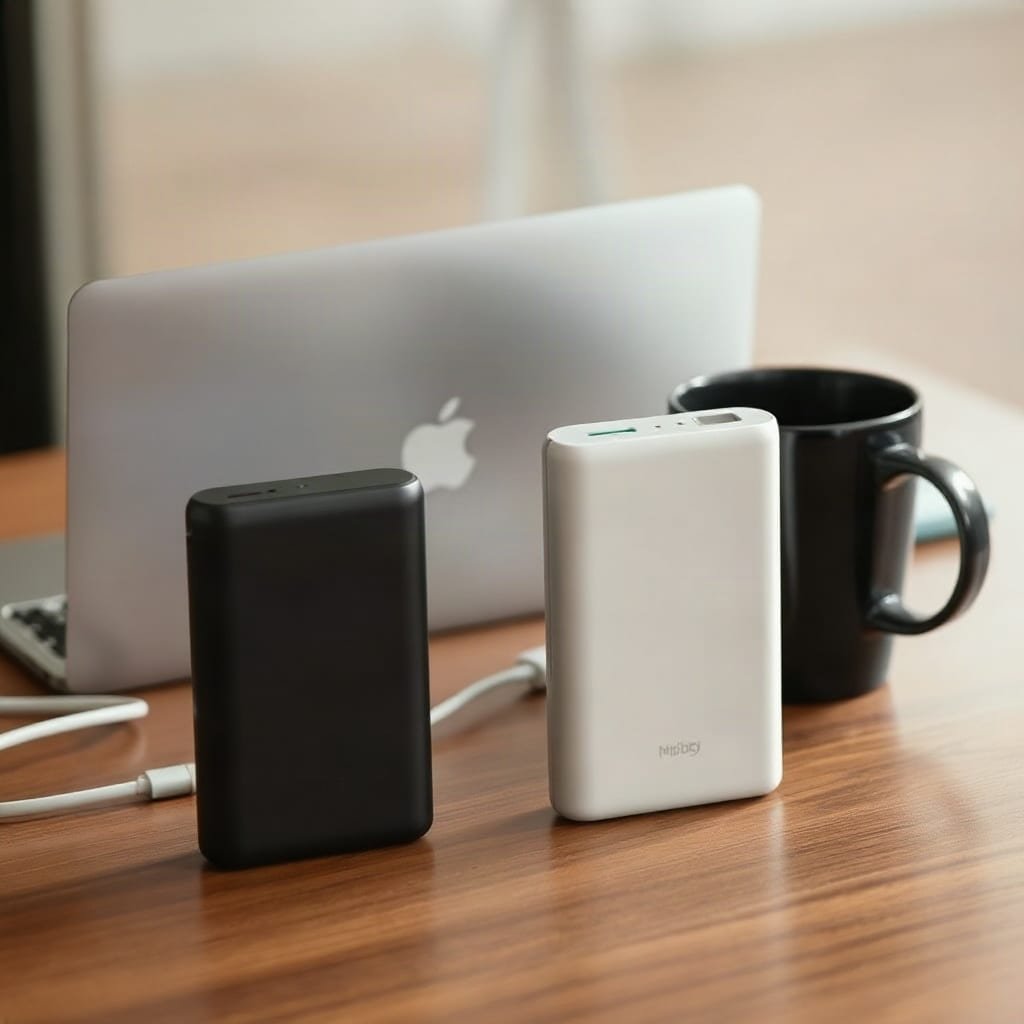
Neither is better in general. Pick the smallest pack that covers your longest stretch between outlets, because weight is the cost you pay on every trip.
| Rated capacity | Energy at 3.7V | Approx. full phone charges | Typical weight | Airline status |
|---|---|---|---|---|
| 10,000mAh | 37Wh | about 2 | 180 to 250g | Under 100Wh, no approval |
| 20,000mAh | 74Wh | 3 to 4 | 350 to 450g | Under 100Wh, no approval |
| 40,000mAh | 148Wh | 7 to 8 | 700g to 1kg | 101 to 160Wh, airline approval |
Charge counts assume about 70 percent delivery efficiency and a 13Wh phone battery. Weights vary by model, so check the spec sheet.
My picks: 10,000mAh for daily carry, 20,000mAh if you travel with a phone, earbuds and a tablet, and 40,000mAh only if you charge a laptop or stay away from outlets for several days. The 20,000mAh class is the sweet spot for most travelers because it clears airline limits without paperwork.
Which Brand Is Best, and Which Power Bank Has the Best Reviews?
No brand wins across the board. Brand lists age badly because the same company ships excellent and mediocre packs in the same year, and star averages reward volume and discounts more than quality.
Pick on the pack's verified specs:
- Real USB-C Power Delivery. The USB Implementers Forum defines the Power Delivery spec, the only fast-charging standard that covers phones, tablets and laptops from one port.
- Passed transport testing. Lithium packs shipped by air need to pass UN 38.3 tests. A manufacturer who cannot name the test report is a red flag.
- A printed Wh rating. Honest manufacturers print it. Hiding it usually means the number is awkward.
- A return window. Thirty days lets you run your own load test.
For "which has the best reviews," look for packs whose negative reviews describe the same minor annoyance (a bright LED, a stiff button) and not the same failure (won't hold charge, runs hot, port died). The one-star reviews tell you more than the average does.
Best Power Bank for Phones, Travel and International Trips
For phones, the best power bank is a 10,000 to 20,000mAh pack with a USB-C port rated at least 20W, which matches what current phones accept. Anything beyond that is for other devices.
For international travel, the plug standard does not matter, because the pack charges from USB-C and any wall adapter works. The airline rule does matter. The FAA's PackSafe guidance says spare lithium batteries, power banks included, go in carry-on only. Packs up to 100Wh need no approval, and packs from 101 to 160Wh need airline approval, with a limit of two. The ICAO dangerous goods instructions that airlines follow set the same thresholds worldwide.
A 40,000mAh pack at 3.7V is 148Wh, which sits 12Wh under the 160Wh airline ceiling and 48Wh over the 100Wh no-approval line.
So a 40,000mAh pack is legal on most flights but needs a call to your airline before you fly. Our 40,000mAh plane guide covers the exact steps. In Europe, the EU's common-charger rule makes USB-C the standard on new phones and, since April 2026, laptops, so one cable can serve everything in your bag.
Wattage Is Where Most Packs Fall Short, Especially for Laptops
A phone needs 20 to 30W. A thin laptop needs 45 to 65W, and a gaming handheld or performance laptop can ask for 100W. A pack that tops out at 18W will charge a laptop slower than the laptop drains, the most common complaint in power bank reviews on Reddit.
USB Power Delivery reaches 100W at 20V and 5A. Check three things:
- Single-port output. The headline wattage should be available from one port, not just across all ports combined.
- Split behavior. Plug in two devices and most packs divide the output. A 100W pack might drop to 65W plus 35W.
- Laptop fit. Compare the laptop's charger rating to the pack's per-port output. Our laptop power bank guide lists typical needs by device class.
Pro Tip: A 100W pack is only 100W with the right cable. Most USB-C cables are rated for 3A, which caps out at 60W. Reaching 100W needs a cable rated for 5A with an e-marker chip. If your "fast" pack seems slow, swap the cable before you blame the pack.
When the Obvious Answer Is Wrong: Bigger Is Not Always Better, and Solar Has Limits
The obvious advice is to buy the biggest pack you can afford. That is wrong for anyone who uses fewer than two devices. A 40,000mAh pack weighs about as much as a bottle of water, and if you carry it daily and use a fifth of it, you hauled around capacity you paid for and never used.
Solar has a similar trap. A 40W panel is a lab rating. In real sun, with clouds, a wrong angle and cable losses, expect roughly 60 percent of that, about 24W. Filling 148Wh at that rate takes six to eight hours of good sun, so plan for a full day, not an afternoon. Our guides on solar power for charging phones and the solar cell phone charger show how that math changes by season and latitude.
Ruggedness also gets overstated. An IP rating comes from the IEC 60529 standard, and IP67 means 1 meter of immersion for 30 minutes. If a pack just says "waterproof," ask for the IP number.
Get a 40,000mAh, 100W Power Bank Built for Long Trips Off the Grid
If you are the traveler this article kept describing, with a laptop, a phone, a console and no outlet for three days, Ifory built the Ifory 40000mAh 100W Power Bank for you. It has 148Wh of capacity and 100W of USB-C Power Delivery, enough to charge a laptop and a phone from the same pack. In this size class we say get the 100W version, because only a 100W pack keeps up with a laptop.
Pair it with the 40W portable solar panel (21.88V/2.19A) to recharge between stops, or look for the bundle promotion that includes the panel free. Shipping is free in the EU and returns run 30 days, so you can run your own load test. The caveats: at 148Wh it needs airline approval to fly, as covered above, and it is heavier than a 20,000mAh pack. Check the spec sheet for the IP rating and per-port output with two devices connected before you buy, ours included.
Frequently Asked Questions
Which power bank has the best reviews?
The packs with the best reviews are not always the best packs, because star averages track sales volume and discounts. Look for measured watt-hours, a sustained-wattage test, and complaints about minor annoyances rather than repeated failures. Reviews written six months or more after purchase are the most reliable.
Is it worth getting a power bank?
Yes, if you spend a day or more away from an outlet or charge a laptop, tablet or console. A 10,000mAh pack gives about two phone charges, which covers most travel days. If your routine is home, office and car, you can skip it.
What brand is the best power bank?
No single brand is best, since the same company can ship strong and weak packs in the same year. Choose based on USB-C Power Delivery support, a printed Wh rating, UN 38.3 test compliance, measured output in independent reviews, and a return window long enough to test it yourself.
Which is better, a 10000mAh or a 20,000mAh power bank?
A 10,000mAh pack is better for daily carry because it weighs 180 to 250g and gives about two phone charges. A 20,000mAh pack is better for travel days with several devices, delivering three to four phone charges while staying under the 100Wh airline limit. Choose the smallest one that covers your longest stretch without an outlet.
How many mAh does a power bank really deliver?
Most packs deliver roughly 65 to 75 percent of their rated energy to your device. The mAh rating is measured at the battery cell's 3.7V, and converting to 5V or higher output loses energy as heat. A 20,000mAh pack therefore holds 74Wh but delivers around 50Wh.
Sources
- Lithium Batteries (PackSafe) | Federal Aviation Administration
- IP Ratings (IEC 60529) | International Electrotechnical Commission
- USB Power Delivery | USB Implementers Forum
- Dangerous Goods | International Civil Aviation Organization