
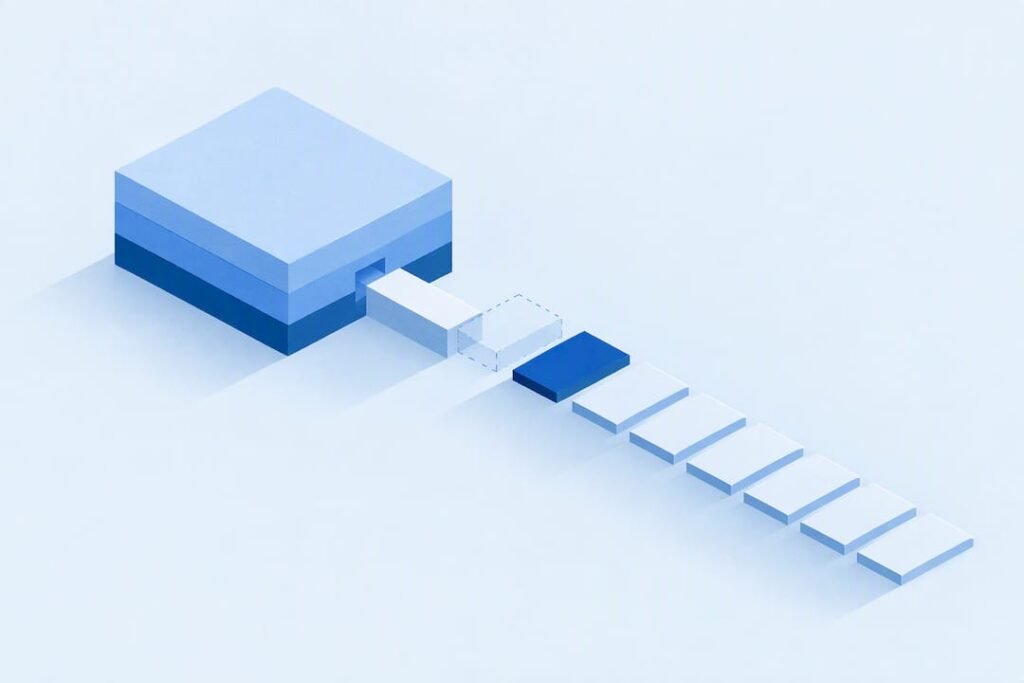
A 500-lumen flashlight typically holds usable brightness for tens of minutes up to a few hours, depending on battery size and heat management, not for a flat run at full power the whole time. The headline runtime number on most packaging refers to one mode, usually the lowest, measured under the ANSI/PLATO FL1 standard. To know what you are actually buying, check the mode table and runtime graph before you check the lumen count.
TL;DR:
- ANSI FL1 runtime starts 30 seconds after activation and ends at 10% of initial output, so quoted hours do not show sustained brightness.
- A single 21700 or 18650 cell typically sustains 500 lumens for roughly 40–260 minutes, while small AA or AAA lights often step down quickly.
- Trust runtime claims more when listings name the tested battery and mode, then show a graph of output decline instead of one hours figure.
- Store rechargeable lights and power banks near 50% charge during long periods of inactivity, and avoid leaving devices with lithium ion batteries fully drained.
Table of Contents
- What flashlight runtime actually measures under ANSI FL1
- How battery type and driver design change runtime at 500 lumens
- A shopping checklist for comparing runtime claims
- Estimating usable minutes from battery specs in the field
- How to measure flashlight runtime accurately at home
- Why runtime matters more than peak lumens on an actual trip
- How charging speed and battery capacity shape total runtime
- Maintenance habits that protect runtime over time
- How I choose a 500-lumen light for a multi-day trip
- Extend your light’s runtime with a high-capacity power bank
- FAQ
- Sources
What flashlight runtime actually measures under ANSI FL1
The number on the box comes from a specific test, not from how long the light stays bright. Under the ANSI/PLATO FL1 standard, runtime is clocked starting 30 seconds after the light turns on, and it stops once output falls to 10% of that initial reading. That means a flashlight can spend most of its quoted runtime well below half its starting brightness and still pass the test.
A few things follow from that definition:
- Runtime is always tied to a single mode, so a “4 hour” claim almost always describes the low or medium setting, not turbo.
- Many lights use stepdown circuitry that drops output automatically to manage heat, so peak brightness often lasts only minutes even when total runtime stretches for hours.
- Thermal throttling hits small, dense lights hardest, since a compact body has less surface area to shed heat at 500 lumens.
Manufacturers that publish runtime graphs are more trustworthy because the graph shows the stepdown curve, according to Lumen & Ledger’s runtime breakdown, which notes that a single hours figure hides exactly the information a buyer needs to judge sustained brightness.
How battery type and driver design change runtime at 500 lumens
Runtime math starts with watt-hours. Multiply the battery’s milliamp-hour rating by its nominal voltage, then divide by 1,000, and you get the energy budget in watt-hours. A rough estimate of runtime at 500 lumens comes from dividing that figure by the flashlight’s approximate watt draw at that output, then subtracting for conversion losses in the driver.
Common setups behave very differently at the same lumen rating:
- AA or AAA-powered lights rated at 500 lumens usually only sustain that output in short bursts before stepping down, since small cells cannot supply the current without excessive heat.
- A single 21700 or 18650 cell commonly supports 500 lumens for roughly 40 to 260 minutes, depending on driver efficiency and how well the body dissipates heat.
- Flashlights with larger built-in lithium-ion packs, or lights powered through an external bank, can sustain 500 lumens for several hours because the extra capacity buffers against the steep drain high output causes.
Two flashlights can share an identical “500 lumen” spec sheet and still differ by hours in real runtime, because driver efficiency and thermal design, not the LED itself, decide how long that output holds.
Pro Tip: Check if a listing names the battery used for its runtime test. A number with no battery spec attached is close to meaningless for comparison.
A shopping checklist for comparing runtime claims
Spec sheets vary wildly in honesty, so a short checklist helps separate a useful listing from a marketing number.
- Look for a mode table that lists lumens and runtime for each setting (turbo, high, medium, low), not a single blended figure.
- Check whether the listing names the exact battery used for testing, since runtime without a battery reference cannot be compared across products.
- Search for a runtime graph rather than a text claim, since a graph reveals stepdown timing and sustained output behavior that a number cannot.
- Treat any “up to X hours” phrase as a low-mode claim unless the listing names the mode directly.
- Read product Q&A sections or independent reviews for measured time to 50% and 10% output, which show how quickly brightness actually fades.
A few extra checks are worth the minute they take:
- Prefer listings with manufacturer-supplied graphs over marketing copy that only lists lumens.
- Cross-reference a vendor’s runtime claim against an independent review when one exists, since third-party testing often reveals stepdown behavior the spec sheet omits.
Lowe’s buying guide makes a related point worth carrying into any purchase: higher lumen ratings drain batteries faster, so matching lumens to the actual task matters more than chasing the highest number on the shelf.
Estimating usable minutes from battery specs in the field
A simple three-step method turns a battery spec into a usable runtime estimate you can do in your head before buying.
- Convert capacity to energy: multiply milliamp-hours by nominal voltage and divide by 1,000 to get watt-hours.
- Estimate the light’s draw at 500 lumens, which varies by LED and driver but generally falls in a predictable range for that output level.
- Divide watt-hours by that draw, then subtract for conversion losses, since USB step-up or step-down circuits and driver inefficiency typically eat into the theoretical total.
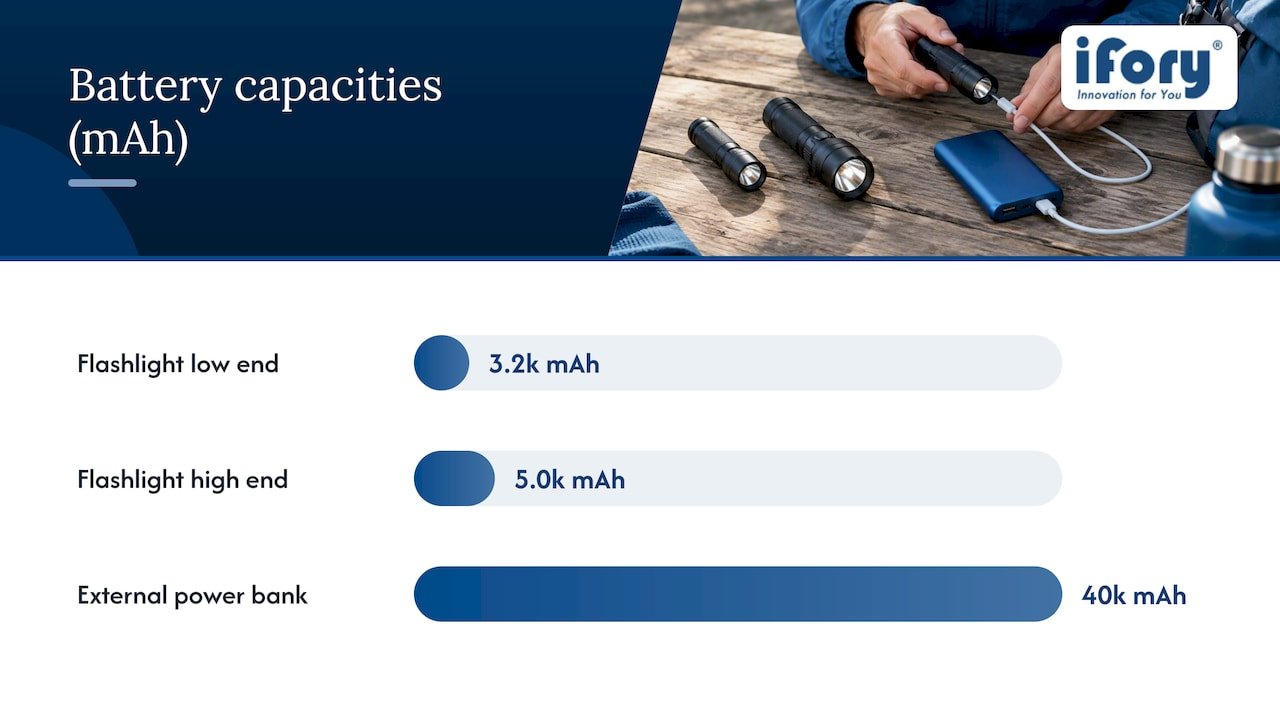
Scenario A: a rechargeable flashlight with an internal cell in the 3,200 to 5,000 mAh range can sustain 500 lumens for roughly an hour to a few hours before stepping down, depending entirely on driver quality and how the body manages heat.
Scenario B: a USB-chargeable light or headlamp drawing power from a 40,000mAh bank, like the one built into Ifory’s power bank, can run for many hours longer than its internal cell alone would allow, since the bank’s capacity dwarfs what fits inside a flashlight body. Our own guide to estimating power bank runtime walks through this math step by step for travel and outdoor setups.
Pro Tip: Budget for a 10% to 30% efficiency loss when calculating runtime through a power bank, since USB conversion and regulation always claim part of the theoretical watt-hours.
A power bank with high capacity and output exists for exactly this gap: when a flashlight’s internal cell runs out mid-trip, a high-capacity external source keeps lighting available without waiting for an outlet.
How to measure flashlight runtime accurately at home
Testing runtime yourself takes patience more than equipment. You need the flashlight fully charged, a stable room temperature around 20 to 25 degrees Celsius, and a way to log light output over time, whether that is a lux meter pointed at a fixed distance or simply a timer and your own eyes checking brightness at intervals.
Set the light on its highest sustained mode, start timing the moment it stabilizes (the FL1 standard waits 30 seconds for this reason), and record when brightness visibly drops, then again when it feels roughly half as bright. Keep the light stationary and avoid moving it between surfaces with different airflow, since a light resting on a table traps heat differently than one held in open air, which skews stepdown timing.
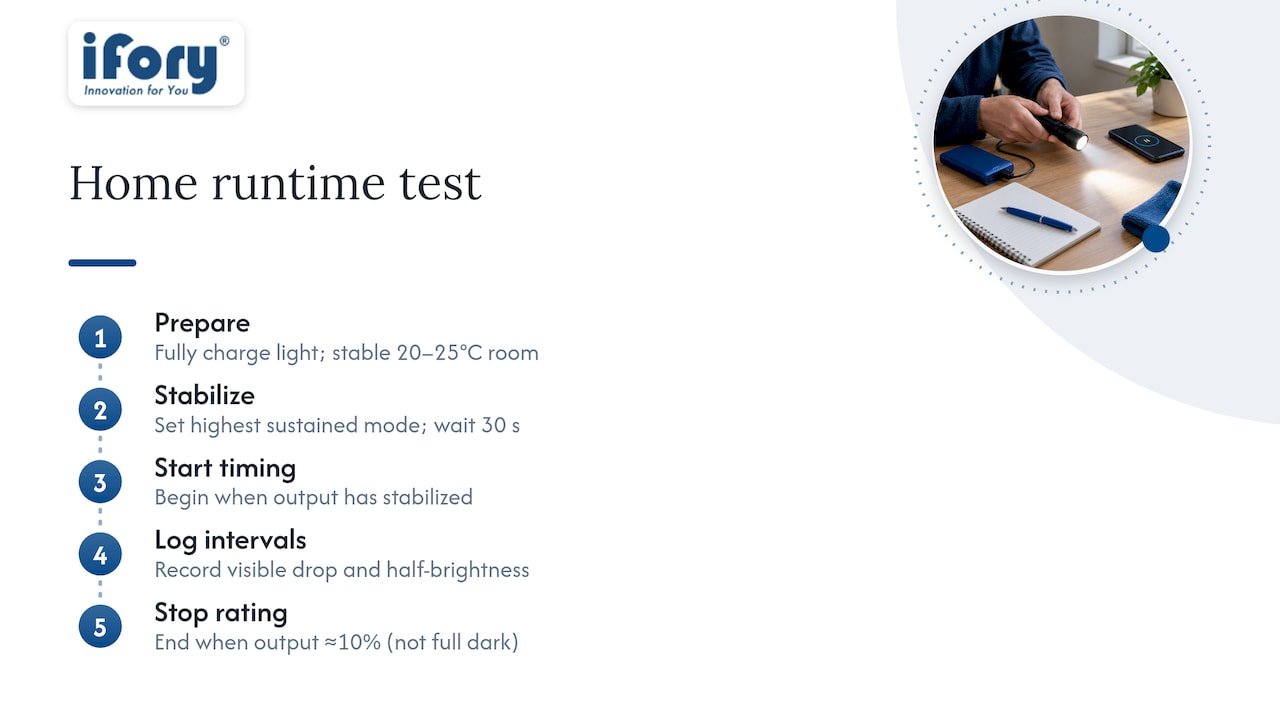
Avoid testing in direct sun or near heat sources, since ambient temperature changes how fast the driver throttles output. If you want a number close to the FL1 definition, stop your stopwatch when output visibly falls to roughly a tenth of where it started, not when the light goes completely dark, since many lights sustain a dim trickle long after their rated runtime ends.
Why runtime matters more than peak lumens on an actual trip
A flashlight’s peak brightness rarely decides whether a trip goes smoothly. Running out of light three hours into a night hike does. Runtime is the number that determines whether a light setup matches the actual length of the activity, which makes it more important than the lumen figure for planning purposes.
Short outings, like an evening dog walk or a quick repair job, rarely stress a flashlight’s runtime limits. Multi-day camping trips, overnight fishing, or emergency kits are a different story, since the light needs to last through several nights without a charging opportunity. STKR Concepts’ comparison of flashlights and lanterns points out that 500 lumens can be overkill for ambient camp lighting, where a lantern spreads light more efficiently and draws less power doing it, while a flashlight’s concentrated beam earns its keep for distance and detail work like scanning a trail or checking a tent stake in the dark.
Matching the tool to the task saves battery life twice over: once by choosing the right beam pattern for the job, and again by avoiding 500-lumen turbo mode when a 100-lumen setting does the same job for four times as long. For multi-day trips, pairing a flashlight with a tent lighting power bank setup removes the guesswork, since the light source gets recharged instead of rationed.
How charging speed and battery capacity shape total runtime
Fast charging and battery capacity affect runtime from opposite directions. Capacity decides how much energy is available in the first place, while charging speed decides how quickly that energy gets replenished between uses, which matters most on multi-day trips where overnight charging windows are short.
A larger capacity bank, such as one rated at 40,000mAh, holds enough energy to recharge a flashlight or headlamp many times over before needing its own recharge, which matters when wall outlets are unavailable for days. Fast charging, in the 100W range on compatible banks, cuts the time needed to top off that capacity from a wall outlet or vehicle, which shortens the window between trips rather than extending runtime on a single charge. Together, the two specs decide how self-sufficient a lighting setup can stay: high capacity carries you through the trip, and fast charging gets you back to full before the next one. Our breakdown of what 100W output means for different devices covers how that charging speed actually applies across phones, lights, and laptops.
Maintenance habits that protect runtime over time
Runtime degrades with age and poor storage habits, not just with use. Lithium-ion cells, whether inside a flashlight or a power bank, lose capacity gradually, and how you store and charge them accelerates or slows that decline.
A few habits make a measurable difference over a battery’s life:
- Store rechargeable lights and banks at roughly 50% charge when not in use for extended periods, since storing at full charge stresses the cell chemistry.
- Avoid letting any lithium-ion device sit fully drained for long stretches, which can permanently reduce usable capacity.
- Clean contacts and threads periodically, since corrosion or grit increases resistance and can cause voltage sag under high-output modes.
- Avoid charging or using lights in direct sun or extreme heat, since elevated temperature during charge cycles is one of the fastest ways to shorten a battery’s usable life.
Our own guidance on power bank lifespan covers this in more depth: expect a usable life of roughly two to four years from a well-maintained lithium-ion pack, with storage habits making the biggest difference in how close you get to that range.
How I choose a 500-lumen light for a multi-day trip
My checklist starts with the mode table, not the lumen count. I want to see sustained output per mode and, ideally, a runtime graph that shows when stepdown kicks in, because that tells me what the light actually does after the first ten minutes.
Thermal management matters almost as much. A light that throttles hard after five minutes at turbo is not giving me 500 lumens in any way that matters on a trail. For anything longer than a single overnight, I stop relying on the flashlight’s internal cell entirely and plan around an external power source, since that removes the single point of failure a small battery represents.
— Mats
Extend your light’s runtime with a high-capacity power bank
A standalone flashlight’s runtime is fixed the moment you buy it. Pairing one with a high-capacity bank changes that math entirely, since you are no longer limited by whatever cell fits inside the flashlight body.

Our Ifory power bank carries a 40,000mAh capacity and 100W output, built around an IP67 waterproof rating and anti-drop structure for conditions where a standard power bank struggles. A few scenarios where that setup earns its weight:
- Multi-day trips where overnight charging isn’t available and a flashlight’s internal cell won’t last.
- Charging a headlamp, phone, and camera from the same bank instead of carrying separate chargers.
- Rugged conditions, including wet or dusty environments, where a standard charger risks failure.
Check current options on our shop page or see the full feature breakdown on our product page before your next trip.
FAQ
Is 500 lumens a lot for a flashlight?
500 lumens sits in a practical middle range: bright enough for distance work like scanning a yard or trail, but well below the several-thousand-lumen output of dedicated search lights. Lowe’s buying guide recommends matching lumens to the task rather than assuming more is always better, since higher output drains batteries faster.
How far does 500 lumens light up?
Throw distance depends more on the reflector and beam pattern than on lumens alone, so two 500-lumen lights can illuminate very different distances. A flood beam spreads 500 lumens over a wide area for close work, while a focused throw beam concentrates the same output into a narrower, longer-reaching column.
Which flashlight has the longest runtime?
The longest runtime generally comes from lights run on their lowest mode with the largest battery capacity, since low output combined with high capacity minimizes drain the most. Checking a product’s mode table and runtime graph, as recommended by Lumen & Ledger, is the most reliable way to compare runtime claims across different lights.
What is 500 lumens equivalent to?
500 lumens roughly compares to a bright household floodlight, enough to light a room or illuminate a trail clearly at night. The comparison varies with beam pattern, since a focused beam at 500 lumens appears far brighter at a distance than a wide flood beam of the same output.
How do I know if a runtime claim is reliable?
A reliable runtime claim names the specific mode, lists the battery used for testing, and ideally includes a runtime graph showing output over time rather than a single blended number. Listings that only state “up to X hours” without a named mode are typically describing the lowest setting, not sustained high output.
Sources
- ANSI/NEMA FL-1 Flashlight Performance Standard | US Made Supply
- Flashlight runtime explained | Lumen & Ledger
- Flashlight and camping lantern buying guide | Lowe’s