
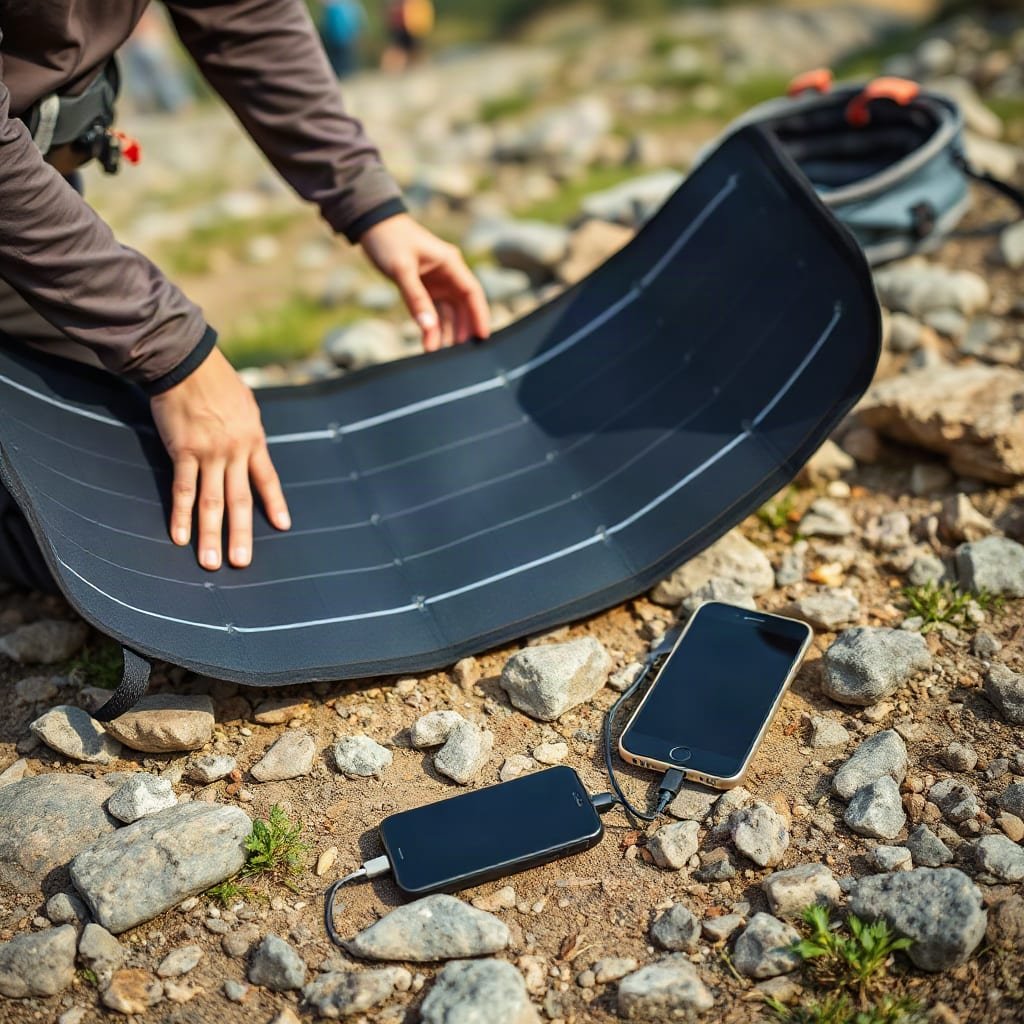
A solar panel phone charger works, and the result depends on where the energy goes: it charges a battery well and a phone badly. Sunlight breaks every few minutes, and each break drops the charging handshake your phone depends on. Run the panel into a power bank, then charge the phone from that, and a 10W panel that felt useless turns into a reliable one-phone-per-day system.
TL;DR:
- A panel plugged directly into a phone stalls every time a cloud passes; a power bank absorbs those gaps and passes on a steady charge later.
- Panel wattage is rated at 1,000 W/m² and 25°C, so expect 60 to 75% of the number on the box in real summer sun.
- A 10W panel needs roughly three hours of cloudless, aimed sunlight to fill one 4,500mAh phone from empty.
- Solar car battery chargers maintain a healthy battery through storage; they cannot rescue a flat one.
- A 200W panel runs a 12V compressor fridge only through a charge controller and a battery, never directly.
Table of Contents
- Why a Solar Panel Phone Charger Works Better Through a Battery
- How Much Power a Solar Panel Actually Delivers to a Phone
- Which Panel Size to Buy for Backpacking, Camping and Travel
- Do Solar Car Battery Chargers Really Work?
- Can a 200W Solar Panel Run a 12 Volt Refrigerator?
- What to Check in a Portable Solar Charger for a Phone
- Why Panels Fail in the Field: Heat, Creases and Water
- Get a Panel and Bank That Keep Charging When the Sun Quits
- Frequently Asked Questions
- Sources
Why a Solar Panel Phone Charger Works Better Through a Battery
A phone plugged straight into a folding panel charges in bursts. A cloud crosses, output falls below the phone's minimum, and the phone stops drawing. When the sun returns, the phone has to negotiate the charge again, and some Android handsets read the interruption as a faulty charger and refuse to resume until you pull the cable and reseat it. Four hours of that gains 20% and a sunburn.
A power bank has none of that temperament. It takes whatever the panel gives, from 5W to 40W, and holds it. When you plug the phone into the bank that evening, the phone sees a stable USB PD source and charges at full speed in about 90 minutes.
The arithmetic matters too. A phone sitting on a rock in the sun with the screen on, GPS running and brightness up burns 3 to 5W while it charges. A 10W panel producing 7W is a net gain of 2 to 3W in that setup. Charging the bank happens later, with nothing else competing for the same watts. If you are carrying a bank anyway, see where it has to go in your luggage before you fly.
How Much Power a Solar Panel Actually Delivers to a Phone
Panel wattage is measured at standard test conditions: 1,000 W/m² irradiance and a 25°C cell temperature. Neither happens on a campsite in August. A panel lying in direct sun runs at 55 to 70°C, and monocrystalline cells lose roughly 0.35% of output per degree above 25, so a hot panel is already 10 to 15% down before a single cloud shows up.
Then there is the angle. A panel aimed straight at the sun collects close to its rating. One lying flat on a backpack collects what the sky gives it at a glancing angle, which is a lot less.
| Rated panel size | Realistic output, clear summer sun | Time to fill a 4,500mAh phone (about 21Wh with conversion losses) |
|---|---|---|
| 5W | 3 to 3.5W | 6 to 7 hours |
| 10W | 6 to 7W | 3 to 3.5 hours |
| 21W | 14 to 15W | About 1.5 hours |
| 40W USB PD | 26 to 30W | Under 1 hour |
Those figures assume a clear sky, a panel re-aimed every hour, ambient temperature under 30°C and a cable under a meter. Lie the panel flat and skip the re-aiming and you land closer to half the rated number. The NREL PVWatts calculator models these losses for rooftop arrays; the same derating logic applies to the panel on your tent.
Shading matters more than most buyers expect. Cells in a folding panel are wired in series, so shading one of six strips can cut output by a third, and shading one edge while you sit in the panel's own shadow can take it to near zero.
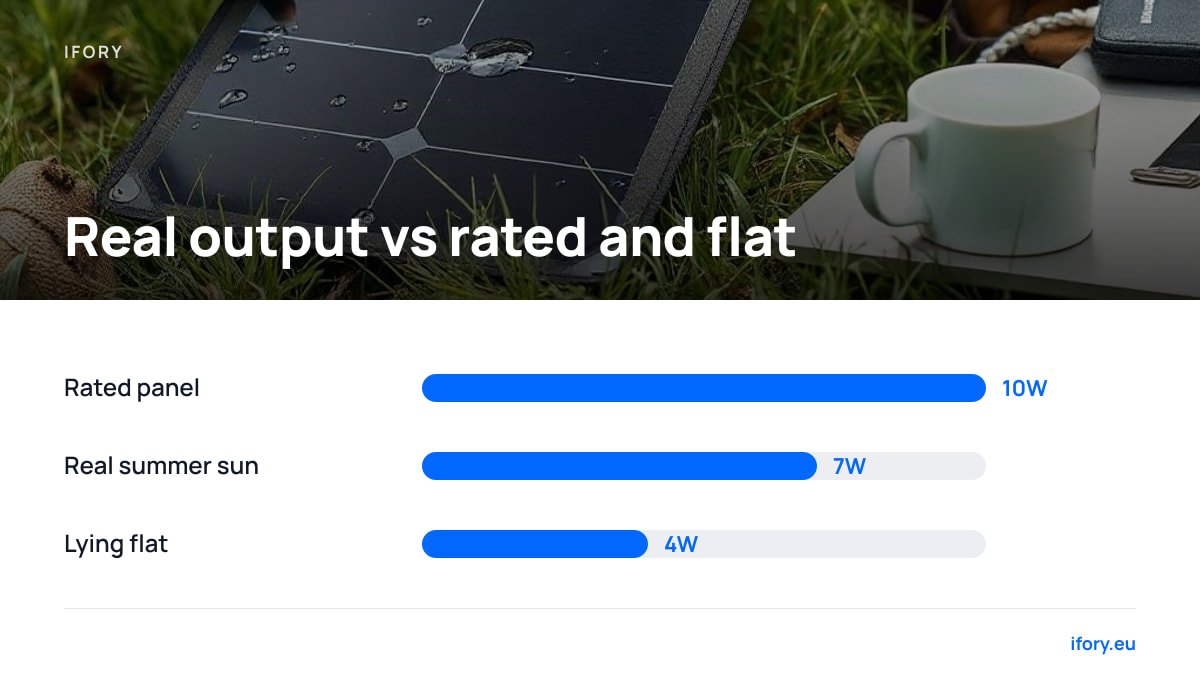
A 10W panel is a 7W panel in real summer sun, and closer to 4W when it lies flat on your pack instead of aimed at the sun.
Which Panel Size to Buy for Backpacking, Camping and Travel
5W to 10W for backpacking. These fold to the size of a paperback and weigh 150 to 300g. They will keep one phone alive on a multi-day hike if you charge a bank during the day and the phone at night. They will not keep two phones and a camera running.
21W for a couple or a long weekend. A 21W three-panel unit recharges a 10,000mAh bank in a day of decent sun and still fits in a lid pocket. This is the size most people should buy.
40W with USB PD for camping, van travel and remote work. At 40W you can push 20V over USB PD, which is what a laptop or a large power bank wants. If you plan to top up a gaming laptop, check the real numbers on 100W power banks and gaming laptops first, because not every laptop accepts charge over USB C at all.
60W to 100W for basecamp. Folding arrays at this size weigh over a kilo and need to be staked out and re-aimed. They make sense when the panel is the power station for a group.
Weight is the honest trade-off. Every step up in panel size costs you grams and setup time. A 40W panel you leave in the tent because it is fiddly is worth less than a 10W panel strapped to your pack.
Do Solar Car Battery Chargers Really Work?
Yes for maintenance, no for rescue. A 10W trickle panel in decent sun returns roughly 30 to 40Wh a day, which is about 2.5 to 3.3Ah at 12V. A parked car's clock, alarm and keyless receiver pull somewhere around 0.5 to 1.2Ah a day. So a small panel offsets the drain and keeps a healthy battery healthy through a winter of storage.
Recharging a flat 60Ah battery needs 60Ah returned. At 3Ah a day that is three weeks of perfect weather, and the battery will likely have sulfated before you get there. A solar maintainer is a storage device, not a jump starter.
The installation detail that catches people: many cars cut the 12V socket when the ignition is off, so a panel plugged into the cigarette lighter charges nothing. Wire to the battery through a fuse, or use the OBD port if the manufacturer supports it.
Can a 200W Solar Panel Run a 12 Volt Refrigerator?
Through a battery, yes, in most summer conditions. A 12V compressor fridge in a 50L class draws roughly 30 to 50Ah a day in 25 to 30°C heat, which is 360 to 600Wh. A 200W panel at four peak sun hours produces 800Wh nominal and 550 to 650Wh after heat and angle losses. That covers the fridge in Spain in July with margin.
It falls short elsewhere. Peak sun hours drop to around one a day in northern Europe in December, and a 200W panel then makes under 200Wh. You need an MPPT charge controller and a battery bank of at least 100Ah to carry the fridge through the dark hours.
Directly, with no battery, no. Compressor startup draws 5 to 8A and needs a stable rail. An open-circuit panel sits near 18 to 22V and sags under load, so the controller and battery are doing the actual work.
What to Check in a Portable Solar Charger for a Phone
USB PD output. A panel with a single 5V/2A port charges a phone slowly and cannot touch a tablet. Look for PD at 9V or 12V. Cheap marketplace listings misstate this often, which is why budget solar chargers on Amazon need checking before you buy.
Cell type and efficiency. Monocrystalline cells run around 20 to 23% efficiency; thin-film amorphous panels run 7 to 10% for the same area. A 10W amorphous panel is physically twice the size of a 10W monocrystalline one.
A water rating you can trace to a standard. IPX4 means protection against splashing from any direction. IP67 means dust-tight and survives 30 minutes at 1 meter of immersion, as defined in IEC 60529. The IEC 60529 standard is what the number refers to, so a listing that says "waterproof" with no IP code is telling you nothing.
Panel count and fold geometry. Four smaller panels fold into a shorter, wider package than three long ones. Shorter folds survive backpack life better.
Connector and cable strain relief. The weakest point on every folding panel is where the cable meets the panel body. Look for a molded strain relief, not a bare grommet.
Pro Tip: Read the PD profile first, then the wattage. A 40W panel that outputs 20V at 2A over USB PD will charge a laptop or a 40,000mAh power bank at close to full speed. A 40W panel limited to 5V/3A delivers the same watts into a phone and nothing useful into anything bigger. Two panels, same number on the box, completely different jobs.
Why Panels Fail in the Field: Heat, Creases and Water
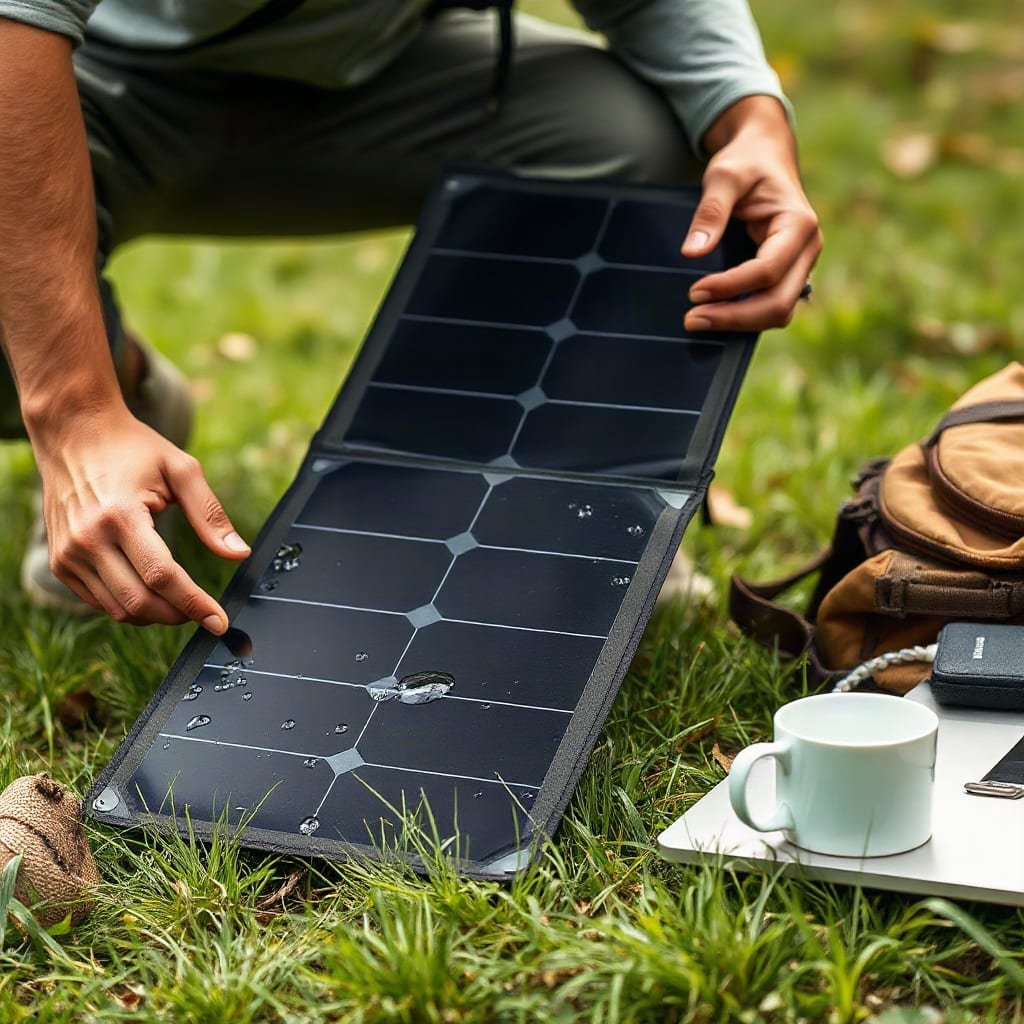
Leave a folding panel on a car dashboard and the cells bake past 80°C. Laminated cells and the solder joints behind them do not enjoy that, and output drops permanently. Store panels flat and out of direct sun when they are not in use.
Fold along the manufactured creases and never in between. A crease across a cell is a broken cell, and a broken cell in a series string drags the whole panel down. Most failures I have seen on trail are mechanical.
Water ratings on folding panels are usually modest. IPX4 handles rain and splashes from a kayak deck. Full immersion is a different claim, and you should confirm the IP code appears on the spec sheet before you trust it near a river.
Get a Panel and Bank That Keep Charging When the Sun Quits
Sunlight stops and starts, and phones are bad at handling that. The Ifory Portable Solar Panel, a 40W PD unit rated at 21.88V/2.19A, is built to feed a battery rather than haggle with a handset, and the 40,000mAh 100W power bank it pairs with holds the day's collection until you need it after dark. Order the bundle and the solar panel comes free, with free shipping and 30 days to send it back.
One limit worth knowing before you fly: 40,000mAh works out to roughly 148Wh, which sits above the 100Wh threshold most airlines use for carry-on without approval, so check the rules on power banks over 100Wh and confirm the dimensions and watt-hour figure on the spec sheet, ours included, against your airline's policy. Panel output also depends on aiming it, so budget the 30 seconds.
Frequently Asked Questions
Can I use solar to charge my phone directly?
You can, and it works poorly compared with charging a power bank first. A phone needs a steady current, and passing clouds interrupt it several times an hour, which stalls the charge or stops it entirely. A power bank absorbs the interruptions and hands the phone a clean, fast charge later.
Do solar car battery chargers really work?
They work as maintainers, not as recovery tools. A 10W panel returns roughly 2.5 to 3.3Ah a day at 12V, which offsets the drain from a car's clock, alarm and keyless entry during storage. Restoring a flat 60Ah battery would take weeks of perfect sun, so carry jump leads instead.
Can a 200 watt solar panel run a 12 volt refrigerator?
Through a charge controller and a battery, yes in decent summer sun. A 12V compressor fridge in the 50L class uses roughly 360 to 600Wh a day, and a 200W panel delivers 550 to 650Wh after realistic losses in a place with four peak sun hours. In a northern European winter it will not keep up.
What is the best portable solar charger for a phone?
A 21W folding monocrystalline panel with USB PD output is the sweet spot for most people: light enough to carry, fast enough to refill a 10,000mAh bank in a day. Buy at 40W if you also need to top up a laptop or a large power bank, and check the PD voltage profile rather than the wattage alone.
Why does my solar charger take all day to charge anything?
Because rated wattage assumes 1,000 W/m² and a 25°C cell, and a panel in the sun runs at 55 to 70°C. Heat and a bad angle typically cost you 40% of the number on the box before you factor in clouds. Aim the panel at the sun and re-aim it every hour to recover most of that.
Sources
- Lithium Batteries | Federal Aviation Administration
- IEC 60529: Degrees of protection provided by enclosures (IP Code) | International Electrotechnical Commission
- Solar Energy Technologies Office | U.S. Department of Energy