
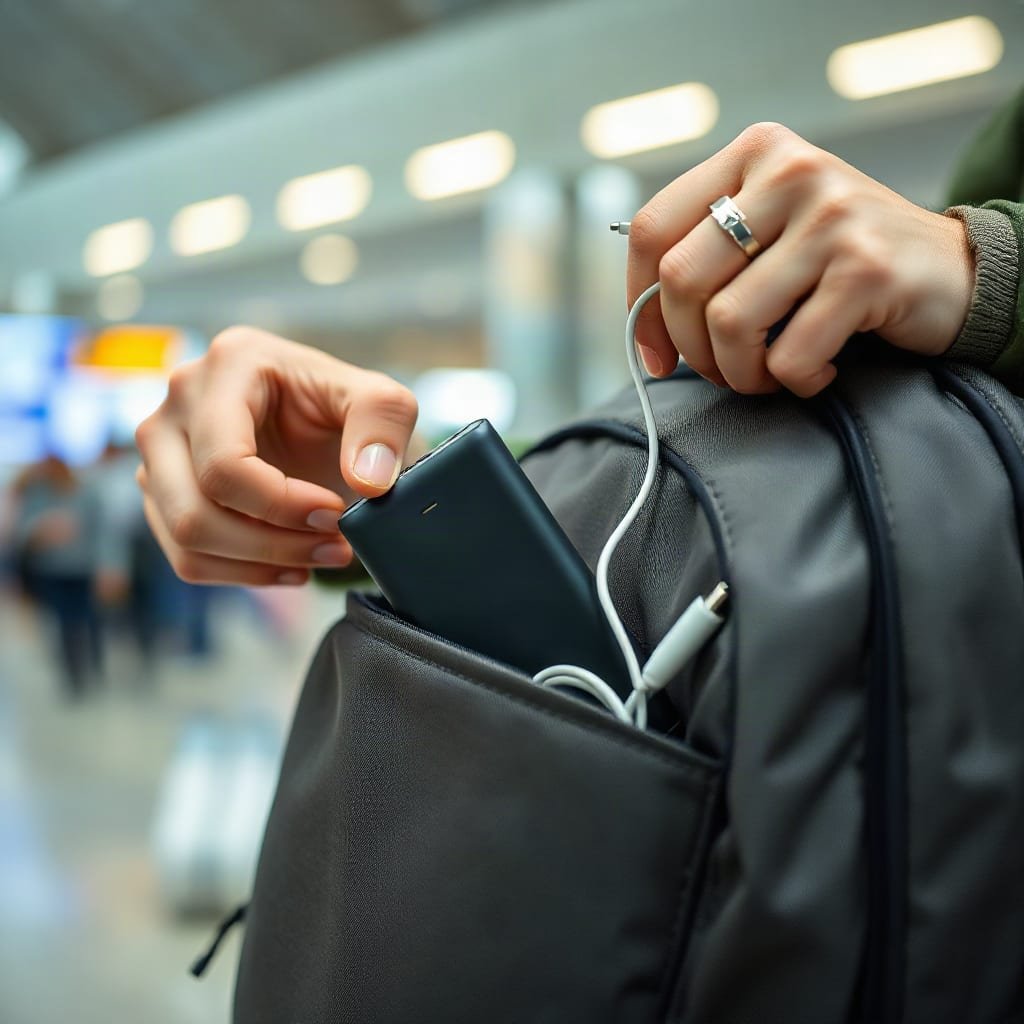
The best travel power bank is the biggest one your airline will let you carry, which on most flights means under 100 Wh, or roughly 27,000mAh. Watt-hours decide whether you can board with it, and USB-C output wattage decides whether it can charge your laptop. Pick 20,000mAh with 65W output for phone-and-laptop trips. Go to 40,000mAh only if you can get airline approval or you travel by land.
TL;DR:
- Convert mAh to watt-hours (mAh x 3.7 / 1,000). Airlines regulate Wh, and the 100 Wh line decides what you can carry without asking permission.
- A 20,000mAh bank (about 74 Wh) is the best pick for most flying travelers. It is the largest size that works for phones, tablets and a light laptop day.
- A 40,000mAh bank is about 148 Wh. That needs airline approval, and the airline can refuse it, so it suits road trips, camping and long remote-work stints better than flights.
- Output wattage matters as much as capacity. A laptop needs 45W to 100W, and a 100W bank only delivers that with a cable rated for it.
- "Waterproof" only means something when a bank lists an IP rating. IP67 is the tested standard, and splash-resistant is a lower level of protection.
Table of Contents
- Watt-Hours Decide Which Travel Power Bank You Can Fly With
- The 100 Wh Airline Line, and What Happens Above It
- How Much Capacity You Need: A Table From Phone-Only to Laptop Trips
- Output Wattage and Cables: Why a 100W Bank Sometimes Charges at 60W
- Best Travel Power Bank by Trip Type: Flights, Camping and Remote Work
- Waterproof and Lightweight Power Banks: What the Labels Actually Promise
- When the Outlet Never Comes: Pairing a Travel Power Bank With Solar
- Get 40,000mAh and 100W for Laptop Days Away From Any Outlet
- Frequently Asked Questions
- Sources
Watt-Hours Decide Which Travel Power Bank You Can Fly With
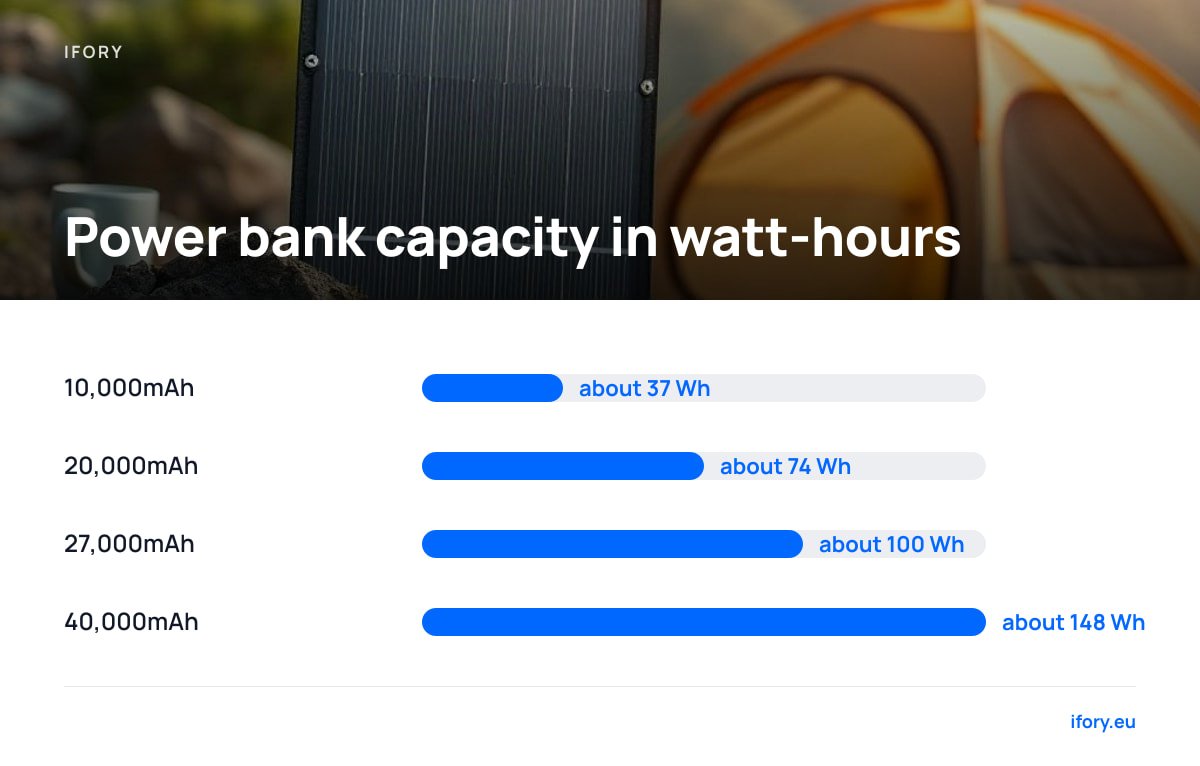
Capacity in mAh is a marketing number. It is measured at the cell's nominal voltage (usually 3.7V), so two banks both rated 20,000mAh can store different energy if their cell chemistry differs. Watt-hours (Wh) are the unit regulators use, and the math is simple: mAh x 3.7 / 1,000.
- 10,000mAh is about 37 Wh.
- 20,000mAh is about 74 Wh.
- 27,000mAh is about 100 Wh.
- 40,000mAh is about 148 Wh.
If a bank's label prints a Wh figure, trust that over your own math. If it prints only mAh, you will be doing the conversion at an airport gate, so do it at home first.
Actual delivered energy is lower than the label. Cells run at 3.7V, but your phone wants 5V to 9V and your laptop wants 20V, so the bank boosts voltage and loses some energy as heat. Assume 65 to 75 percent of rated capacity reaches your device.
The 100 Wh Airline Line, and What Happens Above It
The FAA's PackSafe guidance says spare lithium-ion batteries, which includes power banks, must go in carry-on baggage and never in checked bags. Batteries up to 100 Wh need no special approval. Batteries between 100 and 160 Wh need airline approval, and you are limited to two. Above 160 Wh, they stay home. Most carriers worldwide follow the same thresholds because they come from the international dangerous goods rules. Our guide on why a power bank can't go in checked luggage covers the reasoning and what happens at security if you get it wrong.
148 Wh. That is what a 40,000mAh pack works out to at a standard 3.7V, which lands in the 100 to 160 Wh band where you need the airline's permission before you board.
Two practical points follow. First, approval is at the airline's discretion, so get it in writing (an email is fine) before you travel, not at the check-in desk. Second, some carriers now restrict using a power bank in flight even when carrying one is allowed, so check your airline's policy for the plane itself as well as the terminal.
Every legitimate bank should also have passed UN 38.3 testing, the transport test required for lithium batteries under the UN's dangerous goods framework. It includes altitude simulation, vibration, shock and short-circuit tests. A bank with no certification information anywhere on its listing is a bad sign, whatever the price.
How Much Capacity You Need: A Table From Phone-Only to Laptop Trips
The table assumes about 70 percent of rated energy reaches your device, a phone battery around 15 Wh and a 13-inch laptop battery around 50 Wh.
| Bank size | Approx. Wh | Phone charges | Laptop charges | Flight status |
|---|---|---|---|---|
| 10,000mAh | 37 | 1 to 2 | Under 1 | Carry-on, no approval |
| 20,000mAh | 74 | 3 to 4 | About 1 | Carry-on, no approval |
| 27,000mAh | 100 | 4 to 5 | About 1.5 | Right at the limit |
| 40,000mAh | 148 | 6 to 7 | About 2 | Airline approval, max two |
My pick for most people is 20,000mAh. It covers a long weekend of phone and earbud charging, rescues a laptop once, and still counts as a lightweight power bank. Most 20,000mAh packs weigh 350 to 450 grams, which you will notice in a day bag but not resent. A 10,000mAh bank is fine for a phone-only city break, but a single laptop charge eats the whole thing.
Go bigger when you have a specific reason. Two laptop charges a day, a handheld console and a phone is a 40,000mAh job, and packs of that size weigh well over 700 grams. If you game on the road, our guide to charging a Nintendo Switch away from the dock shows which wattage that actually requires.
Output Wattage and Cables: Why a 100W Bank Sometimes Charges at 60W
Laptops are picky. A thin-and-light ultrabook is happy at 45W to 65W. A performance laptop or a 16-inch machine wants 90W to 100W. If the bank's top USB-C port delivers less than your laptop's charger does, the laptop will either charge slowly or drain while you work.
The cable matters too. Under the USB Implementers Forum's Power Delivery specification, anything above 60W (3A at 20V) needs a cable rated for 5A with an electronic marker chip inside. A plain USB-C cable limits you to 60W without any warning. The bank works, the laptop charges, and you wonder why it is slow.
Pro Tip: Test your bank-and-cable pair with the laptop's battery under 50 percent before the trip. Plug in, open your laptop's battery settings and look at the charging wattage. If it reads around 60W on a 100W bank, your cable is the limit. Swap in a 5A e-marked cable and watch it climb. Do this at home, not at a coworking space on day one.
Also check how many ports can run at full power together. Many banks split their output when two ports are in use, so a 100W bank might give you 65W and 30W instead of 100W plus whatever else you plug in.
Best Travel Power Bank by Trip Type: Flights, Camping and Remote Work
International flights and city trips
A power bank has no voltage setting, so it does not care which country you are in. The wall charger you use to refill it does. Look for 100V to 240V on your charger's label, then bring the right plug adapter (Type C or F across most of the EU, Type G in the UK). A 20,000mAh bank with 45W to 65W output, charged the night before, is the right answer for phone and tablet days abroad.
Camping and hiking
Cold is the problem here. Most lithium-ion cells are specified to charge between roughly 0°C and 45°C, and they lose usable capacity below freezing. Keep the bank inside your jacket or sleeping bag overnight, and charge it only once it has warmed up. If you are out for three days or more, a bank with 30,000mAh or more plus a solar panel beats carrying a second bank.
Remote work and nomad stints
A big bank earns its weight here. If your workday is a laptop, a phone and a hotspot, and your power source is unreliable, 40,000mAh at 100W gives you roughly two full laptop charges plus phone top-ups. If you also use a magnetic phone or laptop accessory, our look at real charge counts for magnetic power banks shows where those compact packs fall short.
Waterproof and Lightweight Power Banks: What the Labels Actually Promise
"Waterproof" on a product page is not a standard. The measurable version is an IP rating. Under IEC 60529, the second digit grades water protection, and 7 means immersion.
1 meter, 30 minutes. That is the entire scope of the IP67 immersion test as defined by IEC 60529.
So IP67 will survive a dunk in a stream or a downpour, but it is not a diving rating, and it only holds while the port covers are closed. IPX4 means splash-proof, which handles drizzle and not a puddle. If the listing says "waterproof" and shows no IP code, assume splash resistance and check the spec sheet.
Weight is a trade-off you cannot design away. Lithium-ion packs hold roughly the same energy per gram regardless of brand, so a lightweight 20,000mAh pack at 350 grams is light because it is small. A rugged shell with rubberized corners and sealed ports adds weight. Pick the lighter one for flights and city trips, and the tougher one for trips where it will get dropped, rained on or kicked around a tent.
When the Outlet Never Comes: Pairing a Travel Power Bank With Solar
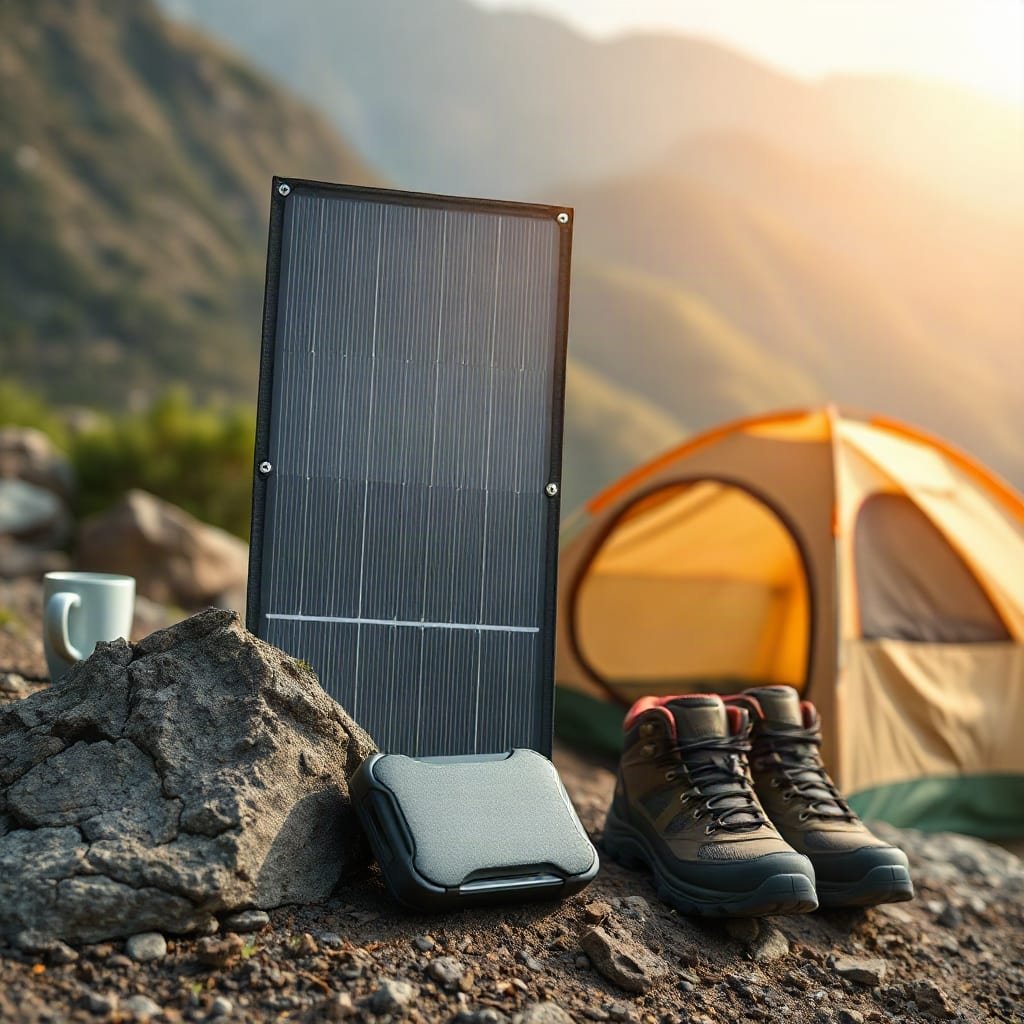
A bank stores energy and cannot make any. Over a week of camping or a long overland stretch, you either carry enough capacity for the whole trip or you refill it with a panel. A 40W panel in direct, high sun gives you realistically 20W to 28W after angle and cloud losses, so refilling a 148 Wh bank takes roughly 6 to 8 hours of strong sun.
Solar is slow, panels need to face the sun, and a cloudy day cuts output by more than half. Use it to top up and extend your trip, not to run a laptop in real time. Our solar panel phone charger breakdown shows what different panel sizes deliver in sunlight, and the solar panel kit buying guide covers sizes and prices if you want a bigger setup.
Get 40,000mAh and 100W for Laptop Days Away From Any Outlet
If you work from a laptop and your trips are more van, hut or campsite than airport lounge, Ifory's 40000mAh 100W Power Bank is built for that gap. It runs a laptop at full speed, handles phones, tablets and handheld consoles, and has a rugged build for off-grid trips. It pairs with the Portable Solar Panel (PD 40W, 21.88V/2.19A) for recharging without a socket, and the bundle currently comes with a free solar panel promotion. Shipping is free in the EU and returns run 30 days. See the product page for current pricing.
The limit: a 40,000mAh pack calculates to roughly 148 Wh, so it sits in the 100 to 160 Wh band that needs airline approval. If you fly more than you travel overland, a 20,000mAh bank is the easier choice. Check the Wh figure on the spec sheet, and get approval from your carrier in writing before you book around it.
Frequently Asked Questions
How many mAh is the best travel power bank?
For most travelers, 20,000mAh (about 74 Wh) is the best balance of weight and capacity, and it travels without airline approval. Go to 27,000mAh for the largest size that stays under the 100 Wh limit. Above that you are into airline-approval territory.
Can I take a 40,000mAh power bank on a plane?
A 40,000mAh bank is about 148 Wh, which falls between 100 and 160 Wh. Under FAA guidance and the international rules most airlines follow, that requires airline approval, and you can carry at most two. Ask your airline before you fly and keep the confirmation with you.
Do I need a special power bank for international travel?
No. A power bank works in any country because it charges devices over USB. What changes is the wall charger you use to refill it, which should say 100V to 240V on its label, plus a plug adapter for the local sockets.
Is a waterproof power bank worth it?
It is worth it for camping, boating, diving trips or monsoon-season travel, as long as it lists a real IP rating such as IP67. If a product only says "waterproof" with no IP code, treat it as splash-resistant at best.
Why is my power bank charging my laptop so slowly?
Usually the cable or the port. Charging above 60W needs a 5A e-marked USB-C cable, and many banks split their output when two ports are active. Use one port, a rated cable and a bank whose USB-C output matches your laptop's original charger.
Sources
- Lithium Batteries (PackSafe) | Federal Aviation Administration
- IP Ratings (IEC 60529) | International Electrotechnical Commission
- USB Power Delivery | USB Implementers Forum
- Transport of Dangerous Goods | United Nations Economic Commission for Europe