
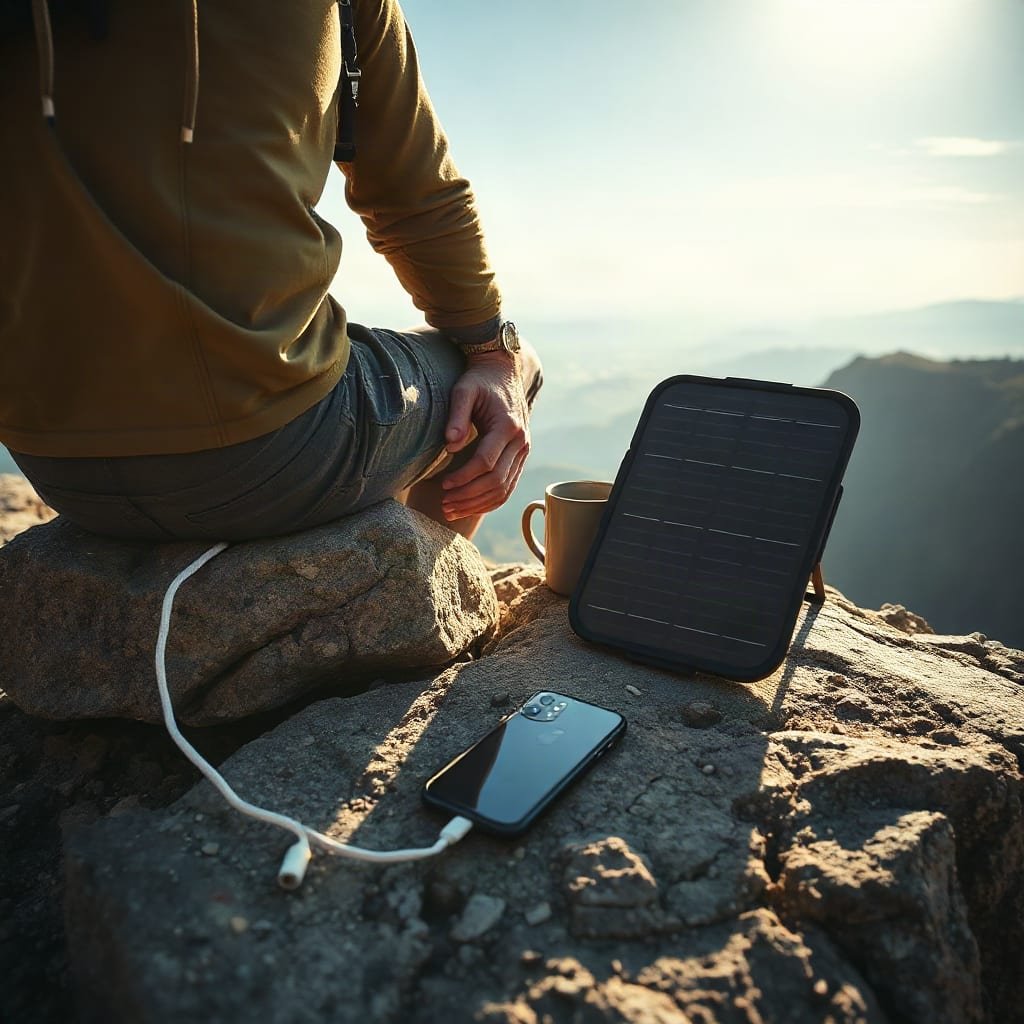
Solar power for charging phones works well when you pair a panel of at least 20W with a power bank, and poorly when you plug a tiny panel straight into your phone. A phone battery holds roughly 12 to 19 Wh, so a 5W panel needs most of a sunny day to fill it, while a 40W panel can do it in under an hour. Clouds, heat and panel angle decide the rest.
TL;DR:
- A phone needs about 20 Wh from the panel to charge from empty once, after conversion losses. Size your panel against that number.
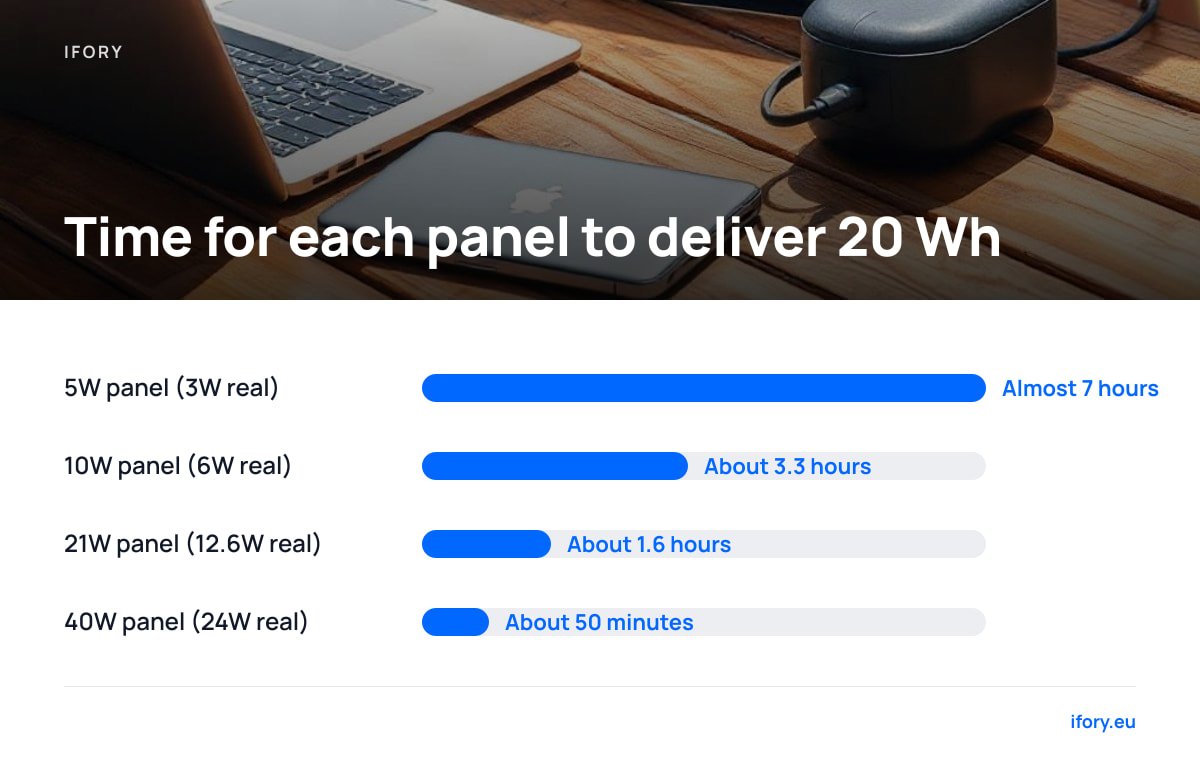
- Plan on a panel delivering about 60% of its label rating. A 40W panel in good sun gives you roughly 24W, or one phone in 50 minutes.
- Power banks with a built-in solar cell are the wrong tool. At about 0.5W, an 8,000mAh bank takes around 59 hours of full sun to fill.
- Charge a power bank with the panel, then charge the phone from the bank. Direct panel-to-phone charging stops and restarts whenever a cloud passes.
- Expect to pay about €15 to €40 for a 5 to 10W panel and €80 to €160 for 40W or more.
Table of Contents
- Solar Power for Charging Phones Starts With One Number: Watt-Hours
- What Size Solar Panel Do You Need to Charge a Cell Phone?
- Why Built-In Solar Power Banks Fail, and What to Buy Instead
- How to Charge a Solar Portable Charger Without Wasting the Sun
- Heat, Clouds and Angle: What Cuts Your Output in Half
- The Best Solar Setup for a Phone and a Laptop Together
- How Much Is a Solar Charger for a Phone?
- Get a Solar Rig That Fills a Phone in About an Hour
- Frequently Asked Questions
- Sources
Solar Power for Charging Phones Starts With One Number: Watt-Hours
Every solar charging question comes down to energy in versus energy out, measured in watt-hours (Wh). A modern phone battery holds between 12 and 19 Wh. A 4,500mAh phone cell at a nominal 3.85V is about 17 Wh. If you want the full conversion math for power banks, our mAh and Wh capacity guide walks through it.
Charging is not lossless. Energy goes through the panel's regulator, sometimes a power bank's boost circuit, and then the phone's own charger. Assume about 75% of what the panel produces reaches the battery. For a 15 Wh phone, the panel must supply about 20 Wh to take it from empty to full.
That 20 Wh figure is the yardstick for everything below. Panel size, sun hours and cost all follow from it.
What Size Solar Panel Do You Need to Charge a Cell Phone?
You need a panel rated at 20W or more if you want a phone to fill in under two hours of decent sun. A 10W panel does the job in an afternoon, and a 5W panel is an emergency measure.
Panel ratings are measured under lab conditions: 1,000 W/m² of sunlight at a cell temperature of 25°C. Your backpack in a real field will not match that. A hand-aimed foldable panel typically delivers around 60% of its label rating, and I use that number in the table below. NREL's PVWatts calculator models fixed, well-aimed rooftop systems and still assumes about 14% in default system losses. A panel you reposition by hand loses more.
| Panel rating | Realistic output (about 60%) | Time to deliver 20 Wh | Best use |
|---|---|---|---|
| 5W | 3W | Almost 7 hours | Emergency top-up only |
| 10W | 6W | About 3.3 hours | One phone per sunny day |
| 21W | 12.6W | About 1.6 hours | One or two phones, a tablet |
| 40W | 24W | About 50 minutes | Phones plus a power bank |
To size a panel for your own trip, divide 20 Wh by your daily sun hours times 0.6. With 3 equivalent full-sun hours, you need about 11W. With only 1 hour, as in northern Europe in December, you need about 33W. The European Commission's PVGIS tool lets you enter a location and read monthly irradiation, so you can check this before you leave. Summer in the Mediterranean gives you several times what a Scandinavian winter does.
My pick: buy the 40W class even if you only carry phones. The extra headroom keeps you charging when the sky goes hazy.
Why Built-In Solar Power Banks Fail, and What to Buy Instead
A power bank with a small solar cell on its face looks like the perfect survival gadget. It isn't. The cell is roughly the size of the bank, and a surface that small cannot collect meaningful energy.
Assume an optimistic 0.5W of real output. An 8,000mAh bank holds about 30 Wh, so filling it takes about 59 hours of full sun.
At 0.5W, filling an 8,000mAh bank from its built-in solar cell takes about 59 hours of full sun.
Those banks do have a use: the little cell trickles in a few percent over a week on a dashboard, which beats nothing. Charge them from a wall or a real panel, and treat the built-in cell as a backup of last resort.
The better setup is two separate pieces. A foldable panel collects and a power bank stores. You can angle the panel at the sun while the bank stays in the shade, and you can upgrade either one independently. Our guide to what actually works in real sun covers the field test results in more detail.
How to Charge a Solar Portable Charger Without Wasting the Sun
To charge a solar power bank, connect the panel's USB-C or USB-A output to the bank's input port, then point the panel at the sun. Check the bank's indicator light a few minutes in to confirm it is receiving power.
- Aim at the sun, not the sky. Face the panel so sunlight hits it at a right angle. Re-aim every 60 to 90 minutes as the sun moves.
- Keep the panel flat and unshaded. A shadow over one cell can drop a foldable panel's output sharply.
- Use a short, thick cable. Long, thin cables lose voltage at 2A and above.
- Keep the bank in the shade. Lithium cells charge poorly and age faster when hot.
- Check the indicator. If the light flickers on and off, the panel is dropping below the bank's minimum input. Wait for clearer sky or tilt the panel.
A 40,000mAh bank holds about 148 Wh at the standard 3.7V cell rating. At 24W of real output and with conversion losses, that is roughly 7 hours of strong sun to fill from empty. In summer that is a day or two of travel. In a European winter it can be four or five days. Keep that in mind when you plan the trip.
Pro Tip: Do not plug your phone straight into the panel. Phones begin and end charging sessions every time the incoming current dips, and each restart wastes energy and can leave the battery at 40% after a full day. Charge a bank with the panel during daylight, then charge the phone from the bank in the evening, in the shade.
Heat, Clouds and Angle: What Cuts Your Output in Half
Three things cost you most of your lost output, and you can control two of them.
Heat
Solar cells produce less at higher temperatures, and phones dislike heat even more. Apple lists 35°C (95°F) as the upper end of the comfortable ambient range for iPhone and warns that higher temperatures can permanently reduce battery capacity.
Apple puts the top of iPhone's comfortable ambient range at 35°C (95°F), and a phone resting on sun-baked rock passes that easily.
Leave the phone in your pack while the panel works. Never charge it under the same sun that is feeding the panel.
Clouds
Overcast skies commonly drop solar output to between 10% and 25% of clear-sky levels. A 40W panel under thick cloud may deliver 4 to 10W, which still trickles energy into a bank but will not fill a phone quickly. This is why the buffer bank matters.
Angle and water
A panel lying flat at noon in summer does fine. In autumn or winter, tilt it toward the sun or output drops quickly. For rain, check the ingress protection code. The IEC 60529 standard defines it, and the second digit covers water. IPX4 handles splashes. IP67 survives immersion to 1 meter for 30 minutes. Ask which part of the panel carries the rating, because the fabric, the junction box and the USB port may differ.
The Best Solar Setup for a Phone and a Laptop Together
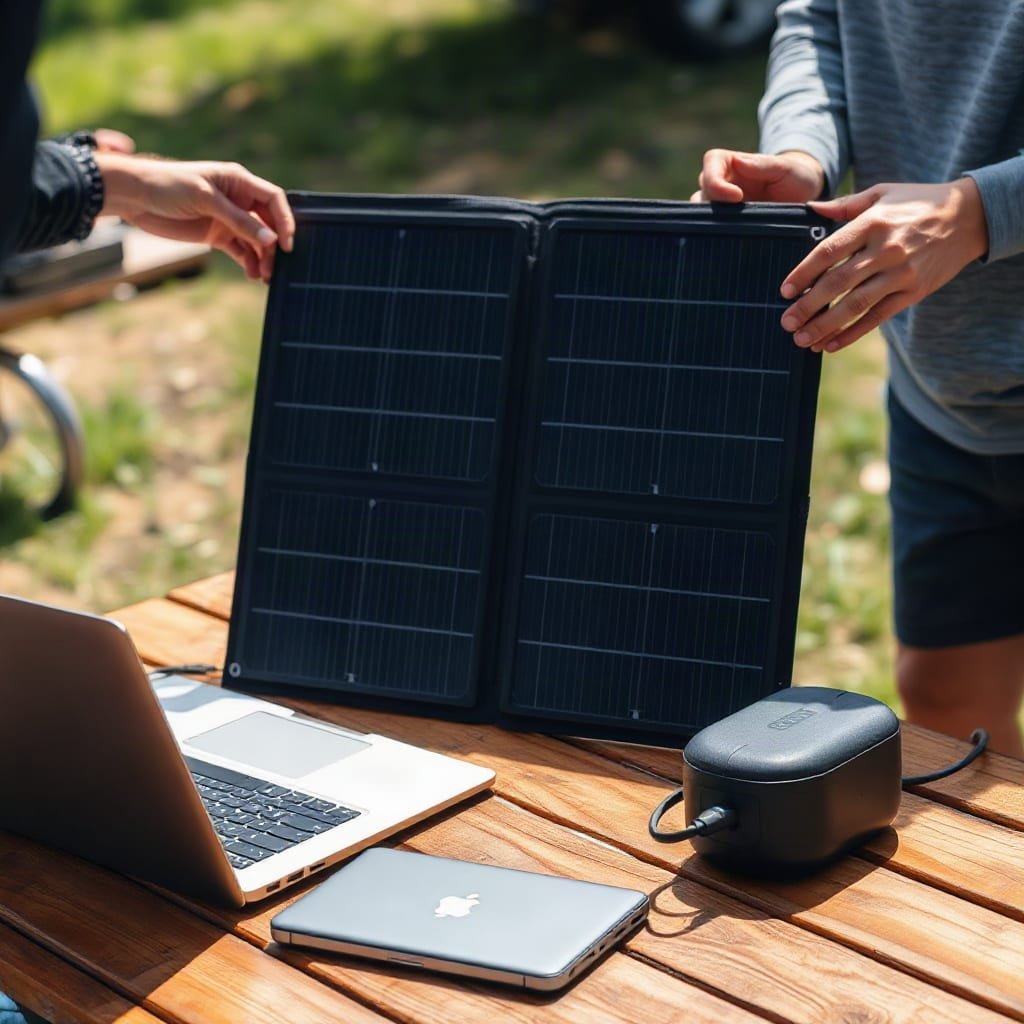
For charging a phone and a laptop from sun, use a 40W panel feeding a bank that outputs 100W over USB-C. The panel cannot run a laptop directly, because ultrabooks typically pull 30 to 65W while charging. The bank stores energy while you work and delivers the burst the laptop needs.
Phone and laptop
Plug the panel into the bank in the morning, work from the shade, and plug the laptop into the bank's USB-C port. For wattage details and the rules for flying with batteries, see our laptop power bank guide. A bank that is too small will not charge your laptop at all, so check that its USB-C port reaches the wattage your charger needs.
iPhone
You do not need an iPhone-specific solar charger. Any panel with a standard USB output works, and iPhones that support fast charging need a USB-C Power Delivery output at 20W or above to use it. Use a certified cable and keep the phone out of direct sun.
Survival kits and home blackouts
A 40,000mAh bank gives you about seven full phone charges (148 Wh × 0.75 ÷ 15 Wh). That covers one person for a week with a panel for top-ups. A household of four will burn through it in two days without help. For longer outages, the panel matters more than the bank, because without it capacity is all you have.
How Much Is a Solar Charger for a Phone?
A solar phone charger costs roughly €15 to €40 for a small 5 to 10W panel, and €80 to €160 for a 40W panel or larger. Prices vary by retailer and change often, so treat these as ballpark figures for the European market.
| Tier | Typical rating | Rough price | What you get |
|---|---|---|---|
| Entry foldable | 5 to 10W | €15 to €40 | One slow phone charge per day |
| Mid foldable | 20 to 30W | €40 to €90 | Phone plus tablet, or a half-filled bank |
| High-output foldable | 40W and up | €80 to €160 | Bank refills and laptop top-ups |
| Solar power bank (built-in cell) | under 1W | €20 to €50 | Backup only, not a primary charger |
The price per watt drops as panels get bigger. A 40W panel usually costs less than twice a 20W one. If you are building a kit from scratch, our solar power phone charger guide lists what to check on a spec sheet.
Get a Solar Rig That Fills a Phone in About an Hour
The problems here are small panels, slow charging and no way to keep working while the sun does its job. Ifory sells a 40,000mAh, 100W fast-charging power bank and a companion 40W portable solar panel (PD output, 21.88V/2.19A) designed to work together. In strong sun, the panel can put one phone's worth of energy into the bank in under an hour, and the bank can then charge a phone, tablet or laptop at up to 100W. The bundle often includes the solar panel free, and shipping is free with a 30-day return window. Check the product page for the current price.
The limit is time. At about 148 Wh, the bank takes roughly 7 hours of strong sun to refill from empty, and much longer in a northern European winter. Also, 148 Wh is above the 100 Wh limit most airlines apply by default to power banks, so confirm your airline's rules before you fly. Our travel power bank guide covers those limits.
Frequently Asked Questions
What size solar panel do I need to charge a cell phone?
A 20W panel is a good minimum, because it fills a typical phone in about 1.6 hours of decent sun. A 10W panel works if you can wait a few hours, and a 5W panel takes almost 7 hours. To size it for your location, divide 20 Wh by your daily sun hours times 0.6.
What is the best solar charger for both my laptop and phone?
Pair a 40W foldable panel with a power bank that outputs 100W over USB-C. The panel fills the bank in daylight and the bank delivers the 30 to 65W a laptop needs. Charging a laptop directly from a 40W panel works poorly, because output drops below the laptop's demand whenever the sun dims.
How to charge a solar portable charger?
Plug the panel's USB output into the power bank's input port and aim the panel directly at the sun. Keep the bank in the shade, use a short cable, and re-aim the panel every 60 to 90 minutes. A 40,000mAh bank takes roughly 7 hours of strong sun to fill from empty with a 40W panel.
How much is a solar charger for a phone?
Small 5 to 10W foldable panels run about €15 to €40 in Europe. A 40W panel or larger usually costs between €80 and €160. Power banks with a built-in solar cell cost €20 to €50, but the cell is too small to charge them in any practical time.
Can I charge an iPhone with solar power?
Yes. Any panel with a standard USB output works, and a USB-C Power Delivery output at 20W or above lets supported iPhones fast charge. Keep the phone out of direct sun, since Apple lists 35°C (95°F) as the top of the comfortable ambient range.
Sources
- PVGIS: Photovoltaic Geographical Information System | European Commission Joint Research Centre
- Maximizing Battery Performance | Apple
- IP Ratings (IEC 60529) | International Electrotechnical Commission