
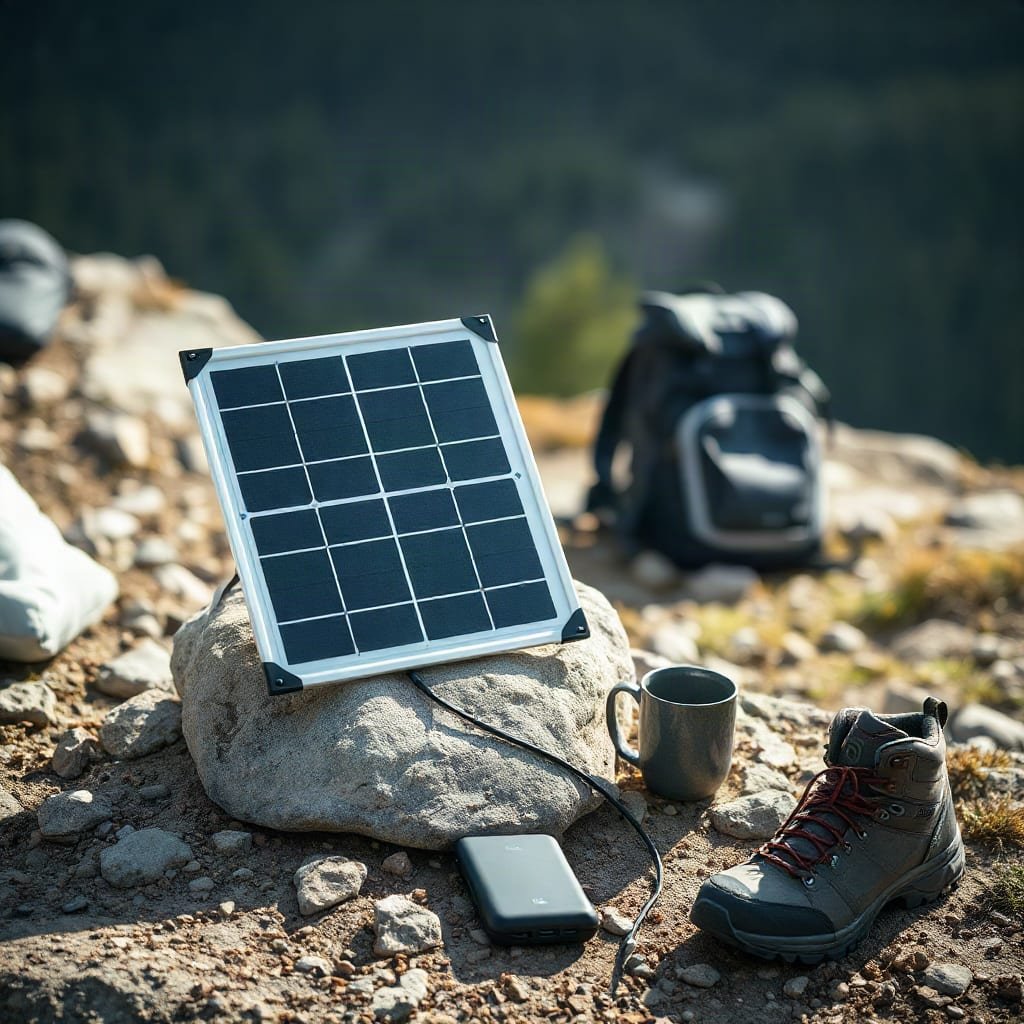
A USB-C solar charger works, but only if the panel is big enough for what you plug in: a 5W panel takes about five hours of clean sun to fill a phone, while a 40W panel can refill a laptop in an afternoon. The USB-C plug says nothing about power. Wattage, Power Delivery support and whether you charge through a power bank decide if you get a full battery or a warm cable.
TL;DR:
- Solar chargers work, but real output in good sun is roughly half to two-thirds of the label wattage, so size up.
- A 5W panel fills a phone in about 5 hours; a 40W panel handles laptops, tablets and consoles in an afternoon.
- Built-in panels on power banks are too small to matter. A 2W panel needs about 34 sunny days to fill a 169Wh bank.
- Feed the panel into a power bank, not straight into your device. The bank smooths out clouds and passing shade.
- You can build a basic 5V solar charger from a panel and a buck converter, but it will never deliver 100W fast charging.
Table of Contents
- Do USB-C Solar Chargers Work? Yes, at the Wattage You Pay For
- What the Label Says vs. What You Get at 2 p.m.
- Why a Built-In Panel on a Power Bank Is the Wrong Idea
- USB-C Solar Charger Setups That Work: Panel, Bank, Device
- How to Make a USB-C Solar Charger From a Panel at Home
- Best Portable Solar Phone Chargers and Solar Power Banks, by Use Case
- Flying and Crossing Borders With a Solar Kit
- Get a 100W Power Bank and 40W Solar Panel That Refill Each Other
- Frequently Asked Questions
- Sources
Do USB-C Solar Chargers Work? Yes, at the Wattage You Pay For
Solar power chargers work. The physics is sound, but the marketing oversells it. A panel turns sunlight into DC electricity, a regulator trims it to a safe voltage, and your device or power bank accepts it. People get let down when they expect a pocket-sized panel to behave like a wall outlet.
The wall charger that came with your phone probably delivers 20W to 30W. A 5W solar panel is a sixth of that on a perfect day. If you have left a small panel on a backpack and come home to a phone at 12 percent, the panel did its job. It was undersized for the task.
Our guide to what actually works in real sun covers field results in more detail. The short version: wattage, sun angle and buffering matter far more than the connector shape.
What the Label Says vs. What You Get at 2 p.m.
Panel ratings are measured in a lab at 1,000 W/m² of light and a 25°C cell temperature. A July afternoon on a Greek ridge is hotter than that, and a September morning in Bavaria is dimmer. Expect roughly half to two-thirds of the label wattage in decent direct sun, and well under a third under haze or thin cloud.
Here is what that means for charging time, using a 15Wh phone battery and a 60Wh laptop battery. These figures are before conversion losses, so add 15 to 25 percent.
| Panel class | Label | Realistic in direct sun | Phone 0 to 100% | Laptop 0 to 100% |
|---|---|---|---|---|
| Pocket panel | 5W | 2.5 to 3.5W | about 5 hours | not practical |
| Mid foldable | 20W | 10 to 14W | about 1.2 hours | about 5 hours |
| Large foldable | 40W | 20 to 28W | about 40 minutes | about 2.5 hours |
Location shifts all of this. The World Bank Group's Global Solar Atlas lets you check the solar resource for any spot on Earth, and the gap inside Europe is large: Andalusia collects close to twice the annual solar energy of central Sweden. Size your panel for the sky you will actually be under.
A 40W panel at 60 percent efficiency gives you about 24W, enough to refill a 15Wh phone battery in roughly 40 minutes of direct sun.
For more on matching panel size to device, see what size panel you need for phones.
Why a Built-In Panel on a Power Bank Is the Wrong Idea
The obvious pick for a lazy hiker is a big power bank with a solar panel glued to its back. It is also the one most likely to disappoint. The panel on those units is roughly phone-sized, so it delivers around 1 to 2W in strong sun.
Take a 45,000mAh-class bank, which holds about 169Wh. A 2W panel delivering 1W effective for 5 hours a day adds 5Wh. Filling the bank from empty takes about 34 days of flawless weather.
A 2W built-in panel needs roughly 34 sunny days to fill a 169Wh power bank.
Those units work as an emergency trickle, and they make a decent torch. As a recharging plan they fail. A separate foldable panel that you can aim at the sun while the bank sits in the shade beats them every time.
USB-C Solar Charger Setups That Work: Panel, Bank, Device
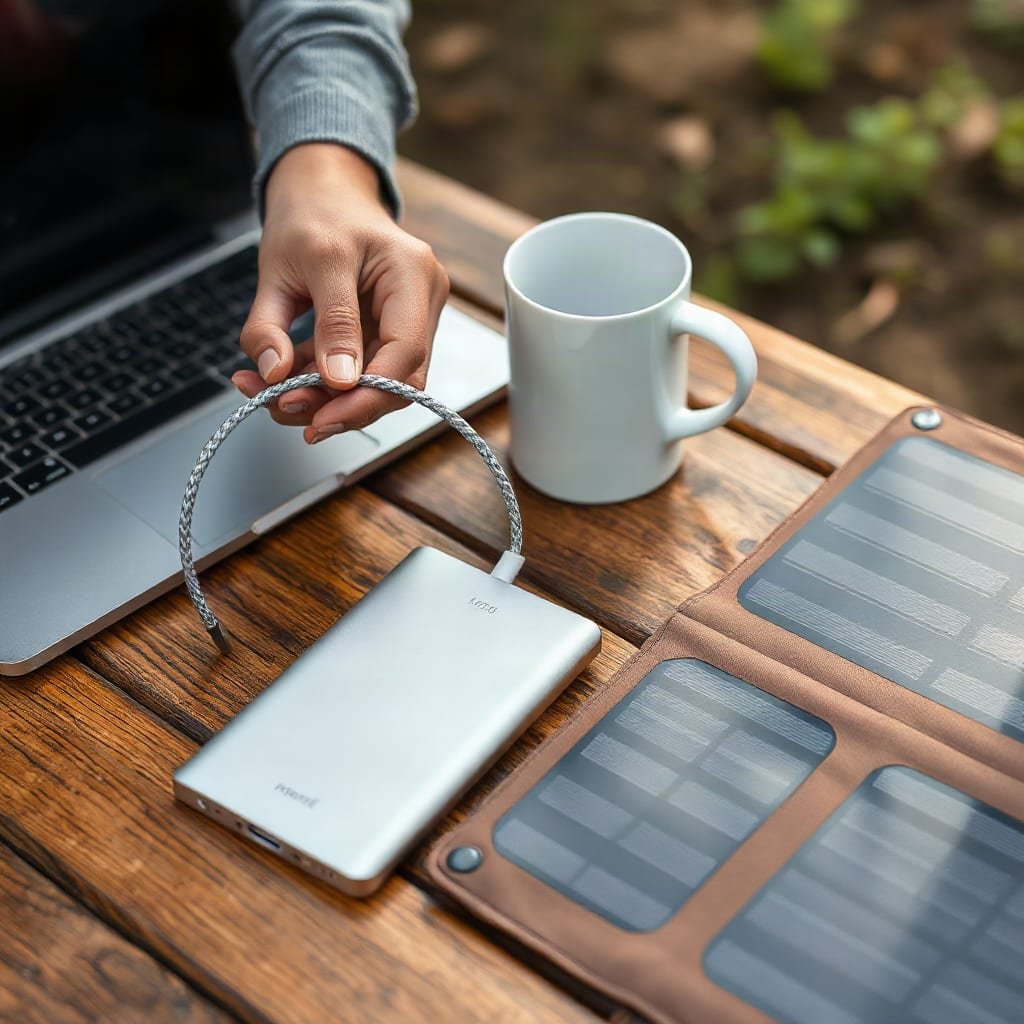
The setup that holds up in the field has three links: panel, power bank, device. Plugging a phone straight into a panel sounds efficient, but clouds make the voltage dip, the phone drops the charge session, and some phones take a minute to restart it. A power bank in the middle absorbs those swings.
Check Power Delivery, Not the Connector
A USB-C port can be 5V only. The USB Implementers Forum defines USB Power Delivery up to 100W (20V at 5A) in its standard range, and that level needs a cable rated for 5A. If a panel advertises USB-C but only lists 5V, it will charge a phone slowly and will not charge a laptop at all. Look for a PD figure on the panel itself, such as PD 40W.
Match the Bank's Input to the Panel
Most big power banks accept less input power than they can output. A bank that outputs 100W might take only 60W to 65W in. That ceiling is fine for solar, since a portable panel will not get near it, but check that the bank accepts the panel's voltage window. If the panel's voltage falls below what the bank wants, charging stops.
Pro Tip: Put the panel in the sun and the power bank in the shade. Lithium cells charge poorly and age faster when hot, and a bank sitting on a black tent roof in July can pass 50°C. Clip the panel to a rock or pack, run a 1 meter cable, and tuck the bank under a jacket. Also re-aim the panel every hour: output drops sharply when sunlight hits at a slant.
How to Make a USB-C Solar Charger From a Panel at Home
You can build a basic one in about 20 minutes. It is a 5V trickle charger for phones and power banks, not a fast charger. It makes a reasonable weekend project and shows how the pieces fit.
You need a 6V to 9V panel rated 3W to 6W, a buck converter module with a USB output (rated for an input at least 25 percent above the panel's open-circuit voltage), a Schottky diode, two short wires, and a USB meter to confirm the numbers.
- Wire the panel through the diode. Put the diode on the positive lead so current cannot flow backward at night.
- Connect to the converter's input terminals. Match polarity carefully; reversed wires can destroy the module.
- Set the output to 5V. Use the USB meter, not a guess.
- Plug a power bank into the USB port. Do not connect your phone first, since the bank tolerates fluctuating input better.
- Test in full sun. A working build shows 0.3A to 0.8A on the meter for a 3W to 6W panel.
The limits: no Power Delivery, no weatherproofing unless you add it, and output that falls fast in clouds. If you want to charge a laptop or a console, buy a purpose-built PD panel.
Best Portable Solar Phone Chargers and Solar Power Banks, by Use Case
"Best" depends on what you carry and for how long. These are the three setups I would pick.
Day Hikes and Festivals: Skip the Panel
On a day trip, a panel adds weight and fiddling for a gain you will not notice. Carry a fully charged power bank. A 10,000mAh bank (about 37Wh) charges a modern phone two to three times. Panels earn their place once you are away from mains for more than two nights.
Weekend Camping and Road Trips: A 20W to 30W PD Foldable Plus a Mid-Size Bank
This is the sweet spot for phones, a tablet, a headlamp and a camera. A 20W panel gives about 10W to 14W in good sun, which tops up a phone in a little over an hour. Pair it with a 20,000mAh bank (about 74Wh).
Multi-Day Trips With a Laptop: A 40W Panel and a Large Bank
If you work from a van or a hut, or run a handheld console, a laptop and a drone, pick the 40W panel and a 40,000mAh bank with 100W output. That bank stores about 148Wh, which is two to three laptop charges. The panel refills it over a day or two. For laptop details, see our laptop power bank guide.
The best solar power bank for portable use is therefore a high-capacity bank paired with a separate panel. A bank with a built-in panel is a backup, not a system.
Flying and Crossing Borders With a Solar Kit
A 40,000mAh pack holds about 148Wh (40Ah at 3.7V). IATA's lithium battery guidance allows passengers to carry spare batteries up to 100Wh in carry-on without airline approval, and 101 to 160Wh with approval, up to two spares. So a 148Wh bank flies, but only with airline sign-off, and only in your cabin bag.
148Wh sits inside the 101 to 160Wh band that airlines must approve before you board.
The panel is not a battery, so it needs no approval. Pack it with the bank in your hand luggage, and keep the airline's confirmation message ready. Our post on flying with a 40,000mAh power bank walks through the steps.
On the EU side, Directive (EU) 2022/2380 made USB-C the common charging port for many portable devices, so a USB-C panel and bank will fit most of what you carry.
Get a 100W Power Bank and 40W Solar Panel That Refill Each Other
If you read the sections above and thought "I want the 40W panel and the big bank, tested together," that is what Ifory built. The Ifory 40000mAh 100W Power Bank is rugged enough for tents and boats, and charges a laptop, phone and console from one pack. The Portable Solar Panel (PD 40W, 21.88V/2.19A) feeds it. The bundle includes the panel free during the current promotion, and shipping is free with 30-day returns.
One caveat: this is a laptop and multi-day setup, and it weighs more than a pocket panel and a small bank. Real solar output will be around half to two-thirds of 40W in good sun, so a full refill of a 148Wh bank takes one to two clear days. Check the spec sheet for input voltage and the airline rules before you fly.
Frequently Asked Questions
Do solar power chargers work?
Yes, as long as the panel's wattage suits the device. A 5W panel fills a phone in about five hours of direct sun, while a 40W panel can charge a laptop in an afternoon. Cloud and haze can cut output by half or more.
What is the best solar power bank for portable use?
A separate foldable panel paired with a high-capacity power bank beats a bank with a built-in panel. Built-in panels deliver only 1 to 2W, so filling a 169Wh bank would take about 34 sunny days. For laptops, look for 100W output and a bank around 148Wh.
How to make a mobile charger using a solar panel?
Connect a 6V to 9V panel through a Schottky diode to a buck converter set to 5V with a USB output, then plug a power bank into it. Confirm voltage with a USB meter before connecting anything valuable. This gives a slow 5V charge and no fast charging.
What are the best portable solar phone chargers?
For phones, a foldable panel in the 20W to 30W range with USB-C Power Delivery is the best balance of weight and speed. A 5W pocket panel works but is slow. For laptops or multi-day trips, step up to a 40W panel.
Can I charge a laptop with a USB-C solar charger?
Yes, if the panel supports Power Delivery at a high enough wattage, such as 40W, and the laptop accepts USB-C charging. A power bank between the panel and laptop smooths out changing sunlight. Expect 2 to 3 hours of good sun for a full charge.
Sources
- USB Power Delivery | USB Implementers Forum
- Global Solar Atlas | World Bank Group, Solargis
- Lithium Battery Guidance | IATA
- Directive (EU) 2022/2380 on common chargers | EUR-Lex, European Union