
Can you bring a 40000mAh power bank on a plane? Yes, in your carry-on only, and usually only with airline approval. At a typical 3.7V cell rating, 40,000mAh works out to about 148Wh. That is above the 100Wh limit that needs no permission and below the 160Wh ceiling that bans a battery outright. Watt-hours decide the answer, and milliamp-hours do not.
TL;DR:
- A 40,000mAh power bank at 3.7V is about 148Wh. Batteries between 100Wh and 160Wh need airline approval and are capped at two per passenger.
- Every power bank goes in carry-on. None go in checked luggage, whatever the size.
- The most a 3.7V power bank can hold without crossing 100Wh is about 27,027mAh, so two 20,000mAh banks (74Wh each) get around the approval requirement.
- Airlines can be stricter than the global baseline, and rules on in-flight use change often. Check your carrier before you pack.
- Get written approval, carry a printout, and make sure the Wh figure is printed on the device itself.
Table of Contents
- Can I Bring a 40000mAh Power Bank on a Plane? The 148Wh Math
- How to Convert mAh to Wh, and Where Labels Mislead
- Carry-On Only: Where a Power Bank Can Go, and What Stays Out of Your Suitcase
- Airline by Airline: Ryanair, Jet2, British Airways, Qatar Airways and Cebu Pacific
- Using a Power Bank in the Cabin: Can You Charge Your Phone Mid-Flight?
- Two 20,000mAh Banks vs. One 40,000mAh: Which I Would Fly With
- Quick Answers: Jeans, Suitcases and Other Packing Questions
- Get a 40,000mAh, 100W Power Bank Ready for the Airline Conversation
- Frequently Asked Questions
- Sources
Can I Bring a 40000mAh Power Bank on a Plane? The 148Wh Math
Security staff and airline dangerous goods rules ignore the mAh number on the box. They look at watt-hours (Wh), which measure energy. The formula is mAh × volts ÷ 1,000, and the volts figure is the nominal voltage of the lithium cells inside, almost always 3.6V or 3.7V.
For a 40,000mAh bank: 40,000 × 3.7 ÷ 1,000 = 148Wh. That lands in the middle tier of the rules described in the FAA's PackSafe guidance and IATA's lithium battery guidance, both of which build on the ICAO technical instructions most countries follow.
| Battery rating | What the global baseline says | Does a 40,000mAh bank fit? |
|---|---|---|
| Up to 100Wh | Allowed in carry-on, no approval needed | No (148Wh) |
| 100Wh to 160Wh | Carry-on only, airline approval required, maximum two per passenger | Yes, this is where it sits |
| Over 160Wh | Not allowed in the cabin or the hold | No, it is under the cap |
27,027mAh. That is the most a 3.7V power bank can hold before it crosses the 100Wh line.
So a 40,000mAh power bank is flyable, but it is the one size where you have to ask first. Nobody can promise you a yes, because approval is the airline's call and some carriers refuse anything above 100Wh.
How to Convert mAh to Wh, and Where Labels Mislead
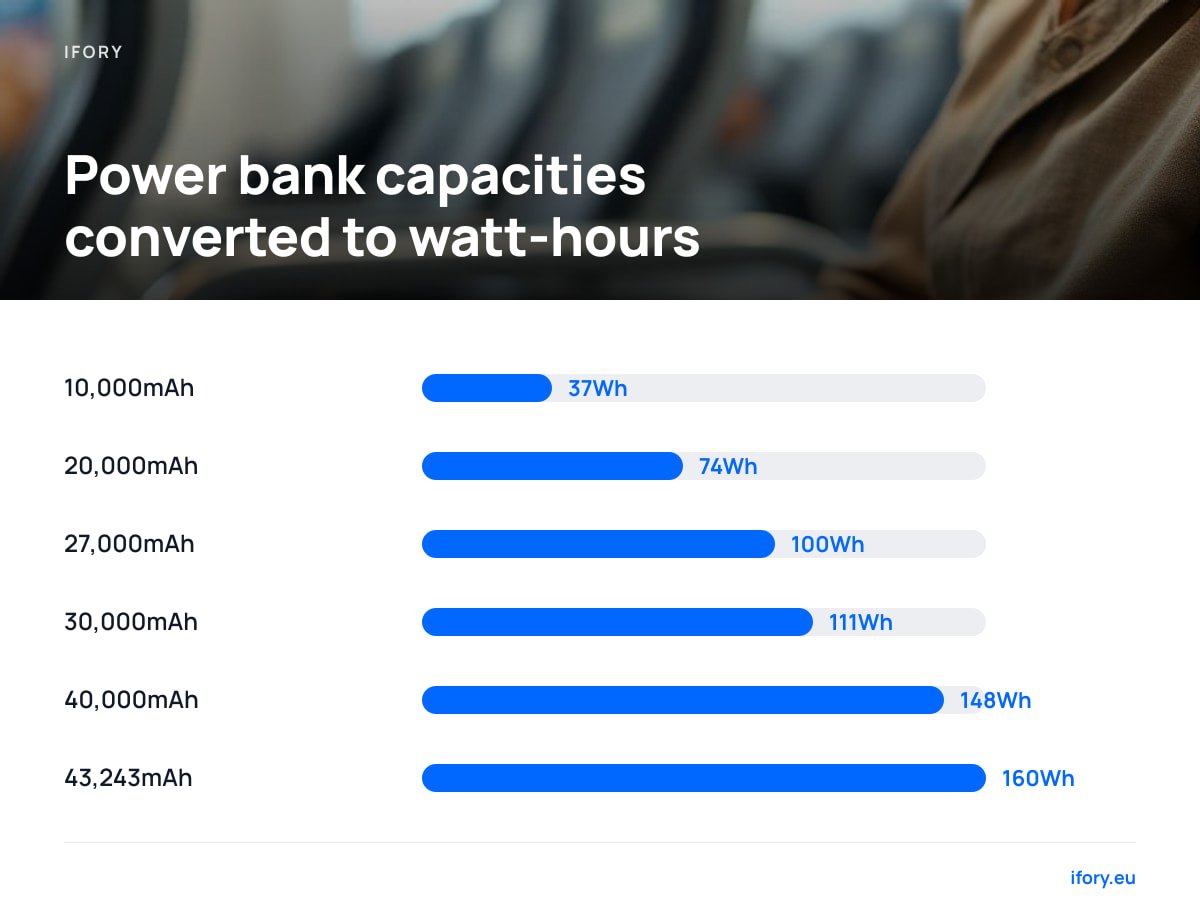
The conversion is simple, but labels complicate it. Here is what common capacities come to at 3.7V nominal.
| Labeled capacity | Approx. Wh at 3.7V | Needs approval? |
|---|---|---|
| 10,000mAh | 37Wh | No |
| 20,000mAh | 74Wh | No |
| 27,000mAh | 100Wh | Borderline, check the label |
| 30,000mAh | 111Wh | Yes |
| 40,000mAh | 148Wh | Yes |
| 43,243mAh | 160Wh | Over the line, prohibited |
Three label problems come up repeatedly:
- mAh at the wrong voltage. Some brands quote capacity at the 5V output instead of the cell voltage, which makes the number look bigger than the energy inside. Read the Wh figure.
- No Wh printed at all. If the casing shows only mAh, a screener has to do the math, and they may not accept yours. Choose a bank with Wh printed on the housing.
- Rounding that crosses a line. A bank marked "99Wh" is fine. One marked "100Wh" sits exactly on the boundary, and some carriers read "up to 100Wh" strictly. If you want zero friction, buy under 99Wh.
Our power bank capacity guide walks through this arithmetic and explains why real-world output also falls short of the label.
Carry-On Only: Where a Power Bank Can Go, and What Stays Out of Your Suitcase
Am I allowed to bring a power bank on an airplane? Yes. Power banks count as spare lithium batteries, and the FAA and IATA rule is that spare lithium batteries travel in carry-on bags only. The reason is practical: crew notice and handle a cell that overheats in the cabin. The same fault in a cargo hold may go unnoticed.
That is why putting a power bank in checked luggage is one of the most common packing mistakes, and why gate agents sometimes ask passengers to pull one out of a bag they are about to tag.
What not to put in a suitcase when flying? The list for batteries is short and firm:
- Power banks and spare lithium batteries. Carry-on only, always, regardless of capacity.
- E-cigarettes and vapes. The same rule applies, because they contain lithium batteries.
- Loose cells and damaged batteries. Swollen, dented or recalled units should not travel at all.
- Valuables and documents. This is not a safety rule, but airlines do not compensate for most of these when lost from the hold.
Devices with built-in batteries, such as phones and laptops, can generally go in either bag, but carry-on is safer for anything you cannot afford to lose.
Pack the power bank in a side pocket or organizer where you can reach it, and cover the USB ports with tape or keep it in its pouch so nothing shorts the contacts.
Airline by Airline: Ryanair, Jet2, British Airways, Qatar Airways and Cebu Pacific
Airlines apply the ICAO baseline as a minimum and are free to add restrictions. Policies on in-flight use and on the number of banks have been changing, so I will not give a per-carrier number that could be stale by the time you pack. Here is how to approach each one.
How many power banks can I bring on a Cebu Pacific flight? The baseline across regulators is up to two spare batteries in the 100Wh to 160Wh band, with no stated hard cap for banks under 100Wh beyond "reasonable personal quantities." Cebu Pacific publishes its own carry-on and dangerous goods rules, and those are what you will be held to. Read that page before your flight and screenshot the section so you have it at the gate.
For the carriers readers ask about most:
- Ryanair and Jet2. Both are low-cost carriers with strict cabin processes and little flexibility at the gate. If your bank is over 100Wh, get a written answer before travel, not at the desk.
- British Airways. A full-service carrier with a dedicated dangerous goods page. It can answer a request to carry a 100Wh to 160Wh bank, so ask in writing.
- Qatar Airways. Same approach. Its published rules apply, and on long-haul routes with connections another carrier's rules may apply too.
Can I bring a 40000mAh power bank on a plane internationally? The ICAO baseline is global, but on a multi-leg itinerary the strictest carrier wins. If one leg refuses 148Wh, your bank stays home or you swap it for a smaller one for the entire trip. Our guide to power banks over 100Wh on planes covers how that approval process usually plays out.
Two. That is the per-passenger cap on batteries between 100Wh and 160Wh, and it applies to every spare, not just power banks.
Using a Power Bank in the Cabin: Can You Charge Your Phone Mid-Flight?
Can I charge my phone with a power bank on a plane? Often yes, but this is where airline rules are changing fastest. Some carriers have restricted or banned using power banks in flight, and others require them to stay visible rather than buried in a seat pocket or overhead bin. Check your carrier's current policy on the day you travel.
Whatever the policy, a few habits help:
- Keep it visible. On your lap, in the seat pocket in front of you, or in a bag under the seat within reach. If it overheats, crew need to get to it fast.
- Don't charge the bank itself from a seat outlet unless your airline says that is fine.
- Charge before you board. Top up your phone and the power bank to full at home, so the in-flight question rarely comes up.
- Treat swelling or heat as an emergency. Press the call button. Do not stuff it in a bag.
Pro Tip: When you email an airline for approval, ask them to quote the Wh figure and the number of units in their reply, then print it alongside a photo of the Wh label on your bank. A gate agent can approve a document in ten seconds, but a promise from a call center they cannot verify takes much longer.
Two 20,000mAh Banks vs. One 40,000mAh: Which I Would Fly With
If you want the least friction at security, take two 20,000mAh banks. Each is about 74Wh, so neither needs approval, and together they give you the same 40,000mAh total with a backup if one fails.
If you want output, the single large bank wins. A 40,000mAh unit with 100W output can run a laptop at full speed, which two small banks often cannot, because smaller banks tend to top out at 20W to 45W. For a work trip with a laptop, that difference matters. Our laptop power bank guide explains wattage and why 65W to 100W suits most laptops.
My pick: for a short flight on a strict low-cost carrier, two 20,000mAh banks. For a long trip with a laptop on a full-service carrier that will approve it in writing, the single 40,000mAh bank, with the approval printed. The larger bank only makes sense if you are willing to do the paperwork.
Quick Answers: Jeans, Suitcases and Other Packing Questions
Why shouldn't you wear jeans on an airplane flight? No airline or regulator forbids them. The case against is comfort: denim is stiff, does not stretch, and gets tight when your feet and legs swell on a long flight. Rivets and buttons can also set off a metal detector and slow your screening. Stretchy trousers or joggers are easier on a long haul, and a cabin bag pocket is a better place for your power bank than a jeans pocket, where it gets squeezed while you sit.
Can you take a power bank on a plane in hand luggage? Yes, and hand luggage is the only place it is allowed.
Can I take a 20000mAh power bank on a plane? Yes. At around 74Wh it is under the 100Wh threshold, so it flies without approval in carry-on on any airline following the ICAO baseline.
Get a 40,000mAh, 100W Power Bank Ready for the Airline Conversation
If you want a bank that runs a laptop, a phone and a handheld console off one unit, Ifory makes a rugged 40,000mAh, 100W fast-charging power bank built for camping, diving, climbing and travel. It pairs with a 40W portable solar panel (21.88V/2.19A) for recharging off-grid, and there is a bundle that includes a free solar panel promotion, plus free shipping and 30-day returns.
The caveat is the one this whole article is about. At the 3.7V cell rating the bank works out to roughly 148Wh, so it falls in the approval-required band and counts toward the two-per-passenger limit. Confirm the Wh value on the spec sheet and on the unit itself, and get your airline's yes in writing before you fly. If your carrier caps batteries at 100Wh, this is a trip bank for the ground, and you would need a smaller one for that flight.
Frequently Asked Questions
Can I bring a 40000mAh power bank on a plane?
Usually yes, in carry-on only and with airline approval. At 3.7V it is about 148Wh, which falls in the 100Wh to 160Wh band that needs permission and is limited to two per passenger. Some airlines refuse anything over 100Wh, so ask before you fly.
How do I calculate watt-hours from mAh?
Multiply the mAh by the nominal voltage and divide by 1,000. For a 3.7V power bank, 40,000mAh gives 148Wh and 20,000mAh gives 74Wh. If the device prints a Wh figure, use that instead.
Can I put my power bank in checked luggage?
No. Power banks and spare lithium batteries must travel in carry-on bags under rules followed by the FAA, IATA and ICAO. A fault in the cargo hold may go unnoticed, while in the cabin crew can respond right away.
Is a 20000mAh power bank allowed on a plane?
Yes. A 20,000mAh bank at 3.7V is about 74Wh, under the 100Wh threshold, so it needs no approval on airlines that follow the ICAO baseline. Carry it in hand luggage.
Can I use my power bank to charge my phone during a flight?
It depends on the airline, and policies on in-flight use have been tightening. Where it is allowed, keep the bank visible and within reach, and charge it fully before you board so you do not need it.
Sources
- Lithium Batteries (PackSafe) | Federal Aviation Administration
- Lithium Battery Guidance Document | International Air Transport Association
- Technical Instructions for the Safe Transport of Dangerous Goods by Air | International Civil Aviation Organization